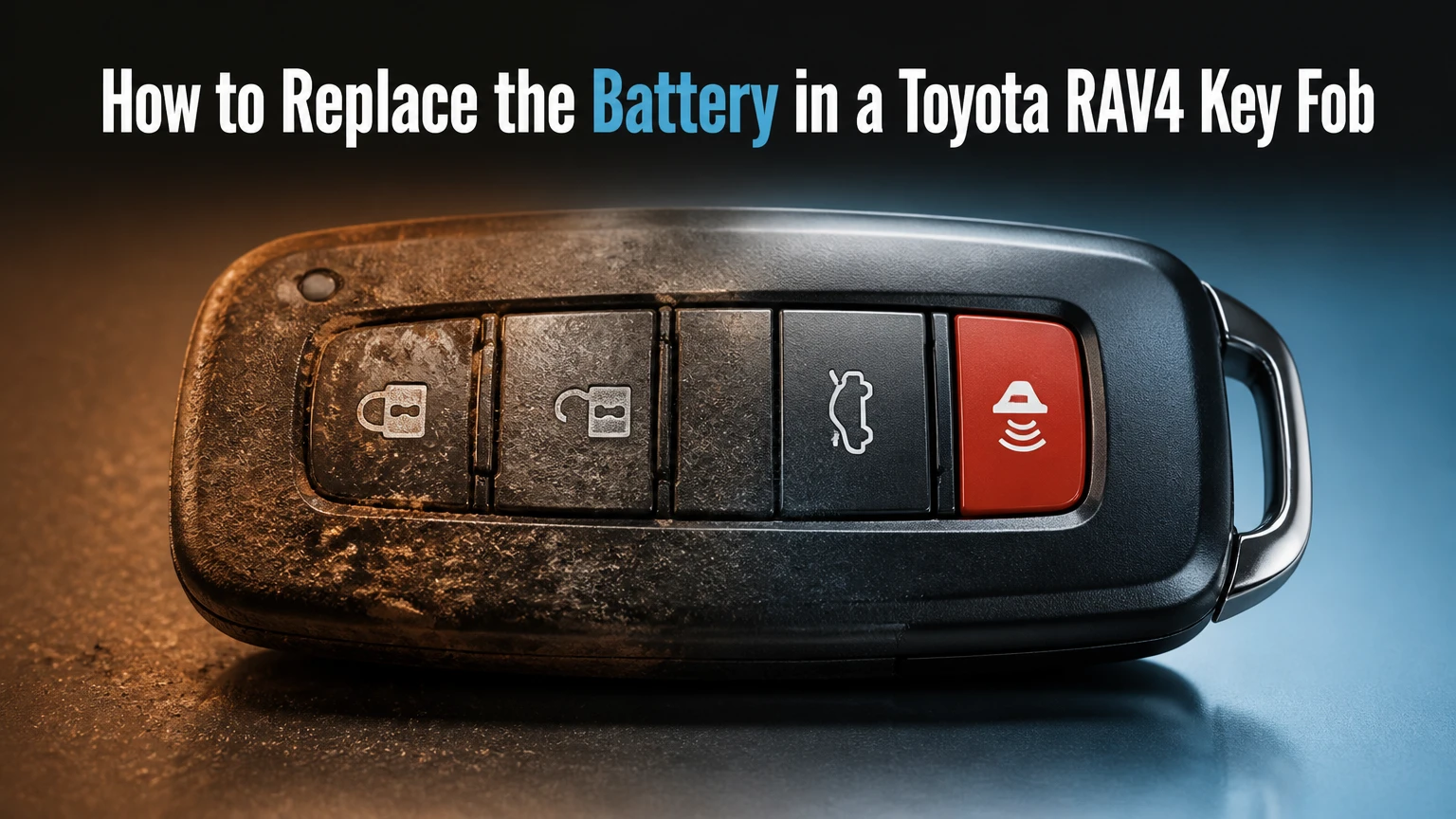
To replace battery toyota key fob rav4 owners usually need one coin-cell battery, the fob’s hidden mechanical key, and 2-5 minutes. Most recent Toyota RAV4 Smart Key fobs use a CR2032, while older remote-head keys may use a CR2016 or CR1620. Confirm the number printed on the old cell or in the owner’s manual before opening the case.
Key Facts at a Glance
A Toyota RAV4 key fob battery replacement normally does not require reprogramming.
A CR2032 is common in RAV4 Smart Key fobs, but battery size varies by fob design and year.
The battery’s marked positive side usually faces upward, but the original orientation is the final authority.
The hidden mechanical key often provides access to the case-opening notch.
A dead fob battery does not necessarily mean the remote is damaged.
A RAV4 with a dead fob battery can usually be started by holding the Toyota emblem side of the fob against the engine-start switch while pressing the brake.
What Battery Does a Toyota RAV4 Key Fob Use?
A Toyota RAV4 key fob uses a 3-volt lithium coin cell, most commonly a CR2032 in Smart Key remotes and a CR2016 or CR1620 in some older remote-head designs. The battery code is more reliable than the vehicle year because Toyota used multiple transmitter shapes and suppliers across markets and trim levels.
The letters and numbers identify physical characteristics. “CR” denotes a manganese-dioxide lithium coin cell, “20” indicates approximately 20 millimeters in diameter, and the final two digits indicate nominal thickness in tenths of a millimeter. A CR2032 is about 3.2 millimeters thick, while a CR2016 is about 1.6 millimeters thick.
Never substitute two CR2016 cells for one CR2032. The stacked arrangement can produce the wrong contact pressure and may damage the holder or electronics.
RAV4 fob battery fitment guide
| RAV4 remote style | Common battery | Approximate cell size | Best verification method |
|---|---|---|---|
| Smart Key with push-button start | CR2032 | 20 mm diameter, 3.2 mm thick | Read the installed cell or manual |
| Older remote-head key | CR2016 | 20 mm diameter, 1.6 mm thick | Read the installed cell before purchase |
| Older compact Toyota remote | CR1620 | 16 mm diameter, 2.0 mm thick | Match the printed code exactly |
| Replacement aftermarket shell | Varies by transmitter | Depends on circuit-board holder | Inspect the original circuit board |
Toyota’s model-year ranges are useful clues, not proof of fitment. A 2013-2018 RAV4 commonly has a CR2032 Smart Key, but a key with a physical blade that turns the ignition may use a different cell. Market, trim, replacement housing, and transmitter part number can all change the answer.
How Does a Toyota RAV4 Key Fob Work?
A Toyota RAV4 key fob sends a coded radio-frequency command to the vehicle’s receiver when a driver presses lock, unlock, panic, or liftgate buttons. A Smart Key fob also participates in short-range proximity communication, allowing the RAV4 to detect an authorized key near the door or inside the cabin.
The coin cell powers the transmitter, button circuitry, indicator functions, and proximity system. The battery does not store the vehicle’s immobilizer identity in the same way a rechargeable device stores data; replacing the cell normally leaves the fob’s pairing intact.
Remote locking and engine authorization are related but separate functions. A fob may still start a RAV4 while its lock and unlock range has become poor, because the emergency transponder-reading method can work when the active radio transmitter has insufficient power.
Toyota owner manuals for Smart Key-equipped vehicles commonly instruct owners to hold the electronic key against the engine switch when the key battery is depleted. That procedure is an emergency reading method, not a replacement for installing the correct battery.
What Should You Do Before Opening the Fob?
Before replacing a RAV4 key-fob battery, identify the remote style, buy the exact coin-cell number, and work over a clean surface where the small circuit board cannot fall. The procedure requires no programming equipment, but a plastic pry tool, a clean cloth, and eye protection reduce the chance of casing or contact damage.
Before-you-start checklist
| Requirement | Typical value | Why it matters |
|---|---|---|
| DIY time | 2-5 minutes | Includes opening, replacement, and testing |
| Difficulty | Low | The case clips open without removing screws |
| Battery quantity | 1 coin cell | Install one matching cell only |
| Primary tool | Mechanical key or plastic pick | Opens the molded case notch |
| Optional tool | Small flat-blade screwdriver | Use only on the plastic seam |
| Work surface | Clean, dry, well lit | Prevents lost clips and contamination |
Buy a reputable lithium battery from a known manufacturer or a high-volume retailer. Check the expiration date and packaging; coin cells stored for years in heat can arrive with reduced usable capacity even when their voltage appears normal.
Wash and dry your hands before handling the replacement. Skin oil on the battery faces or contact springs can increase resistance, although contamination is less common than incorrect orientation or a flattened spring.
How Do You Open a Toyota RAV4 Key Fob?
A Toyota RAV4 key fob opens through a release notch near the hidden mechanical-key slot. Remove the metal key first, then insert its tip or a plastic pry tool into the molded notch and twist gently until the retaining clips release.
Step 1: Remove the mechanical key
- Locate the small release slider on the fob’s side or rear.
- Hold the slider in its release position.
- Pull the metal emergency key straight out.
- Place the key on the work surface so it cannot scratch the fob.
The mechanical key is more than an emergency door key. Toyota designed many Smart Key housings so the blade can help open the battery compartment, which eliminates the need for a specialized tool.
Success checkpoint: The blade should slide out without force while the release slider remains engaged.
Common mistake: Pulling the blade without moving the release slider can damage the retaining mechanism.
Step 2: Separate the case
- Inspect the empty key slot for a small rectangular opening or molded pry point.
- Insert the tip of the mechanical key into that opening.
- Twist the key slightly, rather than forcing it downward.
- Work around the seam only if one clip releases and the remaining clips stay closed.
Use a plastic pick when the fob has a glossy finish or visible scratches. If a screwdriver is necessary, wrap its tip with a thin layer of tape and apply force to the plastic case, never to the circuit board.
Success checkpoint: The two housing halves separate evenly and the rubber buttons remain seated.
Common mistake: Inserting the tool deep into the housing can lift or scratch the circuit board.
How Do You Replace the Coin Cell?
To replace the coin cell, expose the battery holder, record the old battery’s orientation, release the cell from its retaining clip, and install one matching battery without bending the contacts. Most Toyota RAV4 Smart Key fobs place the positive-marked face upward, but the visible markings inside your fob take priority.
Step 3: Expose the battery
After opening the case, examine the arrangement before removing anything. Some RAV4 fobs show the coin cell immediately; others require lifting a small electronic module from the lower housing.
If the circuit board must come out, lift it by its plastic edges or by a nonconductive section. Do not pry against integrated circuits, solder joints, antenna traces, or the green board surface. Photograph the layout with a phone if the rubber button pad or board position is unclear.
Success checkpoint: The battery holder and its spring contacts are visible, and no button pad or board component has moved unexpectedly.
Common mistake: Removing the board when the battery is already accessible creates unnecessary opportunities for a displaced button membrane.
Step 4: Remove and install the battery
- Read the old cell’s code, such as CR2032, before discarding it.
- Note whether the plus sign faces the cover or the circuit board.
- Release the battery from the accessible edge of the holder.
- Slide the new cell under the fixed retaining lip.
- Press the opposite edge down until it sits flat.
Avoid shorting the coin cell by touching both faces with a metal tool. A plastic pick or fingernail is safer. If the cell is tight, press the holder’s release tab rather than levering against the metal spring.
Success checkpoint: The new battery lies flat, the plus and minus markings match the original position, and the contacts touch the cell without visible bending.
Common mistake: Installing a CR2016 where a CR2032 belongs can leave the battery loose, while forcing a thicker cell into a CR2016 holder can deform the cover or contacts.
Step 5: Close and test the fob
- Return the circuit board and rubber button pad to their molded positions.
- Align the two housing halves around the perimeter.
- Press around the edges until every clip clicks shut.
- Reinsert the mechanical key.
- Test lock, unlock, panic, and liftgate buttons from several distances.
A fob should operate immediately after a correctly installed battery. Battery replacement normally does not erase the transmitter code, so a sudden programming requirement points toward a separate fault.
Success checkpoint: The case has no open seam, buttons have normal travel, and the RAV4 responds at a practical distance.
Common mistake: Closing the housing while the rubber membrane is misaligned can make one button stay pressed or fail to operate.
How Long Should a RAV4 Key-Fob Battery Last?
A Toyota RAV4 key-fob battery typically lasts 2-4 years, but heavy Smart Key use, frequent proximity detection, extreme temperatures, and long periods near the vehicle can shorten that range. Toyota does not publish one universal service interval because usage and transmitter design vary.
Replace the cell when the remote range becomes noticeably shorter, the vehicle displays a low-key-battery warning, the buttons work intermittently, or the Smart Key detects the fob inconsistently. Do not wait until the remote fails if the vehicle will be parked far from home or used for travel.
| Symptom | Most likely cause | First action | Typical result |
|---|---|---|---|
| Range falls from 30 m to 5 m | Weak coin cell | Replace battery | Normal range may return |
| One button fails | Worn switch or membrane | Test other buttons | Battery change may not help |
| No buttons work | Dead cell, poor contact, or damaged board | Check polarity and contacts | Isolates power fault |
| Car starts but remote does not lock | Remote transmitter fault or weak cell | Replace and retest | Starting circuit may remain normal |
| Low-battery warning remains | Wrong cell, poor contact, or warning delay | Reopen and inspect holder | Warning should clear after use |
The exact operating distance varies with buildings, other radio transmitters, vehicle position, and local interference. Distance claims should therefore be treated as diagnostic comparisons, not guaranteed specifications.
Which RAV4 Battery Replacement Option Is Best?
DIY replacement is usually the best choice when the fob case is intact and the battery code is clear; a locksmith is better for damaged housings or uncertain electronics, while a Toyota dealer is appropriate when a service visit already includes key-system diagnosis. The main cost difference is labor, not the coin cell.
| Replacement option | Typical part cost | Typical total cost | Typical time | Best use case |
|---|---|---|---|---|
| DIY with CR2032 | $2-$8 | $2-$8 | 2-5 minutes | Intact fob and clear battery code |
| Automotive locksmith | $2-$10 | $10-$30 | 5-15 minutes | Damaged clip or uncertain fitment |
| Toyota dealership | $2-$10 | $15-$50 | 10-30 minutes | Battery swap during scheduled service |
| Full remote diagnosis | $2-$10 battery | $40-$150 | 30-90 minutes | No response after a correct swap |
Prices are typical US consumer ranges, not fixed Toyota fees. Local labor rates, after-hours service, taxes, and whether the technician diagnoses a transmitter fault can change the total substantially.
A battery replacement is not the same service as cutting a new mechanical key or programming a replacement Smart Key. Those services require different equipment and can cost far more.
Is a locksmith or dealer necessary?
A locksmith or dealership is unnecessary for a straightforward battery swap when the fob opens normally and the installed cell is identifiable. Professional help becomes sensible when the case is glued or cracked, the battery holder is broken, both keys fail simultaneously, or the vehicle has an immobilizer fault.
The dealer has access to Toyota service information and vehicle-specific diagnostic equipment. A qualified automotive locksmith may provide faster, lower-cost help and can often determine whether the problem is the battery, contacts, buttons, transmitter, or vehicle receiver.
What If the RAV4 Key Fob Still Does Not Work?
If a Toyota RAV4 key fob does not work after a battery replacement, check polarity, battery seating, contact pressure, case alignment, and the vehicle’s 12-volt battery before considering reprogramming. A new coin cell does not repair a broken button, corroded circuit board, failed antenna, or dead vehicle receiver.
Use this diagnostic order:
- Reopen the case and confirm the battery number.
- Confirm the plus side matches the original orientation.
- Check that the cell sits under the retaining lip and against the spring.
- Inspect for flattened, dirty, or corroded contacts.
- Test every button, not only lock.
- Try the spare fob if available.
- Check whether the RAV4 interior lights, horn, and instrument panel indicate a weak 12-volt battery.
- Test the emergency-start procedure.
Clean lightly contaminated contacts with a lint-free swab and a small amount of isopropyl alcohol. Let the area dry completely before reinstalling the battery. Do not scrape plated contacts aggressively, because removing their surface can create a permanent connection problem.
What if both RAV4 remotes stop working?
If both RAV4 key fobs stop responding at the same time, suspect the vehicle before assuming both coin cells failed together. Check the 12-volt battery, relevant vehicle fuses, receiver behavior, and whether the problem began after water exposure or electrical work.
A spare fob is a useful control. If the spare works, the original fob has a local battery, contact, button, or circuit fault. If neither works and the vehicle’s 12-volt systems are weak, charge or test the vehicle battery before paying for key programming.
Can you start a RAV4 with a dead fob battery?
A push-button Toyota RAV4 can generally be started with a depleted fob battery by pressing the brake, holding the Toyota-emblem side of the electronic key directly against the engine switch, and pressing the switch. The vehicle reads the fob’s transponder at close range even when normal remote transmission is unavailable.
The exact placement can vary by generation, so the owner’s manual remains authoritative. Keep the fob against the switch until the indicator changes or the engine starts. This method does not restore remote locking range; it only provides an emergency way to authorize ignition.
What Variations Require Extra Care?
A wet, cracked, aftermarket, or physically damaged fob requires a different response from a normal battery swap. Replacing the cell is reasonable for a dry fob with intact contacts, but water corrosion and broken solder joints may require board repair or a replacement transmitter.
Wet key fob
Remove the battery immediately if the fob has been submerged. Separate the housing, blot moisture, and allow the board to dry in a ventilated room for at least 24 hours; avoid a hair dryer, oven, radiator, or rice because heat and residue can damage components.
White or green deposits around contacts indicate corrosion. A dry appearance does not prove that the board is electrically healthy.
Cracked or loose housing
A cracked case can permit water entry and may fail to hold the battery against its contacts. Replace the shell only when the original circuit board, transponder, rubber pad, and battery holder remain undamaged; an empty replacement shell is not automatically a programmed key.
Aftermarket replacement fob
An aftermarket transmitter must match the correct Toyota frequency, button layout, immobilizer system, and programming requirements. A battery may fit the housing while the transmitter remains incompatible with the RAV4, so inspect the circuit-board part number before purchasing a complete replacement.
Common Mistakes and How to Fix Them
| Mistake | Result | Recovery action | Prevention |
|---|---|---|---|
| Wrong battery code | Loose or forced cell | Install the exact printed type | Read the old cell first |
| Reversed polarity | No remote response | Reopen and reverse orientation | Photograph the original position |
| Bent contact spring | Intermittent operation | Restore light contact pressure | Lift the cell by its edge |
| Board pried with metal | Scratches or short circuit | Inspect for damage | Use plastic or case-mounted pry points |
| Misaligned button pad | Stiff or dead button | Re-seat the rubber membrane | Test buttons before closing |
| Weak aftermarket cell | Short service life | Replace with a fresh brand-name cell | Check packaging and date |
The most common professional mistake is treating every failure as a programming problem. A technician should first verify battery polarity and contact pressure, because those checks take seconds and do not risk changing the vehicle’s key registration.
Another counterintuitive point is that a fob can start the vehicle but fail to lock the doors. The immobilizer’s close-range transponder path and the remote-control transmitter do not behave identically, so that symptom does not prove the new battery is good or bad by itself.
Does Replacing the Battery Require Reprogramming?
Replacing the battery in a Toyota RAV4 key fob normally does not require reprogramming because the vehicle’s stored key authorization is retained when power is removed from the coin-cell circuit. Reprogramming becomes relevant when the transmitter, immobilizer registration, vehicle receiver, or replacement electronics have changed.
Do not attempt random internet programming sequences before checking the basics. An incorrect sequence can waste time, and some Toyota Smart Key registration procedures require dealer-level or locksmith equipment, especially when no recognized key remains.
If the fob worked before the battery swap and fails immediately afterward, inspect polarity, seating, and contact damage first. If the fob was already nonfunctional, the battery replacement may reveal a failed switch, water-damaged board, or depleted vehicle battery rather than create a programming issue.
How Should You Store and Dispose of the Old Battery?
Store spare CR2032, CR2016, or CR1620 cells in their original packaging at room temperature, away from metal objects, moisture, children, and pets. Cover the faces of a used coin cell with nonconductive tape before disposal to reduce the chance of short circuits during transport.
Coin cells are hazardous if swallowed, particularly by children. Keep new and used batteries out of reach and follow local household battery-recycling rules rather than placing loose cells in a fire, incinerator, or unprotected recycling bin.
A spare battery in the glovebox can be useful, but extreme heat inside a parked vehicle can reduce battery life. A sealed packet in a temperate indoor location is a better long-term storage choice.
Toyota RAV4 Key-Fob Battery FAQ
How do I know whether my RAV4 uses a CR2032?
Read the code printed on the old coin cell after opening the fob. A CR2032 is common in push-button Smart Key remotes, but Toyota RAV4 model year alone cannot guarantee fitment because older remote-head keys and replacement housings may use CR2016 or CR1620 cells.
Can I use an Energizer or Panasonic battery?
Yes. A reputable CR2032, CR2016, or CR1620 from Energizer, Panasonic, Duracell, Sony, or another established manufacturer is suitable when its code, diameter, thickness, and voltage match the original. Brand matters less than authenticity, freshness, correct size, and secure contact.
Why does my RAV4 say the key battery is low after replacement?
A continuing warning usually indicates a reversed battery, wrong cell thickness, weak contact pressure, a depleted replacement battery, or a fob circuit fault. Reopen the case, compare the installed cell with the original, and test the remote before paying for programming.
Can a Toyota dealer replace the battery while I wait?
Many Toyota dealers can replace a key-fob battery during a short service visit, but waiting time and labor charges vary by location. Call ahead, provide the RAV4 year and fob type, and ask whether the quoted price covers only the coin cell or also diagnosis.
What should I do if I lost the mechanical key?
Use the vehicle’s remaining key, contact a Toyota dealer, or call an automotive locksmith with the RAV4 identification and ownership documents. The metal emergency blade and the electronic transmitter are separate components, so replacing a blade does not automatically replace or program the Smart Key.
The Bottom Line
To replace battery toyota key fob rav4 owners should remove the hidden mechanical key, open the case at its molded notch, install the exact coin-cell code in the original orientation, and test every function before leaving the work area. A CR2032 is common, but reading the old battery is safer than relying on model year. Reprogramming is normally unnecessary, and a push-button RAV4 can usually start by holding the fob against the engine switch when its battery is depleted.