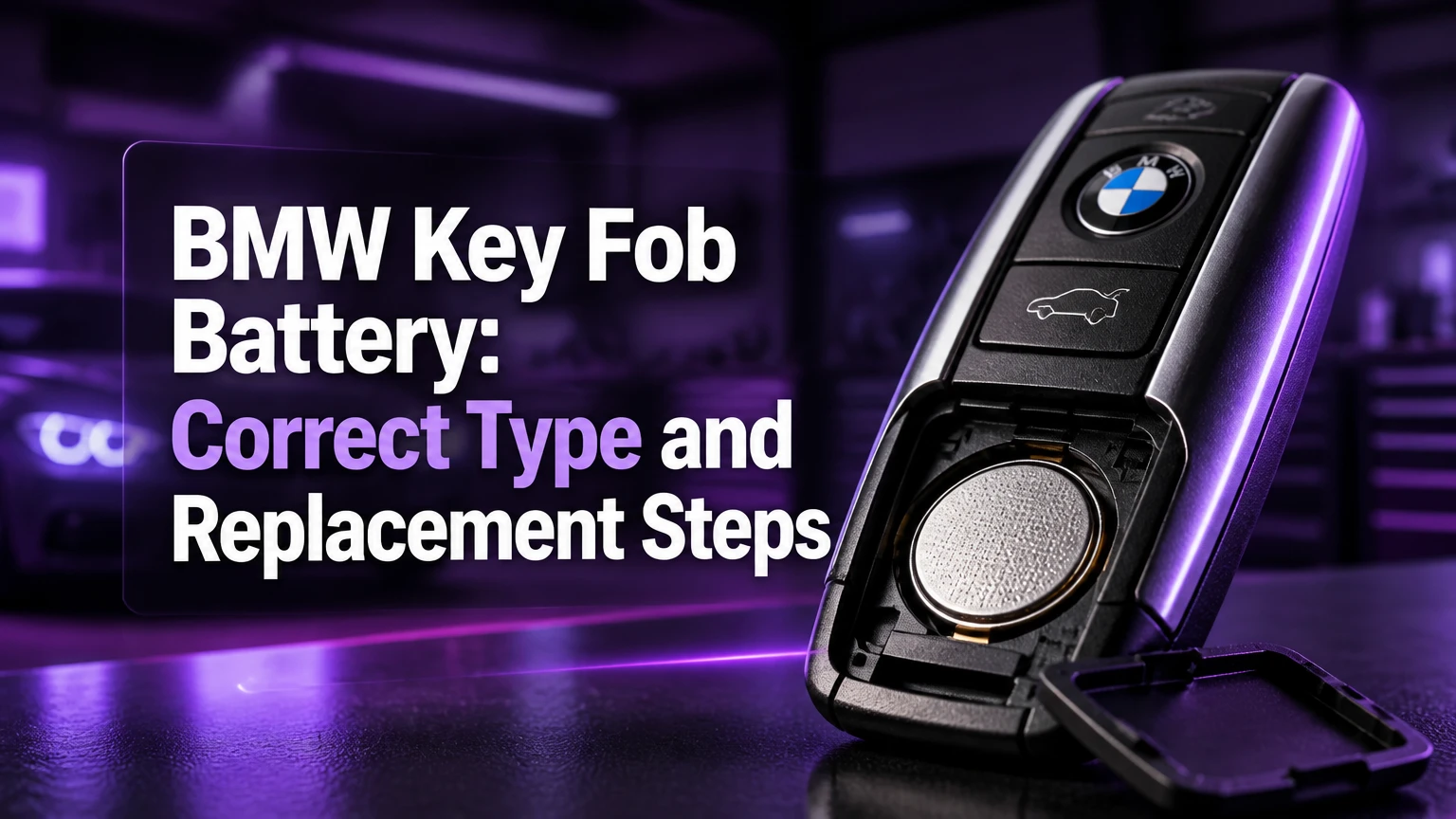
A BMW key fob battery is usually a 3-volt CR2032 or CR2450 lithium coin cell, while many older sealed diamond-shaped keys use a rechargeable VL2020 cell. The correct battery depends on the key casing and its existing marking, not simply the BMW model or year. Standard replacement normally takes under five minutes and does not erase the key’s programming.
Key Facts
A modern BMW remote commonly uses a CR2032 or CR2450 battery, but the two cells are not interchangeable.
The positive side of a replacement coin cell normally faces the marked positive terminal or the back-cover side shown by the key design.
Replacing a standard non-rechargeable cell usually does not require key programming.
A sealed E-Series diamond key may contain a soldered rechargeable VL2020 battery and requires electronics repair.
Comfort Access can shorten battery life because the key participates in proximity detection while near the vehicle.
A dead remote does not necessarily prevent starting: BMW provides an emergency key-detection procedure that varies by vehicle generation.
Which BMW Key Fob Battery Do You Need?
The fastest reliable method is to open the battery compartment and read the number printed on the old cell, or check the vehicle’s owner’s manual. Key shape narrows the answer, but it does not prove fitment because BMW used multiple transmitters across series, markets, option packages, and production periods.
A CR2032 measures 20 millimeters across and 3.2 millimeters thick. A CR2450 measures 24.5 millimeters across and 5.0 millimeters thick, so the thicker cell cannot safely replace a CR2032 in a shallow holder. A VL2020 is a rechargeable 20-millimeter cell designed for charging inside certain older keys; a disposable CR2032 is not a drop-in substitute.
| Key design or clue | Likely battery | Typical BMW use | Correct verification |
|---|---|---|---|
| Compact modern remote with a removable back cover | CR2032 | Many G-Series, i-Series, and Comfort Access remotes | Read the old cell and holder marking |
| Larger rectangular F-Series remote | CR2450 or CR2032 | Selected 2009-2019 vehicles | Check the installed battery, not only the year |
| Older diamond-shaped sealed remote | VL2020 rechargeable | Many E-Series keys, including E46 and E39 examples | Inspect the cell and terminal orientation |
| BMW Display Key with screen | Internal rechargeable pack | Selected late-model vehicles | Follow the BMW manual or use dealer service |
| Comfort Access remote | CR2032, CR2450, or rechargeable design | Depends on transmitter generation | Identify the exact fob casing and battery |
BMW’s own owner documentation is the controlling source for a vehicle-specific fitment. Parts websites often group batteries by model, but those lists can combine different keys used within one model year.
CR2032 Versus CR2450
CR2032 and CR2450 batteries both provide approximately 3 volts, but their physical dimensions and holders differ. A CR2450 offers greater nominal capacity, often around 500-620 mAh compared with roughly 200-240 mAh for a CR2032, yet capacity does not make it a valid substitute.
| Battery | Diameter | Thickness | Typical nominal capacity | Rechargeable |
|---|---|---|---|---|
| CR2032 | 20.0 mm | 3.2 mm | 200-240 mAh | No |
| CR2450 | 24.5 mm | 5.0 mm | 500-620 mAh | No |
| VL2020 | 20.0 mm | 2.0 mm | About 20 mAh | Yes |
| CR2025 | 20.0 mm | 2.5 mm | About 150-170 mAh | No |
A CR2025 may physically fit some CR2032 holders, but its reduced thickness can create weak contact and intermittent operation. Use the specified cell rather than treating similar-looking coin batteries as interchangeable.
How Does a BMW Key Fob Battery Work?
The BMW key fob battery powers the transmitter, button circuitry, indicator functions, and, in proximity-equipped keys, low-power communication with the vehicle. Pressing Lock or Unlock causes the circuit board to transmit an encrypted command through a radio-frequency system; Comfort Access also uses vehicle antennas to detect an authorized key nearby.
The exact radio frequency depends on market and vehicle configuration. Older and current BMW systems may use regional frequencies such as 315 MHz or 433.92 MHz, while the security system manages rolling or changing authorization data. The battery change interrupts power but normally does not delete the transponder identity or rolling-code state.
Comfort Access changes the practical battery-life equation. Repeatedly leaving the key beside the vehicle, near a metal door, or in a location where the car repeatedly searches for it can increase activity. BMW does not publish one universal replacement interval because temperature, proximity use, button frequency, and key design all affect consumption.
BMW owner manuals commonly display the warning, “The vehicle key battery is discharged.” That message points to a low key-cell condition, but a nonresponsive remote after replacement can also result from poor terminal contact, a damaged fob, radio interference, or a vehicle-side fault.
How Do You Replace a Modern BMW Key Battery?
A modern BMW coin-cell replacement requires the mechanical key blade, a plastic pick or small flat tool, a correctly identified coin cell, and about five minutes. The defining success factor is opening the back cover at its intended notch rather than forcing the seam or inserting a tool into the circuit board.
Before You Start
| Requirement | Typical specification |
|---|---|
| Time | 3-5 minutes for an accessible coin-cell holder |
| Difficulty | Low for a removable back cover; high for a sealed soldered key |
| Replacement part | 1 fresh CR2032 or CR2450, matching the old cell |
| Tools | Mechanical key blade, plastic pry pick, clean dry cloth |
| Preparation | Photograph the battery orientation before removal |
| Safety | Keep the cell away from children and pets; recycle the old cell |
Step 1: Remove the Mechanical Key
Press the small release button on the side or rear of the BMW fob and pull out the metal emergency blade. The exposed key slot often reveals the notch used to release the back cover.
Do not use the emergency blade as a lever against the painted or gloss-plastic exterior. Position its flat end only in the molded opening intended for cover removal.
Success checkpoint: The blade comes out without bending, and the cover-release notch is visible.
Common mistake: Pressing the release button while prying the wrong seam, which can mark the housing.
Step 2: Release the Back Cover
Insert the tip of a plastic pick into the notch inside the key-blade cavity. Twist gently until the first retaining tab releases, then work around the cover without bending it sharply.
Some fobs have two cover sections, and some have a separate battery door. Stop if the cover resists after the first release, because the tool may be in the wrong slot.
Success checkpoint: The rear plate lifts evenly and the circuit board remains seated.
Common mistake: Sliding a metal screwdriver across the board, which can bridge contacts or scratch the housing.
Step 3: Install the Correct Coin Cell
Lift the old battery from its edge using a plastic pick. Compare the new battery’s size, printed code, and polarity with the old one before inserting it.
Most modern BMW coin-cell fobs place the positive side, marked with a plus sign and printed text, upward. Follow the holder’s molded polarity mark if it differs from the orientation suggested by a generic diagram.
Success checkpoint: The cell sits flat under the retaining clip and cannot rattle.
Common mistake: Installing a CR2450 into a CR2032 holder, forcing the clip over the thicker cell, or touching both battery faces with oily fingers.
Step 4: Close and Test the Fob
Align the rear-cover tabs, press around the perimeter until each tab clicks, and reinstall the mechanical blade. Test Lock, Unlock, and trunk release beside the vehicle, then test from a normal distance.
A new battery should produce a firm button response and consistent range. Do not repeatedly press every button for several minutes, because unnecessary transmissions consume the new cell and may confuse diagnosis.
Success checkpoint: The vehicle responds consistently to at least two commands from several meters away.
Common mistake: Assuming one successful unlock proves the battery is correctly seated when the trunk or lock button remains intermittent.
Can You Replace a Sealed BMW Diamond-Key Battery?
A sealed BMW diamond key usually requires a soldered rechargeable VL2020 cell rather than a user-accessible coin battery. Replacing it involves opening the welded casing, desoldering the old cell, matching the terminal geometry, soldering the replacement, and resealing the housing.
The cell must match both voltage and physical tab orientation. Some replacement VL2020 batteries have terminals at different angles, and installing the wrong orientation can reverse polarity or prevent the case from closing. A rechargeable cell also depends on the key’s inductive charging circuit, which charges while the key is inserted into the ignition on applicable vehicles.
| Repair choice | Typical cost | Typical time | Main risk | Appropriate use |
|---|---|---|---|---|
| DIY VL2020 replacement | $8-$20 in parts | 30-60 minutes | Cut traces or solder bridges | Experienced electronics hobbyist |
| Automotive locksmith | $20-$60 | 20-45 minutes | Variable shell quality | Most failed rechargeable keys |
| Electronics repair shop | $25-$75 | 30-90 minutes | Incorrect tab placement | Precision board work |
| BMW dealer replacement key | $200-$500 or more | Several days | Highest total cost | Lost, damaged, or nonrepairable key |
A utility knife can split the seam, but it also creates a real injury and circuit-board hazard. For a key that still contains valuable immobilizer electronics, a locksmith with BMW key experience is usually a better choice than cutting blindly through the casing.
A sealed key is not a good candidate for a CR2032 conversion. The charging circuit, holder geometry, and battery chemistry were designed for a rechargeable cell.
What Is the Replacement Cost and Battery Life?
A standard DIY BMW key fob battery replacement typically costs $4-$15 and takes less than five minutes. A dealer or independent service provider may charge $15-$75 for a simple cell replacement, while a complete replacement key is far more expensive because it includes immobilizer programming and vehicle-specific security credentials.
| Service or battery situation | Typical parts cost | Typical labor or total cost | Expected time |
|---|---|---|---|
| Name-brand CR2032 two-pack | $5-$10 | $0 DIY | 3-5 minutes |
| Name-brand CR2450 two-pack | $6-$12 | $0 DIY | 3-5 minutes |
| Locksmith coin-cell service | $5-$15 | $15-$40 total | 10-20 minutes |
| VL2020 soldered repair | $8-$20 | $20-$75 total | 30-90 minutes |
| BMW dealer coin-cell service | $10-$25 | $25-$75 total | 15-60 minutes |
| New programmed BMW key | $150-$500 or more | Included or additional | 1-7 days |
Typical standard remote life is 2-5 years. Comfort Access keys often reach only 1-2 years when used frequently, especially when stored near the parked vehicle. A key kept away from the car and used only for occasional button commands can last longer.
Battery age matters before installation. Lithium coin cells slowly lose capacity in storage, and discount listings may contain old, poorly stored, or counterfeit products. Buy sealed cells from a reputable battery supplier, keep them in the original package, and never carry a loose coin cell with metal objects.
Does Changing a BMW Key Battery Require Programming?
Changing a standard BMW key fob battery normally does not require programming or resynchronization. The battery powers the remote electronics, while the key’s immobilizer and rolling-code data remain stored in nonvolatile components.
Some older BMW transmitters can lose synchronization after repeated button presses while out of range, but the recovery sequence is generation-specific. A commonly repeated instruction to turn the ignition on and off five times, then press a particular button sequence, is not a universal BMW procedure and should not be applied without the correct owner’s manual.
If the remote stops responding immediately after replacement, check polarity and contact pressure first. Programming is not the logical first repair for a coin-cell fob that became inactive during a simple battery swap.
Why Does the New Battery Not Work?
A BMW key fob that remains dead after battery replacement usually has a contact, polarity, wrong-cell, damaged-board, or unrelated vehicle fault. Testing the new cell with a multimeter should show close to 3 volts at rest for a fresh CR2032 or CR2450, although open-circuit voltage alone does not prove adequate performance under load.
Use this diagnostic sequence:
- Remove the cell and verify its code, diameter, thickness, and positive-side orientation.
- Inspect the retaining clips for flattened metal or contamination.
- Gently restore contact tension with a plastic pick, without bending the clip sharply.
- Install a second fresh cell from a different package if the first cell measures low.
- Test the spare BMW key to determine whether the vehicle receiver works.
- Check whether the fob works near the car but not at distance, which suggests range or transmitter weakness.
- Look for water intrusion, cracked solder joints, corrosion, or a loose button dome.
- Seek locksmith or dealer diagnosis if both keys fail simultaneously.
A fresh battery cannot repair a failed transmitter, damaged antenna, broken push-button switch, or vehicle receiver. If the engine starts but remote buttons fail, the immobilizer may be healthy while the radio section is defective.
How Do Comfort Access and Storage Affect Battery Life?
Comfort Access can reduce BMW key battery life because the key participates in passive proximity detection rather than transmitting only when a button is pressed. Storing the fob directly beside the vehicle, near the door handle, or in a metal-lined container can cause repeated communication attempts.
The key should not be stored in the same pocket as objects that press buttons continuously. A bag pressing Unlock against the vehicle can drain a cell quickly and may unlock the car repeatedly. A Faraday pouch can reduce passive communication, but a poorly made pouch may not block all frequencies, so it should be tested rather than assumed effective.
A practical storage rule is to keep spare keys several meters away from the parked vehicle, especially overnight. Do not place the key on top of the tire, inside a wall adjacent to the garage, or on a shelf immediately beside the driver’s door.
How Can You Unlock and Start a BMW With a Dead Key?
A dead BMW key fob can usually unlock the driver’s door with its hidden mechanical blade and start the vehicle through the emergency key-detection location. The exact detection point differs by generation, so the owner’s manual takes priority over a generic online diagram.
For many push-button BMWs, remove the mechanical blade from the fob, use it to release the driver-door-handle cover, and turn the concealed lock. The alarm may sound when the door opens. To start, hold the entire key fob against the marked steering-column receiver or place it in the designated key tray while pressing the brake and Start/Stop button.
| Vehicle feature | Dead-key action | Important variation |
|---|---|---|
| Hidden mechanical blade | Remove blade from fob | Door-handle cover differs by model |
| Push-button start | Hold fob at marked receiver | Receiver may be on steering column or console |
| Key slot | Insert fob into slot | Common on selected older BMW generations |
| Display Key | Use emergency recognition procedure | Internal battery and screen design vary |
| Vehicle still refuses start | Try spare key and manual | Immobilizer, not just remote battery, may be involved |
A dead remote battery does not automatically mean the BMW immobilizer has lost authorization. Remote locking and engine-start authorization are related but separate functions.
Should You Use DIY Service, a Locksmith, or a Dealer?
DIY replacement is the best option for an accessible CR2032 or CR2450 holder when the battery number is confirmed and the cover opens cleanly. A locksmith is preferable for a sealed rechargeable key, damaged shell, intermittent transmitter, or soldering job. A BMW dealer is appropriate when the key is lost, the immobilizer must be programmed, or warranty documentation matters.
| Option | Typical total cost | Best case | Poor fit |
|---|---|---|---|
| DIY | $4-$15 | Modern removable cover | Sealed soldered key |
| Independent locksmith | $15-$75 | VL2020 repair or shell replacement | Unverified generic parts |
| Electronics repair shop | $25-$75 | Board-level soldering | New key authorization |
| BMW dealer | $25-$500+ | Programming or documented replacement | Cheapest simple battery swap |
Ask an independent provider whether the replacement cell is a named-brand part, whether the original circuit board remains in the shell, and whether they test both remote range and emergency starting. Generic shell replacements can fit poorly around the buttons and may weaken water resistance.
What Mistakes Damage BMW Key Fobs?
The most expensive mistakes are using the wrong battery thickness, prying through the circuit board, and treating a rechargeable sealed key as a disposable coin-cell design. BMW fobs contain small surface-mounted components that can be damaged by a short circuit, excessive force, static discharge, or a contaminated battery contact.
Avoid these failures:
- Wrong polarity: Photograph the old orientation before removal and follow the holder’s plus and minus marks.
- Wrong size: Never force a CR2450 into a CR2032 holder or substitute a CR2032 for a VL2020 charging circuit.
- Metal-tool short: Use a plastic pick around contacts and the circuit board.
- Stale battery: Buy sealed cells from a reputable retailer and inspect packaging.
- Loose contact: Check that the retaining clip presses firmly against the cell.
- Water exposure: Replace the shell or repair corrosion before installing a new battery.
- Improvised synchronization: Do not use a model-specific button sequence without confirming the BMW generation.
- Loose-cell storage: Keep spare lithium cells packaged and away from children, coins, and keys.
One practitioner rule is worth remembering: if the cover does not release with modest pressure at the molded notch, stop. A replacement shell or professional repair costs less than a damaged immobilizer board.
Frequently Asked Questions
How often should a BMW key fob battery be replaced?
Replace a BMW key fob battery when range drops, button response becomes intermittent, or the vehicle reports a discharged key battery. A standard remote commonly lasts 2-5 years, while heavily used Comfort Access keys often last 1-2 years. Replace the cell before a long trip if the remote has already shown reduced range.
Can a BMW key fob charge while driving?
Some older BMW diamond keys charge inductively while inserted in the ignition, using a rechargeable VL2020 cell. Modern removable CR2032 and CR2450 batteries are primary lithium cells and must not be recharged. A BMW Display Key has its own charging arrangement, so follow the vehicle manual rather than placing it in an improvised charger.
Can I use a CR2032 instead of a CR2450?
A CR2032 cannot be treated as a universal replacement for a CR2450. Although both cells provide approximately 3 volts, the CR2032 is smaller in diameter and 1.8 millimeters thinner, which can cause a loose fit or poor contact in a CR2450 holder. Install the exact number specified by the fob.
Will a dead key battery lock me out of the BMW?
A dead key battery usually does not prevent manual entry or emergency engine starting. Remove the mechanical blade to unlock the driver’s door, then place the fob at the BMW vehicle’s emergency detection point or key slot. The location differs by generation, and a completely damaged or unrecognized key may require professional diagnosis.
Why does only one BMW key need a battery?
Each BMW key has its own battery, usage pattern, and exposure to Comfort Access detection. One key may stay near the vehicle or be used more frequently, while the spare remains in a drawer. Replacing one cell does not recharge or renew the other key, so test both remotes separately.
How do I confirm the exact battery for my BMW?
Read the number printed on the installed cell, inspect the holder for a molded battery code, and compare the result with the owner’s manual. If the fob is sealed, identify the internal cell through a BMW locksmith or repair technician. VIN-based parts lookup can confirm the transmitter, but the physical key remains the final check.
The Bottom Line
The correct BMW key fob battery is determined by the transmitter’s physical design and installed battery marking: commonly CR2032 or CR2450 for modern removable covers, and often VL2020 for older sealed rechargeable diamond keys. Replace modern cells carefully in under five minutes, keep the positive side correctly oriented, and do not assume a new battery requires programming.
A BMW key fob battery replacement is a straightforward DIY task only when the fob has an accessible coin-cell compartment. For sealed keys, Display Keys, damaged boards, or persistent failure after a verified fresh cell, use a BMW-capable locksmith or dealer rather than forcing the casing.