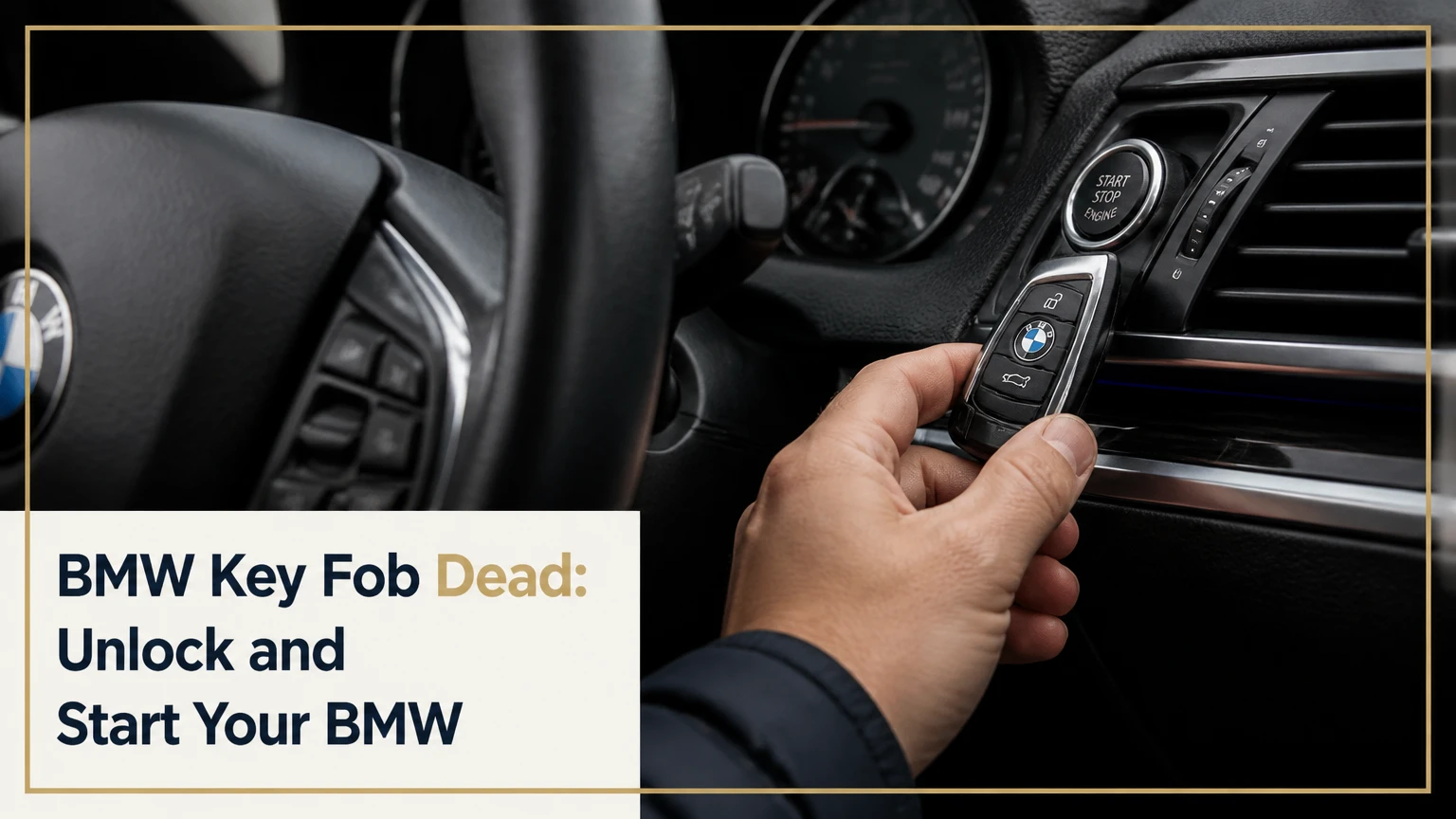
A BMW key fob with a dead battery can usually still unlock and start the vehicle because the integrated mechanical key opens the door and a passive transponder permits emergency starting. Remove the metal blade, unlock the driver’s door, hold the fob against the marked backup sensor or steering-column area, press the brake, and press Start/Stop.
Key Facts
A dead BMW key-fob battery does not automatically disable the immobilizer transponder.
The integrated metal blade unlocks the driver’s door when the remote buttons fail.
BMW emergency-start sensor locations differ by chassis, model year, and key system.
CR2032 and CR2450 cells are commonly replaceable; VL2020 cells are commonly rechargeable and may be soldered.
Replacing a standard replaceable battery normally does not require key programming.
If the fob works near the vehicle but the engine will not crank, test the BMW 12-volt battery before buying a key.
What Should You Do When Your BMW Key Fob Is Dead?
Use the mechanical key to enter the BMW, then place the back or marked end of the fob against the vehicle’s backup detection area while pressing the brake and Start/Stop button. The procedure usually takes 1-3 minutes and requires no new battery, but the exact sensor position depends on the BMW chassis.
The emergency-start function uses a passive transponder or near-field detection system. That circuit can remain readable when the coin cell no longer powers the buttons, display, or remote locking transmitter. BMW owner manuals commonly describe the procedure with wording similar to, “Hold the remote control against the marked area,” although the marked area and wording vary between manuals.
Do not assume every BMW uses the same spot. A newer model may identify a small key symbol near the steering column, while another may use a tray, center-console pocket, or designated area below the steering wheel.
Step 1: Remove the Mechanical Key
Press the release catch on the side or rear of the fob and pull the internal metal blade from its slot. The blade is intended for the driver’s door lock, not for turning the engine on vehicles equipped with a Start/Stop button.
Keep the fob close to the vehicle during the procedure. A weak battery, damaged casing, or interference from a metal wallet can make the passive detection process less reliable.
Step 2: Expose the Hidden Door Lock
Insert the blade into the driver’s door lock if the key cylinder is visible. On many BMW models with flush door handles, the cylinder sits behind a removable plastic cover at the outer end of the handle.
Look for a narrow slot on the underside or lower edge of the cover. Insert the blade into that slot, apply gentle outward pressure, and pull the cover away from the handle. Protect the paint with a thin cloth if the blade contacts the painted surface.
Forcing the cap upward from the wrong point can break its retaining clip. The cover may also swing from a hinge, so do not pull it several inches away from the door after it releases.
Step 3: Start the BMW
Sit in the driver’s seat, close the door, press the brake pedal firmly, and touch the back or marked end of the fob to the backup sensor. Press the Start/Stop button while keeping the fob in contact with the marked area for several seconds.
You will know the procedure worked when the instrument cluster wakes, the engine starts, or the vehicle changes from key-not-detected to an ignition-ready state. If the cluster remains completely dark, the vehicle battery may be discharged rather than the key being the only fault.
Some BMW models identify the emergency sensor with a key icon or horizontal lines. Consult the vehicle’s owner manual if the steering-column location does not respond.
Which BMW Key Battery Does Your Fob Use?
BMW key battery type depends on the key housing, Comfort Access equipment, chassis generation, and production date, so the model name alone cannot guarantee the correct cell. Read the marking on the existing battery or confirm the BMW part number before purchasing a replacement.
| BMW key style | Typical BMW applications | Common battery or power source | Replaceable by owner |
|---|---|---|---|
| Diamond-shaped key | E46 3 Series, E39 5 Series, E53 X5 | VL2020 rechargeable cell | Usually no, sealed housing |
| Slot-style key with hatch | E90 3 Series, E60 5 Series, E83 X3 | CR2032 in many Comfort Access versions | Yes, if hatch is present |
| Sealed slot-style key | E90, E60, E70, E87 applications | VL2020 rechargeable cell | No, soldered or sealed |
| Modern blade-style fob | Many F30, F10, G20, G30 vehicles | CR2032 or CR2450, depending on part | Usually yes |
| Display Key | G11 7 Series, G05 X5, G07 X7, i8 | Internal rechargeable battery | Charging is owner-level; cell replacement varies |
| Digital Key device | Compatible iPhone or Android phone | Phone battery and NFC/UWB hardware | Depends on phone and BMW compatibility |
A Comfort Access feature usually indicates a replaceable coin cell on many later BMW keys, but it is not a universal rule. BMW used several housings and battery arrangements during overlapping production years.
How Can You Identify the Correct Cell?
Remove the blade or battery cover and read the code printed on the cell. CR2032 measures approximately 20 millimeters in diameter and 3.2 millimeters thick, while CR2450 measures approximately 24 millimeters in diameter and 5.0 millimeters thick.
Do not substitute a CR2450 for a CR2032 because the larger cell may not fit the contacts or cover. Do not replace a rechargeable VL2020 with a normal CR2032 in a circuit designed to recharge the installed cell.
The most reliable identification method is the original battery marking, followed by the key’s BMW part number. A dealer parts department can verify the part number using the vehicle identification number, but a VIN check may not identify a replacement key that was previously retrofitted.
How Do You Replace a BMW Key-Fob Battery?
A replaceable BMW key battery can normally be changed in 5-10 minutes with the correct coin cell and a plastic pry tool. Remove the metal blade, release the rear cover through the blade slot or battery hatch, install the cell with the same polarity as the original, and test every button before discarding the old battery.
Modern F-Series and G-Series Fobs
- Remove the metal blade. Press the release button and slide the blade completely out.
- Open the rear cover. Insert the blade tip or a plastic trim tool into the release groove inside the empty blade slot. Twist gently rather than prying against the painted face.
- Record polarity. Photograph the old battery before removal. The positive side is often marked with a plus sign and may face upward, but housing design determines orientation.
- Install the replacement. Fit the battery under the retaining tab first, then press the opposite edge into place. Avoid bending the contact spring.
- Close the housing. Press around the perimeter until each retaining clip clicks.
- Test the fob. Check lock, unlock, trunk, panic, and Comfort Access functions from several distances.
The replacement does not normally erase the immobilizer pairing. The battery powers the remote transmitter and convenience functions, while the key’s security data remains stored in its electronics.
E90, E60, and Other Slot Fobs
Inspect the back of the key for a separate rectangular battery door. If the door exists, open it with a fingernail or plastic tool and install the specified CR2032 or other marked cell.
A sealed key with no battery door usually contains a rechargeable VL2020 or related cell. Place that key in the ignition slot, drive for 30-60 minutes, and retest it if the vehicle still accepts the key mechanically. A rechargeable cell that repeatedly dies after charging has probably reached the end of its service life.
Cutting open a sealed BMW key and soldering a new cell can damage the circuit board, antenna, transponder, or housing. It also creates a safety issue if the replacement cell is installed backward or if the soldered tabs short against the board. A specialist key technician is safer than a first-time repair attempt.
Can a BMW Display Key Be Recharged?
A BMW Display Key can usually be recharged through its USB port or on a compatible vehicle wireless charging tray. A completely blank display may need several minutes of charging before it responds, but a battery that discharges quickly after charging usually requires professional replacement rather than another charging cycle.
| Display Key symptom | First action | Typical observation | Likely next step |
|---|---|---|---|
| Screen blank after storage | USB charge for 30 minutes | Charging symbol appears | Continue to full charge |
| No response after 30 minutes | Try a known-good cable and adapter | No symbol or vibration | Inspect port or seek service |
| Vehicle does not recognize key | Charge, then use backup sensor | Engine may start at sensor | Diagnose communication system |
| Battery lasts less than one day | Full charge and timed test | Rapid percentage loss | Internal battery service |
| Wireless pad does not charge | Test USB charging | USB works, pad does not | Check pad compatibility or fuse |
A Display Key is more complex than a standard remote. Its touchscreen, rechargeable battery, vehicle information functions, and remote-control features can fail independently, so a blank screen does not prove that the immobilizer transponder is unusable.
Why Does the BMW Start With a Dead Fob but Not Unlock Remotely?
The remote buttons require electrical power from the coin cell, while the emergency-start transponder can be read through passive energy from the vehicle. Remote locking and immobilizer authorization are separate functions, so a BMW may start normally even when every fob button appears dead.
Try the spare key if available. If the spare key works, the primary fob likely has a battery, casing, switch, or circuit problem. If both keys fail in the same way, investigate the vehicle’s 12-volt supply, receiver, antenna, or security system.
Symptom-Based Diagnosis
| Symptom | Most likely area | Immediate test | Typical repair direction |
|---|---|---|---|
| Buttons fail, emergency start works | Fob battery or transmitter | Replace marked cell | Battery or fob repair |
| One key fails, spare works | Individual fob | Test spare at 5-10 meters | Repair or replace failed fob |
| Both keys fail, cluster is dark | BMW 12-volt battery | Measure voltage or use booster | Charge or replace vehicle battery |
| Remote works only beside car | Antenna, interference, or weak cell | Move away from chargers and tags | Receiver or antenna diagnosis |
| Key-not-detected message persists | Sensor, key electronics, or immobilizer | Use marked backup area | Scan vehicle security modules |
| Engine cranks slowly | Vehicle battery or starter circuit | Observe interior-light dimming | Battery and starting-system test |
A resting 12-volt battery near 12.6 volts is generally fully charged, while approximately 12.2 volts indicates a substantially discharged battery and a reading near 12.0 volts requires prompt testing. Voltage alone does not prove battery health because a failing battery can show acceptable voltage without delivering starting current.
Can Interference Make a BMW Key Fob Appear Dead?
Radio-frequency interference can reduce remote range without preventing emergency starting. Test the BMW key away from wireless chargers, aftermarket LED equipment, toll tags, other vehicle keys, and dense metal containers before replacing the fob.
A useful field test is distance. Stand 5-10 meters from the BMW with the key alone in your hand and press unlock. If the remote works only at the door handle, replace the coin cell first. If a new cell changes nothing, a vehicle receiver, diversity antenna, wiring fault, or fuse may be involved.
The exact fuse number is chassis-specific. Do not rely on a generic Fuse 63 reference because BMW fuse assignments change by model, body domain controller, and production year. Use the fuse card or wiring information for the specific vehicle.
Does a BMW Key Need Programming After Battery Replacement?
A normal battery replacement does not usually require programming because the new cell supplies power to an already paired remote. Programming becomes relevant when the key’s electronics, rolling-code synchronization, immobilizer authorization, or vehicle control module has a separate fault.
Older BMW remotes may require resynchronization after prolonged button failure or battery disconnection. A common older sequence involves unlocking the vehicle, switching the ignition on and off, then holding unlock while pressing lock several times, but the timing and sequence vary by chassis.
Do not use a random internet synchronization sequence on a modern G-Series BMW. A wrong sequence may affect only convenience functions, but diagnosis with BMW-compatible equipment is more reliable than repeated unverified attempts.
An immobilizer key is different from a remote shell. The shell can be replaced without programming, but the transponder and remote electronics must match the vehicle’s security system.
How Much Does a Replacement BMW Key Cost?
Typical replacement pricing ranges from $150-$450 for a qualified automotive locksmith and $300-$800 through a BMW dealer in the United States, while a shell-only replacement can cost approximately $15-$60. The final price depends on chassis, key type, programming capability, emergency service, location, and proof of ownership.
| Replacement option | Typical US cost | Typical time | Main requirement |
|---|---|---|---|
| Coin-cell battery | $3-$12 | 5-10 minutes | Correct CR2032, CR2450, or listed cell |
| Replacement shell | $15-$60 | 20-60 minutes | Working original electronics |
| Automotive locksmith | $150-$450 | Same day in many areas | Vehicle and ownership verification |
| BMW dealer key | $300-$800 | 1-3 business days | VIN, identification, registration |
| Display Key replacement | $500-$1,000 or more | 1-3 business days | VIN-specific ordering and programming |
| Specialist sealed-key repair | $80-$250 typical | Same day to several days | Repairable board and battery |
Prices are typical market ranges, not BMW’s published universal rates. Dealer pricing varies by country and vehicle, and newer encrypted key systems limit which locksmiths can supply and register a working key.
A used BMW key bought online is usually unsuitable as a complete replacement because its security electronics may already be paired with another vehicle. A used key can sometimes provide a plastic shell or physical blade, but it should not be treated as a guaranteed programmable key.
Which Replacement Route Makes Sense?
Choose a new dealer key when the vehicle is a newer G-Series model, the security system requires factory authorization, or reliability matters more than price. Choose a reputable automotive locksmith when the locksmith confirms compatibility with the exact chassis and can perform ownership verification.
Choose a shell or battery repair only when the original transponder and circuit board still function. Do not buy a low-cost remote based only on matching button shape, because frequency, immobilizer generation, Comfort Access hardware, and regional specification may differ.
Can You Use BMW Digital Key Instead of the Fob?
BMW Digital Key can replace a physical fob only when the vehicle, smartphone, operating-system version, account, and market support the feature and setup was completed in advance. Digital Key Plus may support passive entry and start, while standard Digital Key commonly relies on NFC positioning and phone contact with the vehicle.
Initial setup generally requires the BMW vehicle, a compatible phone, the My BMW app, an active BMW ID, and the required physical keys. A phone cannot usually be configured as an emergency substitute after the physical keys are already unavailable.
BMW states that supported iPhones can retain a limited NFC function after the phone powers down, allowing Digital Key use for a limited period. BMW’s published guidance commonly describes up to approximately five hours under supported conditions, but device model, battery condition, and Digital Key version affect the result.
Digital Key is not a universal rescue method. Treat it as a planned backup, not a replacement for carrying a working physical key.
What Are the Most Common BMW Dead-Fob Mistakes?
The most damaging mistake is prying the wrong part of the door handle or key housing with a metal screwdriver. Paint damage, broken retaining clips, lifted circuit-board contacts, and cracked sealed housings are common consequences of using force before locating the release slot.
Avoid these errors:
- Using the metal blade at the Start/Stop button. The blade opens the door; the fob communicates with the immobilizer.
- Installing the coin cell backward. Match the original polarity and inspect the plus marking.
- Choosing a battery by vehicle model alone. Verify the key housing and printed cell code.
- Assuming a no-crank event proves key failure. Check the cluster, interior lights, and 12-volt battery.
- Trying repeated modern-key programming sequences. Chassis-specific security systems require different procedures.
- Buying a used complete key without checking pairing. A previously assigned immobilizer key may be unusable in another BMW.
One practical rule saves time: test the emergency start before ordering parts. If the BMW starts with the fob at the backup sensor, the key’s immobilizer identity is probably still recognized, narrowing the repair to battery or remote-function diagnosis.
What If the BMW Key Is Locked Inside the Car?
Do not use the mechanical key to force a window, door seal, or trunk. Contact roadside assistance, a licensed automotive locksmith, or BMW Roadside Assistance, and keep proof of ownership available for service.
Comfort Access may lock a key inside under unusual conditions involving a weak fob battery, a second key, trunk operation, or a system fault. A locksmith can usually verify the key’s location and open the vehicle without damaging the weather seal.
If a child, animal, or vulnerable person is locked inside, call emergency services immediately. Do not spend time searching for a replacement battery before addressing the immediate safety risk.
BMW Key Fob Dead: When Should You Call a Professional?
Call a professional when the key remains unrecognized after a correct emergency-start attempt, the sealed fob needs soldering, both keys fail, the vehicle battery is discharged, or the door-lock cover will not release without force. A BMW-capable locksmith or dealer can identify whether the fault is in the key, CAS or FEM security module, body controller, receiver, antenna, or vehicle power supply.
Bring the vehicle registration, photo identification, VIN, and every available key. Ask for a diagnosis before authorizing a replacement, because replacing a $500 key will not repair a failed antenna or a flat 12-volt battery.
A professional also provides the correct security path for a lost key. BMW can deactivate missing keys from the vehicle’s authorization list, while a shell swap alone cannot protect against a lost functioning transmitter.
FAQ
Will a BMW alarm go off when I unlock it with the metal key?
The BMW alarm may sound when the door is opened with the mechanical blade because the vehicle has not yet authenticated the remote electronically. Insert the recognized fob into the backup location or start the vehicle promptly; the alarm should normally disarm after successful authorization. Exact behavior depends on alarm and chassis configuration.
How long should I drive a BMW to recharge an old key?
A sealed rechargeable BMW key may need approximately 30-60 minutes in the ignition or vehicle charging position before retesting. Driving does not restore a failed VL2020 cell permanently. If the key dies again after a short period, replace or professionally repair the rechargeable cell rather than repeating long drives.
Can a dead BMW key fob drain the car battery?
A dead coin cell inside a BMW fob does not normally drain the vehicle’s 12-volt battery. A continuously transmitting, damaged, or water-contaminated fob can behave differently, but repeated vehicle battery discharge should first be tested for parasitic draw, battery age, charging-system faults, and aftermarket accessories.
Can I start a BMW with only the metal key?
The metal blade alone usually cannot start a push-button BMW because it is a mechanical door key, not the electronic immobilizer credential. Keep the complete fob near the backup sensor, even when the coin cell is dead. BMW vehicles with older ignition-slot systems may use a different starting procedure.
Why does my BMW say key not detected after a new battery?
A BMW may display key not detected after a new battery because of incorrect polarity, wrong cell size, poor contact, a damaged fob, radio interference, a failed vehicle receiver, or a discharged 12-volt battery. Test the spare key, inspect the contacts, use the backup sensor, and diagnose the vehicle if both keys fail.
Is a BMW key fob waterproof?
A BMW key fob is designed to tolerate ordinary incidental moisture, not immersion, pressure washing, or prolonged water exposure. Water can corrode the battery contacts and damage the remote circuit even when the case appears intact. Dry a wet key without heat, remove the battery if accessible, and obtain professional inspection after significant exposure.
The Bottom Line
When a BMW key fob dead condition prevents remote entry, remove the integrated metal blade, release the hidden driver-door lock cover, and use the fob against the vehicle’s marked backup sensor while pressing the brake and Start/Stop button. Replace a verified CR2032 or CR2450 when the housing allows it, but treat sealed VL2020 and Display Key repairs as specialist work. If the emergency start fails for both keys, test the BMW 12-volt battery and vehicle receiver before purchasing an expensive replacement key.