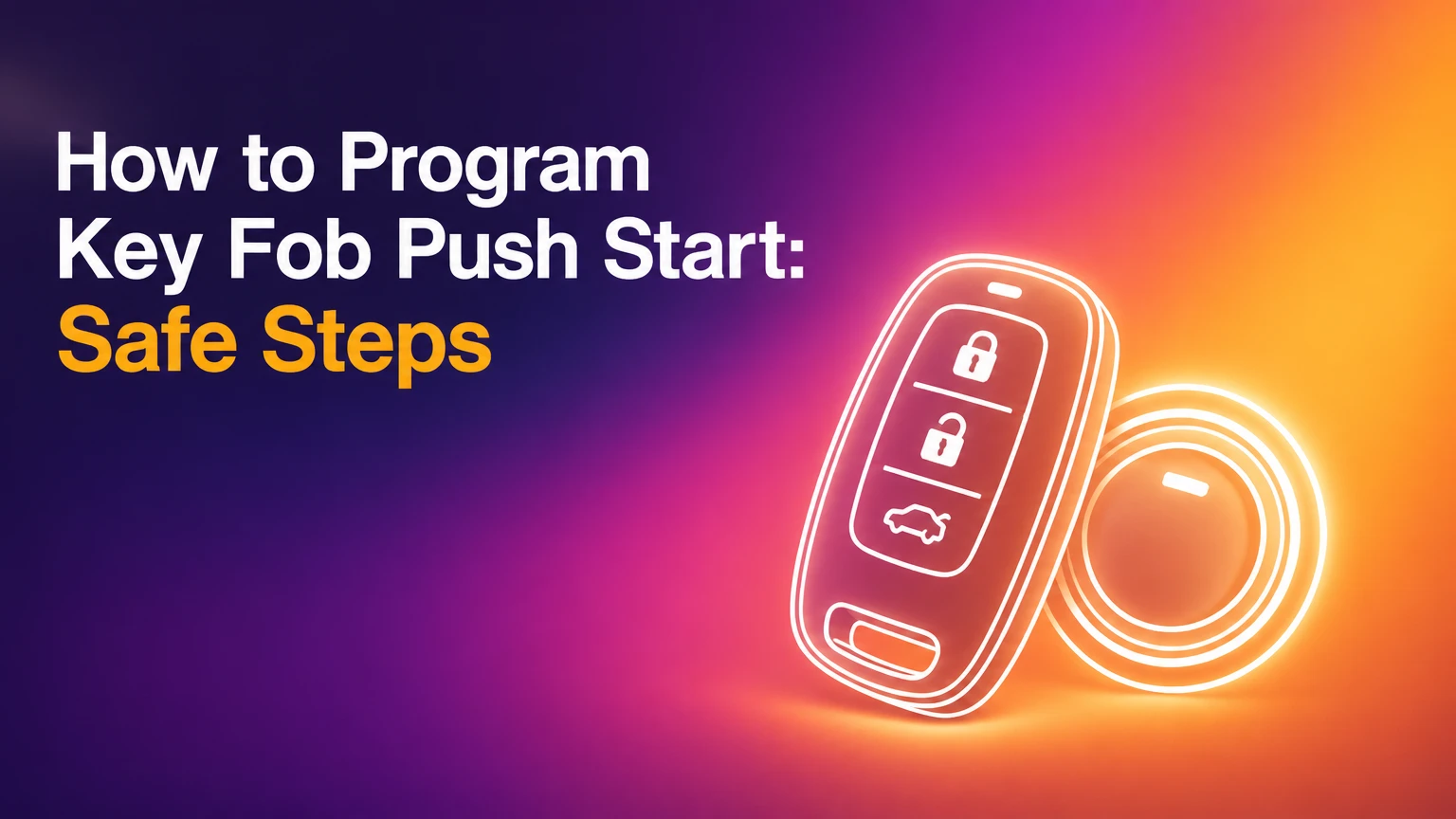
To program a push-start key fob, the vehicle must authorize the fob’s immobilizer transponder and, on many models, its remote functions. First match the exact vehicle-specific fob, then follow the manufacturer’s on-board sequence or use a compatible immobilizer scan tool. Most procedures take 15-60 minutes, but all-keys-lost cases usually require a locksmith or dealer.
Key Facts
A push-start fob usually contains separate functions for remote buttons, passive entry, and engine immobilizer authorization.
The exact year, make, model, trim, market, and existing-key status determine the programming method.
An ordinary OBD-II code reader cannot usually add an immobilizer key.
A fresh CR2032 or CR2025 battery helps the fob transmit, but replacing the battery does not program the fob.
Some vehicles require one working key for self-programming, while others require security access through a scan tool.
A fob that locks and unlocks doors may still fail to authorize the engine.
What Is a Push-Start Key Fob?
A push-start key fob is a proximity transmitter that lets a vehicle authenticate an authorized key before enabling ignition. The fob may provide passive door access, lock and unlock buttons, remote start, and a separate immobilizer transponder, so one successful function does not prove that every function is programmed.
A typical passive-entry system uses a low-frequency signal from antennas inside the vehicle. When the fob is close enough, the fob responds through a radio-frequency channel with encrypted authentication data. The immobilizer or body control module validates that exchange before allowing the engine control module to operate the vehicle.
The exact radio frequency depends on region and vehicle generation. Common North American systems use 315 MHz or 433.92 MHz, while some remote-start systems use different long-range bands. The FCC ID identifies a transmitter approval, but the FCC ID alone does not guarantee compatibility with a particular vehicle.
| Fob function | Vehicle component involved | Typical symptom after partial programming |
|---|---|---|
| Lock and unlock buttons | Remote keyless entry receiver | Doors respond, but engine will not start |
| Passive door entry | Exterior antennas and body control module | Handle touch fails, buttons may still work |
| Push-button starting | Immobilizer, antenna, ECM, or BCM | “Key not detected” or no crank |
| Remote start | Remote-start module and engine controls | Fob works, remote start remains unavailable |
| Emergency blade key | Mechanical door cylinder | Opens door without electronic authorization |
A useful practitioner rule is to test the start authorization separately from the button functions. Door operation proves that the fob is transmitting, not that the vehicle has accepted its immobilizer identity.
What Must You Check Before Starting?
Before programming a push-start key fob, verify the replacement part, vehicle condition, required credentials, and procedure for the exact vehicle. Plan for 30-60 minutes, maintain stable vehicle voltage, keep every existing fob present, and obtain the owner’s manual or a vehicle-specific programming guide.
Confirm the fob identity
Compare the replacement fob with the original by checking:
- Manufacturer part number.
- FCC ID or regional equivalent.
- Button layout and number of buttons.
- Frequency and market specification.
- Transponder type and board generation.
- Vehicle year, model, trim, and body style.
A visually identical fob can contain a different circuit board or immobilizer chip. A North American 315 MHz fob may not replace a 433.92 MHz European-market unit, and a five-button remote-start fob may not substitute for a four-button version even when the case fits.
Prepare the vehicle and tools
| Requirement | Typical value | Why it matters |
|---|---|---|
| Programming time | 15-60 minutes | Includes setup, pairing, and testing |
| Fob battery | CR2032 or CR2025 | Confirm the marking inside the fob |
| Vehicle battery | Above 12.2 V at rest | Low voltage can interrupt security routines |
| Working fobs | 1-2, if required | Some self-programming modes need an existing key |
| Diagnostic tool | Immobilizer-capable, vehicle-specific | Generic OBD-II readers usually cannot add keys |
| Access credential | PIN, security token, or account login | Required on selected vehicles and tools |
Turn off aftermarket chargers, unplug unnecessary accessories, and keep phones or other vehicle keys several feet away during pairing. Never begin an immobilizer procedure with a weak vehicle battery or an uncertain replacement part.
How to Program Key Fob Push Start: The Safe Process
The safest programming process has seven stages: identify the correct fob, locate the backup reader, enter the required ignition mode, follow the model-specific routine, pair the replacement, confirm immobilizer authorization, and test every function. The sequence below is a decision framework, not a universal button combination.
Step 1: Identify the exact vehicle procedure
Find the owner’s manual section named “Smart Key,” “Passive Key,” “Immobilizer,” or “Key Programming.” Record whether the vehicle permits on-board programming and whether all existing fobs must be present.
You will know this step is complete when the instructions name your exact year and model rather than only the brand. A common mistake is using a Ford sequence on another Ford generation, where the button timing, number of keys, or required tool differs.
Step 2: Locate the backup fob pocket
Place a working or replacement fob in the vehicle’s emergency reader when the instructions require it. Common locations include the center-console tray, cup holder, glove box, steering-column area, or a marked pocket near the start button.
The backup reader may work even when the fob battery is dead because it uses short-range inductive communication. The exact location varies by model, so the owner’s manual is more reliable than a generic online diagram.
| Common reader location | Vehicles that may use a similar location | Starting implication |
|---|---|---|
| Center-console tray | Toyota, Lexus, selected Nissan models | Hold fob in tray while pressing brake |
| Cup holder or console bin | Hyundai, Kia, selected GM models | Position may be directional |
| Beside start button | Ford, Volkswagen, selected Stellantis models | Touch fob to button or marked surface |
| Steering-column pocket | Some Ford and European vehicles | Insert fob before ignition request |
You will know the location is correct when the dashboard recognizes the fob or the vehicle starts despite a low fob battery. Do not assume that a visible cup holder is an antenna.
Step 3: Enter the required ignition mode
Use the exact pedal and button instruction from the vehicle manual. Many push-button vehicles enter accessory mode when the driver presses the Start/Stop button without pressing the brake, while programming routines for other vehicles require the brake pedal, clutch pedal, or a diagnostic command.
The accessory mode is not the same as engine-running mode. Pressing the brake at the wrong time can start the engine, terminate a learning routine, or produce a different immobilizer state.
You will know the vehicle is in the intended mode when the instrument cluster displays the specified accessory or ignition indicators. The common mistake is counting seconds from a generic guide instead of following the vehicle’s actual confirmation chime or display message.
Step 4: Use on-board programming only when supported
Follow the manufacturer’s sequence for adding a key, including any required cycling of ignition, insertion of an existing fob, or confirmation through the instrument cluster. Some Ford, General Motors, and Stellantis vehicles support limited on-board procedures, but many newer systems do not.
A typical sequence may require all doors closed, one or two working fobs inside, accessory mode, a timed ignition change, and placement of the new fob in the backup slot. These details are examples, not universal instructions.
You will know the procedure worked when the cluster displays a key-added message, sounds the specified chime, or the manual identifies a successful learning confirmation. If the vehicle gives no confirmation, stop rather than repeatedly cycling the ignition.
Step 5: Add the replacement with a compatible scan tool
If manual programming is unavailable, connect a vehicle-specific immobilizer tool to the OBD-II port and select the exact year, make, model, and system. Follow the tool’s “Add Key,” “Smart Key Learning,” or equivalent function, then place the fob against the designated reader when prompted.
Maintain battery voltage throughout the procedure. Some tools require a security PIN, online authorization, a token calculation, or an active manufacturer account. An inexpensive diagnostic scanner that reads engine fault codes cannot automatically perform those security functions.
You will know the tool completed the process when it reports a successful key count or the vehicle recognizes the fob after ignition is switched off and on. The common mistake is selecting a similar model or interrupting communication while the tool writes immobilizer data.
Step 6: Program remote functions if separate
Test passive entry, lock, unlock, trunk release, panic, and remote start only after engine authorization succeeds. Some vehicles learn remote buttons during immobilizer pairing; others use a separate body-control or remote synchronization procedure.
Remote start may also require a hood-switch signal, transmission-in-park status, closed doors, a programmed climate setting, or a factory subscription. A fob can therefore be correctly programmed while remote start remains disabled for a separate vehicle fault.
You will know the remote portion works when each button performs its intended function at the expected range. Do not interpret a lock chirp as proof that the immobilizer chip has been accepted.
Step 7: Test the fob and retain a spare
With the vehicle outside and stationary, test the new fob at the driver’s door, trunk, start button, and emergency reader. Repeat the test with the original fob so that a failed replacement does not become the only usable key.
A successful test includes locking and unlocking, passive entry if equipped, starting with the brake or clutch applied, shutting down, and restarting. Verify the mechanical emergency blade separately because electronic programming does not cut or encode a blade key.
The process is complete when the vehicle starts twice, the remote buttons work, the dashboard shows no key warning, and every original fob still functions.
Can You Program It Without a Scan Tool?
You can program a push-start key fob without a scan tool only when the vehicle manufacturer provides an on-board learning procedure and the required working keys are available. Many vehicles require immobilizer security access, so a manual lock-unlock sequence may synchronize remote buttons without adding engine authorization.
| Situation | Manual programming likelihood | Safer next action |
|---|---|---|
| One working fob, older model | Medium to high | Check owner’s manual for add-key mode |
| One working fob, recent model | Low to medium | Confirm tool requirement before buying fob |
| All fobs lost | Low | Call an automotive locksmith or dealer |
| European luxury vehicle | Low | Use an authorized specialist with security access |
| Remote buttons only need resynchronization | Medium | Follow the remote-specific manual routine |
The distinction matters because “remote programming” and “immobilizer programming” are different operations. A door-lock response may indicate that only the radio transmitter was learned, while the engine controller still rejects the transponder.
When Is an OBD-II Tool Required?
An immobilizer-capable OBD-II tool is required when the vehicle stores smart-key identities in a body control module, immobilizer module, or electronic steering-lock system that has no user-accessible learning mode. The tool must support the specific vehicle, not merely communicate through the OBD-II connector.
| Tool category | Can read engine codes | Can add immobilizer keys | Typical user |
|---|---|---|---|
| Generic code reader | Yes | No | Basic diagnostics |
| Enhanced scan tool | Yes | Sometimes | Brand-specific repair work |
| Key programmer | Yes, on supported vehicles | Yes | Locksmith or trained DIY user |
| Dealer diagnostic system | Yes | Yes, with authorization | Dealership service department |
The OBD-II connector is only the communication path. Security functions may remain blocked unless the programmer supports the vehicle’s protocol and obtains the required credentials.
Do not choose a tool solely because an online listing says “works with all cars.” Confirm coverage by exact model year, immobilizer system, region, and whether the tool supports adding a key when one key remains or when all keys are lost.
How Do You Buy the Correct Fob?
Buy a replacement push-start fob by matching the vehicle’s original part number, FCC ID, board type, frequency, button layout, and market specification. A case that fits the shell is insufficient because the immobilizer chip and radio circuit may be incompatible.
| Verification item | Example value | Failure if mismatched |
|---|---|---|
| FCC ID | HYQ14FBA | Buttons may not transmit correctly |
| Frequency | 315 MHz | Vehicle may ignore the signal |
| Battery | CR2032 | Wrong thickness or contact pressure |
| Button count | 4 buttons | Missing trunk or remote-start command |
| Part number | Vehicle-specific OEM code | Tool may reject the fob |
| Condition | New or vehicle-unlocked used unit | Used fob may remain locked to another car |
OEM fobs usually provide the most predictable fit and software compatibility. Aftermarket units can cost less, but quality varies by board supplier, battery contacts, casing, and firmware.
A used smart fob may be reusable on some vehicles after reset, while other systems permanently lock the fob to its original vehicle. Ask the seller whether the unit is new, unlocked, refurbished, or merely a replacement shell.
What Changes When Every Fob Is Lost?
All-keys-lost programming is more restricted, more expensive, and more security-sensitive than adding a spare key. The vehicle may erase previous key identities, require a PIN or online authorization, and leave the vehicle unusable if the procedure is interrupted.
Bring proof of ownership and government identification to a locksmith or dealer. A mobile automotive locksmith can often perform the work at the vehicle, but the service may require a working 12-volt battery, access to the diagnostic port, and a correctly cut emergency blade.
| Service situation | Typical time | Typical cost in the United States |
|---|---|---|
| Add one compatible spare | 15-45 minutes | $80-$250 |
| Replace one lost fob | 30-90 minutes | $150-$400 |
| All keys lost, standard vehicle | 45-120 minutes | $250-$600 |
| Luxury or encrypted vehicle | 1-3 hours | $400-$1,200 or more |
| Dealer replacement and programming | 1-3 hours | $250-$800 |
These are typical market ranges, not fixed prices. Vehicle brand, region, emergency callout, key availability, blade cutting, and immobilizer security access can change the total.
Erasing lost keys is sensible when the vehicle supports it, because a missing fob could otherwise remain authorized. Ask the technician whether erased fobs can be restored later and whether the procedure will delete every currently programmed key.
What Are the Programming Options?
A dealership is the most predictable option for vehicles with proprietary software or online security authorization. A certified automotive locksmith is often faster and less expensive for standard vehicles, while DIY programming makes sense only when the fob and tool are verified for the exact vehicle.
| Option | Typical cost | Typical time | Main advantage | Main limitation |
|---|---|---|---|---|
| Dealership | $250-$800 | 1-3 hours | Factory software and parts | Highest labor and towing exposure |
| Automotive locksmith | $150-$500 | 20-90 minutes | Mobile service and broad coverage | Tool coverage varies |
| DIY kit | $40-$250 | 30-120 minutes | Lowest labor cost | Compatibility and error risk |
| Used fob plus specialist | $100-$350 | 30-120 minutes | Potential parts savings | Fob may be locked or defective |
DIY is a poor choice when every key is lost, the vehicle is immobilized in an unsafe location, or the car uses an encrypted European security platform. A locksmith is usually the practical middle option for a standard Toyota, Honda, Ford, GM, Hyundai, Kia, Nissan, or Stellantis vehicle, provided the replacement part is correct.
The dealer is not automatically required for every push-start vehicle. The deciding factors are security authorization, tool coverage, ownership verification, and whether the fob can be added without erasing the immobilizer system.
Common Mistakes and How to Fix Them
Most failed key-fob programming attempts result from incorrect parts, insufficient vehicle voltage, an unsupported procedure, or confusion between remote synchronization and immobilizer learning. Recovery depends on the error, so avoid repeated attempts when a tool reports a security or communication failure.
Wrong FCC ID or part number
Symptom: The fob looks correct, but no buttons or proximity functions work.
Fix: Compare the original fob’s FCC ID, part number, frequency, button count, and regional specification. Return the unit before opening or modifying it.
Weak fob battery
Symptom: The range is short, the LED is dim, or the vehicle intermittently reports no key.
Fix: Install the battery type printed inside the fob, confirm polarity, and clean bent contacts. Battery replacement alone does not add the fob to the vehicle.
Low vehicle battery voltage
Symptom: The programmer resets, the dashboard goes dark, or pairing stops midway.
Fix: Charge or replace the vehicle battery and use a regulated support supply when the manufacturer or tool requires one. Do not disconnect power during a write operation.
Full key memory
Symptom: The tool accepts the procedure but refuses to add another key.
Fix: Check the vehicle’s key-memory limit. Erase only when necessary, because an erase-all function can remove every authorized fob, including the one that was working.
Used or locked fob
Symptom: The programmer identifies the fob but cannot complete learning.
Fix: Confirm whether the vehicle permits used-fob reuse. Some fobs require manufacturer-level reset, while others cannot be reassigned.
Incorrect backup reader location
Symptom: The vehicle says “key not detected,” even with a fresh battery.
Fix: Search the owner’s manual for “dead key fob starting” or “emergency key reader.” Hold the fob in the specified pocket or against the marked start-button area.
Why Does the Car Say Key Not Detected?
A “key not detected” warning means the vehicle failed to complete proximity authentication, but the cause may be the fob battery, vehicle battery, antenna, radio interference, incorrect fob, or immobilizer registration. The emergency reader can distinguish a weak wireless signal from a completely unrecognized key.
Try the following sequence:
- Move the fob away from a smartphone, laptop, metal wallet, or second vehicle key.
- Replace the fob battery and confirm polarity.
- Hold the fob against the start button or in the manual’s backup pocket.
- Press the brake or clutch firmly and try again.
- Test the spare fob, if available.
- Check whether the dashboard recognizes the fob but blocks starting.
- Stop if both fobs fail, because the vehicle may have an antenna, battery, or immobilizer fault.
If the buttons work but the engine will not start, the remote transmitter may be functional while the immobilizer transponder remains unregistered. If the emergency reader also fails, professional diagnosis is more appropriate than another generic programming sequence.
Can a Remote-Start Fob Be Added Separately?
A remote-start fob can be added separately only when the vehicle’s body-control and remote-start systems support that configuration. Programming the transmitter does not guarantee that the vehicle has the factory remote-start module, hood switch, software activation, or subscription required to run the engine remotely.
Check the vehicle build sheet, owner’s manual, and existing remote-start hardware. A remote-start button on an aftermarket fob cannot create missing safety inputs or install a factory module.
Remote start also fails when the hood is open, the vehicle is not in Park, a door is unlocked, the engine warning system reports a qualifying fault, or the key is already inside the vehicle. Diagnose those conditions after basic fob programming succeeds.
What Is the Safest Choice for Luxury and European Cars?
The safest choice for many BMW, Mercedes-Benz, Audi, Porsche, and newer Land Rover vehicles is an authorized dealer or an automotive locksmith with documented manufacturer-level security access. Encrypted immobilizer systems, gateway modules, online credentials, and replacement-key ordering make generic DIY tools unsuitable for many configurations.
This recommendation is about risk, not brand prestige. A failed security procedure can lock a module, require recovery programming, or leave the vehicle unable to start, turning a replacement-key task into a larger repair.
Ask the provider three questions before authorizing work:
- Does the tool support the exact model year and immobilizer system?
- Will the provider erase missing keys from vehicle memory?
- What happens if the supplied aftermarket fob fails to learn?
A specialist should also verify ownership and explain whether the replacement is OEM, aftermarket, new, unlocked, or refurbished.
Frequently Asked Questions
Does changing the key fob battery erase programming?
Changing a fob battery normally does not erase its programming because the vehicle stores the authorized identity separately from the battery-powered transmitter. Reinstall the correct battery with the positive side oriented properly, then test the buttons and emergency-start location if the vehicle still reports no key.
Can I program a spare fob if one key still works?
Often, yes, but only if the vehicle supports adding a key through an on-board routine or a compatible programmer. Keep the working fob present because some systems require it for authorization, while other vehicles still require a security-capable scan tool even when one key remains.
Will a locksmith program a key fob at my home?
A mobile automotive locksmith can often program a push-start fob at your home or roadside location when the vehicle is accessible and the locksmith has the correct tool. The provider may request identification, proof of ownership, the VIN, and confirmation that the replacement fob matches the vehicle.
Can an OBD-II scanner program any push-start fob?
No. A generic OBD-II scanner can read or clear many engine fault codes, but immobilizer programming requires vehicle-specific security functions. Confirm exact model-year coverage, PIN or online authorization requirements, and support for smart-key addition before purchasing a programming tool.
Why does the new fob unlock doors but not start the car?
The remote transmitter may have synchronized while the immobilizer transponder did not. Recheck the fob part number, use the vehicle’s emergency reader, and repeat the authorized key-learning procedure. If the vehicle still refuses to start, diagnose the immobilizer system rather than repeating remote-button programming.
Is dealer programming necessary when all keys are lost?
Dealer programming is not always necessary, because a qualified automotive locksmith may support all-keys-lost programming for the vehicle. Dealer service becomes the safer route when the vehicle requires proprietary online authorization, the model has encrypted gateway security, or local locksmiths cannot verify tool coverage.
The Bottom Line
How to program key fob push start depends on the vehicle’s immobilizer architecture, not merely on the presence of a Start/Stop button. Match the exact fob, follow the manufacturer’s procedure, use an immobilizer-capable tool when required, and test starting separately from door-button operation. DIY works for supported add-key situations; a qualified locksmith or dealer is safer for all-keys-lost and encrypted vehicles.