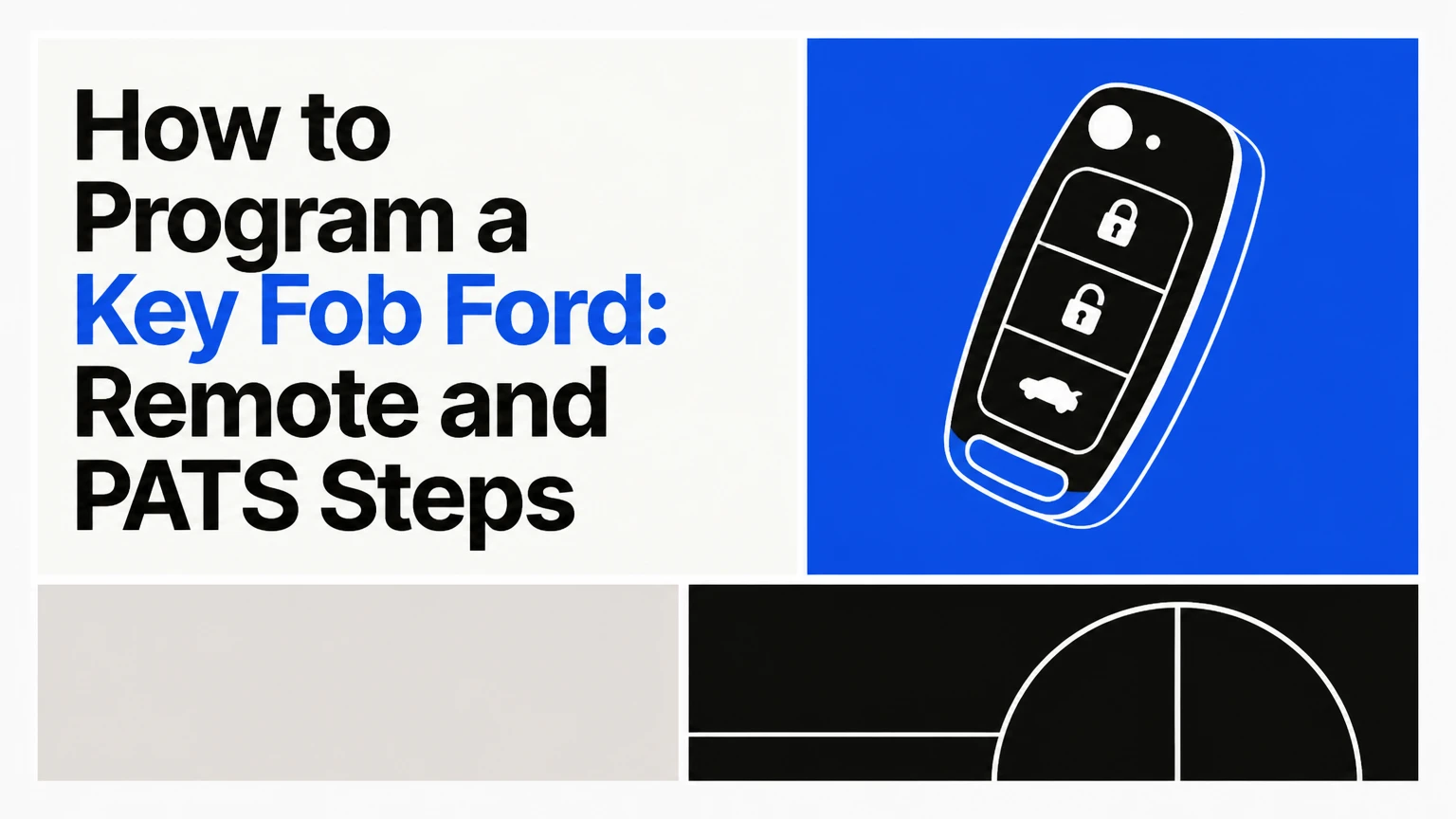
To program a Ford key fob, first identify whether you need to pair the remote buttons, the immobilizer transponder, or both. Many traditional-key Fords pair remote-lock functions through an ignition-cycle sequence, while PATS starting authorization usually needs two recognized keys or professional equipment. Push-button models use a vehicle-specific backup-slot procedure.
Key Facts at a Glance
- Ford Remote Keyless Entry, or RKE, controls functions such as lock, unlock, panic, trunk release, and sometimes remote start.
- Ford Passive Anti-Theft System, or PATS, authorizes the engine to start through a coded transponder inside the key or smart fob.
- The common eight-cycle ignition procedure usually pairs remote buttons, not the PATS immobilizer chip.
- A Ford with Intelligent Access commonly needs two already programmed keys for onboard addition of a third key.
- A locksmith can usually add a Ford key with one existing key, but the vehicle, market, and security system determine whether that option is available.
- A replacement fob must match the vehicle’s frequency, FCC ID or part number, button layout, and programming capability.
What does Ford key-fob programming actually change?
Ford key-fob programming changes one of two separate vehicle records: the RKE transmitter identity or the PATS key identity. RKE pairing lets the Body Control Module recognize button commands; PATS programming lets the immobilizer recognize the coded chip required for engine operation.
A remote can therefore lock the doors without starting the vehicle. Conversely, a correctly cut and PATS-programmed key can start the engine even when its lock buttons have not been paired. Treating those systems as one task causes many unnecessary dealer visits and many incorrect online procedures.
| Function | Ford system | Where the code is stored | Typical result after programming |
|---|---|---|---|
| Lock and unlock | RKE | Remote transmitter and vehicle module | Doors respond to buttons |
| Trunk or liftgate release | RKE | Remote transmitter and vehicle module | Rear latch responds |
| Remote start | RKE plus vehicle configuration | Fob, BCM, and vehicle software | Engine starts remotely if equipped |
| Engine authorization | PATS | Key or fob transponder and immobilizer | Engine starts normally |
| Door keypad entry | SecuriCode | Vehicle keypad and stored code | Five-digit entry unlocks doors |
Ford’s owner-manual procedures are the controlling authority because the same model name can use different systems across years, trims, engines, and markets. A 2015 Ford F-150, for example, may have a conventional ignition key, Intelligent Access, remote start, or a fleet-specific configuration.
How can you tell which Ford key system you have?
A metal blade that turns an ignition cylinder indicates a traditional-key system. A START/STOP button indicates Intelligent Access or another push-button system, although some vehicles still include a concealed emergency blade and a backup transponder-reading pocket.
Use these checks before starting:
- Look at the ignition: identify a key cylinder or a START/STOP button.
- Inspect the fob: note the number of buttons, remote-start symbol, panic button, and removable blade.
- Check the dashboard: messages such as “No Key Detected” point to an Intelligent Access system.
- Read the owner’s manual: search the exact model year for “remote control,” “coded key,” “spare key,” or “backup slot.”
- Check the replacement: compare FCC ID, part number, button arrangement, frequency, and vehicle compatibility.
A fob that looks identical can still be incompatible. Frequency, encryption generation, regional specification, and onboard software matter more than exterior shape.
Which Ford programming method should you use?
Use the eight-turn procedure for compatible traditional-key vehicles when the goal is remote-button pairing. Use the backup-slot sequence for compatible push-button vehicles when you have the required number of recognized fobs. Use a locksmith or dealer when you need PATS programming without the required keys.
| Vehicle situation | First method to consider | Minimum recognized keys | Main function |
|---|---|---|---|
| Metal ignition key, remote buttons only | Eight-cycle ignition procedure | 1 working key | RKE transmitter pairing |
| Metal ignition key, new engine-starting key | Onboard spare-key procedure if supported | Usually 2 programmed keys | PATS key addition |
| Push-button start, adding a smart fob | Backup-slot procedure if supported | Commonly 2 working fobs | Intelligent Access and PATS |
| One working key, replacement needed | Automotive locksmith | 1 working key in many cases | Scan-tool key programming |
| No working keys | Locksmith or dealer | 0 | All-keys-lost programming |
| Used fob from another vehicle | Compatibility check plus erasure or programming | Vehicle-dependent | RKE and possibly PATS |
The word “usually” matters. Ford changed procedures during production, and some models use a four-cycle sequence, a different ignition-position pattern, or no owner-programmable method at all. A failed eight-cycle attempt does not prove the vehicle or fob is defective.
How do you program a Ford remote with an ignition key?
To pair a compatible Ford remote with a traditional ignition key, close the doors, cycle the ignition from OFF to RUN eight times within 10 seconds, leave the key in RUN on the eighth cycle, then press a button on every remote within the confirmation window. The door locks should cycle when programming mode opens and after each accepted remote.
Before you start
| Requirement | Typical specification |
|---|---|
| Time | 5-10 minutes |
| Difficulty | Low, but timing-sensitive |
| Vehicle condition | Battery charged, doors closed |
| Existing key | At least 1 key that turns ignition |
| New remote battery | Fresh CR2032 or vehicle-specified equivalent |
| Tools | No scan tool; owner’s manual recommended |
The procedure below applies only when the vehicle supports this RKE sequence. It does not automatically program a transponder key for engine starting.
Step 1: Prepare the vehicle
Close every door, sit in the driver’s seat, and unlock the doors with the interior power-unlock switch if needed. Keep all replacement remotes available because some Ford systems erase or suspend previously learned RKE transmitters when programming mode ends.
Turn off accessories that could distract you from the timing sequence. Confirm that the key turns smoothly between OFF and RUN without reaching the START position.
Step 2: Cycle the ignition eight times
Insert the working key and turn it from OFF to RUN eight times within 10 seconds. RUN is the position immediately before the starter engages, and the eighth cycle must finish in RUN.
Do not crank the engine. Do not pause several seconds between cycles. The sequence must be quick enough for the vehicle module to interpret it as a programming command.
Success checkpoint: the power-door locks cycle once, usually lock then unlock.
Common mistake: counting a START position or leaving the key in ACCESSORY causes the vehicle to ignore the sequence.
Step 3: Press a button on each remote
After the locks cycle, press any button on the first remote within the vehicle’s programming window, commonly about eight seconds. Press a button on every other remote, including an older remote that already worked.
Success checkpoint: the locks cycle after each accepted transmitter.
Common mistake: programming only the new fob can leave an old fob unusable on systems that rewrite the active transmitter list.
Step 4: Exit programming mode
Turn the ignition to OFF and remove the key. Test lock, unlock, panic, trunk release, and remote start if the vehicle is equipped and the feature is enabled.
Success checkpoint: every intended remote operates the vehicle from a normal distance, commonly 15-50 feet in open conditions.
Common mistake: testing beside a building or with a weak battery can make a correctly programmed remote appear unreliable.
What if the locks do not cycle?
Repeat the sequence with a charged vehicle battery and a faster, more consistent rhythm. If the locks still do not cycle, verify the exact model-year procedure, because Ford used different sequences on some Focus, Fiesta, Mustang, Escape, Explorer, and truck applications.
A remote-button failure can also result from a wrong FCC ID, incompatible frequency, incorrect button configuration, defective aftermarket electronics, or a vehicle module fault. Replacing the battery will not correct an incompatible transmitter.
How do you add a smart fob with push-button start?
A compatible Ford Intelligent Access vehicle commonly adds a new smart fob by placing two recognized fobs in the vehicle’s backup slot in sequence, switching the ignition on for each, and then placing the new fob in the same slot. The exact slot location and timing vary by model year, so the owner’s manual takes priority.
Step 1: Find the backup slot
Ford places the passive key backup pocket in different locations. Common examples include under a rubber cupholder mat, inside the center console, in a console tray, or behind a removable steering-column cover.
The pocket reads the transponder even when the fob battery is weak or completely discharged. It is not always a visible slot, and a shallow tray may be the intended location.
Step 2: Authenticate the first working fob
Place the first recognized fob in the backup pocket. Press the START button without pressing the brake, allowing the vehicle to enter the ignition-on state. Wait approximately five seconds, switch the ignition off, and remove the fob.
Step 3: Authenticate the second working fob
Place the second recognized fob in the pocket within the time stated by the owner’s manual, commonly about 10 seconds. Press START without the brake, wait approximately five seconds, switch off, and remove the second fob.
Step 4: Add the new fob
Place the unprogrammed compatible fob in the backup pocket within the next programming window. Press START without the brake to place the ignition on.
Success checkpoint: the instrument cluster displays a key-programmed message, the locks cycle, or the vehicle accepts the new fob after the ignition is switched off.
Common mistake: pressing the brake during the sequence can attempt to start the vehicle instead of selecting the required ignition state.
This procedure is not universal. Some Ford vehicles use a menu-based process, a different number of recognized keys, or require a scan tool even when two working fobs are present.
Can you program a Ford key with only one working key?
You can often pair remote buttons with one working ignition key, but you generally cannot add a new PATS starting key through the vehicle’s onboard procedure with only one recognized key. Ford introduced two-key requirements to prevent an unauthorized person with one temporarily available key from creating additional starting keys.
A locksmith may still program a replacement with one key by using diagnostic equipment at the OBD-II port. The locksmith verifies ownership and uses a security access procedure supported by the specific vehicle.
| Available keys | Likely DIY result | Professional route | Typical U.S. price |
|---|---|---|---|
| 2 working coded keys | Add a supported spare key | Optional | $20-$100 for compatible key |
| 1 working coded key | Remote pairing often possible; PATS uncertain | Mobile locksmith | $100-$250 |
| 0 working coded keys | Onboard programming unavailable | Locksmith or dealer | $180-$500+ |
| Working remote, no starting key | RKE works; PATS absent | Cut and program coded key | $150-$400 |
| Used smart fob | Compatibility and prior pairing issues | Locksmith or dealer | $150-$500+ |
These are typical U.S. consumer ranges, not fixed Ford prices. Smart fobs, proximity systems, all-keys-lost jobs, encrypted security gateways, and emergency callouts increase the total.
How much does Ford key programming cost?
Ford key programming typically costs $20-$100 for a compatible owner-programmed spare, $100-$250 through an automotive locksmith, or $250-$500 or more through a dealership for a smart fob or all-keys-lost job. The total includes the key or fob, cutting, programming, labor, and sometimes a security-code service.
A DIY programmer kit can cost approximately $100-$150 and may include one compatible key, but coverage is vehicle-specific. Read the kit’s supported model list before purchase, and confirm whether the kit programs RKE, PATS, or both.
| Route | Typical total | Typical time | Best use |
|---|---|---|---|
| Owner, remote-only pairing | $20-$50 | 5-10 minutes | Existing ignition key, compatible remote |
| Owner, coded spare procedure | $20-$100 | 10-20 minutes | Two recognized keys and supported vehicle |
| Automotive locksmith | $100-$250 | 30-90 minutes | One key, mobile service, lower cost |
| Ford dealer | $250-$500+ | 1-4 hours | Complex smart-key or security case |
| DIY programmer kit | $100-$150 | 30-120 minutes | Supported model and confident owner |
A dealer quote may exclude key cutting or towing. Ask for a written total that identifies the part number, programming charge, cutting fee, and whether all existing keys must be present.
How do you verify a replacement Ford fob before buying?
Verify the replacement fob’s FCC ID, Ford part number, frequency, button layout, transponder type, and model-year coverage before buying. A matching appearance is insufficient because two four-button remotes can use different radio protocols or immobilizer systems.
Check the original fob’s markings inside the shell or on its rear label. Compare the replacement against Ford parts information, a reputable locksmith database, or the exact owner’s manual. Avoid listings that claim compatibility with a long, unqualified range of vehicles.
A replacement may also need a cut emergency blade. Blade cutting and electronic programming are separate operations. A fob can pass remote pairing while its emergency blade remains unusable, and a cut blade can unlock a door without authorizing the engine.
Why did Ford key-fob programming fail?
Ford programming commonly fails because the procedure does not match the vehicle, the replacement fob is incompatible, the timing window was missed, the vehicle battery is weak, or the user attempted RKE programming when PATS programming was required. The first diagnostic question is whether the remote buttons or engine-start authorization failed.
Use this recovery sequence:
- Test the original key or fob: confirm the vehicle itself responds normally.
- Install the correct battery: match polarity and use the specified coin-cell type.
- Verify compatibility: compare FCC ID, part number, frequency, and button layout.
- Repeat with all doors closed: remove other fobs from the cabin during the attempt.
- Use the correct ignition state: RUN for a key cylinder, ignition-on without brake for many push-button procedures.
- Check the security indicator: a rapidly flashing theft light may indicate a PATS issue rather than an RKE issue.
- Stop repeated attempts: excessive trial-and-error can erase learned remotes on some systems.
A fob that locks doors but produces a “No Key Detected” message has an RKE success and a passive-detection problem. A key that starts the engine but does not operate locks has a PATS success and an RKE pairing problem.
Can you program the Ford door keypad or clear MyKey?
The SecuriCode keypad and Ford MyKey are separate features from key-fob programming. The keypad stores a factory five-digit code and a personal code, while MyKey applies restrictions such as speed alerts, audio limits, or persistent reminders to a programmed key.
Ford states that the factory keypad code can often be found on the owner’s wallet card or a vehicle module label. On some vehicles, inserting two recognized keys in sequence allows the code to appear in the instrument display, but the retrieval procedure varies.
To create a personal keypad code on supported Ford vehicles:
- Enter the five-digit factory code.
- Press the 1-2 button within five seconds.
- Enter a new five-digit personal code.
- Press 1-2 again to store the code.
- Test the new code after the locks confirm acceptance.
MyKey restrictions require an Admin key to clear or change them. Programming a new remote does not automatically remove MyKey limits, and replacing the fob battery cannot convert a restricted key into an Admin key.
What should you do with a used Ford fob?
A used Ford fob is worth using only when its part number, frequency, transponder system, and vehicle coverage match the target vehicle. Some used remote transmitters can be relearned, while some smart keys remain linked to the original vehicle or require professional erasure.
Ask the seller whether the fob is new, refurbished, or previously installed. Confirm that the emergency blade, buttons, battery contacts, and case are intact. A low price is less attractive when the fob cannot be returned after unsuccessful programming.
Do not send vehicle security codes to an unknown seller. Use an established automotive locksmith or Ford dealer for transactions involving VIN-based programming or all-keys-lost service.
What are the expert rules for avoiding repeat failures?
Three practitioner rules prevent most wasted attempts. First, diagnose the subsystem before buying parts. Second, verify compatibility from identifiers rather than photographs. Third, preserve a working key until the replacement has started the engine and operated every required remote function.
A fresh battery is necessary for many RKE attempts, but it cannot program a PATS chip. This distinction is counterintuitive because both functions are packaged inside one plastic fob.
Another practical rule concerns timing: perform the procedure with a timer visible and the replacement fobs arranged in order. On a push-button vehicle, confusing the ignition-on state with an engine-start command is a common reason for an otherwise correct sequence to fail.
The limitation is equally important. Generic procedures cannot guarantee success for every Ford because model-year software, market security rules, and trim-level equipment differ. The exact Ford owner’s manual, Ford service information, or a qualified automotive locksmith outranks a generic internet sequence.
Frequently Asked Questions
Can a Ford key fob work after changing its battery?
Yes, changing a Ford fob battery normally preserves its programming because the transmitter memory is nonvolatile. Install the correct coin cell with the positive side oriented correctly, then test every button. Battery replacement will not restore a damaged circuit, incompatible fob, lost RKE pairing, or missing PATS authorization.
Does a Ford key fob need programming after battery replacement?
Usually, no. A Ford remote generally retains its RKE identity after a normal battery change, although accidental button presses, damaged contacts, or an already weak transmitter can expose an existing fault. If the fob stopped working immediately after replacement, inspect polarity, terminals, case alignment, and battery voltage before reprogramming.
Can I start a Ford with a dead smart-fob battery?
Often, yes. Place the dead or weak smart fob in the vehicle’s designated backup slot, then press START according to the owner’s manual. The backup antenna reads the passive transponder separately from the fob’s coin-cell-powered radio signal, allowing the vehicle to authorize starting in many Intelligent Access models.
How many Ford keys can the vehicle remember?
The number varies by model, year, and module configuration. Many Ford vehicles support several learned keys or remotes, but the limit may be four, eight, or another vehicle-specific value. Reaching the limit can require a scan tool to erase old records before adding replacements.
Can a locksmith program a Ford key without the original?
Often, yes, but the locksmith must use vehicle-specific diagnostic equipment and verify ownership. All-keys-lost programming may require security access, a PIN-related service, or gateway authorization, and some newer models take longer. A dealer remains an alternative when local locksmith equipment does not support the vehicle.
Why does the remote work but the Ford engine will not start?
The remote buttons and engine immobilizer use different systems. A working lock button proves RKE communication, not PATS authorization. The key may need transponder programming, the blade may be incorrectly cut, or the vehicle may have a PATS antenna, battery-voltage, or immobilizer fault requiring diagnostic testing.
The Bottom Line
How to program a key fob Ford depends on the function and vehicle architecture. Use the eight-cycle ignition method for supported remote-button pairing, use the backup slot for compatible Intelligent Access procedures with the required recognized fobs, and use a locksmith or dealer when PATS programming cannot be completed onboard. Confirm the exact model-year instructions before buying a replacement.