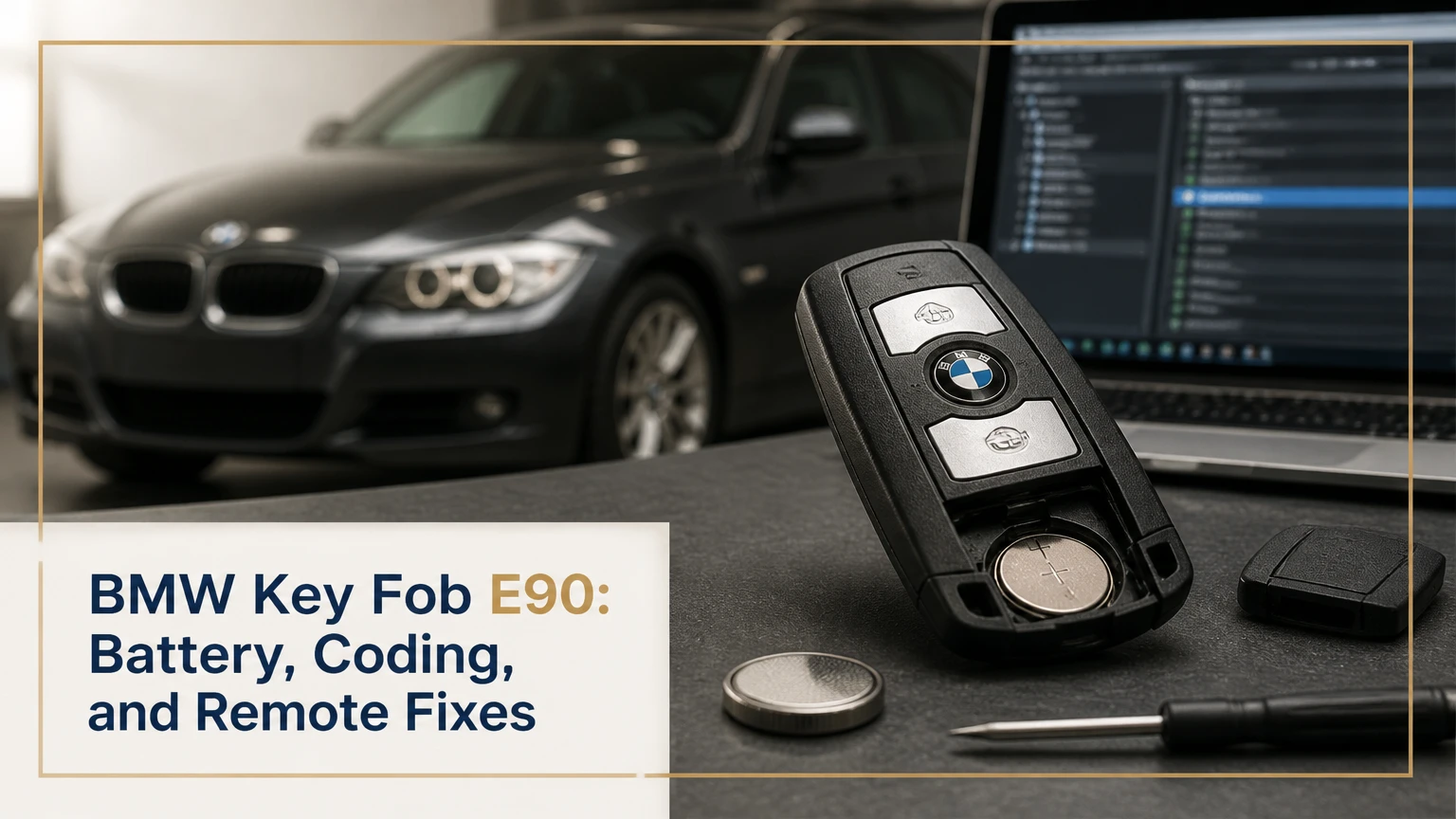
The BMW E90 key fob is a rectangular slot key used by the 2005-2011 BMW 3 Series. Standard keys contain a rechargeable VL2020 battery, while Comfort Access keys normally use a replaceable CR2032; the remote transmitter, passive immobilizer, CAS module, and vehicle receiver can fail independently.
Key Facts at a Glance
- A standard BMW E90 key charges its rechargeable VL2020 battery while inserted in the dashboard slot.
- A Comfort Access BMW E90 key normally uses a replaceable CR2032 battery and has a rear battery door.
- A BMW E90 that starts normally but does not respond to remote buttons may have a diversity antenna, fuse, wiring, or transmitter fault.
- A dead remote battery usually does not prevent a standard E90 key from starting the engine when the key is inserted into the slot.
- A used BMW E90 key already assigned to another vehicle generally cannot be reassigned to a different VIN.
- BMW E90 key frequency must match the vehicle market and transmitter hardware, commonly 315 MHz or 868 MHz.
What Is the BMW E90 Key Fob?
The BMW E90 key fob is a slot-mounted electronic key for the fourth-generation BMW 3 Series, including the E90 sedan, E91 Touring wagon, E92 coupe, and E93 convertible. The E90 platform entered production in the mid-2000s, so exact equipment varies by model year, market, engine, and factory options.
The key combines several systems in one housing. Its buttons transmit lock, unlock, trunk, and sometimes panic commands; a passive transponder authorizes starting; the CAS, or Car Access System, manages key recognition; and the car’s receiver handles the radio-frequency remote signal. These functions do not depend on exactly the same circuit or power source.
The dashboard slot is therefore more than a storage point. On standard-key cars, inserting the fob allows the vehicle to read the key and, during normal use, replenish the rechargeable battery. On Comfort Access cars, the vehicle detects the fob wirelessly for entry and starting, although the slot remains available as a backup and charging is not provided for the CR2032.
How Does the E90 Key System Work?
The BMW E90 key system uses separate authorization paths for remote locking and engine start. The radio transmitter operates the central-locking system, while the passive immobilizer exchange between the key and CAS authorizes the vehicle to start.
That separation explains a common diagnostic result: the BMW E90 starts when the key is inserted, but its lock and unlock buttons do nothing. The result points first toward a depleted transmitter battery, damaged button circuit, incorrect frequency, failed diversity antenna, antenna power supply, or wiring fault rather than an immobilizer failure.
The opposite pattern also matters. If the buttons work but the car refuses to start, investigate CAS communication, the electronic steering lock, key recognition, vehicle voltage, or a mechanical slot problem. Replacing the coin cell will not normally repair a red steering-wheel lock warning.
Which E90 Key Type Do You Have?
The fastest identification method is to inspect the back of the rectangular fob. A solid, sealed rear cover usually indicates the standard non-Comfort Access key; a small removable battery hatch usually identifies Comfort Access.
| Key configuration | Rear housing | Battery | Charging behavior | Entry and starting |
|---|---|---|---|---|
| Standard slot key | Solid sealed plastic | VL2020, rechargeable | Charges in slot during normal use | Insert key to start |
| Comfort Access key | Removable rear hatch | CR2032, replaceable | Does not charge in slot | Pocket unlock and push-button start |
| Replacement shell | Appearance varies by supplier | Existing board-dependent | Depends on original circuit | Must match board and frequency |
| Aftermarket virgin key | New housing and uncoded electronics | Market-specific battery | Depends on key design | Requires compatible coding |
Button count and housing shape are useful clues, but they are not conclusive. Check whether the car unlocks when the key remains in your pocket, whether the door handles have Comfort Access touch sensors, and whether the rear cover has a battery door.
A replacement shell can mislead owners because sellers often use “E90 key” for several visually similar BMW keys. Match the circuit board, button layout, transponder type, frequency, and Comfort Access configuration before ordering.
Which Battery Does a BMW E90 Key Use?
A standard BMW E90 key uses a rechargeable VL2020 cell, while a Comfort Access key generally uses a replaceable CR2032 lithium coin cell. The battery type cannot be chosen by model year alone because Comfort Access is an option and regional equipment differs.
| Battery or component | Typical E90 application | Owner replacement | Charging | Main risk |
|---|---|---|---|---|
| VL2020 | Standard sealed slot key | No, not without opening case | Yes, through slot | Board or case damage during soldering |
| CR2032 | Comfort Access fob | Yes, through rear hatch | No | Reverse polarity or damaged contacts |
| CR2025 | Usually not the specified E90 replacement | No, unless exact specification permits | No | Incorrect thickness and capacity |
| Rechargeable substitute | Repair-specific only | Technician recommended | Depends on cell chemistry | Unsafe charging mismatch |
The VL2020 is not an ordinary CR2032 replacement. A standard key’s charging circuit expects a rechargeable cell, and installing a non-rechargeable coin battery can create leakage, charging, or safety problems.
How Do You Replace a Comfort Access Battery?
Replace a Comfort Access CR2032 by opening the rear battery hatch, removing the old cell, installing the new cell with the polarity marked inside the holder, and testing every button beside the vehicle. The process normally takes 2-5 minutes and requires only the correct battery.
- Remove the emergency mechanical blade if it obstructs the cover.
- Open the small rear battery door using its release point.
- Note the old cell’s orientation before removal.
- Install a fresh CR2032 from a reputable manufacturer.
- Close the hatch fully so the contacts remain pressed against the cell.
- Test lock, unlock, and trunk functions from several metres away.
You will know the replacement worked when the buttons respond consistently, the vehicle locks and unlocks without repeated presses, and the operating range returns. A new battery that produces no response does not prove the transmitter is defective, because a failed antenna or incorrect key frequency can create the same symptom.
Do not leave the battery loose inside the housing. Movement can cause intermittent contact, which owners often mistake for a failing receiver.
Can You Replace a Standard Key’s VL2020 Yourself?
A standard BMW E90 key’s VL2020 can be replaced, but the sealed case must be cut open and the old cell desoldered. The repair requires a temperature-controlled soldering iron, suitable soldering skill, correct battery tabs, and a replacement case or adhesive suitable for resealing the housing.
The practical risk is greater than the battery price. Excess heat can lift circuit-board traces, short components, or damage the charging circuit; cutting too deeply can sever the board or antenna. A key specialist can often transfer the original electronics into a new shell while preserving the immobilizer identity.
The key does not become useless merely because the rechargeable cell is old. If the remote range gradually declined over months or years, the cell is a reasonable suspect. If the key stopped after water exposure, physical impact, or a failed button, battery replacement alone may not restore it.
Why Does the E90 Start but Not Lock or Unlock?
When a BMW E90 starts but the remote buttons fail, diagnose the remote-power and receiver circuits separately from the immobilizer. Begin with the key battery and buttons, then check the vehicle receiver, fuse supply, antenna wiring, and door-lock actuators.
| Observed symptom | Most likely area | First test | Typical repair direction |
|---|---|---|---|
| Starts, no buttons, one key only | Key battery or transmitter | Test spare key and battery | Battery, board, or key replacement |
| Starts, no buttons, every key | Vehicle receiver or fuse | Check central-locking operation inside car | Fuse, diversity antenna, wiring |
| Short range, intermittent operation | Battery, moisture, antenna | Test at different distances | Battery, dry connector, receiver |
| Driver door moves, others do not | Door actuator or wiring | Use interior lock switch | Actuator or door harness |
| Locks but will not unlock | Button circuit or actuator | Test interior and mechanical locks | Key board or lock assembly |
| Red steering-wheel symbol | ELV, CAS, or voltage | Scan vehicle modules | Electrical diagnosis, not battery swap |
Test a spare key before dismantling the vehicle. If the spare works normally, the original fob is the primary suspect; if both keys fail in the same way, the car-side receiver or power supply becomes more likely.
The BMW E90 diversity antenna, often called the antenna amplifier, receives remote commands. On an E90 sedan it is located near the rear-window and headliner area, while the E91 Touring uses a rear-spoiler-mounted arrangement that is especially exposed to water entry and tailgate-hinge wiring damage.
Where Is the E90 Diversity Antenna?
The E90 sedan’s remote receiver is positioned around the rear-window area beneath interior trim, commonly near the rear headliner and third brake-light region. The E91 wagon places related antenna equipment in the rear spoiler or tailgate area, where water ingress and broken hinge-loom conductors are recurring inspection points.
Do not remove the headliner first. Confirm the symptom across all available keys, inspect the fuse-card circuit designation, check for water staining, and scan relevant body modules if equipment is available. Fuse numbering changes with production date and market, so the glovebox fuse diagram is more reliable than a generic internet number such as F63.
A receiver fault does not usually erase the key’s immobilizer authorization. That is why remote failure and normal engine starting can coexist.
When Are Door Lock Actuators the Problem?
Door-lock actuators are likely when the vehicle receives a command but one door remains locked, moves slowly, makes a buzzing or whirring sound, or responds only after repeated attempts. The actuator is an electric motor and latch assembly inside the door, separate from the key transmitter.
Use the interior central-locking switch to compare results. If the same door fails from the interior switch, remote-key programming is not the primary problem. If all doors respond to the interior switch but the remote does not, return to the key, receiver, fuse, and antenna diagnosis.
A weak car battery can also produce strange body-electronics behavior. Measure resting voltage before condemning a module; a typical healthy fully charged 12-volt battery reads approximately 12.6 volts at rest, while substantially lower readings warrant charging and battery testing.
How Do You Resync or Initialize an E90 Key?
A BMW E90 may resynchronize the rolling remote code after the key is inserted into the slot, but that procedure does not transform a used key from another vehicle into a valid key for your VIN. For an existing key that suddenly stops responding, insert it, switch ignition on briefly without starting, remove it, then test the buttons; exact procedures can vary by CAS software and market.
Online “button dances” are often copied from older BMW models such as the E46. They should not be treated as universal E90 programming instructions.
A new, compatible key ordered for the vehicle is normally supplied with vehicle-specific immobilizer data. Inserting it into the slot may complete remote initialization or synchronization, but the slot does not generally perform unrestricted immobilizer coding. A key that is not virgin, compatible, and correctly prepared will not become valid through a 10-20 second insertion.
Can You Program a Used E90 Key?
A used BMW E90 key generally cannot be programmed to a different vehicle because its security data is assigned to the original vehicle identity. A used key may still start its original car, yet its remote and transponder data cannot simply be erased with ordinary consumer software.
Some specialist tools and refurbishment services manipulate or replace internal data, but compatibility, legality, and security risks vary. A seller’s claim that a used key is “programmable” often means the housing is reusable, not that the immobilizer can be freely paired.
Buy a virgin, vehicle-compatible key from BMW or use a reputable automotive locksmith that can verify the CAS version and key type. Never send a vehicle identification number to an unknown seller or upload CAS data to an unverified service.
What Frequency Does an E90 Replacement Key Need?
The replacement transmitter must use the same radio frequency as the vehicle’s original key and regional configuration. North American E90 vehicles commonly use 315 MHz hardware, while many European vehicles use 868 MHz, but the vehicle market and original part number should control the purchase.
| Market or evidence | Common frequency | Verification method | Wrong-frequency result |
|---|---|---|---|
| United States and Canada | 315 MHz | Original part number and board label | Engine may start, remote may fail |
| Many European markets | 868 MHz | VIN-compatible catalog and key label | No reliable lock response |
| Japanese-market vehicle | Market-specific | VIN and original transmitter | Remote incompatibility |
| Australia-market vehicle | Market-specific | Local BMW catalog and FCC or equivalent marking | Board may not communicate |
Frequency alone is not enough. Button layout, Comfort Access support, CAS generation, transponder type, and mechanical blade design must also match. A visually identical key with the wrong frequency can produce the particularly confusing result of starting the car while failing to lock or unlock it.
Avoid selecting a key solely from a photograph. Compare the original key’s part number, FCC or regional certification marking, board layout, and vehicle VIN.
What Does an E90 Replacement Key Cost?
A typical dealer-supplied BMW E90 replacement key costs about $300-$500 in the United States, while a qualified automotive locksmith commonly charges about $150-$300. Prices vary with local labor, whether a working key remains, Comfort Access hardware, taxes, and whether all keys have been lost.
| Replacement route | Typical cost | Typical time | Best use case | Main limitation |
|---|---|---|---|---|
| BMW dealer by VIN | $300-$500 | 2-5 days | Guaranteed vehicle-specific order | Highest price and documentation requirements |
| Specialist locksmith | $150-$300 | About 1 hour | Working key or urgent replacement | Requires CAS-capable equipment |
| Shell-only repair | $15-$40 | 30-90 minutes | Damaged buttons or case | Does not repair a dead circuit |
| Unverified used key | $20-$80 | Variable | Mechanical parts only | Immobilizer assignment and frequency risk |
A dealer normally requires proof of ownership and identification before ordering. A locksmith should ask for the VIN, vehicle documents, key type, frequency, and CAS details rather than promising that any inexpensive marketplace key will work.
All-keys-lost situations cost more because the technician must verify ownership, access the vehicle, identify the CAS system, and create a compatible replacement without relying on an existing authorized key. Emergency access, towing, and module-level work can add substantially to the listed key price.
Which Replacement Route Should You Choose?
Choose a BMW dealer when security certainty and documentation matter most, a CAS-capable locksmith when speed and price matter, and a shell or battery repair when the original electronics still function. An inexpensive used key is suitable mainly as a source of mechanical parts, not as a guaranteed replacement.
Dealer Replacement
Dealer ordering is the lowest-risk option because the key is matched to the VIN and supplied through BMW’s authorized parts process. The trade-off is a typical 2-5 day wait and a $300-$500 price before unusual programming or emergency-access charges.
Bring government identification, registration or title, and the vehicle identification number. Ask whether the quoted price includes the key, blade, programming, tax, and any required emergency-key service.
Automotive Locksmith
A locksmith with BMW-compatible CAS equipment can often provide a virgin key faster and for less money than a dealer. Confirm that the technician supports the E90 production year, Comfort Access configuration, regional frequency, and all-keys-lost procedures before booking.
The key distinction is equipment capability. A generic key-cutting shop may duplicate the metal blade but cannot create a working electronic key.
DIY Shell or Battery Repair
DIY repair makes financial sense when the original board still responds, the case is cracked, or a standard key needs a professional VL2020 replacement. It is a poor choice when the board is water-damaged, the immobilizer data is uncertain, or the vehicle has no remaining working key.
Do not cut open a sealed fob with the battery still connected unless you understand the board layout. A replacement shell can restore physical buttons and case integrity, but it cannot correct a failed transmitter, wrong frequency, receiver fault, or missing security authorization.
How Do You Use the Mechanical and Valet Key?
Pull the small release tabs or catch on the fob and slide out the emergency metal blade. The blade unlocks the driver’s door manually and can operate the trunk or glovebox locks where the vehicle’s locking equipment permits.
For valet use, lock the glovebox with the mechanical blade and set the trunk lock to its secure position if the vehicle has that feature. Keep the blade separately or retain it with the owner’s documents, because the electronic buttons do not replace mechanical entry during a dead-battery event.
The mechanical blade does not authorize the engine by itself. Starting still requires a recognized electronic key and a functioning CAS or immobilizer system.
Can the E90 Key Open Windows or the Sunroof?
Holding the unlock button can command window opening and, on equipped vehicles, sunroof opening when the remote comfort function is enabled. Holding the lock button may close windows and the sunroof in some markets, but regional safety coding and vehicle configuration can disable that command.
The BMW owner’s manual documents remote comfort opening and warns owners to monitor the closing area. European and North American vehicles may differ because coding, anti-trap settings, and market safety requirements are not identical.
Test the feature with the car parked and clear of people or objects. If lock and unlock work but the windows do not move, the remote is not necessarily faulty; the comfort function may be disabled, the car battery may be low, or a window initialization issue may exist.
Common Mistakes That Waste Money
- Replacing the key when both keys fail. Two simultaneous failures usually justify testing the receiver, fuse, power supply, and wiring first.
- Installing a CR2032 in a standard sealed key. The standard fob expects a rechargeable VL2020, not a non-rechargeable coin cell.
- Assuming the slot programs every key. Slot insertion can synchronize an authorized key, but it does not freely marry a used key to another VIN.
- Using a generic fuse chart. E90 fuse assignments vary, so confirm the circuit on the vehicle’s own fuse card.
- Buying by housing shape. Frequency, board, CAS generation, and Comfort Access support determine operation.
- Ignoring moisture. E91 spoiler leaks, sedan rear-window leaks, and damaged tailgate wiring can disable remote reception while leaving engine starting normal.
One practitioner rule is especially useful: diagnose the symptom pattern before opening the fob. “Starts but does not unlock” is a radio or receiver question; “unlocks but does not start” is an authorization or vehicle-electronics question.
BMW E90 Key Fob FAQ
Does a dead BMW E90 key battery stop the car from starting?
Usually, no. A standard BMW E90 key can often start the car after its rechargeable remote battery has failed because the inserted key and CAS use a separate passive authorization path. Comfort Access vehicles may provide a designated emergency-start position, so consult the owner’s manual for the exact procedure.
How long does an E90 key battery last?
A Comfort Access CR2032 commonly lasts about 2-3 years under ordinary use, although temperature, button frequency, and battery quality change the interval. A standard VL2020 often lasts many years because it recharges in the slot, but an original E90 key may now be old enough for cell degradation, damaged solder joints, or case failure.
Why does only one E90 key work?
One-key failure usually points to the failed key’s battery, button contacts, transmitter board, water damage, or incorrect internal repair. Test the spare from the same position and distance, then inspect the non-working key. If the spare also fails, diagnose the vehicle receiver before purchasing another fob.
Can a BMW dealer cut a replacement mechanical blade?
Yes. A BMW dealer or qualified locksmith can usually supply or cut the emergency blade using the VIN, the original key code, or a compatible blank. The blade only provides mechanical access; it does not replace the electronic transponder, remote transmitter, Comfort Access system, or CAS authorization.
Is a BMW E90 key waterproof?
The BMW E90 fob is resistant to ordinary incidental exposure, not reliably waterproof for immersion or prolonged moisture. Water can corrode button contacts, battery connections, and circuit-board components. Remove the battery where possible, dry the housing safely, and have a damaged key inspected before repeated button testing.
What should I do if every key is lost?
Contact a BMW dealer or a reputable automotive locksmith that handles BMW CAS systems, and prepare identification, registration, and the VIN. All-keys-lost service requires ownership verification and a compatible new key; costs typically exceed a normal spare-key replacement because vehicle access and security data work are added.
The Bottom Line
The BMW key fob E90 system becomes easier to diagnose when remote locking, passive starting, CAS authorization, and the diversity antenna are treated as separate functions. Identify standard versus Comfort Access first, install the correct battery, test a spare key, and follow the symptom to the key, receiver, wiring, actuator, or steering-lock system.
For a new key, use a VIN-matched dealer key or a CAS-capable locksmith rather than a used marketplace fob. For a failed remote with normal starting, investigate frequency, battery condition, receiver power, rear-window or spoiler wiring, and water damage before buying an expensive replacement.