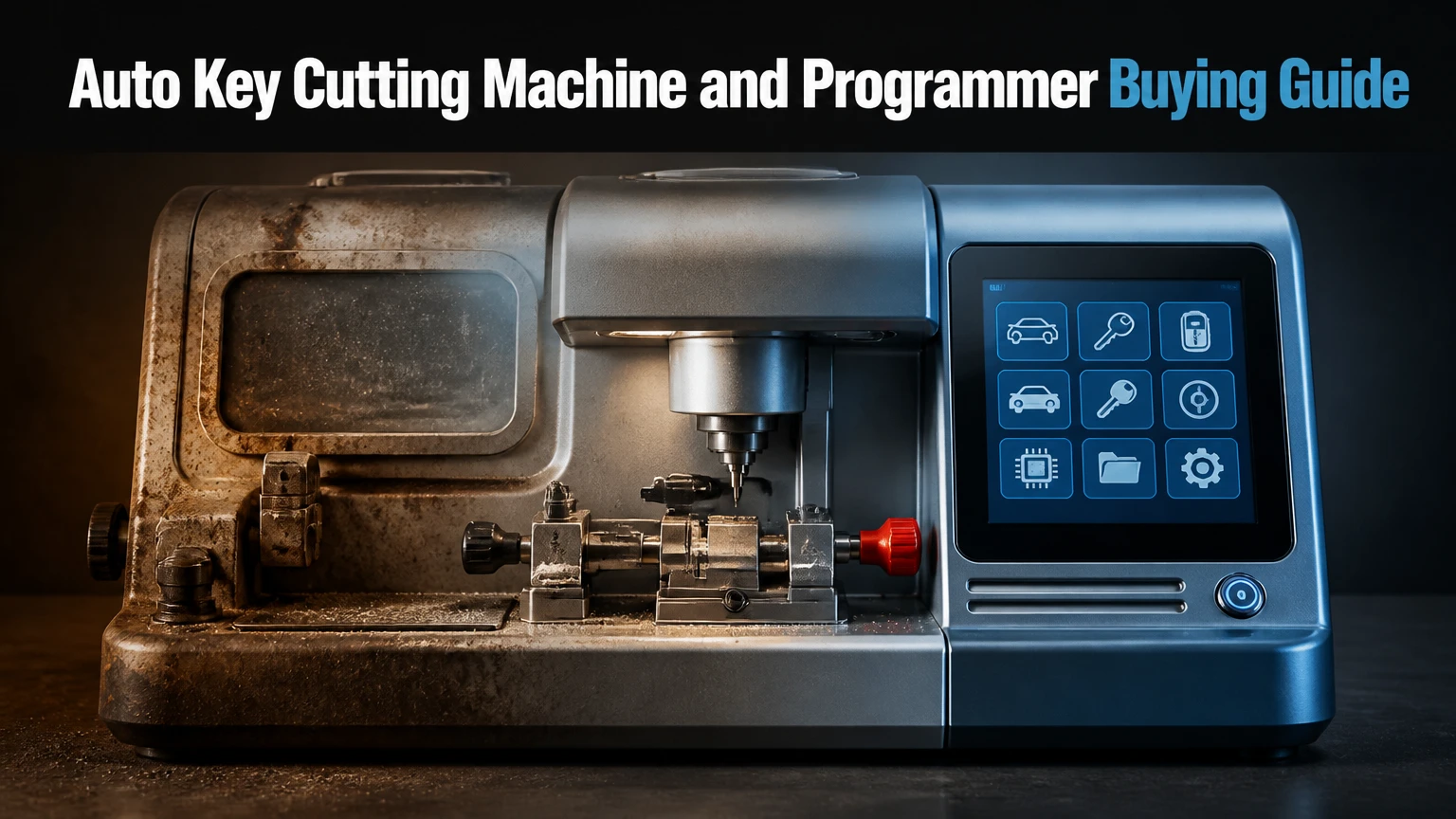
An auto key cutting machine and programmer is a two-part automotive locksmith system that cuts a vehicle key blade and electronically matches an approved transponder or remote to the vehicle. The cutter creates the physical key, while the programmer communicates with the immobilizer, body control module, or related security system.
Key Facts at a Glance
- A key cutter and a key programmer perform different jobs; one cannot reliably replace the other.
- A code-cut key can be made without an original key when the correct manufacturer key code and blade profile are available.
- Remote-button pairing and engine-start authorization are separate functions on many vehicles.
- OBD programming is faster than bench or EEPROM work, but secure gateways and vehicle security generations can block ordinary procedures.
- Typical professional hardware costs $2,500-$6,000 for a general cutter-programmer setup, excluding blanks, tokens, subscriptions, and training.
- Battery stabilization, verified vehicle identification, and lawful proof of authorization matter more than maximum software menu count.
What Is an Auto Key Cutting Machine and Programmer?
An auto key cutting machine and programmer combines physical key origination with electronic vehicle-key registration. Some products integrate both functions in one ecosystem, but most professional locksmiths use a separate automatic cutter and a diagnostic or immobilizer tablet because cutting precision and vehicle coverage are different purchasing decisions.
The cutting machine works with an automotive blank, clamp, cutter, tracer, and software database. It can duplicate an existing key, decode a worn or unworn blade, or generate a key from a valid code. The programmer handles the electronic identity inside a transponder, remote, smart key, or vehicle immobilizer module.
A combined setup is therefore a workflow, not necessarily one box. A compact cutter may support Ford HU101, Honda HON66, Toyota TOY43, or other profiles, while a programmer may support only selected model years, security generations, or regions. Product names alone do not prove compatibility.
What does the cutter actually do?
The cutter creates the blade geometry that allows the key to enter and mechanically operate a lock or ignition. Edge-cut keys use cuts along one edge, whereas laser or sidewinder keys commonly use a milled track through the blade center or side.
Automatic machines use a tracer or electronic decoding process to measure a key, then move the cutter along calculated coordinates. A code-cut operation skips the physical decoding stage and uses a bitting record. The result still depends on the correct blank, clamp, jaw, calibration, and code.
A practical distinction matters: a machine can cut a mechanically perfect key that still cannot start the engine. The transponder may be absent, incompatible, unregistered, locked, or incorrectly configured.
What does the programmer actually do?
The programmer establishes or manages an electronic relationship between a vehicle and an authorized key device. Depending on the vehicle, communication may occur through the OBD-II diagnostic connector, a bench connection to a module, a manufacturer-supported server, or a specialized immobilizer interface.
The immobilizer verifies a transponder response before allowing engine operation. The remote-control portion may separately operate locking, unlocking, trunk release, or panic functions. A vehicle can therefore accept remote buttons while rejecting the transponder, or start the engine while a remote remains unsynchronized.
SAE J1962 defines the widely used 16-pin diagnostic connector, but connector access does not guarantee immobilizer access. A secure gateway, online authorization requirement, unsupported software version, or model-specific procedure can prevent programming through an ordinary diagnostic tablet.
How Does the Complete System Work?
The complete system follows a dependency chain: identify the vehicle, select compatible hardware and blank, cut the blade, prepare the key device, register the immobilizer identity, then test every function. A typical duplicate-key job takes 15-30 minutes when an operating key is available; all-keys-lost work commonly takes 45-120 minutes, depending on vehicle security and access.
Step 1: Verify the vehicle and authorization
Record the exact year, make, model, engine or platform where relevant, market region, key type, and immobilizer generation. Confirm ownership or lawful authorization before cutting or programming, and record the vehicle identification number according to local privacy and locksmithing rules.
Do not rely on a photograph of a key shell. The same model name can use different blade profiles, transponder families, frequencies, or smart-key systems across countries and production dates.
Success checkpoint: the machine and programmer databases display the same vehicle generation and key configuration.
Common mistake: selecting a model by badge alone and ignoring the production month, region, or immobilizer generation.
Step 2: Identify the mechanical data
Use the least-worn reliable source available. An original key, factory key code, lock decoding, or authorized code database can provide the bitting. A heavily worn key may no longer represent the original cuts accurately.
A key code is a manufacturer reference that maps to a particular bitting pattern. Bitting numbers are the individual cut-depth values or positions used to create the blade. Code formats and depth conventions differ by manufacturer, so a number sequence is not universally transferable between machines.
Success checkpoint: the blank profile, jaw selection, cut direction, and bitting record agree.
Common mistake: tracing a rounded key and reproducing its wear, which can cause a new blade to fit one lock poorly or bind another.
Step 3: Cut and inspect the blade
Install the specified automotive blank flush against the clamp stop. Select the correct jaw and cutting mode, then complete the cut using the manufacturer’s calibration and cutter recommendations.
Remove burrs without changing the designed cut geometry. Test the finished blade in the accessible locks and ignition only with appropriate care. A blade that turns a door lock does not automatically prove that it will operate the ignition.
Success checkpoint: the blade enters and rotates smoothly without excessive force, binding, or visible uncut areas.
Common mistake: using an edge-cut jaw for a sidewinder blade. The result can damage the blank, cutter, or clamp.
Step 4: Prepare the electronic key
Confirm that the replacement key contains the correct transponder architecture and remote hardware. Some keys use a separate immobilizer chip, while others integrate the chip into a smart-key circuit board. Universal or cloneable products still require correct frequency, encryption family, and vehicle support.
A 315 MHz or 433 MHz label is only one compatibility attribute. Frequency does not identify the transponder protocol, rolling-code system, regional approval, or immobilizer generation.
Success checkpoint: the programmer identifies the key device or confirms a supported blank type before vehicle registration begins.
Common mistake: assuming that a key with the correct shell and frequency will start every vehicle using that frequency.
Step 5: Register the key through an approved procedure
Connect the programmer using the supported vehicle method and follow the current software instructions. Some vehicles permit a guided add-key procedure; others require security credentials, an online account, a gateway authorization, or a bench method performed by a qualified specialist.
Never interrupt a module write, disconnect the diagnostic cable, or allow the vehicle battery to collapse during a programming operation. Use a suitable battery support unit that matches the vehicle and procedure. The often-repeated 12.2-volt cutoff is not universal, because voltage requirements vary by vehicle and charger; stable voltage within the manufacturer’s specified range is the correct rule.
Success checkpoint: the tool reports completion, the security indicator behaves normally, and the key starts the vehicle or performs its intended function.
Common mistake: treating an “add key” procedure as equivalent to “all keys lost.” The latter may erase or invalidate previously working keys on some systems.
Step 6: Test every function
Test engine authorization, lock and unlock buttons, trunk release, proximity detection, emergency blade operation, warning messages, and the remaining original keys. Confirm that the vehicle does not show an immobilizer or low-battery fault after the procedure.
Document the key type, software version, method used, and final result. Records reduce repeated errors on future jobs and help identify whether a failure is mechanical, electronic, or vehicle-side.
Which Types of Equipment Are Available?
The appropriate equipment type depends on the key profiles, vehicle brands, job volume, and security levels being serviced. No single machine provides universal coverage, especially across newer European vehicles and vehicles with gateway-protected diagnostics.
| Equipment type | Typical capability | Typical price | Best use |
|---|---|---|---|
| Manual duplicator | Traces edge-cut blades | $300-$1,500 | Low-volume duplicate keys |
| Automatic CNC cutter | Code cutting and sidewinder support | $2,000-$7,000 | Mobile and shop origination |
| OBD immobilizer tablet | Guided key registration and diagnostics | $800-$4,500 | Domestic and Asian service work |
| Bench or EEPROM tool | Module-level data work | $1,500-$8,000+ | Specialist, high-security repairs |
| Integrated ecosystem | Cutter, remote generation, software database | $4,000-$12,000+ | Full-service locksmith operations |
Automatic CNC cutters
Xhorse Condor machines, Silca Futura Auto systems, and comparable automatic cutters are designed for repeatable code cutting and broad vehicle databases. Their useful attributes include interchangeable jaws, calibration routines, onboard or connected databases, cutter availability, and support for laser or sidewinder profiles.
A premium database does not eliminate setup errors. Incorrect blank selection, clamp pressure, worn cutters, metal debris, or a machine that has been transported without recalibration can produce inaccurate keys.
Programming tablets and immobilizer tools
Autel MaxiIM IM508S and IM608 II, Xhorse VVDI systems, and TOPDON immobilizer products occupy different capability tiers. Compare supported model years, security functions, online requirements, token policies, cable coverage, battery support, and update terms rather than comparing screen size or the number of menu items.
EEPROM and bench capability requires electronics training, controlled power, data backups, and a recovery plan. It is not a sensible first purchase for a shop that mainly duplicates functioning keys.
Which Setup Should You Buy?
For most general automotive locksmiths, a reliable automatic cutter paired with a midrange immobilizer programmer is more practical than an expensive all-in-one promise. The right combination depends on service territory, dominant vehicle brands, all-keys-lost frequency, and whether the operator can support advanced bench work.
| User profile | Cutter direction | Programmer direction | Typical initial budget | Main limitation |
|---|---|---|---|---|
| Repair shop | Automatic CNC cutter | Autel IM508S-class tablet | $3,000-$7,000 | Limited advanced European coverage |
| Mobile locksmith | Battery-capable compact cutter | Xhorse or Autel mobile platform | $4,000-$10,000 | Power, weather, and inventory constraints |
| General dealership support | High-throughput CNC cutter | Diagnostic tablet with OE access | $6,000-$15,000 | Subscription and account costs |
| European specialist | Silca or comparable precision cutter | IM608 II plus bench capability | $8,000-$20,000+ | Training and module recovery risk |
| Occasional duplicate service | Manual or entry automatic cutter | Outsourced programming | $500-$3,000 | Cannot complete every customer job |
How should a mobile locksmith configure the system?
A mobile operator should prioritize transport stability, internal battery options, compact clamps, offline database access, a clean power source, and inventory coverage for common local vehicles. A cutter that is theoretically portable but requires unstable mains power can create more downtime than a heavier machine with dependable field support.
Carry a battery support unit, spare cutter, blank inventory, OBD cable replacements, lighting, protective covers, and a documented shutdown procedure. Mobile all-keys-lost jobs need more time because vehicle access, authorization, security gateways, and weather all affect the workflow.
Is a premium programmer worth the cost?
A premium programmer becomes worthwhile when supported jobs justify its updates, tokens, cables, training, and recovery equipment. A $3,000 tablet that completes two additional profitable jobs each month may pay back faster than a $10,000 device used only for occasional complex vehicles.
The software coverage list must be checked by exact vehicle and security generation. “All makes” usually means broad menu coverage, not universal support for every year, region, key type, and immobilizer revision.
Automatic CNC Cutter or Manual Duplicator?
Automatic CNC cutters are preferable for code cutting, high-security blades, and repeatable production, while manual duplicators remain useful for inexpensive edge-cut duplicates and shops that value simple operation. A manual machine cannot generate a key from code without another decoding or originating method.
| Criterion | Automatic CNC cutter | Manual duplicator | Practical consequence |
|---|---|---|---|
| Code cutting | Usually supported | Usually unavailable | CNC supports all-keys-lost mechanical work |
| Sidewinder blades | Supported on suitable models | Limited or unavailable | CNC covers more modern profiles |
| Setup time | 2-10 minutes | 1-5 minutes | Manual can be faster for simple duplicates |
| Typical accuracy | Database and calibration dependent | Operator dependent | CNC reduces tracing variation |
| Software dependence | Database and updates required | Minimal | Manual remains usable offline |
| Purchase range | $2,000-$7,000 | $300-$1,500 | CNC needs higher job volume |
A CNC cutter is not automatically better for every job. For a shop cutting a few traditional keys each week, the purchase and update cost may not recover quickly. For code-originated keys, laser profiles, and mobile service, the CNC advantage is substantial.
OBD Programming or Bench Work?
OBD programming is generally faster and involves less vehicle disassembly, but bench work may be necessary when a secure gateway blocks commands, the vehicle module is inaccessible through normal diagnostics, or the supported procedure explicitly requires module-level access. Bench work carries greater risk and should be performed only with suitable training.
| Method | Typical time | Vehicle access | Main risk | Suitable operator |
|---|---|---|---|---|
| Guided OBD add key | 10-30 minutes | Diagnostic connector | Communication loss | Trained general locksmith |
| OBD all keys lost | 30-90 minutes | Diagnostic connector | Key erasure or lockout | Experienced programmer |
| Gateway-authorized OBD | 20-60 minutes | Connector plus authorization | Account or token failure | Registered professional |
| Bench immobilizer work | 1-3 hours | Module removal or harness | Data corruption | Electronics specialist |
| Manufacturer service | 1-3 hours | OE diagnostic environment | Appointment delay | Dealer or authorized repairer |
Modern secure gateways are not simply software annoyances. They are designed to restrict security-related diagnostic commands, and bypass requirements vary by manufacturer, vehicle year, market, and tool. Use authorized access rather than attempting to defeat a vehicle security control.
How Much Does the Equipment and Service Cost?
A practical professional setup typically costs $2,500-$6,000 for a general cutter and programmer combination, while advanced European capability can exceed $15,000 after specialist tools, subscriptions, cables, power equipment, and training are included. Customer pricing varies by vehicle, key type, region, travel, and whether all keys are lost.
| Cost category | Entry range | Professional range | Specialist range |
|---|---|---|---|
| Key cutter | $400-$1,500 | $2,000-$7,000 | $7,000-$12,000 |
| Programmer | $300-$1,200 | $1,000-$4,500 | $5,000-$12,000+ |
| Software updates | $100-$500/year | $300-$1,500/year | $1,500-$3,000+/year |
| Tokens or online access | $10-$30/job | $10-$60/job | $30-$150+/job |
| Battery support | $100-$300 | $250-$800 | $500-$1,500 |
| Training and accessories | $200-$800 | $500-$2,000 | $2,000-$8,000+ |
Typical duplicate-key labor takes 15-30 minutes when the original key works and the vehicle supports a straightforward procedure. All-keys-lost jobs can take 45 minutes to several hours, particularly when a gateway, module removal, remote generation, or manufacturer authorization is involved.
The machine price is only part of ownership cost. Blank inventory, broken cutters, calibration, insurance, database updates, account fees, and failed-job recovery can materially change the break-even point.
What Are the Most Common Failure Modes?
Most failed automotive key jobs result from an identification, power, mechanical setup, or compatibility error rather than a defective programmer. Stopping early is safer than repeating a failed write with a different menu option.
| Symptom | Likely cause | Safe first check | Escalation point |
|---|---|---|---|
| Communication failure | Low voltage, wrong cable, gateway | Battery, cable seating, vehicle selection | Stop before repeated writes |
| Key turns lock but not ignition | Wrong bitting or worn cylinder | Compare code and inspect blade | Re-decode or repair cylinder |
| Shallow or offset cuts | Wrong jaw or calibration | Recalibrate and inspect clamp | Replace damaged cutter |
| Remote works, engine will not start | Transponder not authenticated | Verify chip type and status | Use supported immobilizer procedure |
| Original key stopped working | Erasure or incomplete learning | Check procedure result and key list | Qualified recovery service |
| Programmer freezes | Software, network, or power issue | Stable power and current version | Contact manufacturer support |
One counterintuitive rule matters: a freshly code-cut blade can expose a worn ignition cylinder. A worn duplicate may turn because its rounded cuts match the cylinder’s wear, while a factory-accurate code cut binds against damaged wafers. That situation calls for cylinder diagnosis, not aggressive filing of the new key.
Another practitioner rule is to preserve the customer’s working key whenever possible. Test the replacement before changing any key list, because an unsuccessful programming attempt can create a second problem that did not exist at arrival.
What Should You Check Before Buying?
Use the exact vehicle coverage list, not broad brand claims, as the primary buying document. Request support details for the ten vehicle models most common in your service area, including year ranges, key types, gateway requirements, online credentials, and whether the procedure is add-key, all-keys-lost, bench, or unsupported.
Check these criteria:
- Blade coverage: edge-cut, laser, sidewinder, Tibbe, high-security, and motorcycle profiles.
- Clamp system: included jaws, replacement cost, alignment marks, and support for narrow or thick blanks.
- Database access: offline operation, update frequency, regional coverage, and code availability.
- Immobilizer coverage: transponder families, smart keys, rolling codes, PIN handling, and security generations.
- Power protection: vehicle battery support, tool battery life, write interruption warnings, and recovery procedures.
- Operating cost: annual updates, tokens, cloud accounts, cables, adapters, and proprietary accessories.
- Training: manufacturer manuals, formal courses, technical support, and documented rollback procedures.
- Legal controls: proof-of-ownership policy, data handling, insurance, and local locksmith licensing.
An honest limitation is unavoidable: no universal automotive key machine exists. A cutter database can be excellent while its programmer ecosystem is weak, and a powerful programmer cannot compensate for an inaccurate blade or incompatible blank.
FAQ
Can one machine cut and program every car key?
No. A combined ecosystem may cover many vehicles, but blade profiles, transponder protocols, remote frequencies, immobilizer generations, gateways, and regional rules differ. Verify exact year, model, key type, and security system support before promising a customer that a job can be completed.
Is key programming the same as remote programming?
No. Immobilizer programming authorizes engine starting, while remote programming pairs buttons with locking or convenience functions. Some vehicles combine the processes, but many treat them separately. A functioning remote does not prove that the transponder has passed immobilizer authentication.
Can a new car key be made without the original?
Often, yes, when an authorized key code or supported vehicle data source is available. The cutter still needs the correct blank and profile, and the programmer may require security credentials or a specific all-keys-lost procedure. Vehicle access and proof of authorization remain necessary.
What frequency does my transponder key use?
Frequency alone cannot identify a compatible key. Common remote bands include 315 MHz and 433 MHz, with other regional variants, but protocol, encryption, chip family, board design, and vehicle software also determine compatibility. Use the vehicle-specific tool database and key specification.
Why does a programmed key turn the ignition but not start the engine?
The mechanical blade may be correct while the transponder remains unregistered, locked, incorrectly selected, or incompatible. Check the immobilizer status and chip identification rather than recutting the blade. A blinking security indicator often points toward authentication failure, but the vehicle manual and diagnostic data should guide diagnosis.
Should a beginner buy an EEPROM programmer?
Usually no. EEPROM work involves module removal, circuit-board handling, data backups, controlled power, and recovery from corrupted memory. A beginner serving ordinary duplicate-key jobs should start with supported OBD workflows, formal training, a battery stabilizer, and a clearly limited vehicle coverage list.
Conclusion: Choosing an Auto Key Cutting Machine and Programmer
Choose an auto key cutting machine and programmer as a matched workflow, not as a single universal solution. Prioritize accurate blade coverage, exact vehicle-specific programmer support, stable power, operating costs, training, and lawful authorization; then expand into gateway and bench work only when your job volume and skills justify the additional risk.