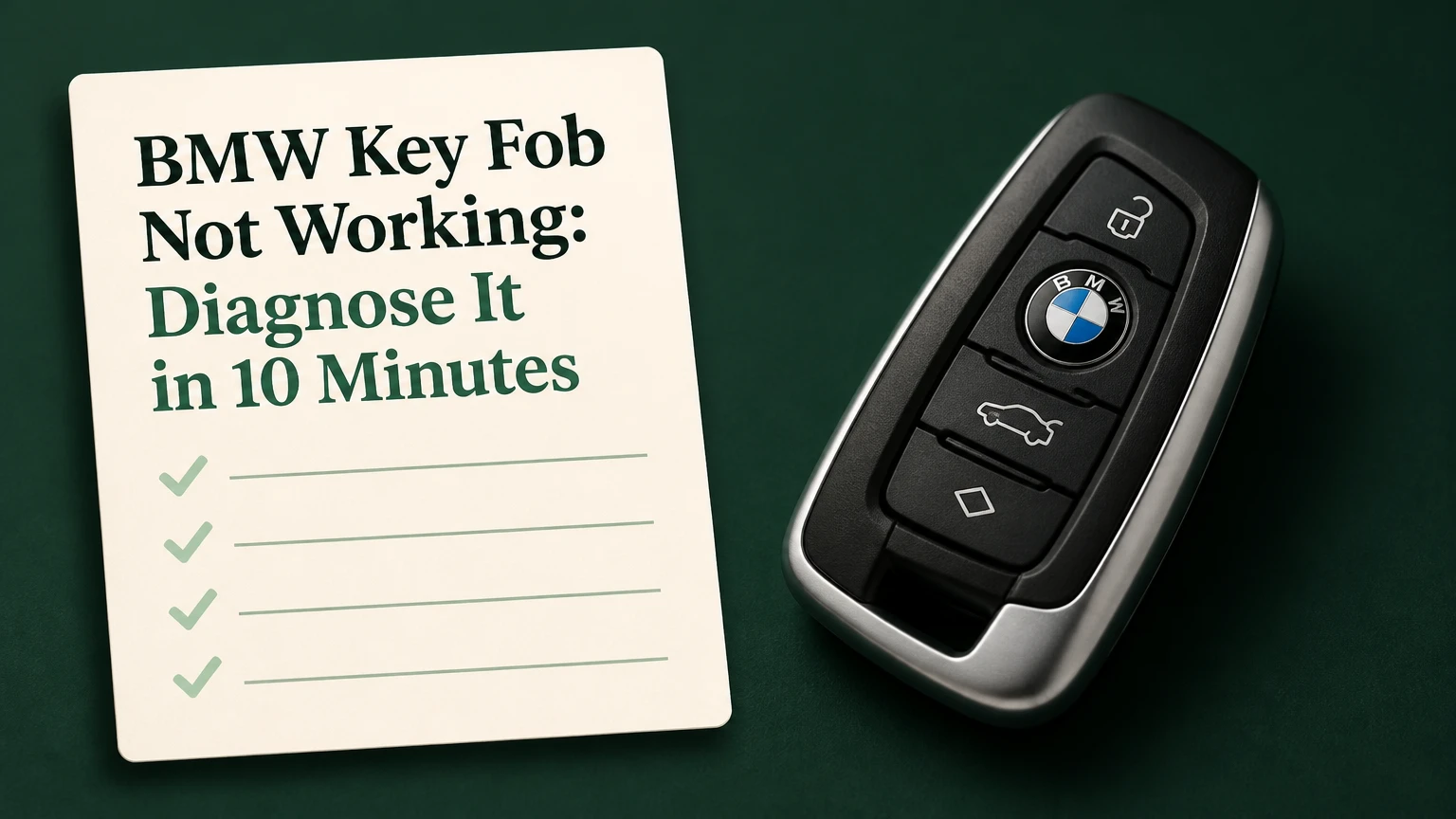
A BMW key fob that is not working usually has a depleted coin-cell battery, lost remote synchronization, damaged switches or circuitry, or a vehicle-side power or receiver fault. Replace the correct battery first, then test manual entry, emergency starting, and a spare key. Those results identify whether the fob, BMW, or programming needs attention.
Key Facts
A BMW key fob battery is commonly a replaceable CR2032 or CR2450, but some older keys use a rechargeable VL2020 cell.
A dead fob battery normally prevents remote locking and unlocking but does not erase the immobilizer key data.
BMW emergency starting usually requires holding the fob against the vehicle’s marked key-recognition area while pressing the brake and Start/Stop button.
If both BMW keys fail simultaneously, investigate the vehicle battery, receiver, antenna, fuse, or body-control module before buying keys.
Older E-series keys may be resynchronized manually, while many F-series and G-series replacements require BMW-capable programming equipment.
Typical replacement costs range from $200-$450 through an automotive locksmith and $400-$900 through a BMW dealer in the United States.
Why Is My BMW Key Fob Not Working?
A BMW key fob stops working for four main reasons: a flat battery, a synchronization problem, physical fob damage, or a fault in the BMW’s access system. The symptom pattern matters more than the key’s appearance. A fob with a working metal blade but no buttons points toward the remote circuit, while two failed keys point toward the car.
Start with the lowest-risk test. Use the spare key, observe whether the dashboard wakes normally, and try the fob immediately after installing the specified battery. Do not order a replacement key until those tests separate a single-key problem from a vehicle problem.
BMW’s remote transmitter sends encrypted radio data to the vehicle. Comfort Access also uses low-frequency proximity antennas, and the immobilizer separately verifies the authorized transponder before allowing the engine to run. These are related systems, but a failure in one does not prove that all three have failed.
What Does Each Button Symptom Mean?
The button symptom provides a useful first diagnosis, although BMW model-year differences prevent it from replacing a scan test.
| Symptom | Most likely area | First test | Likely next action |
|---|---|---|---|
| No lock, unlock, trunk, or light response | Fob battery or circuit | Install specified cell | Inspect contacts and board |
| One button fails | Micro-switch or worn rubber pad | Test remaining buttons | Repair switch or replace fob |
| Remote buttons work, Comfort Access fails | Door handle or LF antenna | Try buttons from 2 meters away | Diagnose Comfort Access system |
| Doors respond, engine will not start | Recognition antenna or immobilizer | Emergency-start procedure | Scan CAS, FEM, or BDC system |
| Both keys fail remotely | Vehicle power or receiver | Check car battery voltage | Test receiver, fuse, and modules |
| Key works after repeated presses | Weak battery or poor contact | Press battery into its clips | Clean contacts or replace holder |
A remote button failure and an engine-start failure should be diagnosed separately. The immobilizer transponder may remain recognized even when the radio transmitter battery is completely flat.
How Does a BMW Key Fob Work?
A BMW key fob combines a radio transmitter, an immobilizer transponder, and, on Comfort Access vehicles, passive proximity functions. The remote buttons communicate with the body electronics, while the immobilizer authorizes starting through a separate vehicle-key exchange.
Remote locking uses an encrypted, changing authorization value rather than one permanently repeated code. BMW systems have used different electronic architectures across generations, including EWS, CAS, FEM, and BDC modules, so programming procedures and component names vary by chassis.
Comfort Access adds low-frequency antennas inside the cabin and around the doors. These antennas detect a nearby authorized key, but a failed door-handle sensor, antenna, or vehicle battery can imitate a dead fob. A BMW Display Key also contains a rechargeable lithium-ion battery and a screen, making its failure pattern different from a basic coin-cell remote.
Why Can a BMW Start With a Dead Fob Battery?
A BMW can often start with a dead fob battery because the passive immobilizer transponder may still be read at close range. The emergency-start location differs by chassis, so the vehicle owner’s manual takes priority over generic internet instructions.
On many push-button BMWs, place the fob against the marked key symbol or designated recognition surface, press the brake or clutch, and press Start/Stop. BMW owner manuals commonly give the instruction, “Hold the remote control against the marked area,” but the marked area and exact wording vary by model.
You will know the test worked when the instrument cluster recognizes the key and the engine starts normally. If the cluster reports that no key is detected even at the marked area, test the spare key and the vehicle battery before assuming that a new coin cell will solve the problem.
What Battery Does a BMW Key Fob Use?
The correct BMW key-fob battery depends on the fob design and chassis, not simply the vehicle’s model name. Common replaceable cells include CR2032 and CR2450, while older diamond keys can contain a soldered rechargeable VL2020.
Check the number printed on the old cell and the polarity marking inside the housing. A CR2032 and CR2450 both provide approximately 3 volts, but they have different thicknesses and capacities. A cell that physically fits poorly can lose contact when the fob is carried in a pocket.
| BMW key style or generation | Typical battery | Charging method | Common fault |
|---|---|---|---|
| E39, E46, E53 diamond key | Rechargeable VL2020 | Inductive charging in ignition | Aged soldered cell |
| E60, E82, E90, E70 Comfort Access key | CR2032 | Manual replacement | Worn micro-switch or clip |
| F10, F15, F25, F30 blade key | CR2450 in many versions | Manual replacement | Water or impact damage |
| G11, G30, G05 Display Key | Internal lithium-ion pack | Qi pad or USB, model-dependent | Charging or screen failure |
The table shows typical configurations, not a universal BMW battery chart. BMW produced multiple key revisions within the same chassis, and regional equipment packages can change the battery type.
How Do You Replace a BMW Key Battery?
Replace a replaceable BMW coin cell in five to ten minutes with the mechanical key blade and a new battery matching the original marking. Keep the circuit board dry, avoid metal tools across the cell contacts, and confirm the positive side orientation before closing the case.
- Press the small release button and pull the internal metal key from the fob.
- Use the blade or a plastic pry tool at the housing seam or battery-cover notch.
- Photograph the old battery orientation before removal.
- Install the same battery number, usually CR2032 or CR2450, with the marked positive side in the documented direction.
- Check that the clips hold the cell firmly and that the case closes without pressure.
- Test lock, unlock, trunk, and panic functions from several feet away.
You will know the replacement succeeded when the vehicle responds consistently to all working buttons. One successful unlock does not prove the repair, because a weak contact or damaged switch can produce intermittent operation.
Use a clean glove or hold the cell by its edges. Skin oil is not usually the primary reason a new lithium coin cell fails, but contamination can affect contacts, especially when the fob already has weak spring tension.
What Should You Check Before Reprogramming the Key?
Check the BMW vehicle battery before reprogramming a key, especially when the dashboard is dim, the interior lights are weak, or several electronic functions are malfunctioning. A low vehicle battery can prevent body-control modules and the central locking receiver from operating normally.
Try the following sequence:
- Unlock the driver’s door with the mechanical blade.
- Switch on the interior lights or ignition.
- Observe whether the instrument cluster illuminates at normal brightness.
- Test the spare key, if available.
- Measure the vehicle battery with a multimeter or have it load-tested.
- Charge the battery with a suitable charger before repeated start attempts.
A healthy resting 12-volt battery often measures approximately 12.6 volts after resting, while readings near 12.0 volts indicate substantial discharge. Exact voltage depends on temperature, battery age, recent charging, and whether the BMW uses an AGM battery. A voltage reading alone does not replace a load test.
BMWs with intelligent battery sensors may also require battery registration after replacement. That procedure does not repair a key fob, but incorrect battery maintenance can create low-voltage faults that confuse the diagnosis.
How Do You Resynchronize an Older BMW Key?
Many older E-series BMWs with an ignition slot can resynchronize an already authorized remote by cycling the ignition and pressing the fob buttons in a specific sequence. The procedure synchronizes remote locking; it does not turn an unknown blank key into a valid immobilizer key.
- Enter the BMW and close all doors.
- Insert a working key into the ignition.
- Turn the key briefly to Position 1, then return it to Position 0.
- Remove the key from the ignition.
- Hold the unlock button on the fob.
- Press the lock button three times within approximately 10 seconds while holding unlock.
- Release unlock and watch for the locks to cycle.
- Repeat the button sequence for every other authorized remote without turning the ignition again.
The central locking system should lock and unlock the doors when synchronization succeeds. If the sequence produces no response, verify the battery, use the correct chassis-specific procedure, and avoid repeating random sequences from another BMW generation.
This method is commonly associated with E46 and E90-era vehicles, but not every E-series configuration responds identically. Many F-series and G-series vehicles do not support owner-performed remote programming through button presses. Replacement keys generally require vehicle-specific diagnostic equipment and security data.
Which BMW Key Problems Need Repair or Replacement?
A BMW key fob needs repair when the battery clips, tactile switches, solder joints, or housing are damaged but the immobilizer and circuit board remain serviceable. A replacement is safer when the board has severe corrosion, the key is lost, the immobilizer data is unavailable, or repair cost approaches a programmed key.
| Failure condition | Repair suitability | Typical time | Typical United States cost |
|---|---|---|---|
| Replaceable CR2032 or CR2450 cell | High | 5-10 minutes | $3-$10 |
| Worn rubber button pad | Moderate | 30-90 minutes | $30-$100 |
| Broken battery clip | Moderate | 30-120 minutes | $60-$180 |
| VL2020 soldered-cell failure | Specialist repair | 1-3 hours | $80-$180 |
| Water-corroded circuit board | Low to moderate | 1-3 days | $100-$250 |
| Lost or unusable programmed key | Replacement required | Same day to 5 days | $200-$900 |
Do not cut open a rechargeable diamond key unless you can safely solder lithium rechargeable cells and protect the board from heat. A poorly installed VL2020 can damage charging circuitry or leave the key unsafe to use.
A key shell replacement changes the plastic housing and metal blade, not necessarily the electronic identity. Moving the original circuit board into a compatible shell can be less expensive than buying a programmed key, but the blade may still require cutting.
How Much Does a BMW Key Replacement Cost?
A BMW key replacement typically costs $200-$450 from a qualified automotive locksmith and $400-$900 from a dealer, with newer Comfort Access and Display Keys often at the higher end. The final price depends on chassis, key type, programming method, location, proof of ownership, and whether all keys are lost.
| Replacement route | Typical price | Typical timeframe | Best fit |
|---|---|---|---|
| BMW dealer, standard key | $400-$700 | 2-5 business days | VIN-matched OEM replacement |
| BMW dealer, Comfort Access or Display Key | $600-$900 | 2-5 business days | Newer G-series security systems |
| European-car locksmith | $200-$450 | 1-3 hours | Faster local replacement |
| Key shell or battery repair | $30-$180 | 30 minutes to 3 hours | Existing electronics still usable |
| Unprogrammed online key | $20-$150 | 2-7 shipping days | Specialist DIY projects only |
Prices are typical United States ranges, not guaranteed quotes. Dealers usually order keys by VIN and require identification and proof of ownership. A reputable locksmith should also verify ownership before cutting or programming a BMW key.
An online key that matches the outer shape may still contain the wrong frequency, transponder type, or security data. A blank key cannot generally be programmed by pressing buttons in the cabin. Ask the seller or locksmith whether the key is new, refurbished, VIN-specific, and compatible with the exact BMW chassis.
Which BMW Key Solution Fits Your Situation?
The correct solution depends on the failed function, the number of affected keys, and the vehicle generation. Battery replacement is the first choice for one dead remote, while a locksmith or dealer is appropriate when the immobilizer, Comfort Access system, or programmed key data is involved.
| Situation | Most likely cause | Recommended action | Avoid |
|---|---|---|---|
| One remote fails, spare works | Battery or fob hardware | Replace cell and inspect board | Buying a vehicle receiver |
| Both remotes fail | Vehicle battery or receiver | Charge and scan BMW | Ordering two replacement keys |
| Remote works, car will not start | Recognition or immobilizer issue | Use marked-area start test | Repeatedly changing coin cells |
| Key was dropped once | Switch, clip, or solder fracture | Inspect housing and contacts | Gluing the case before testing |
| Key was submerged | Board corrosion | Disconnect use and seek repair | Heating with a high-temperature dryer |
| Older diamond key will not hold charge | VL2020 degradation | Specialist rechargeable-cell repair | Installing a CR2032 modification |
| Display Key screen is blank | Discharged internal battery or freeze | Charge on approved pad or USB | Opening the lithium-ion pack |
A practitioner rule is useful here: if the spare key works normally, the BMW is usually not the first component to replace. If neither key works after the vehicle battery is charged, scan the relevant access-control modules before purchasing keys.
What If the BMW Key Got Wet?
Remove the battery if the design allows it, stop pressing buttons, and seek circuit inspection after water exposure. Pressing buttons while moisture bridges the board can turn a recoverable contamination problem into a short-circuit failure.
Do not rely on rice, prolonged sunlight, or a household oven. Surface drying cannot remove corrosion beneath integrated circuits or under switches. A locksmith experienced with BMW electronics can clean and inspect the board, although severe corrosion may make replacement more reliable.
What If Comfort Access Stops Working?
Comfort Access failure with working remote buttons usually indicates a door-handle sensor, low-frequency antenna, vehicle battery, or Comfort Access module problem. Test each door, the trunk, and conventional button locking before diagnosing the fob.
If only one door handle fails, the local handle sensor is more suspicious than the key. If all passive-entry functions fail while buttons work, the vehicle-side antenna network deserves testing. A new fob will not repair a failed door antenna.
What If the Fob Works Only Nearby?
A BMW fob that works only at very short range commonly has a weak battery, poor battery contact, damaged antenna trace, or water-related circuit damage. Replace the battery with the exact specified type, clean accessible contacts with electronics-safe cleaner, and retest outdoors away from strong radio interference.
Do not treat short range as proof of lost programming. Synchronization problems usually produce consistent nonresponse, while a damaged antenna or weak battery often produces distance-sensitive behavior.
Common BMW Key-Fob Mistakes
The most expensive BMW key-fob mistakes involve replacing the wrong component, using an incompatible blank key, or attempting programming on a chassis that does not support the procedure. Correct diagnosis takes less time than recovering from an unnecessary immobilizer or module repair.
- Assuming a flat remote battery erased the key. The remote battery powers buttons and radio transmission; immobilizer authorization is a separate function on many BMW designs.
- Using CR2032 in a CR2450 housing. Both cells are nominally 3 volts, but their dimensions and retention force differ.
- Programming every internet sequence. E-series synchronization instructions do not automatically apply to F-series or G-series BMWs.
- Buying a cheap blank key without checking security compatibility. Matching button count and shell shape does not guarantee matching frequency or immobilizer technology.
- Ignoring the spare-key result. A working spare is one of the strongest isolation tests available to the owner.
- Repeatedly trying to start a low-voltage BMW. Voltage recovery and battery testing should come before repeated immobilizer troubleshooting.
BMW’s official owner information and BMW USA Display Key guidance are more reliable than generic battery charts because BMW changed key designs within model lines. Use the vehicle manual and the number printed on the existing battery as the final authority.
When Should You Call a BMW Locksmith or Dealer?
Call a BMW locksmith when one key is lost or damaged and you need same-day mobile service, provided the locksmith supports the exact EWS, CAS, FEM, or BDC generation. Choose a dealer when the vehicle is newer, all keys are lost, the security system has module faults, or an OEM Display Key is required.
A locksmith should be able to explain the key type, programming method, ownership documents, warranty, and whether the replacement is OEM or aftermarket before work begins. A dealer offers a more standardized VIN-matched process, but typically at a higher price and with several business days of waiting.
Do not attempt an immobilizer repair from a generic online tutorial. Security-module work can disable starting, corrupt vehicle data, or create a larger repair bill when the original problem was only a coin cell.
BMW Key Fob FAQ
Will a BMW start if the key-fob battery is dead?
Usually, a BMW with a dead remote battery can start if the immobilizer transponder and vehicle recognition system remain functional. Hold the fob against the model-specific marked recognition area, press the brake or clutch, and press Start/Stop. The owner’s manual identifies the correct location for that BMW.
Does changing the BMW key battery require reprogramming?
Changing a BMW key battery normally does not require reprogramming. If the remote stopped responding after the change, check polarity, battery contact, housing pressure, and synchronization. Older E-series remotes may require resynchronization, while newer replacement keys generally require diagnostic programming rather than a battery-related reset.
Can I lock my BMW with a dead key fob?
Yes, a BMW can usually be locked manually with the internal metal key. Remove the blade from the fob, unlock the driver’s door through the mechanical lock cylinder, and follow the vehicle manual for securing the remaining doors. Mechanical locking does not prove that remote functions are repaired.
Why does my BMW say the key is not detected?
A BMW may display “key not detected” because of a dead fob battery, poor recognition position, a weak vehicle battery, a damaged key, or a vehicle-side antenna fault. Test the emergency-start location, then try the spare key. If both keys fail, diagnose the vehicle rather than replacing both remotes.
How long does a BMW key-fob battery last?
A replaceable BMW coin cell commonly lasts about two to four years, depending on button use, Comfort Access activity, temperature, and storage conditions. A rechargeable VL2020 key battery can last many years but eventually loses capacity because of age and repeated charging cycles.
Is an aftermarket BMW key safe to buy?
An aftermarket BMW key can be suitable when a qualified locksmith confirms exact chassis, frequency, transponder, and programming compatibility. Cheap listings often omit whether the key is blank, refurbished, or VIN-specific. Confirm ownership requirements, return policy, programming support, and warranty before purchasing.
The Bottom Line
A BMW key fob not working is most often a battery, contact, synchronization, or isolated fob-hardware problem, but two failed keys change the diagnosis toward the vehicle battery, receiver, antenna, or access-control module. Start with the correct CR2032, CR2450, or rechargeable-cell identification, test the spare, and use emergency starting before paying for programming.
For an older E-series key, resynchronization may restore remote locking. For many F-series and G-series BMWs, replacement keys require a dealer or BMW-capable automotive locksmith. Diagnose the failure pattern first, because a five-minute battery test can prevent a $400-$900 replacement.