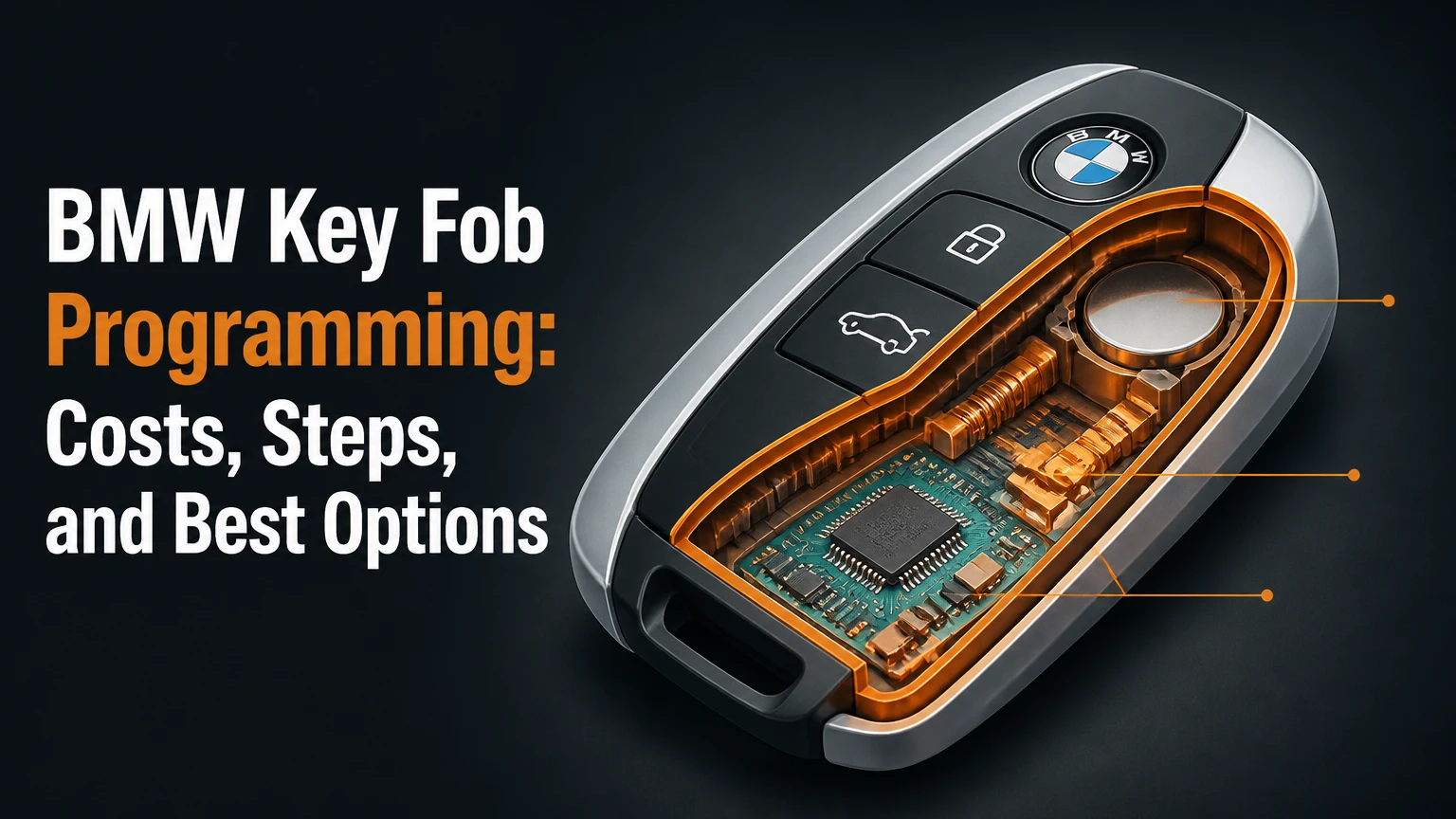
BMW key fob programming pairs a vehicle’s remote-control transmitter and immobilizer credential with the correct BMW security module. Older BMWs may allow owner-level remote synchronization, while most modern F-Series and G-Series vehicles require a compatible new key, diagnostic equipment, and ownership verification.
Key facts
Remote synchronization restores lock, unlock, and trunk-button operation; it does not always authorize engine starting.
E46, E39, and E53 BMW models commonly support a manual remote-initialization sequence when one valid key remains.
Modern CAS, FEM, and BDC systems usually require professional key enrollment rather than a universal button sequence.
A typical independent European automotive locksmith charges about $150-$350 for a replacement and programming service.
A BMW dealership commonly charges about $400-$800 or more, depending on the key, model, market, and labor.
A used BMW key often cannot be reused because its immobilizer credential is cryptographically tied to another vehicle.
What BMW Key Fob Programming Actually Does
BMW key fob programming has two separate jobs: synchronizing the radio remote and authorizing the immobilizer transponder. The remote controls functions such as locking, unlocking, trunk release, and panic alarm; the immobilizer credential permits the Digital Motor Electronics system to enable engine operation.
A BMW can therefore show two different symptoms. The doors may respond while the engine will not start, or the engine may recognize the key while the lock buttons remain inactive. Treating both symptoms as one programming problem leads to unnecessary parts and incorrect procedures.
Remote initialization is owner-manageable on some older E-chassis vehicles. Immobilizer enrollment is different. EWS, CAS, FEM, and BDC modules store security data that generally requires vehicle-specific equipment and a legally verified replacement key.
How BMW key security works
BMW key security combines a passive transponder with a radio-frequency remote. The transponder receives power from the vehicle’s antenna and exchanges an encrypted authentication response; the remote transmitter uses a vehicle-specific rolling-code system to prevent a previously captured button transmission from being reused.
BMW key frequencies vary by market and system. North American vehicles commonly use 315 MHz, while many European vehicles use 433 MHz, but frequency alone does not identify a compatible key. Part number, antenna design, encryption generation, chassis, and regional configuration also matter.
The key does not normally contain a conventional programmable “code” that an owner can type into the car. The vehicle stores authorized key data in its access system, and the correct enrollment process depends on that system’s design.
Which BMW functions are involved?
| Function | Typical BMW component | Key interaction | Common symptom when faulty |
|---|---|---|---|
| Engine authorization | EWS, CAS, FEM, or BDC | Passive transponder authentication | Starter operates, engine does not run |
| Lock and unlock | General Module, CAS, FEM, or BDC | Radio transmitter and rolling code | Engine starts, buttons do not work |
| Comfort Access | CAS, FEM, or BDC plus door antennas | Passive proximity detection | Touch-to-unlock fails |
| Key memory | Access module and diagnostic software | Authorized key slot or credential | New key is rejected |
| Emergency start | Steering-column or dash reader | Short-range transponder reading | Vehicle starts only with key held at reader |
Which BMW Key Type Do You Have?
The BMW chassis and production year provide a useful starting point, but the VIN and installed access module determine the exact procedure. A 2011 BMW may use a different system from another 2011 model, especially across markets and production transitions.
| BMW key style | Common examples | Typical security system | Owner programming outlook |
|---|---|---|---|
| Diamond-shaped key | E46, E39, E53, approximately 1999-2006 | EWS 3 or related EWS systems | Remote synchronization often possible |
| Rectangular slot key | E90, E60, E70, approximately 2006-2011 | CAS 2, CAS 3, or CAS 3+ | Remote sync may be possible; immobilizer work is professional |
| F-series integrated key | F30, F10, F25, approximately 2012-2019 | FEM, BDC, or CAS 4 variants | Usually requires specialized equipment |
| Display or G-series key | G20, G30, G05, G07, approximately 2019 onward | BDC generation-dependent systems | Dealer or high-end locksmith normally required |
Do not order a key from a photograph alone. Two visually identical BMW remotes can use different frequencies, circuit boards, part numbers, or immobilizer generations. A locksmith or dealer should verify the VIN, market, key option, and whether the vehicle has Comfort Access before quoting a final price.
How Do You Program an Older BMW Spare Key?
Older BMW remote synchronization typically takes 5-10 minutes and requires one working key, a closed vehicle, and a second compatible remote. The sequence usually programs the radio buttons, not a lost immobilizer credential, so the new key must still be mechanically and electronically compatible with the vehicle.
The following procedure is commonly associated with many E46, E39, E53, E83, E85, E90, and E60 configurations, but BMW variations exist. Stop if the ignition positions, key shape, or vehicle response do not match.
Before you start
| Requirement | Typical value | Why it matters |
|---|---|---|
| Working key | 1 valid key | Starts the initialization session |
| New remote | 1 compatible BMW key | Must match frequency and system |
| Cabin condition | Doors, trunk, hood closed | Prevents interruption by body-module inputs |
| Timing window | About 30 seconds | New remotes must follow the first key quickly |
| Total time | 5-10 minutes | Includes preparation and testing |
Step 1: Close the vehicle and prepare every key
Sit in the vehicle, close every door, and keep all keys together. Remove other transmitters, aftermarket alarm remotes, and spare keys from the cabin if they might cause confusion.
You will know the setup is correct when the interior is quiet and the instrument cluster shows no open-door warning. A common mistake is leaving the trunk ajar, which can prevent the central locking module from entering the intended initialization state.
Step 2: Cycle the working key
Insert the working key into the ignition. Turn it to Position 1, where accessories activate but the engine remains off, then return it to Position 0 within approximately five seconds and remove the key.
Do not start the engine. The timing begins with the ignition cycle, and a long delay can cancel the sequence.
Step 3: Initialize the working remote
Press and hold the unlock button on the working key. While holding unlock, press the BMW lock button three times in quick succession, then release unlock.
The doors should lock and unlock automatically. That cycle confirms that the vehicle accepted the remote-initialization command. If no cycle occurs, check the key battery, button order, ignition timing, and door-latch status before repeating.
Step 4: Initialize every additional remote
Within about 30 seconds of the confirmation cycle, hold unlock on the next key and press the lock button three times. Release unlock after the three presses, then wait for another lock-unlock cycle.
Repeat the complete remote sequence for every key you want to use during the same session. A practitioner rule is to initialize the known working keys again, even when they already operate, because certain BMW systems may remove remote synchronization from keys omitted from the session.
Step 5: Test each function
Turn the ignition on briefly or close and reopen the driver’s door to end the sequence, depending on the model instructions. Test lock, unlock, trunk release, and engine starting separately.
A successful result means the remote buttons work consistently and the vehicle starts normally. If the remote works but the engine does not start, the problem is immobilizer authorization or key compatibility, not ordinary remote synchronization.
Can You Program a Modern BMW Key at Home?
Most modern BMW replacement keys cannot be fully programmed at home with a button sequence. Holding a key against the steering-column symbol can allow emergency transponder recognition on some F-Series vehicles, but that procedure does not universally create a permanent replacement key or enroll Comfort Access functions.
For an approved emergency-start procedure, place the recognized key at the marked steering-column or dash reader, press the brake, and press the Start/Stop button as instructed by the vehicle manual. The exact reader location varies. Do not assume that a warning disappearing means the new key has been permanently added.
Modern BMW systems can involve CAS, FEM, BDC, encrypted EEPROM data, secure gateway access, and vehicle-specific programming. Tools such as BMW ISTA are designed for authorized diagnostic work, while aftermarket devices vary by chassis and licensing. An incorrect write to FEM or BDC data can leave the vehicle unable to recognize existing keys.
What changes when every key is missing?
All-keys-lost BMW service is substantially different from adding a spare. A manual remote sequence cannot recreate the immobilizer authorization required for starting, and a generic OBD2 scanner cannot safely substitute for key-generation equipment.
A professional normally verifies ownership, identifies the access module, obtains a compatible key, and performs a controlled enrollment or replacement procedure. Some systems require module data access, secure online authorization, or a new key ordered against the VIN. Never accept a service provider’s claim that every BMW key can be “cloned” from a photograph.
What Does Comfort Access Change?
Comfort Access adds proximity detection, so the BMW recognizes a key near the vehicle rather than relying only on button presses. The system uses antennas in areas such as door handles, the cabin, and the luggage compartment, which creates more possible failure points than basic remote locking.
A replacement key must support the vehicle’s Comfort Access hardware and regional configuration. A key that starts the engine and operates its buttons may still fail touch-to-unlock if it lacks the correct passive-entry capability or if an antenna, handle, or key battery is defective.
Comfort Access also increases the value of diagnosis before replacement. If both keys suddenly lose proximity operation but buttons still work, suspect the vehicle-side antenna system or battery condition rather than assuming both keys require programming.
What Are the Costs and Timeframes?
Typical BMW key replacement and programming costs range from $150-$350 through an independent automotive locksmith and $400-$800 or more through a dealership. The final price depends on the key type, whether cutting is needed, whether all keys are lost, Comfort Access hardware, regional labor rates, and OEM key availability.
| Service situation | Typical price | Typical time | Main cost driver |
|---|---|---|---|
| Older remote-only synchronization | $0-$60 DIY | 5-10 minutes | Compatible blank and battery |
| Independent locksmith, spare key | $150-$350 | 30-60 minutes | Key, cutting, mobile programming |
| Independent locksmith, all keys lost | $250-$600+ | 1-3 hours | Security access and module procedure |
| BMW dealership replacement | $400-$800+ | 1-3 business days | VIN-ordered OEM key and labor |
| Display Key or complex BDC service | $600-$1,200+ typical | 1-5 business days | Specialized key and secure programming |
These are typical consumer ranges, not BMW factory prices. A dealer may require the vehicle at the premises, proof of ownership, and an identity document before ordering a key. A mobile locksmith may charge a lower labor price but use an aftermarket remote whose fit, battery life, or Comfort Access behavior differs from an OEM part.
Locksmith or Dealership: Which Is Better?
A qualified European-vehicle locksmith is usually the better value for a conventional spare key, while a BMW dealership is the lower-risk choice for Display Keys, newer BDC systems, lease vehicles, and unusual security faults. The deciding factors are system generation, key availability, ownership documentation, and the technician’s equipment.
| Decision factor | Independent locksmith | BMW dealership | Practical winner |
|---|---|---|---|
| Typical spare-key price | $150-$350 | $400-$800+ | Locksmith |
| Mobile availability | Often on-site in 30-60 minutes | Usually vehicle visit required | Locksmith |
| OEM key certainty | Must be verified before service | Factory VIN ordering | Dealership |
| Modern BDC capability | Depends on equipment and training | Factory diagnostic access | Dealership |
| All-keys-lost service | Often available, $250-$600+ typical | Available with VIN verification | Depends on system |
| Warranty and lease documentation | Provider-specific | Manufacturer service record | Dealership |
| Risk from poor programming | Possible module corruption | Lower with factory procedure | Dealership |
Ask a locksmith for the exact key part number, programming method, warranty period, and whether the quoted price includes cutting, Comfort Access, VAT or sales tax, and emergency service. A low quote that excludes the key or secure gateway fee is not comparable to a dealer quote.
Why Is a BMW Key Not Programming?
A BMW key usually fails to program because the key is incompatible, the battery is depleted, the vehicle is not in the correct initialization state, or the fault is actually in the immobilizer or vehicle-side antenna system. Repeating the same button sequence will not repair a wrong-frequency key or damaged CAS, FEM, or BDC module.
| Symptom | Most likely cause | First check | Correct next action |
|---|---|---|---|
| Buttons do nothing | Dead battery or wrong frequency | Install specified battery | Verify part number and market |
| Remote works, engine will not start | Immobilizer mismatch | Test known working key | Use professional diagnostic service |
| Key starts car, buttons fail | Remote not synchronized | Repeat older-key sequence | Diagnose remote board or receiver |
| Comfort Access fails only | Door antenna, handle, or battery | Test buttons and spare key | Scan Comfort Access components |
| No lock-unlock confirmation | Open latch or failed receiver | Check doors, trunk, hood | Scan body module if sequence remains inactive |
| New key rejected | Used key or full memory | Verify key status and module | Obtain compatible virgin or authorized key |
Expert rules that prevent expensive mistakes
- A fresh battery does not make a used immobilizer key reusable. Battery replacement affects transmission, not cryptographic ownership.
- A key that physically fits the slot is not necessarily electronically compatible. BMW used multiple CAS generations within overlapping model years.
- Do not disconnect or rewrite a FEM or BDC module with unstable voltage. A battery charger designed for programming support reduces voltage-drop risk, but it does not make an unsuitable tool safe.
- Button synchronization cannot clear a blocked or missing immobilizer slot. Diagnostic status must be checked when a vehicle has had many previous keys or an all-keys-lost event.
- Test the old key before buying a new one. If both keys fail the same function simultaneously, the car may be the fault.
Can You Use a Used BMW Key?
A used BMW key is generally unsuitable for direct reuse as a replacement because its immobilizer data may be permanently assigned to the original vehicle. Some specialists can extract or alter data from certain older systems, but compatibility, legality, security risk, and success vary by chassis.
A used shell can be useful when the original electronics remain healthy. Moving a working circuit board into a replacement housing may restore physical buttons and appearance without changing immobilizer data, although the shell must fit the board and blade arrangement.
Avoid sellers who promise that a universal blank will program every E-series or F-series BMW. Before purchase, confirm the original and replacement key part numbers, frequency, button layout, transponder type, Comfort Access support, and return policy.
BMW Digital Key and Other Alternatives
BMW Digital Key can provide phone-based locking and starting on supported vehicles, phones, and equipment packages, but it is not a universal replacement for a physical key. Compatibility depends on the vehicle’s production year, ConnectedDrive configuration, smartphone hardware, region, and active BMW account.
| Alternative | Vehicle requirement | Typical capability | Main limitation |
|---|---|---|---|
| Spare physical key | Compatible BMW access system | Start, lock, unlock | Purchase and enrollment cost |
| BMW Digital Key | Supported BMW and phone | Phone-based entry and start | Model, phone, and account restrictions |
| Digital Key Plus | Supported vehicle with UWB | Passive proximity access | Requires compatible UWB phone |
| Replacement shell | Working original electronics | Restores casing and buttons | Does not create a new key |
| Mechanical emergency blade | Matching lock cylinder | Manual door access | Cannot authorize engine start |
Digital access is useful as a convenience or backup, but retain a physical key for a dead phone, discharged vehicle battery, account problem, or software outage. BMW Digital Key also does not repair a failed CAS, FEM, BDC, antenna, or conventional remote.
What Information Should You Give a Locksmith?
Provide the VIN, model, model year, market, key count, key symptoms, and whether the vehicle starts with any existing key. Include photographs only as supplementary evidence because key appearance does not reliably identify the electronic system.
Use this checklist:
- State the full model, such as 2015 BMW 328i or 2020 BMW X5 xDrive40i.
- Provide the VIN privately through the provider’s secure process.
- Report whether one or more keys still start the engine.
- Separate button failure from starting failure.
- State whether the vehicle has Comfort Access or a Display Key.
- Ask whether the replacement is OEM, aftermarket, new, or previously assigned.
- Request a written total including programming, cutting, travel, tax, and warranty.
- Confirm ownership documents required before arrival.
A reputable provider should ask questions before quoting. A provider who requests immobilizer data without ownership verification presents an avoidable security risk.
FAQ
Does programming a BMW key erase the old key?
Adding a compatible spare does not automatically erase a functioning key from every BMW system. However, older remote-initialization procedures can require all desired remotes to be synchronized in one session, while modern immobilizer enrollment uses system-specific key status. Test every key before leaving the service appointment.
How long does BMW key programming take?
Older remote synchronization commonly takes 5-10 minutes. A locksmith replacement usually takes 30-60 minutes when a working key and compatible replacement are available; all-keys-lost cases commonly take 1-3 hours, while dealer-ordered keys may require 1-3 business days.
Can a dead BMW key battery prevent starting?
A dead battery can stop button transmission and passive Comfort Access, but many BMW keys retain a passive transponder that may still permit starting. Hold the key against the marked emergency reader and follow the vehicle procedure. If the engine still will not start, test another key or arrange immobilizer diagnosis.
Does BMW key fob programming require a code?
The owner normally does not enter a simple security code. Older remotes may use a button sequence, while modern BMW key enrollment uses vehicle-specific security data managed through authorized diagnostic equipment. A PIN-only claim is not a reliable description of current BMW programming.
Can a BMW dealership program an aftermarket key?
A dealership will generally prefer or require a genuine BMW key ordered for the vehicle’s VIN, and policy varies by location. An aftermarket key may operate on some older remote systems, but OEM fit, frequency, encryption, Comfort Access, and warranty support are more predictable.
Should I program a spare before losing my only BMW key?
Yes. Adding a verified spare while one working key remains is usually less expensive and less disruptive than an all-keys-lost service. Confirm that the spare supports the vehicle’s immobilizer and Comfort Access functions, then test engine starting and every remote button before storing it.
The Bottom Line
BMW key fob programming is simple remote synchronization on some older vehicles, but modern key replacement is a security enrollment procedure involving CAS, FEM, BDC, or related modules. Use the manual sequence only when the chassis supports it, do not confuse emergency key recognition with permanent programming, and compare a verified European locksmith quote with the higher-cost dealership option before authorizing work.