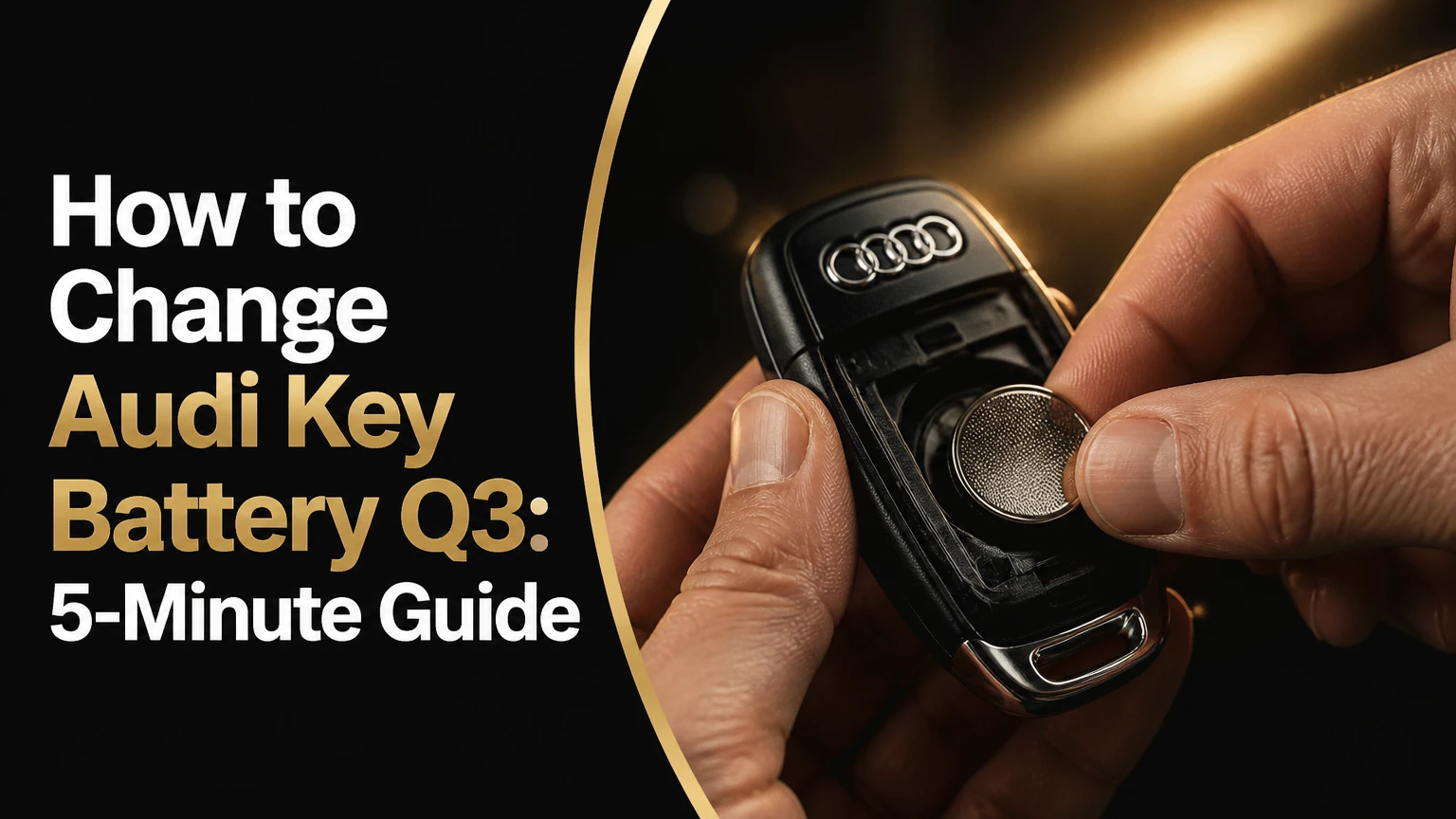
To change an Audi Q3 key battery, identify the fob style, install the same coin-cell specification shown on the old battery or in the owner’s manual, and confirm the positive side orientation. Most Q3 remotes use a 3-volt CR2032, but some key assemblies can differ. The replacement normally takes 3-5 minutes and requires no coding.
Key Facts at a Glance
- Most Audi Q3 key fobs use one 3-volt CR2032 lithium coin cell, but the old battery remains the safest specification check.
- Audi Q3 flip-key remotes open through a notch near the folded metal blade.
- Audi Q3 Advanced Key remotes release the emergency key before the battery tray or rear cover can be removed.
- Battery polarity is normally marked inside the tray or on the battery holder; matching that diagram matters more than assuming the positive side faces upward.
- A battery replacement does not erase the immobilizer transponder or engine-start authorization.
- A new battery will not repair a broken button, corroded circuit board, water damage, or an unprogrammed replacement key.
What You Need Before Starting
Audi Q3 battery replacement is a low-risk task when the correct cell and opening point are confirmed first. The main factor that determines success is not the screwdriver technique, but matching the replacement battery to the exact fob and installing it without bending the contacts.
Place the key on a clean, dry surface. Keep the replacement battery sealed until the fob is open, and do not allow the old and new cells to contact loose metal objects.
| Requirement | Typical specification | Why it matters |
|---|---|---|
| Replacement battery | 1 x 3-volt CR2032, or the exact old-cell type | Prevents incorrect thickness or voltage |
| Small tool | 1 x 2-4 mm flathead screwdriver | Fits the release notch without excessive force |
| Alternative tool | 1 x plastic pry tool or 1 x medium coin | Reduces scratching risk on plastic covers |
| Working time | 3-5 minutes | Covers opening, replacement, and testing |
| DIY cost | $3-$8 per battery pack | Typical retail range in the United States |
| Surface | 1 clean, dry towel | Prevents dropped parts and cosmetic damage |
Inspect the fob before opening it. Photograph the battery orientation if the marking is difficult to read, and write down the battery code printed on the old cell. CR2032 and CR2025 are both 20 mm wide, but the CR2032 is 3.2 mm thick while the CR2025 is 2.5 mm thick, so they are not interchangeable in every holder.
Which Audi Q3 Key Fob Do You Have?
The Audi Q3 key style identifies the opening method, but model year alone does not guarantee the battery design. The first-generation Q3, commonly identified as the 8U, often uses a folding-blade remote; later F3-generation vehicles commonly use an Advanced Key-style remote with a removable emergency key.
Type A: Folding-Blade Remote
A folding-blade Audi Q3 key has a metal blade that pivots out after pressing a release button. The battery cover usually separates through a slot exposed when the blade is extended.
This design is common on many earlier Q3 vehicles, including examples from approximately 2011-2018, although market and equipment differences exist. Do not force the rear shell from the outer seam because the intended release point is normally inside the blade recess.
Type B: Advanced Key Remote
An Audi Q3 Advanced Key remote is flatter and stores a removable emergency key inside its body. A release button, slider, or pair of tabs frees the emergency key, after which the battery tray or rear cover becomes accessible.
Many 2019-and-newer Q3 vehicles use this general arrangement. Some keyless-entry remotes have a sliding tray, while others expose a latch inside the emergency-key channel. The exact release movement can differ even between visually similar keys.
| Fob feature | Likely design | First action | Battery access |
|---|---|---|---|
| Blade pivots outward | Folding-blade remote | Press blade-release button | Notch inside blade recess |
| Blade pulls completely out | Advanced Key remote | Press side or end release | Tray or latch behind key |
| Separate metal key ring | Removable emergency key | Slide or squeeze release | Rear cover after key removal |
| No visible release point | Variant or aftermarket housing | Check manual and fob markings | Do not pry the outer seam first |
If the housing has no obvious notch, compare the fob with the Q3 owner’s manual or inspect the replacement-key instructions for the vehicle’s market. An aftermarket shell can resemble an Audi remote while using a different opening procedure.
How to Change Audi Key Battery Q3
The complete Audi Q3 procedure is: open the correct fob section, remove the old coin cell, install the matching cell with the marked polarity, close the housing, and test every remote function. A folding-blade key usually opens at the blade recess, while an Advanced Key normally requires emergency-key removal first.
Step 1: Prepare and Identify the Battery
Set the replacement battery beside the fob and verify its code. If the old cell says CR2032, use a reputable 3-volt CR2032 from a known battery manufacturer; if it says CR2025, do not substitute automatically.
Use the old battery as an orientation reference. The side marked with a plus sign is the positive face, while the unmarked or smaller face is negative.
Success checkpoint: The replacement code, diameter, thickness, and voltage match the old cell or the Audi documentation.
Common mistake: Buying a CR2032 solely because it is commonly listed for Audi keys. A common specification is not proof for every remote revision.
Step 2: Open a Folding-Blade Q3 Remote
Press the blade-release button and swing the metal key outward. Look into the empty blade channel for a small molded notch, then place the flathead screwdriver or coin into that notch.
Twist gently rather than levering against the painted outer shell. Work around the designed split only if the cover does not release with moderate pressure.
Success checkpoint: The battery cover lifts away without cracking the shell or separating the circuit board from its supports.
Common mistake: Inserting the screwdriver into the decorative seam around the entire fob. That can mark the plastic and damage retaining clips.
Step 3: Open an Advanced Key Remote
Press the emergency-key release and pull the metal key fully out. Look into the channel where the key was stored, then locate the internal latch or tab that releases the battery cover.
On tray-style versions, press the release while sliding the tray out in the direction indicated by the molded arrows. On cover-style versions, press the latch and lift the rear panel from its intended edge.
Success checkpoint: The battery tray or rear cover moves in one guided direction and exposes the coin cell.
Common mistake: Pulling on the emergency key ring as though it were a tray handle. The ring removes the metal key, but it does not necessarily release the battery compartment.
Step 4: Remove the Old Coin Cell
Note the old battery’s positive and negative orientation before removal. Use the screwdriver tip or a fingernail at the holder’s removal notch, applying enough pressure to lift one edge rather than prying against the circuit board.
Avoid touching nearby electronic components. If the cell is stuck, inspect whether a retaining tab is holding it instead of increasing force.
Success checkpoint: The old battery leaves the holder and the metal contacts remain flat, aligned, and attached.
Common mistake: Bending the spring contact upward sharply. A slightly lifted contact may improve pressure, but excessive bending can break the soldered contact or prevent the cover from closing.
Step 5: Install the New Battery
Hold the replacement cell by its edge, or use a clean tissue, and place it into the holder with the polarity shown by the fob. In many Audi remotes the positive side faces outward or upward, but the printed diagram is the deciding reference.
Press the cell down until it sits beneath the retaining lip. Do not force the battery past a tab, and remove any factory sticker from the active face before installation.
Success checkpoint: The coin cell is level, the retaining clip holds it, and the plus marking matches the fob diagram.
Common mistake: Installing the cell upside down or leaving a protective film attached. Both faults can produce a dark LED and a completely inactive remote.
Step 6: Reassemble and Test the Fob
Snap the cover into place evenly, or slide the battery tray fully home until it clicks. Reinsert the emergency key into an Advanced Key remote, then press lock, unlock, and the trunk button from close range.
Test the remote beside the vehicle first. Afterward, test from approximately 10-30 feet away, because a weak signal can appear functional at arm’s length while still indicating a poor battery connection.
Success checkpoint: The red indicator LED flashes and the vehicle responds to at least lock and unlock commands.
Common mistake: Testing only the LED. The LED confirms that the fob has electrical power, but it does not prove that the vehicle receiver, buttons, or radio signal is working correctly.
What Battery Does an Audi Q3 Key Use?
The most common Audi Q3 key battery is a CR2032 3-volt lithium coin cell, but the correct battery is the code printed on the removed cell or specified for the exact remote. Battery type can vary with key supplier, model generation, replacement housing, and regional equipment.
| Battery code | Voltage | Thickness | Q3 replacement guidance |
|---|---|---|---|
| CR2032 | 3 V | 3.2 mm | Common fit for many Q3 remotes |
| CR2025 | 3 V | 2.5 mm | Use only when the fob specifies it |
| CR2016 | 3 V | 1.6 mm | Do not use unless the holder identifies it |
| Two-cell holder | 6 V total | 2 cells | Confirm visually and in Audi documentation |
The diameter of these cells is generally 20 mm, but thickness changes the pressure exerted by the holder. A thinner cell can move inside a holder, while a thicker cell can prevent the cover from closing or stress the contacts.
Coin cells present a swallowing hazard. Keep unused and removed batteries away from children and pets, tape the faces before transport, and use a local battery-recycling collection point rather than placing loose cells in household recycling.
Does Changing the Battery Reprogram the Audi Q3 Key?
Changing the battery normally does not reprogram the Audi Q3 key or erase the immobilizer transponder. The remote may need resynchronization if its buttons stop operating, but the correct procedure depends on the Q3 generation, ignition system, and market.
First, test the key close to the vehicle and start the Q3 normally. If the engine starts but remote locking does not work, the immobilizer is functioning and the remaining problem concerns remote synchronization, battery contact, or the key’s radio circuit.
Some Audi vehicles can resynchronize after a manual lock-and-unlock sequence, while others require an ignition cycle or diagnostic equipment. Procedures copied from another Audi model can be unsuitable for a Q3, especially when a push-button start system replaces a conventional ignition lock.
Use the vehicle’s owner’s manual for the exact pairing sequence. If the manual procedure fails, an Audi dealer or qualified automotive locksmith can check key authorization and radio communication without assuming that another battery is needed.
Why Does the New Q3 Key Battery Not Work?
A new Audi Q3 battery that does not operate the remote usually has incorrect polarity, an unremoved protective film, poor contact pressure, the wrong cell specification, or a damaged key circuit. Check those causes in that order before attempting synchronization.
Use this diagnostic sequence:
- Press a remote button and observe the red LED.
- Confirm the battery code and positive-side orientation.
- Remove any shipping sticker from the battery face.
- Reseat the cell under the retaining clip.
- Inspect the contacts for corrosion, flattening, or breakage.
- Test the spare Q3 key, if available.
- Try the manual procedure in the Audi owner’s manual.
- Obtain a radio and immobilizer check if both keys fail.
| Symptom | Likely cause | First repair | Escalation point |
|---|---|---|---|
| No LED and no remote response | Upside-down cell or poor contact | Reseat and check polarity | Broken holder or circuit |
| LED flashes but car does not respond | Synchronization or radio fault | Follow Q3 manual pairing steps | Locksmith or Audi diagnostic scan |
| Works only within 1-2 feet | Weak cell or shielding | Install a verified fresh cell | Antenna or fob circuit test |
| Buttons feel loose | Worn membrane or switch | Inspect button pad | Replace or repair housing |
| Engine will not start | Immobilizer or key authorization issue | Use emergency-start method | Dealer or automotive locksmith |
| Cover will not close | Wrong thickness or misaligned cell | Verify CR2032 versus CR2025 | Replace damaged holder |
A remote battery cannot restore a broken microswitch or a water-damaged circuit board. If the key was submerged, the LED remains dark with a verified cell, or the housing has cracked around the holder, professional repair is more appropriate than repeated battery changes.
How Do You Start a Q3 With a Dead Key Battery?
An Audi Q3 with a dead key-fob battery can often still be started because the vehicle contains a passive emergency-reading method. Hold the remote at the location identified in the Q3 owner’s manual, typically near the steering-column marking or designated start-button area, while pressing the brake and start control.
The exact emergency-start position varies by Q3 generation and equipment. Some vehicles read the transponder when the key is placed against a marked surface; others use a specific pocket or center-console location.
Use the mechanical emergency key to unlock the driver’s door if the central locking system does not respond. The alarm may sound briefly after manual entry, but placing the authorized key at the vehicle’s reader and switching the ignition on should allow normal authorization.
Do not treat emergency starting as proof that the remote battery replacement succeeded. The passive transponder and the remote-control transmitter are separate functions.
Which Q3 Battery Replacement Option Costs Less?
DIY Audi Q3 battery replacement typically costs $3-$8 and takes 3-5 minutes, while an independent locksmith or repair shop commonly charges $15-$30. Dealer pricing often falls around $50-$150 or more when labor, inspection, or key-related service is included.
These are typical United States ranges, not fixed Audi prices. A replacement key, programming, damaged housing, or diagnostic appointment can cost substantially more than a simple coin-cell change.
| Service option | Typical cost | Typical time | Best use |
|---|---|---|---|
| DIY battery swap | $3-$8 | 3-5 minutes | Correct cell and intact housing |
| Independent repair shop | $15-$30 | 10-20 minutes | Assistance opening a difficult fob |
| Automotive locksmith | $20-$60 | 15-30 minutes | Battery plus remote testing |
| Audi dealership battery service | $50-$150+ | 20-60 minutes | Official inspection or uncertain key fault |
| New programmed key | $200-$600+ | 1-3 hours | Lost, damaged, or unauthorized key |
DIY is the sensible choice when the fob opens cleanly and the old battery specification is visible. A locksmith becomes more valuable when the shell is damaged, both remote keys fail, or the vehicle requires key authorization rather than a battery swap.
When Should You Replace the Whole Key?
Replace or professionally repair the Audi Q3 key when a verified battery does not restore the LED or remote function, the circuit board shows corrosion, the button switches are damaged, or the key housing cannot retain the battery. A battery change addresses power, not structural or electronic failure.
A replacement shell may solve broken clips, worn rubber buttons, or a cracked case if the original circuit board and transponder are transferred correctly. A complete programmed key is required when the electronic module or immobilizer authorization is missing.
Keep both original keys available during service. Some diagnostic and replacement-key procedures require the vehicle and all existing keys to be present, and losing the remaining working key can increase cost and downtime.
Common Mistakes and Expert Checks
Experienced key technicians use a few simple rules that prevent most failed Audi Q3 battery swaps:
- Read the old cell before buying. Model-year charts are useful shortcuts, but the physical fob and installed battery resolve ambiguity.
- Use the intended notch. Scratches usually come from prying at the decorative perimeter rather than the molded release point.
- Do not stack coin cells. A holder designed for one 3-volt cell should never receive two batteries because the resulting voltage can damage electronics.
- Check contact geometry. A battery that sits low, rocks in the tray, or loses function when the fob is squeezed has a mechanical contact problem.
- Separate remote failure from start authorization. A Q3 that starts but will not lock remotely has a different fault path from a Q3 that does not recognize the key.
- Avoid metal short circuits. Keep the screwdriver from bridging both battery faces or touching multiple board contacts at once.
The most counterintuitive point is that a newly installed battery can measure 3 volts with a multimeter and still fail under load if it is old, counterfeit, or poorly connected. Testing the fob LED and vehicle response provides more useful evidence than voltage alone.
FAQ
How often does an Audi Q3 key battery need replacement?
An Audi Q3 key battery commonly lasts two to four years under typical use, but frequent button presses, passive keyless-entry activity, cold temperatures, and storage near the vehicle can shorten that interval. Replace the cell when range declines, the remote works intermittently, or the Q3 displays a key-battery warning.
Can I use a rechargeable battery in an Audi Q3 key?
Do not substitute a rechargeable coin cell unless the fob documentation specifically approves it. Audi Q3 remotes are designed around a 3-volt lithium coin-cell specification, while rechargeable alternatives can have different voltage behavior, capacity, and charging requirements.
Why does the Q3 key work after warming the battery?
Cold temperatures reduce the available output of a coin cell, so a marginal Audi Q3 battery may work briefly after warming in a pocket. Warming does not repair the cell. Replace it with a fresh battery of the correct type and verify the holder contacts.
Will a new battery increase the key-fob range?
A fresh battery can restore normal Audi Q3 remote range when the old cell has low capacity or poor load performance. It cannot increase range beyond the vehicle’s designed radio performance, and short range after replacement points toward interference, a damaged antenna, or a fob circuit fault.
Can a locksmith change an Audi Q3 key battery?
An automotive locksmith can replace an Audi Q3 coin cell and test the remote, often at a lower typical cost than a dealership. Locksmith service is particularly useful when the fob housing is difficult to open, the remote needs synchronization, or the vehicle does not recognize the key after replacement.
What should I do if I lose the emergency key?
If the Audi Q3 emergency key is missing, use the spare key if available and order a correctly cut replacement through an Audi dealer or qualified automotive locksmith. A replacement mechanical blade may unlock the door, but it does not automatically provide remote functions or immobilizer authorization.
The Bottom Line
To change Audi key battery Q3, match the old coin-cell specification, open the fob through its designated release point, install the battery with the marked polarity, and test both remote commands and vehicle starting. Most jobs take 3-5 minutes and cost $3-$8. If the LED remains dark or the engine cannot authorize the key, the problem is probably beyond the battery.