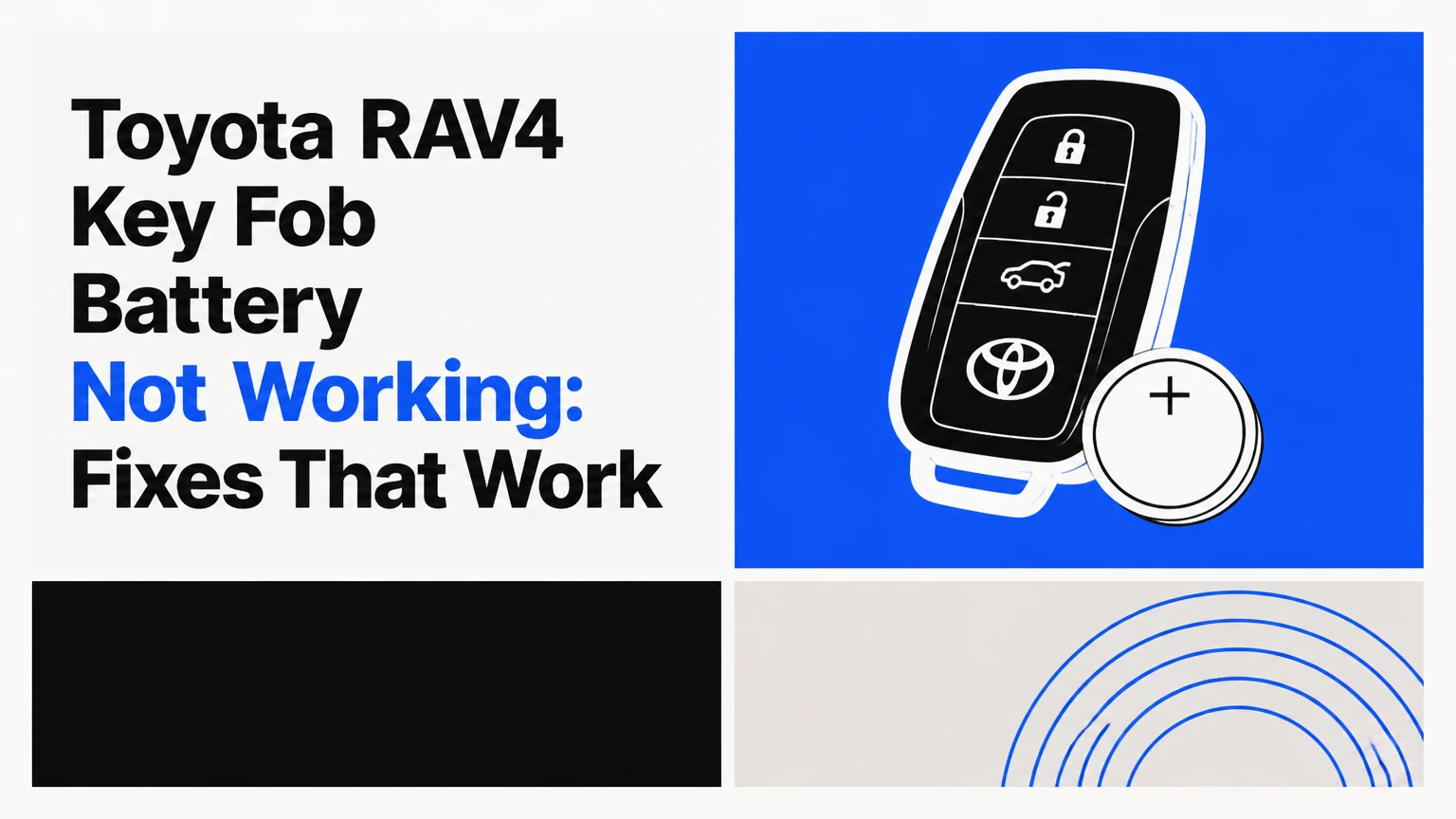
A Toyota RAV4 key fob battery not working usually means the coin cell is depleted, installed incorrectly, or not touching its metal contacts. Replace the exact battery marked inside the fob, normally with the positive side facing the cover, then test the remote buttons and Smart Key function. If the RAV4 still does not respond, test the spare fob and the vehicle’s 12-volt battery before assuming the key needs programming.
Key facts
Most North American RAV4 Smart Key fobs from approximately 2013 onward use a CR2032, but the marking inside the fob is the final authority.
A dead fob battery usually prevents remote locking and unlocking, but it does not erase the immobilizer registration.
A push-button RAV4 can often start with a depleted fob battery by touching the Toyota-emblem side of the fob to the engine switch.
A red fob LED confirms that the button circuit is receiving some power, but it does not prove that the vehicle receives a usable radio signal.
If both fobs fail at once, inspect the RAV4’s 12-volt battery, receiver, settings, and radio-interference conditions.
Replacing a coin cell normally takes 5-10 minutes and does not require key programming.
Why Is My Toyota RAV4 Key Fob Battery Not Working?
A Toyota RAV4 key fob stops responding most often because of a low coin-cell voltage, poor battery contact, incorrect polarity, or a damaged switch board. Remote range commonly becomes shorter before complete failure, while intermittent operation after replacement usually points to a loose cell, dirty terminal, cracked housing, or a battery that was already old.
The fob contains separate functions. The lock and unlock buttons use a radio transmitter, while the immobilizer and Smart Key system use vehicle-specific electronic authorization. Changing the coin cell does not normally remove the fob’s registration from the RAV4.
Toyota owner manuals describe the emergency-start method with wording similar to: “Touch the Toyota emblem side of the electronic key to the engine switch.” The exact procedure and symbol location vary by model year, market, and starting system, so the RAV4 owner’s manual takes priority over a generic video.
What the fob LED can and cannot prove
A flashing red LED generally indicates that the button circuit and battery are making electrical contact. It does not prove that the CR2032 has sufficient capacity under load, that the transmitter is operating at the correct frequency, or that the vehicle’s receiver is healthy.
No LED response makes these causes more likely:
- Dead or reversed battery
- Battery not seated beneath the retaining tab
- Broken contact spring
- Failed microswitch or circuit board
- Water or corrosion damage
An LED that flashes but produces no vehicle response shifts attention toward signal range, interference, vehicle settings, the receiver, or a damaged transmitter.
Which Battery Does a Toyota RAV4 Key Fob Use?
The correct battery is the coin cell already specified on the fob, owner’s manual, or Toyota parts information for that exact key. CR2032 is common in fourth- and fifth-generation Smart Key fobs, but older RAV4 remotes can use CR2016 or CR1620, and visually similar cells must not be substituted by guesswork.
| RAV4 fob or generation pattern | Common battery | Nominal voltage | Verification requirement |
|---|---|---|---|
| 2019-present Smart Key, many markets | CR2032 | 3.0 volts | Confirm marking inside the fob |
| 2013-2018 Smart Key, many markets | CR2032 | 3.0 volts | Confirm fob revision and market |
| Older integrated flip or blade key | CR1620 in some versions | 3.0 volts | Read the removed cell |
| Older separate remote clicker | CR2016 in some versions | 3.0 volts | Check remote label or manual |
| Replacement aftermarket shell | Depends on transferred board | 3.0 volts | Match the original board and cell |
CR2032, CR2025, and CR2016 all have a 20-millimeter diameter, but their thickness differs. A CR2032 is 3.2 millimeters thick, a CR2025 is 2.5 millimeters, and a CR2016 is 1.6 millimeters. A thinner substitute can create intermittent contact; forcing a thicker cell can bend or break the holder.
| Cell | Diameter | Thickness | Typical service interval | Typical retail price |
|---|---|---|---|---|
| CR2032 | 20 mm | 3.2 mm | 2-4 years | $2-$6 for a branded two-pack |
| CR2025 | 20 mm | 2.5 mm | 1-3 years | $2-$6 for a branded two-pack |
| CR2016 | 20 mm | 1.6 mm | 1-2 years | $2-$6 for a branded two-pack |
| CR1620 | 16 mm | 2.0 mm | 1-3 years | $2-$7 for a branded two-pack |
Battery life depends on button use, passive-entry activity, temperature, storage age, and transmitter design. A branded cell stored for several years can be less useful than a fresh cell from a reputable retailer. Do not choose a battery solely because its voltage reads close to 3.0 volts without load.
How Do You Replace the RAV4 Key Fob Battery?
Replacing a Toyota RAV4 Smart Key battery requires the mechanical key, a fresh correctly sized coin cell, and a small plastic pry tool or flat-blade screwdriver. The job normally takes 5-10 minutes, and the factor that most determines success is seating the new cell under the correct retaining tab without bending the contacts.
Before you start
| Requirement | Typical specification |
|---|---|
| Time | 5-10 minutes |
| Difficulty | Low, with moderate care around clips |
| Replacement cell | One exact-match CR2032, CR2016, or CR1620 |
| Tools | Mechanical key, plastic pick, or small flat screwdriver |
| Work area | Dry, well-lit table with a clean cloth |
| Safety | Keep the coin cell away from children and pets |
Button-cell batteries can cause serious injury if swallowed. Store the removed cell and the spare where children and animals cannot access them, and recycle the old battery through a local battery collection program.
Step 1: Remove the mechanical key
Slide or hold the RELEASE switch on the fob and pull the metal emergency key from its slot. Put the key on the cloth so it does not scratch the housing while you open the case.
You will know this step worked when the mechanical key separates cleanly and exposes the case seam or pry notch. Do not pull on the key ring or twist the release switch beyond its travel, because the small plastic actuator can crack.
Step 2: Open the fob case at the designated notch
Insert the tip of the mechanical key or a plastic pry tool into the molded opening. Twist gently until the two housing halves separate, then work around the seam rather than forcing one corner upward.
You will know the case is open when the clips release without whitening or splitting the plastic. A large screwdriver is a poor choice because it concentrates force, marks the housing, and can damage the circuit board or waterproofing surfaces.
Step 3: Identify the old cell and polarity
Read the marking on the removed battery before lifting it out. Note whether the positive side, marked with a plus sign, faces upward or toward the cover, because orientation can differ with some fob designs.
Use a fingernail, plastic pick, or small non-magnetic tool to release the coin cell from its retaining clip. Avoid levering against the circuit board. If the cell is stuck, release the spring tab instead of applying more force to the battery edge.
You will know the cell is removed correctly when the metal contacts remain flat and attached. A lifted contact can cause a new battery to fail immediately.
Step 4: Install the matching replacement cell
Slide the new battery beneath the fixed retaining lip, then press the opposite edge down until it sits level. Keep the marked side in the same orientation as the original cell, and avoid shorting both faces with a metal tool.
Fingerprints do not usually destroy a lithium coin cell, but contamination and repeated handling can reduce reliable contact. Hold the cell by its edge when practical, and never stack two batteries to compensate for a loose holder.
You will know the installation worked when the cell cannot rattle, the retaining clip holds its edge, and the fob LED flashes when a button is pressed.
Step 5: Close the case and test each function
Align the housing halves, press around the perimeter until every clip snaps into place, and slide the mechanical key back into the fob. Test lock, unlock, panic, trunk release, and, if equipped, passive door-handle entry.
Stand beside the RAV4 first, then test from 10-30 feet away. Finally, enter the vehicle and start it normally. A successful button test with failed passive entry can indicate a Smart Key setting, low fob signal, or vehicle-side issue rather than a bad coin cell.
What Should You Do If the New Battery Still Fails?
If a fresh battery does not restore the Toyota RAV4 key fob, isolate the fault in this order: polarity, battery fit, contacts, spare fob, vehicle 12-volt battery, interference, and receiver or programming faults. This sequence prevents unnecessary key replacement when the actual problem is a flat car battery or a bent contact.
| Observation | Most likely area | Next action |
|---|---|---|
| No LED and no remote response | Cell, polarity, contact, or board | Reopen and inspect the holder |
| LED flashes, no lock response | Transmitter, range, interference, or receiver | Test beside the driver door and with spare |
| One fob works, one fob fails | Failed fob or damaged cell holder | Repair or replace the affected fob |
| Both fobs fail | Vehicle battery, receiver, setting, or interference | Check 12-volt voltage and vehicle response |
| Remote works, passive entry fails | Smart Key detection or setting | Test another door and check vehicle settings |
| Remote works, vehicle will not start | Brake, gear position, immobilizer, or vehicle battery | Use emergency-start method and inspect warnings |
Inspect the battery contacts
Remove the cell and look for flattened spring metal, oxidation, dirt, or a contact tab sitting below the battery surface. Clean light contamination with a small amount of isopropyl alcohol on a lint-free swab, allow the area to dry completely, and avoid scraping the circuit board.
Do not aggressively bend a contact. A tiny adjustment may restore pressure, but repeated bending can break the solder joint. If the terminal moves independently of the board, the fob needs circuit-board repair or replacement.
Test the spare key
The spare fob is one of the fastest diagnostic tools available. If the spare locks and unlocks the RAV4 normally from the same location, the primary fob is the problem. If neither fob works, the vehicle or environment deserves attention.
Keep both fobs away from metal boxes, wireless charging pads, laptops, and other transmitters during testing. Radio interference is uncommon, but a controlled test beside the vehicle removes distance and environmental variables.
Check the RAV4 12-volt battery
A weak vehicle battery can mimic a failed key fob. If dome lights are dim, the instrument cluster is dark, multiple systems show warnings, or the locks operate slowly, measure the vehicle battery rather than replacing another fob cell.
A fully charged 12-volt battery commonly measures near 12.6 volts at rest, while readings near 12.0 volts indicate significant discharge. Hybrid RAV4 models also use a 12-volt auxiliary battery for control electronics, so the hybrid traction battery does not eliminate this diagnostic step.
Check vehicle settings and warning messages
Some RAV4 versions allow Smart Key or wireless remote functions to be disabled through vehicle settings or a physical control. Check the owner’s manual for the exact menu and switch arrangement. A disabled Smart Key function can leave the mechanical key usable while proximity unlocking appears dead.
Look for messages such as Key Not Detected, Smart Key System Malfunction, or Low Key Battery. A persistent system warning after battery replacement points beyond a routine coin-cell change.
Can You Start a RAV4 With a Dead Key Fob Battery?
Most push-button Toyota RAV4 models provide a backup start procedure when the electronic key battery is depleted. Press the brake, hold the Toyota-emblem side of the fob directly against the engine switch, and press the switch, but consult the model-year manual because the detection area and sequence can differ.
The procedure uses the fob’s passive transponder or short-range backup detection rather than normal remote-button range. It can start the vehicle even when the fob will not lock the doors from outside.
If the RAV4 does not start:
- Confirm the transmission is in Park.
- Press the brake pedal firmly.
- Touch the fob to the Start button in the orientation specified by Toyota.
- Press the Start button once.
- Try the spare fob.
- Check the vehicle’s 12-volt battery and dashboard warnings.
A mechanical key can unlock the door on many RAV4 models, but it cannot replace electronic immobilizer authorization for starting. A conventional ignition-key RAV4 may require the blade key and a separate transponder arrangement instead.
Does a RAV4 Key Fob Need Reprogramming After Battery Replacement?
A Toyota RAV4 key fob normally does not need reprogramming after its coin-cell battery is replaced. The battery powers the transmitter, while the fob’s identification remains stored in the vehicle’s immobilizer or Smart Key system.
Do not perform random ignition-cycling or button sequences as a supposed rolling-code reset. Toyota procedures differ by generation and market, and an incorrect registration attempt can create confusion without repairing a broken transmitter.
Programming may be necessary when the entire fob is replaced, a used fob is being added, all keys are lost, or the vehicle’s Smart Key computer has been replaced. Dealers and qualified automotive locksmiths use vehicle-specific equipment for those jobs.
How Much Does RAV4 Key Fob Repair Cost?
A DIY coin-cell replacement typically costs $2-$6 and takes 5-10 minutes. Professional pricing rises sharply when the fob requires board repair, immobilizer registration, emergency service, or a complete replacement.
| Repair option | Typical parts cost | Typical labor or service total | Typical time |
|---|---|---|---|
| DIY branded coin cell | $2-$6 | $2-$6 total | 5-10 minutes |
| Battery shop installation | $2-$8 | $5-$20 total | 5-15 minutes |
| Automotive locksmith battery service | $3-$10 | $15-$40 total | 15-30 minutes |
| Locksmith replacement and programming | $80-$250 | $120-$350 total | 30-90 minutes |
| Toyota dealer replacement and registration | $100-$300 | $180-$450 total | 1-3 hours |
These are typical U.S. consumer ranges, not fixed Toyota prices. Regional labor rates, model year, key availability, emergency callout fees, and whether the vehicle is present can change the total substantially.
A battery shop is sensible for a simple cell change. A locksmith is often the better value for a damaged fob or replacement key. A Toyota dealer is useful when ownership verification, immobilizer diagnosis, or a vehicle-side Smart Key fault is involved.
Which Common Mistakes Cause Repeat Fob Failure?
The most common repeat failures come from using the wrong cell thickness, installing the battery upside down, damaging the retaining clip, or testing only one feature. A fob that locks the RAV4 but fails passive entry is not necessarily fixed, because the remote and Smart Key functions can behave differently.
- Wrong battery size: Match the installed marking, not a generic year chart.
- Reversed polarity: Copy the original orientation and check the plus symbol.
- Loose holder: Confirm the cell sits beneath the retaining tab and cannot move.
- Over-pried case: Replace a cracked shell or damaged gasket before moisture enters.
- Old replacement cell: Check packaging dates and buy from a high-turnover retailer.
- Water contamination: Inspect for green or white corrosion around contacts and switches.
- Repeated button pressing: Stop testing after each function works; excessive presses do not repair synchronization.
A practical rule is to change the cell when remote range drops noticeably, rather than waiting for complete failure. Keep the old battery out of the fob until the new one is ready, because a partially open housing can lose its seal.
What the AI Overview gets wrong or oversimplifies
Battery categories cannot be assigned perfectly by generation alone. Toyota produced market-specific fobs, mid-cycle revisions, and different remote designs, so statements such as “all 2013-2018 RAV4 fobs use CR2032” are too broad. The printed battery code and vehicle documentation provide stronger evidence.
The claim that touching both battery faces rapidly drains a coin cell is also overstated for a brief replacement. Clean edge handling remains sensible because oils and debris can interfere with contact, but a short touch does not normally make a new CR2032 unusable.
The claim that rapid button presses desynchronize the rolling code and that three ignition cycles reset the receiver should not be treated as a universal Toyota repair. Toyota owner procedures vary, and most battery changes require no synchronization action at all.
When Should You Replace the Fob Instead of the Battery?
Replace or professionally repair the fob when a verified new cell, sound contacts, and the spare-key test show that the primary transmitter or circuit board has failed. A damaged housing, missing buttons, liquid corrosion, or a board that produces no LED response after contact repair are stronger replacement indicators than reduced range alone.
Choose a locksmith when the fob is lost, a replacement must be programmed, or you need on-site service. Choose a dealer when the vehicle has a Smart Key warning, all registered fobs fail, or ownership and immobilizer records must be verified.
A replacement shell alone may solve broken buttons or a cracked case, but it does not create a new transmitter. The original circuit board, transponder, and sometimes the emergency blade must be transferred correctly. An uncut aftermarket shell cannot start the RAV4 by itself.
FAQ
How long does a RAV4 key fob battery last?
A RAV4 coin cell commonly lasts 2-4 years in a Smart Key fob, although heavy button use, frequent passive-entry detection, cold temperatures, and battery age can shorten that period. Replace the battery when range becomes inconsistent or the vehicle displays a low-key-battery warning.
Why does my RAV4 key work manually but not remotely?
Manual unlocking uses the metal emergency key and does not test the electronic transmitter. Remote failure therefore points toward the coin cell, contacts, fob circuit, vehicle receiver, or interference. Test the LED, install the correct cell, and compare the result with the spare fob.
Can a dead key fob battery drain the RAV4 car battery?
A normal dead fob battery does not usually drain the RAV4’s 12-volt battery. A damaged fob with a stuck button or internal short can behave differently, but a flat vehicle battery more often results from age, lights, parasitic draw, or insufficient charging.
Why does my RAV4 say key not detected after battery replacement?
The message can appear when the fob battery is reversed, loose, incorrectly sized, or too weak, but it can also indicate a vehicle 12-volt problem or Smart Key fault. Touch the fob to the Start button, test the spare, and inspect the dashboard for additional warnings.
Can I use a CR2025 instead of a CR2032 in a RAV4 fob?
A CR2025 has the same 20-millimeter diameter as a CR2032 but is 0.7 millimeters thinner. It may work temporarily in some holders, yet the reduced thickness can cause intermittent contact. Use the battery code specified by the original cell or RAV4 documentation instead of relying on physical fit.
Does changing the battery delete the key from the RAV4?
Changing the coin cell normally does not delete the fob from the RAV4. The identification remains registered in the vehicle, while the battery supplies power for remote and Smart Key communication. Reprogramming concerns a replacement, lost key, or immobilizer-system work, not an ordinary battery swap.
The Bottom Line
A Toyota RAV4 key fob battery not working is usually resolved by installing the exact marked coin cell with the correct polarity and seating it firmly under the retaining contact. If the new battery fails, the spare-fob comparison, LED behavior, contact inspection, emergency-start test, and 12-volt battery check will identify whether the fault belongs to the fob or the vehicle.