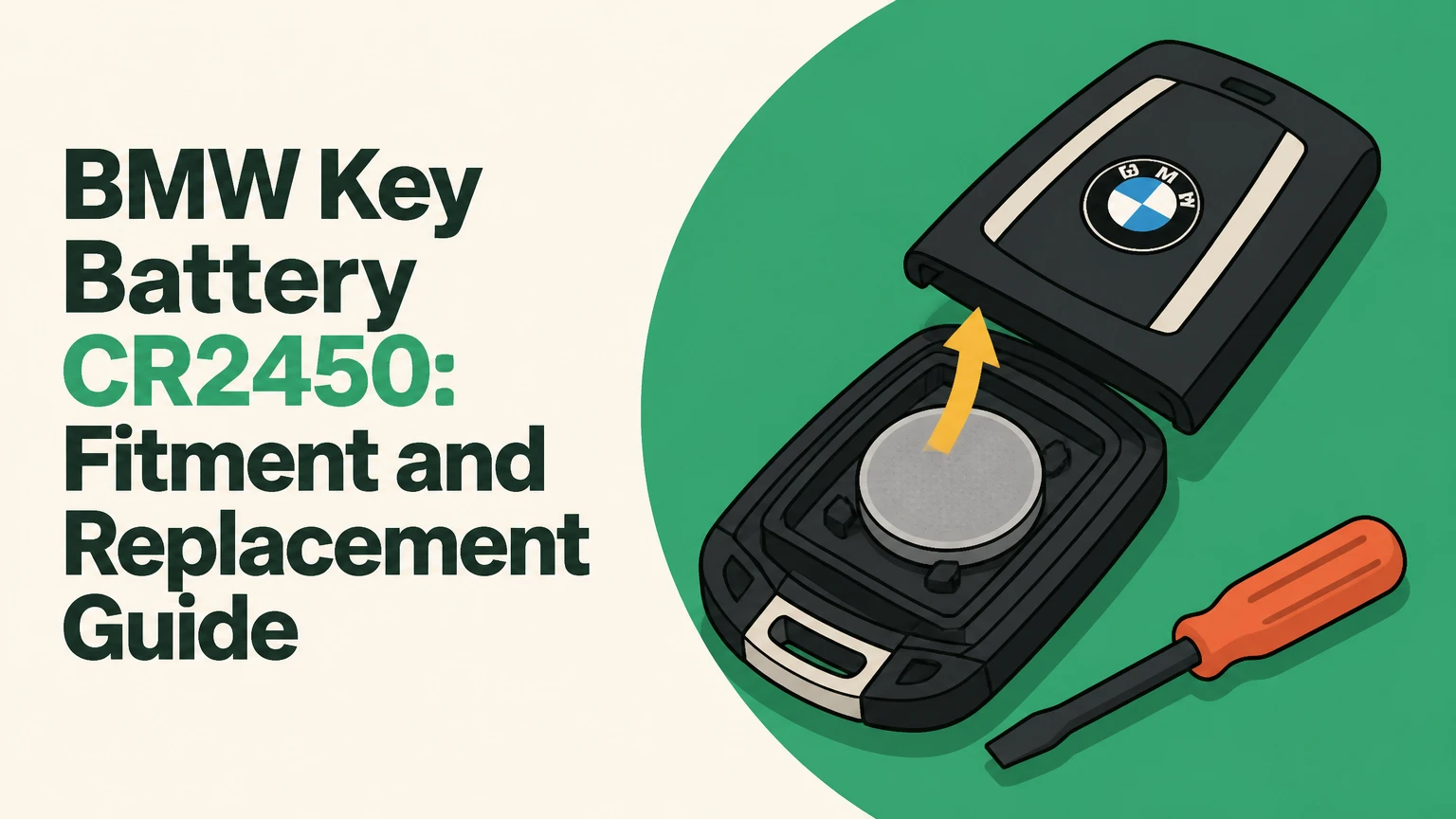
A BMW key battery CR2450 is a 3-volt lithium manganese dioxide coin cell used in some BMW remote keys, especially certain F-Series Comfort Access fobs. The CR2450 measures 24.5 mm wide and 5.0 mm thick, but BMW fitment depends on the exact key housing, battery holder, and equipment package, not the vehicle model or year alone.
Key Facts at a Glance
- A CR2450 battery has a nominal voltage of 3 volts and dimensions of 24.5 × 5.0 mm.
- A CR2450 is approximately 2 mm thicker than a CR2032, so the cells are not automatically interchangeable.
- Many BMW Comfort Access fobs use CR2450 cells, while other BMW remotes use CR2032 or a rechargeable internal battery.
- The old battery number printed on the cell is the most reliable replacement reference.
- Replacing a user-serviceable coin cell normally does not require key reprogramming.
- A Display Key or sealed rechargeable BMW key requires a different procedure from a removable-battery remote.
What Is the Correct BMW Key Battery CR2450?
The correct BMW key battery CR2450 is a non-rechargeable 3-volt CR2450 coin cell that fits a compatible remote housing. The “24” identifies the approximate 24 mm diameter, and the “50” indicates a nominal 5.0 mm thickness under the IEC battery naming system.
Panasonic, Energizer, Renata, Duracell, and other established manufacturers produce CR2450 cells. Panasonic’s CR2450 technical documentation specifies lithium manganese dioxide chemistry and a nominal 3-volt voltage; listed capacity varies with discharge conditions, so the commonly quoted approximately 620 mAh figure is a typical rating rather than a guaranteed usable amount in every BMW remote.
A BMW fob does not consume the entire rated capacity under one identical load. Comfort Access periodically monitors for the vehicle, button presses create radio transmissions, and cold temperatures reduce available output. Two keys with identical batteries can therefore show different service lives.
CR2450 Specifications
| Attribute | CR2450 value | Practical meaning |
|---|---|---|
| Chemistry | Lithium manganese dioxide | Primary cell, not rechargeable |
| Nominal voltage | 3.0 V | Normal voltage for the remote circuit |
| Diameter | 24.5 mm | Must match the circular holder |
| Nominal thickness | 5.0 mm | Determines whether the cover closes |
| Typical capacity | About 620 mAh | Rating depends on load and test conditions |
| Operating temperature | Commonly about -30°C to 60°C | Brand and datasheet limits vary |
Do not install a rechargeable LIR2450 in place of a CR2450 unless the BMW key was specifically designed for that chemistry and charging circuit. An LIR2450 has a different nominal voltage, usually about 3.6 to 3.7 volts, and can damage electronics designed for a CR-series primary cell.
Which BMW Keys Use a CR2450?
Certain trapezoid or shield-shaped BMW F-Series remotes with Comfort Access use a CR2450, but the same broad key family can contain different battery holders. A removable rear cover and the number on the old cell provide stronger evidence than a general vehicle-generation chart.
The following applications are common examples, not a substitute for inspecting the key:
| BMW key or vehicle example | Approximate generation | Common battery pattern | Verification method |
|---|---|---|---|
| F30 3 Series remote | 2012-2019 | CR2450 or CR2032 | Read old cell and inspect holder |
| F10 5 Series remote | 2011-2016 | CR2450 or CR2032 | Confirm key housing and equipment |
| F25 X3 remote | 2011-2017 | CR2450 or CR2032 | Check printed battery number |
| F15 X5 remote | 2014-2018 | CR2450 or CR2032 | Open removable battery panel |
| G20 3 Series remote | 2019 onward | Commonly CR2032 | Verify the exact fob |
| G05 X5 or G07 X7 remote | 2019 onward | Commonly CR2032 | Check cell before purchase |
Production dates overlap because BMW sold different markets, trim levels, replacement keys, and equipment packages at the same time. A 2016 BMW can have a CR2450 key, a CR2032 key, or a rechargeable key depending on the remote design.
How Can You Identify the Battery Without Guessing?
Identify a BMW key battery by removing the mechanical blade, opening the battery cover, and reading the code printed on the existing cell. If the old marking is illegible, measure the holder clearance and compare the housing with the BMW parts documentation or an authorized dealer’s key record.
Look for these clues:
- CR2450: The cell is visibly thick, approximately 5 mm.
- CR2032: The cell is thinner, approximately 3.2 mm.
- Rechargeable pack: The key may have no removable battery door and may charge through a vehicle slot or external charging system.
- Display Key: A screen, charging port, or charging cradle indicates a different battery system.
- Aftermarket shell: A replacement housing may use a different holder from the original BMW shell.
The most common purchasing mistake is treating “F-Series Comfort Access” as a complete part number. It is a useful clue, not a final confirmation.
CR2450 vs. CR2032: Which One Fits?
A CR2450 and CR2032 have the same nominal voltage and diameter, but a CR2450 is 1.8 mm thicker. A CR2032 may sit loosely in a CR2450 holder, while a CR2450 can prevent a CR2032 cover from closing or put excessive pressure on the contacts.
| Battery | Voltage | Diameter | Thickness | Typical capacity |
|---|---|---|---|---|
| CR2016 | 3.0 V | 20.0 mm | 1.6 mm | About 90 mAh |
| CR2025 | 3.0 V | 20.0 mm | 2.5 mm | About 160-170 mAh |
| CR2032 | 3.0 V | 20.0 mm | 3.2 mm | About 210-240 mAh |
| CR2430 | 3.0 V | 24.5 mm | 3.0 mm | About 270-300 mAh |
| CR2450 | 3.0 V | 24.5 mm | 5.0 mm | About 500-620 mAh |
Capacity figures are typical manufacturer values and vary by brand, drain rate, cutoff voltage, and temperature. The CR2430 is the same diameter as a CR2450 but is 2 mm thinner, so it is not a reliable substitute unless the holder is specifically designed to retain it.
What Happens if the Wrong Thickness Is Installed?
A CR2450 in a CR2032 holder can bow the cover, deform contact springs, crack the plastic shell, or leave the battery under damaging mechanical pressure. A CR2032 in a CR2450 holder can lose contact when the key moves, producing intermittent locking, reduced range, or a key that works only when squeezed.
Never stack two thinner cells to imitate a thicker battery. Stacking creates an unsafe 6-volt arrangement, reverses the intended contact geometry, and can damage the remote.
How Do You Replace the Battery?
Most user-serviceable BMW F-Series remotes take about two minutes to open and replace, provided the correct cell and housing are present. The main success factor is prying the separate battery cover at its intended release point rather than splitting the sealed remote shell.
Before You Start
| Requirement | Typical value |
|---|---|
| Time | 2-5 minutes |
| Difficulty | Easy, with moderate care around plastic tabs |
| Battery | 1 new CR2450, if confirmed by the old cell |
| Tools | Valet key, plastic pry tool, or small flat screwdriver |
| Cost | About $2-$8 per cell, depending on pack size |
| Preparation | Photograph the old battery orientation |
Use a plastic pry tool when available. A metal screwdriver can mark the housing or slip into the circuit board area, although the supplied mechanical key is often sufficient for the dedicated release slot.
Step 1: Remove the Mechanical Key
Press the release button on the side or spine of the BMW fob. Pull the metal valet key straight out and place it where it cannot scratch the housing.
The empty blade channel often exposes the battery-cover release point. Do not insert a tool deep into the channel, because the remote contains plastic guides and contact components near the opening.
Success checkpoint: The metal blade is fully removed and the small release groove is visible.
Common mistake: Pulling on the blade without pressing the release button, which can damage the retaining mechanism.
Step 2: Open the Battery Cover
Insert the valet-key tip or a plastic pry tool into the designated groove near the battery cover. Twist gently until the separate rear panel releases, then lift the panel without forcing the perimeter seam of the entire remote.
BMW key designs differ. Some covers lift from one edge; others release through a tab and then rotate away. Excessive force usually indicates that the tool is in the wrong slot or that the housing is a sealed design.
Success checkpoint: The battery compartment opens while the outer remote seam remains intact.
Common mistake: Prying around the complete fob seam, which can separate a glued housing and expose the transponder or circuit board.
Step 3: Record Polarity and Remove the Cell
Observe the old battery before touching it. In many BMW removable-battery fobs, the positive side marked with a plus sign faces upward toward the cover, but the holder’s markings control if they differ.
Lift the old cell from its edge using a nonconductive tool. Avoid shorting the positive and negative faces with a screwdriver, because a coin cell can heat during a direct short.
Success checkpoint: The old battery comes out without bending the metal contacts.
Common mistake: Levering against a contact spring until it loses tension.
Step 4: Install the CR2450
Slide the edge of the new CR2450 under the retaining tabs first, then press the opposite edge down until it is seated. Keep the plus side in the same orientation as the removed cell and remove any shipping sticker from the battery surface.
Do not use adhesive, foam, paper, or folded foil to compensate for a wrong-size cell. A correct battery should sit firmly in the holder without forcing the cover or requiring improvised spacers.
Success checkpoint: The cell is flat, secure, and fully captured by the tabs.
Common mistake: Installing a CR2450 upside down or leaving a protective film over a contact surface.
Step 5: Close and Test the Fob
Align the rear-cover tabs, press the panel closed, and reinstall the mechanical key. Test lock, unlock, trunk, and panic functions near the vehicle before leaving the work area.
A button test confirms the radio remote, but it does not prove that Comfort Access passive entry works. Test both passive entry and the interior start authorization if the vehicle supports them.
Success checkpoint: The cover is flush, buttons respond, and the vehicle recognizes the key.
Common mistake: Assuming a working lock button proves that every keyless feature has been restored.
Which CR2450 Battery Should You Buy?
The best CR2450 for a BMW key is a fresh cell from a traceable manufacturer with intact packaging, a recent production date, and a stated 3-volt specification. Panasonic, Energizer, Renata, and Duracell are reasonable choices when purchased through an authorized or reputable channel; brand name alone does not prove freshness.
| Brand example | Cell type | Typical retail range | Selection consideration |
|---|---|---|---|
| Panasonic CR2450 | 3 V lithium coin cell | $1.50-$3 per cell in multipacks | Common technical documentation and availability |
| Energizer CR2450 | 3 V lithium coin cell | $2-$4 per cell | Widely distributed, long stated shelf life |
| Renata CR2450 | 3 V lithium coin cell | $2-$5 per cell | Swiss-made option with electronics-market presence |
| Duracell CR2450 | 3 V lithium coin cell | $3-$8 per cell | Convenient retail access, inspect contact surface |
| Generic marketplace cell | Varies | $0.50-$2 per cell | Higher risk of old, counterfeit, or poorly stored stock |
Duracell and some other brands may use a bitter coating on coin cells intended to discourage swallowing. The coating can add contact resistance in a marginal holder, but wiping a battery with alcohol is not a universal cure and can remove labeling or contaminate the contact. First verify polarity, seating, and battery freshness; replace the cell if the contact surface is visibly contaminated.
How Much Does BMW Key Battery Replacement Cost?
A DIY CR2450 replacement typically costs $2-$8 for one cell or approximately $5-$15 for a multipack. A BMW retailer or independent automotive locksmith may charge roughly $10-$30 for a simple user-serviceable battery replacement, with regional labor and inspection fees creating the difference.
A much higher quote may involve a sealed rechargeable key, a replacement remote, diagnostic testing, or key programming rather than a coin cell. Ask whether the quoted service covers only a battery or includes a new transmitter.
How Long Should a BMW CR2450 Last?
A CR2450 in a BMW remote commonly lasts about 2-5 years, while a Comfort Access key often reaches the shorter end of that range because passive-entry communication increases standby activity. Battery age, daily button presses, temperature, storage near the vehicle, and weak contact pressure can shorten the interval.
The 3-5 year estimate frequently quoted for BMW keys is a practical range, not a warranty. A key used several times daily in a cold climate may need replacement sooner; a secondary key stored in a dry room may last longer.
Store the key several feet away from the parked BMW rather than on a shelf directly beside the vehicle. Passive systems can repeatedly wake when the key remains within communication range, and the vehicle may also experience unnecessary wake cycles. A Faraday pouch can reduce radio communication when properly closed, but test the pouch because inexpensive versions may shield inconsistently.
Do not keep a loose CR2450 in a glovebox with coins, keys, or metal debris. Store spare cells in their original nonconductive packaging, away from heat and children, and recycle used lithium coin cells through a local battery collection program.
Why Does the Key Still Not Work After Replacement?
A BMW key that remains inoperative after a fresh CR2450 usually has a polarity, contact, battery-quality, housing, or vehicle-recognition problem rather than a synchronization problem. Diagnose the simple physical causes first, then separate remote-button failure from Comfort Access and engine-start authorization.
Use this sequence:
- Check the code: Confirm that the installed cell is CR2450, not CR2032, CR2430, or LIR2450.
- Check polarity: Match the plus marking to the holder or original orientation.
- Remove film: Confirm that no protective sticker covers either contact face.
- Check seating: Verify that the cell is flat under the retaining tabs.
- Inspect contacts: Look for bent, recessed, dirty, or corroded springs.
- Measure voltage: A fresh CR2450 commonly reads near 3.0-3.3 volts with no load, but open-circuit voltage alone does not prove performance under load.
- Test another function: Compare lock, unlock, trunk release, passive entry, and vehicle starting.
- Try the spare key: If the spare works, the fault is probably in the original fob.
- Inspect the vehicle: If both keys fail, investigate the vehicle battery, antenna, receiver, or central locking system.
Do not aggressively bend contacts upward. A small adjustment may restore pressure, but excessive bending can break a solder joint or prevent the cover from closing.
Does BMW Key Battery Replacement Require Reprogramming?
Replacing a coin cell in a BMW remote usually does not erase the key’s authorization or require reprogramming. The immobilizer transponder and remote-control memory remain separate from the replaceable battery circuit in most applicable BMW designs.
A key may need diagnosis or programming if the remote was previously damaged, the vehicle lost key data, a replacement transmitter was installed, or the fault affects both locking and starting. Repeatedly performing internet “resynchronization” sequences cannot repair a dead battery, broken contact, failed button, or incompatible fob.
Can You Start a BMW With a Dead Key Battery?
A BMW with a dead remote battery can often start when the key is held at the vehicle’s designated emergency-detection location, but the exact location varies by model and owner’s manual. Many BMWs use a marked area near the steering column or a specific center-console compartment, while other models specify a different position.
Try the following only after confirming the vehicle’s instructions:
- Hold the key against the marked key symbol or emergency-detection area.
- Press the brake pedal if required by the model.
- Press the Start/Stop button while holding the fob in position.
- Keep the key steady for several seconds if recognition is delayed.
This procedure uses the passive transponder or near-field detection system and may work even when the coin cell cannot power the radio transmitter. It does not prove the CR2450 is installed correctly, and it will not overcome a discharged vehicle battery or immobilizer fault.
What About Display Keys and Rechargeable BMW Keys?
BMW Display Keys and some older BMW remotes use rechargeable batteries, so a CR2450 replacement is inappropriate unless the housing explicitly identifies a CR2450. A screen, charging cradle, USB charging interface, or sealed case indicates that the key belongs to a different service procedure.
| Key characteristic | Likely battery arrangement | Correct action |
|---|---|---|
| Removable rear battery cover | CR2450 or CR2032 coin cell | Open and read the old battery |
| BMW Display Key screen | Internal rechargeable battery | Charge or use qualified repair service |
| Sealed older remote | Internal rechargeable pack | Follow the owner’s manual or dealer procedure |
| Thin modern G-Series fob | Often CR2032 | Confirm printed cell code |
| Replacement aftermarket shell | Varies by holder | Inspect the installed electronics and cover |
Older rechargeable BMW keys can be damaged by inserting a primary lithium coin cell. The charging circuit, voltage profile, and physical contacts may not match. BMW owner manuals distinguish rechargeable keys from replaceable-battery keys, so the vehicle manual and fob construction should decide the procedure.
Common Mistakes and How to Fix Them
| Mistake | Result | Corrective action | Typical recovery time |
|---|---|---|---|
| Forcing CR2450 into CR2032 holder | Cover will not close or contacts deform | Remove it and install the specified thickness | 2-5 minutes |
| Installing CR2032 in CR2450 holder | Intermittent or absent contact | Use the correct 5.0 mm cell | 2-5 minutes |
| Leaving shipping film attached | Remote remains dead | Remove film and reseat cell | Under 2 minutes |
| Prying the outer seam | Cracked or separated housing | Stop, locate battery-cover tab, inspect shell | 5-30 minutes |
| Bending contacts too far | Broken spring or loose connection | Replace housing or seek electronics repair | 15-60 minutes |
| Assuming lock failure means programming loss | Unnecessary programming charge | Test battery, spare key, and emergency start | 5-15 minutes |
One counterintuitive failure occurs when the remote works only immediately beside the car. That pattern often indicates a weak battery, poor contact, or damaged antenna rather than complete key loss. Button presses can still register at very short range while the passive-entry system fails at normal distance.
Another common mistake is replacing the fob battery when the actual problem is the vehicle’s 12-volt battery. If both authorized keys lose range or fail simultaneously, test the vehicle battery and central locking system before buying another CR2450.
BMW Key Battery CR2450 Buying Checklist
Use the following checklist before ordering a battery or paying for service:
- Read the old cell number instead of relying only on the BMW year.
- Confirm CR2450 dimensions: 24.5 mm diameter and 5.0 mm thickness.
- Buy a 3-volt primary lithium cell from a traceable seller.
- Check packaging for damage, leakage, or an implausibly old date code.
- Avoid LIR2450 rechargeable cells in a CR2450 holder.
- Keep the plus-side orientation visible while changing the cell.
- Test both buttons and passive Comfort Access after installation.
- Keep the spare key away from the parked vehicle when not in use.
- Store spare cells in original packaging and away from children.
- Use the owner’s manual for emergency-start positioning.
Frequently Asked Questions
Can I use a CR2430 instead of a CR2450 in a BMW key?
A CR2430 has the same 24.5 mm diameter and 3-volt chemistry as a CR2450, but it is 2.0 mm thinner. The thinner cell may work briefly in a holder designed to accommodate it, yet it can lose contact when the fob moves. Use the exact battery code printed on the removed cell rather than treating CR2430 as an equivalent.
Does Comfort Access drain the BMW key battery faster?
Comfort Access can shorten battery life because the key participates in passive-entry detection while stored near the vehicle. A practical service interval is often about 2-5 years, with keys used daily or kept close to the car tending toward the shorter end. Storage several feet away or in a tested Faraday pouch can reduce unnecessary wake activity.
How do I know whether my BMW key needs CR2032 or CR2450?
Open the battery compartment and read the marking on the old cell. CR2032 is 3.2 mm thick, while CR2450 is 5.0 mm thick; both are 3-volt lithium cells, so voltage and diameter alone cannot identify the correct part. A cover that will not close is a warning, not a reason to force the battery.
Why does my BMW say the key battery is low after replacement?
A low-battery warning can persist when the replacement cell is old, has poor contact, is installed incorrectly, or has a protective sticker attached. Test the cell, inspect the holder, and drive or operate the key normally for a short period. If the warning returns quickly, compare the spare key and inspect the vehicle for receiver or charging-system faults.
Can a BMW key battery be charged?
A CR2450 is a primary lithium battery and must not be charged. Only BMW keys designed with an internal rechargeable battery should be charged through their specified vehicle slot, cradle, or connector. Substituting a rechargeable LIR2450 for a CR2450 can expose the remote to the wrong voltage and charging behavior.
Should I replace both BMW key batteries at the same time?
Replace both keys together only if both batteries are the same age and show similar weakness. Each fob has its own battery, so replacing a healthy spare adds cost without improving the active key. A practical approach is to replace the failing key and keep a verified spare CR2450 available if the second fob uses the same cell.
The Bottom Line
The BMW key battery CR2450 is correct for some removable-battery Comfort Access remotes, particularly certain F-Series shield-shaped keys, but BMW model year alone cannot confirm fitment. Read the old cell, match the 24.5 × 5.0 mm size, install the positive side correctly, and avoid forcing a CR2450 into a CR2032 holder. Most replacements take about two minutes and do not require reprogramming; persistent failure requires contact, fob, vehicle-battery, or receiver diagnosis.