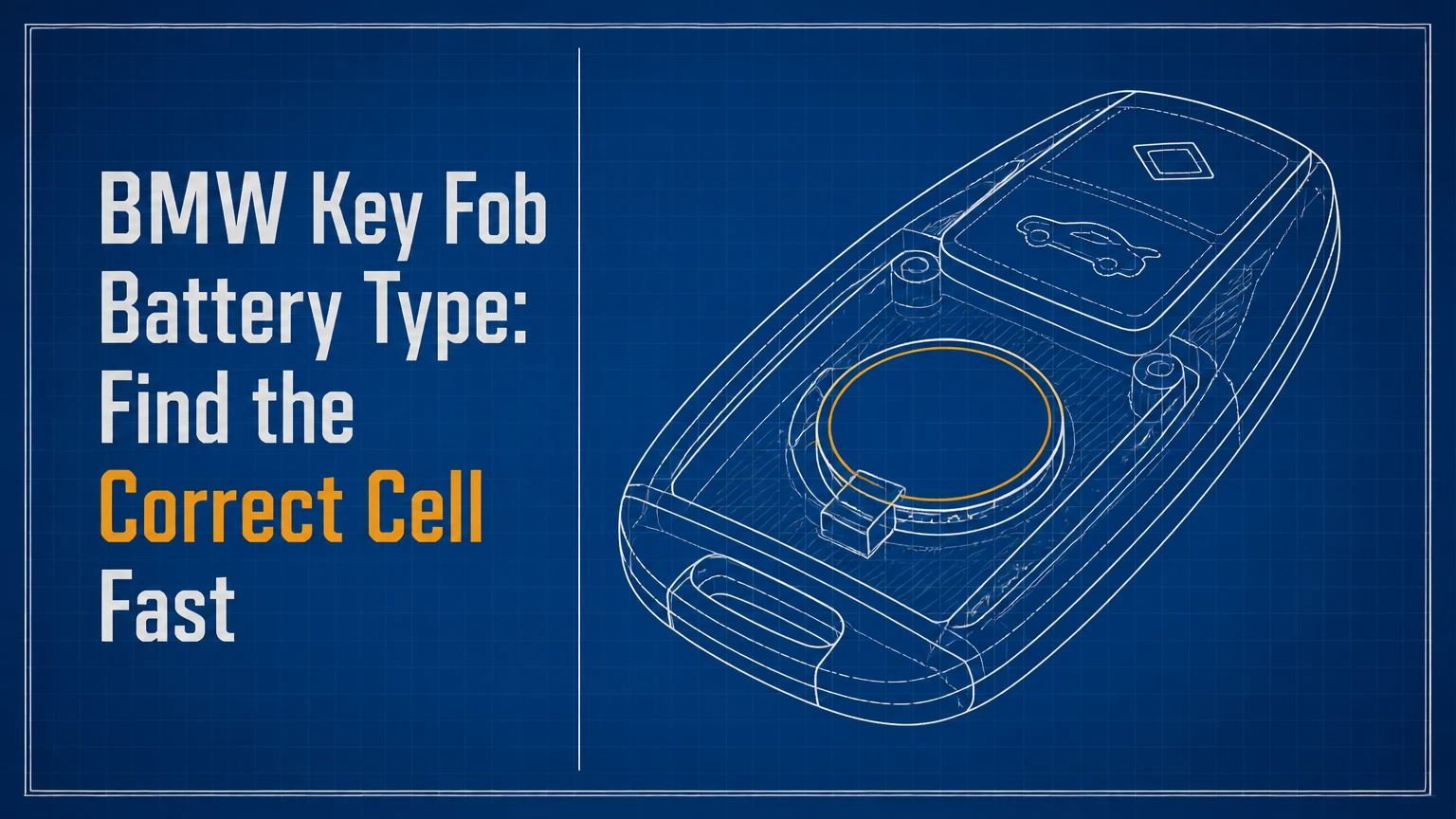
The correct BMW key fob battery type depends on the fob’s construction and charging system, not the BMW model name alone. Most modern removable-battery keys use a 3-volt CR2032 or CR2450 lithium coin cell, while older sealed keys may contain a rechargeable VL2020 soldered to the circuit board; BMW Display Keys use an internal rechargeable lithium-ion battery.
Key Facts at a Glance
- A BMW key with a removable battery door usually uses a CR2032 or CR2450 cell.
- A sealed older BMW diamond or trapezoid key may use a rechargeable Panasonic VL2020 with welded tabs.
- CR2032 measures approximately 20 mm in diameter and 3.2 mm thick; CR2450 measures approximately 24.5 mm by 5.0 mm.
- A disposable CR2032 or CR2450 must never be charged in an ignition slot or charging tray.
- BMW Comfort Access can stop detecting the key before the buttons stop responding because proximity operation often demands more reliable battery output.
- The battery code printed on the old cell or inside the fob is more reliable than a generic model-year chart.
What BMW Key Fob Batteries Do
A BMW key fob battery supplies low-voltage power to the remote transmitter, button circuitry, status electronics, and, in Comfort Access keys, proximity-related functions. Pressing lock or unlock causes the fob to send an encrypted radio-frequency command to the vehicle’s receiver and body electronics.
The battery does not normally contain the key’s immobilizer authorization. BMW vehicles use a separate transponder and vehicle-side security system for starting authorization, so a dead remote battery often prevents remote control while the engine can still start through the emergency detection procedure. The exact architecture differs by generation.
BMW key fobs also consume power differently depending on use. Frequent Comfort Access detection, repeated button presses, long periods in a hot vehicle, and accidental button compression inside a bag can shorten service life. A spare key that sits unused for years can also develop a flat cell, especially when its battery is rechargeable and no longer receives charging current.
Which BMW Functions Stop Working First?
Comfort Access proximity unlocking commonly becomes unreliable before the lock and unlock buttons fail completely. The fob may work beside the driver’s door but fail from several metres away, or the car may display a low-key-battery warning while the mechanical key remains fully usable.
A dead battery can affect these functions:
- Remote locking and unlocking
- Trunk or tailgate release
- Panic or alarm control
- Comfort Access touch unlocking
- Comfort Access push-button starting detection
- Remote memory-profile recognition on some vehicles
A flat remote cell does not automatically mean that the key must be programmed again. Battery replacement and key initialization are separate issues.
Which Battery Fits a BMW Key Fob?
The best identification method is to remove the emergency key, open the battery compartment if the case is designed for opening, and read the code printed on the cell. If the case is sealed or the battery has solder tabs, do not force a flat coin cell into the housing because chemistry, charging, and contact geometry may be different.
| Fob construction or example | Common battery | Chemistry and voltage | Replacement approach |
|---|---|---|---|
| Modern removable BMW key, many G-chassis examples | CR2032 | Disposable lithium, 3 V | User replacement, usually 5-10 minutes |
| Thick removable Comfort Access key, selected F-chassis examples | CR2450 | Disposable lithium, 3 V | User replacement, usually 5-10 minutes |
| Older sealed diamond key, selected E-chassis examples | VL2020 | Rechargeable lithium vanadium, 3 V | Soldered repair or shell replacement |
| Older sealed trapezoid key, selected non-Comfort Access examples | VL2020 | Rechargeable lithium vanadium, 3 V | Soldered repair, tab orientation matters |
| BMW Display Key, including selected G11 and i8 applications | Internal lithium-ion pack | Rechargeable, model-specific | Service repair or specialist replacement |
Model examples are useful for narrowing the answer, but they are not proof. BMW used multiple key designs during the same production period, and replacement shells may also conceal a different original circuit board.
How Do You Identify the Cell Without Guessing?
Look for four clues: the printed battery code, a removable cover, welded or soldered tabs, and the cell’s physical thickness. A CR2032 is about 20 mm wide and 3.2 mm thick. A CR2450 is about 24.5 mm wide and 5.0 mm thick. A VL2020 is about 20 mm wide and 2.0 mm thick, but its welded tabs distinguish it from a normal CR2020 coin cell.
Do not identify the battery by diameter alone. CR2025 and CR2032 share a 20 mm diameter and 3 V nominal voltage, yet the 0.7 mm thickness difference can create weak spring pressure and intermittent operation. The letter “R” indicates a round cell, while the number generally describes diameter and thickness in millimetres.
CR2032, CR2450, and VL2020 Compared
CR2032 is the most common removable BMW key battery, but CR2450 is appropriate when the fob’s carrier is physically wider and deeper. VL2020 belongs to a different category because it is rechargeable and normally attached to the printed circuit board with metal tabs.
| Battery | Diameter | Thickness | Nominal voltage | Rechargeable? | Typical retail price |
|---|---|---|---|---|---|
| CR2025 | 20 mm | 2.5 mm | 3 V | No | $1-$4 per cell |
| CR2032 | 20 mm | 3.2 mm | 3 V | No | $1-$5 per cell |
| CR2450 | 24.5 mm | 5.0 mm | 3 V | No | $2-$7 per cell |
| VL2020 | 20 mm | 2.0 mm | 3 V | Yes | $5-$15 with tabs |
| Display Key pack | Model-specific | Model-specific | Rechargeable pack | Yes | $50-$200 repair estimate |
Prices are typical consumer or specialist ranges in the United States and vary by brand, seller, region, and whether installation is included. A branded Panasonic, Murata, Sony, or Varta cell is generally a safer purchase than an untraceable bulk battery with uncertain storage history.
Is CR2042 the Same as CR2032?
CR2042 is a real 3 V coin-cell designation, but it is not a universal substitute for CR2032. The two cells share a 20 mm diameter, while CR2042 is approximately 4.2 mm thick, so a BMW fob designed for CR2032 may not close correctly or may compress its contacts excessively.
BMW owners should treat CR2042 as a fitment-specific possibility, not the default BMW battery. The code printed on the original cell and the battery holder determines suitability. A thicker cell can damage a cover, deform a contact, or prevent the fob from sealing.
Can You Use CR2025 Instead of CR2032?
A CR2025 may power a BMW key temporarily if the contacts maintain firm pressure, but it is not the correct replacement for a holder designed for CR2032. Its thinner body can move inside the carrier, producing intermittent locking, reduced range, or complete failure when the key is tilted.
A folded paper spacer is not a professional repair. It can obstruct the contacts, trap moisture, or create a short circuit. Use the specified cell, and replace a damaged battery carrier rather than compensating for the wrong thickness.
Do BMW Keys Recharge the Battery?
Only BMW keys designed with a rechargeable cell or an internal rechargeable pack should be charged. Older ignition-slot keys with VL2020 batteries could receive charging current from the vehicle when inserted, while many modern Comfort Access keys use disposable CR2032 or CR2450 batteries that are not rechargeable.
A BMW ignition slot does not automatically charge every key. Inserting a disposable coin cell into a slot or wireless charging area can cause overheating, leakage, or cell failure. The presence of a slot identifies the vehicle’s key-recognition method, not necessarily the battery chemistry.
| Key technology | Charging method | Safe user action | Main limitation |
|---|---|---|---|
| VL2020 ignition-slot key | Vehicle charging circuit, when supported | Replace with matching rechargeable tabbed cell | Case cutting and soldering required |
| CR2032 Comfort Access key | No charging | Replace with a new CR2032 | Disposable cell only |
| CR2450 Comfort Access key | No charging | Replace with a new CR2450 | Disposable cell only |
| BMW Display Key | USB or model-specific wireless charging | Use the specified charging interface | Internal pack is not a normal coin cell |
Rechargeable VL2020 cells also have a finite service life. A replacement cell with the wrong tab angle, reversed polarity, or poor solder joint can leave the key apparently dead even when the new cell measures close to 3 V.
How Do You Replace a Removable BMW Key Battery?
Replacing a removable BMW key battery usually takes 5-10 minutes and requires the correct coin cell plus a plastic pry tool or the emergency key. The factor that determines success is correct battery identification, because the case can close around a wrong cell while the contacts remain unreliable.
Before You Start
| Requirement | Typical specification |
|---|---|
| Time | 5-10 minutes |
| Difficulty | Low, if the cover is removable |
| Materials | 1 matching CR2032 or CR2450 cell |
| Tools | Emergency key, plastic pick, lint-free cloth |
| Safety | Keep the old cell away from children and pets |
| Prerequisite | Confirm the code and polarity before removal |
Step 1: Remove the Emergency Key
Press the small release button on the rear or side of the BMW fob and pull out the mechanical key. The exposed key slot often reveals the notch used to separate the battery cover.
Do not insert the blade deeply into the electronic area. You will know this step worked when the metal key is fully removed and the release button returns to its normal position. A common mistake is using the emergency key as a lever before locating the intended case seam.
Step 2: Open the Battery Cover
Insert the emergency key or a plastic tool into the designated slot and twist gently until the cover releases. Work around the seam rather than prying one corner sharply, because concentrated force can break retaining clips.
You will know the cover is released when the rear panel lifts without bending. A metal screwdriver can scratch the plastic or bridge two contacts, so wrap its tip or use a nylon pick when possible.
Step 3: Record Polarity and Replace the Cell
Photograph the old battery before removing it. In many BMW removable fobs, the positive side marked “+” faces outward or upward, but the holder determines the final orientation.
Slide the old cell out from beneath the retaining clip instead of levering directly against the circuit board. Install the new cell without bending the spring contact. A common mistake is pressing the coin into place from the centre, which can flatten the contact and reduce tension.
Step 4: Close and Test the Fob
Snap the cover shut, reinstall the mechanical key, and test lock, unlock, trunk release, and vehicle detection. Stand beside the car first, then test from the normal operating distance.
A successful replacement produces immediate button response and stable range. If the buttons work but Comfort Access does not, check the vehicle’s exterior-handle sensors, key position, and second key before assuming programming failure.
How Are VL2020 BMW Keys Repaired?
A VL2020 BMW key is repaired by opening the sealed shell, desoldering the old tabbed cell, soldering a matching rechargeable VL2020, testing the charging circuit, and installing a replacement shell. The work normally takes 30-90 minutes for a specialist and is unsuitable for anyone without soldering experience.
VL2020 is not interchangeable with CR2032 merely because both are round 3 V cells. The rechargeable cell must have the correct tab arrangement, polarity, and clearance. Some keys use tabs bent at approximately 90 degrees; others use a different orientation.
A professional repair should include:
- Identification of positive and negative terminals before desoldering.
- Inspection for lifted PCB pads or corrosion.
- Installation of a genuine rechargeable cell with pre-welded tabs.
- Soldering that limits heat exposure to the circuit board.
- Charging-current and remote-function testing.
- A replacement shell if the original case was cut open.
The safer alternative is a mail-in key rebuild or automotive locksmith service. A replacement shell alone does not transfer the immobilizer electronics, and a newly purchased blank key generally requires vehicle-specific programming and may not be a simple battery solution.
What Does BMW Key Battery Replacement Cost?
A removable CR2032 or CR2450 replacement typically costs $1-$7 for the cell and 5-10 minutes of owner time. A professional counter service may charge approximately $10-$30, while VL2020 soldered-key repair commonly costs $40-$120 depending on shell damage, shipping, and circuit-board condition.
| Service or purchase | Typical parts cost | Typical labor or total | Typical time |
|---|---|---|---|
| CR2032 replacement at home | $1-$5 | $1-$5 total | 5-10 minutes |
| CR2450 replacement at home | $2-$7 | $2-$7 total | 5-10 minutes |
| Retail or locksmith coin-cell service | $1-$7 | $10-$30 total | 10-20 minutes |
| VL2020 mail-in repair | $5-$15 cell | $40-$120 total | 3-10 days |
| Display Key battery service | $20-$80 parts | $50-$200 total | 1-5 days |
These figures are typical ranges, not BMW-published prices. Dealer pricing can exceed independent locksmith pricing, particularly when the dealer recommends a complete key rather than a battery repair.
How Long Does a BMW Key Battery Last?
A disposable BMW key battery typically lasts 1-3 years, while a rechargeable VL2020 may provide approximately 8-15 years before capacity falls below reliable operating levels. Actual life depends on temperature, Comfort Access activity, button use, storage conditions, and battery age at purchase.
A low-battery warning should be treated as a replacement prompt rather than a precise countdown. Some keys continue working for weeks; others lose reliable proximity operation quickly in cold weather. Lithium coin cells deliver less usable performance under heavy load and low temperature, which explains why a marginal key can fail during winter even when its buttons worked the previous day.
Store a spare key away from constant button pressure and extreme heat. A key left inside a vehicle can also experience repeated detection attempts, which may consume more energy than a key stored outside the car.
Why Is a BMW Key Still Dead After Battery Replacement?
A BMW key that remains dead after a new battery usually has incorrect polarity, poor contact pressure, a damaged circuit board, a wrong battery size, or a depleted rechargeable-cell circuit. Confirm the cell code first, then inspect the holder and measure the installed battery with a multimeter.
Use this diagnosis sequence:
- Verify the new cell measures close to its nominal 3 V with no major voltage collapse.
- Confirm the positive marking matches the original orientation.
- Inspect spring contacts for flattening, oxidation, or displacement.
- Check that the cover applies pressure to the battery.
- Test the spare key to separate vehicle faults from fob faults.
- Try the emergency starting position if the car does not detect the key.
Finger oils rarely insulate a clean coin cell completely, but contamination can reduce contact reliability. Wipe the cell with a dry lint-free cloth and avoid abrasive chemicals that remove plating from the contacts.
Can a BMW Start With a Dead Key Battery?
A BMW can often start with a dead remote battery if the vehicle’s immobilizer recognizes the key in its emergency detection position. The exact location varies: many push-button BMWs require holding the fob against the marked steering-column area or directly against the start button while pressing the brake or clutch.
Consult the owner’s manual for the specific chassis. A dead remote battery and a failed immobilizer transponder are different faults, and the emergency procedure cannot overcome a damaged or unrecognized key.
Does a New BMW Key Battery Need Programming?
A normal battery replacement does not usually require programming because changing the cell does not erase the key’s stored authorization. If the remote remains unresponsive, the cause is more often a contact problem, failed fob electronics, incorrect battery type, or a vehicle-side receiver fault.
Older BMW remote-initialization procedures vary by generation and market. The often-repeated sequence involving ignition cycling and pressing unlock or lock is not universal, so applying it to the wrong chassis can waste time and may affect other paired remotes. Use the model-specific owner’s manual or a BMW diagnostic specialist when synchronization is genuinely required.
Common BMW Battery Mistakes
- Buying by BMW year alone: BMW changed key designs within model runs. Read the cell code or inspect the holder.
- Installing CR2025 in a CR2032 carrier: The thinner cell can lose contact during movement.
- Charging a disposable cell: CR2032 and CR2450 are primary lithium cells, not rechargeable batteries.
- Forcing a CR2450 into a CR2032 shell: The larger diameter and thickness can damage the cover or contacts.
- Using a bare VL2020 without tabs: A solderable tabbed version protects the PCB from improvised mounting.
- Assuming a dead fob needs coding: Battery failure and vehicle authorization are separate diagnostic paths.
- Cutting a sealed key without a replacement shell: The original case may not close securely after repair.
One practitioner rule is especially useful: replace the battery type, diameter, thickness, chemistry, and terminal arrangement as a matched set. Nominal voltage alone is not enough.
BMW Key Fob Battery FAQ
What battery does a 2015 BMW key use?
A 2015 BMW key may use a CR2450, CR2032, or a rechargeable VL2020 depending on the chassis, Comfort Access equipment, and fob design. Many F-chassis Comfort Access keys use CR2450, while older sealed designs can use VL2020. Open the fob or read the original cell before buying.
What battery does a BMW Display Key use?
A BMW Display Key uses an internal rechargeable lithium-ion battery or model-specific rechargeable pack rather than a standard CR2032 or CR2450. The key charges through its specified USB or wireless interface. Battery replacement usually requires specialist disassembly because the pack is integrated into the display key housing.
How can I tell whether my BMW has Comfort Access?
Comfort Access usually allows locking by touching the exterior door-handle ridges and unlocking by grasping the handle while the key remains in your possession. The vehicle equipment list, owner’s manual, or VIN-based build record can confirm the system. Fob appearance alone is not conclusive.
Why does my BMW say remote control battery discharged?
The message means the vehicle has detected low output from the key’s remote battery or rechargeable cell. Replace a removable CR2032 or CR2450 promptly, or arrange VL2020 or Display Key service. If the warning returns immediately, inspect contacts and charging circuitry instead of repeatedly buying batteries.
Can I replace a BMW key battery at a dealership?
A BMW dealership can replace a removable battery, but some dealerships recommend a complete key when the cell is soldered or the Display Key pack is integrated. An independent automotive locksmith may offer a lower-cost VL2020 rebuild. Ask whether the quoted price covers only a cell, a shell, or a complete programmed key.
Should I replace the spare BMW key battery too?
Replace the spare battery if both keys are the same age, especially when the vehicle uses disposable cells older than two years or rechargeable VL2020 cells showing reduced range. Test the spare separately before changing it, because a stored key can remain healthy while the frequently used key fails first.
The Bottom Line
The correct BMW key fob battery type is determined by the battery code, holder, and charging design. Choose CR2032 or CR2450 for the matching removable holder, use a tabbed rechargeable VL2020 only for the older soldered design, and treat BMW Display Key battery service as a specialist repair. When the key remains dead, check polarity, contacts, and emergency detection before attempting programming.