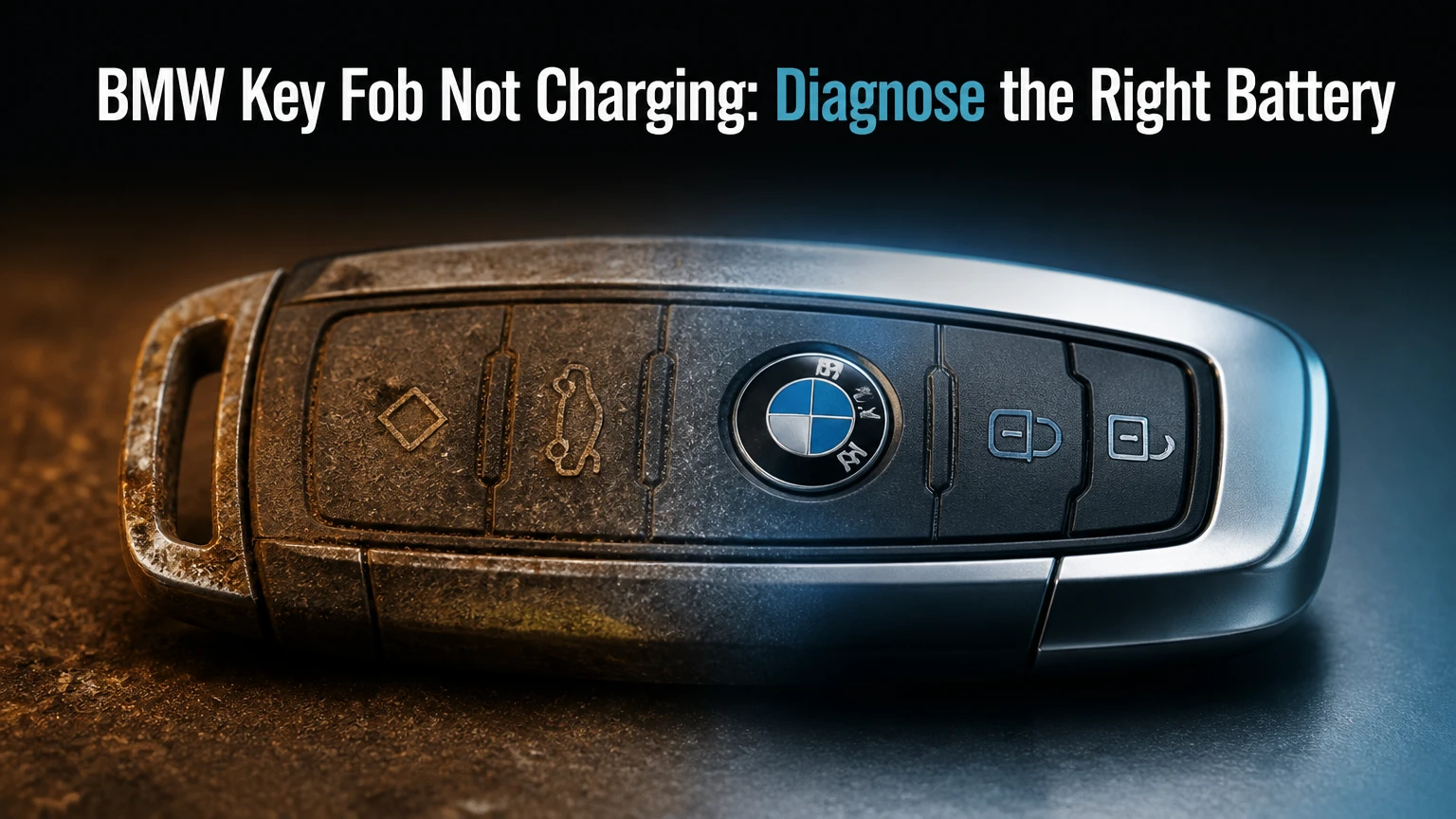
A BMW key fob not charging usually has a worn internal rechargeable battery, a damaged battery connection, or a failed ignition antenna ring. Older sealed BMW keys charge inductively when inserted into the ignition, but Comfort Access keys may use a replaceable CR2032 instead. Identify the key first, then test the key and vehicle separately.
Key Facts at a Glance
- BMW diamond keys commonly use a sealed Panasonic VL2020 rechargeable coin cell.
- The ignition antenna ring transfers charging power when a compatible key sits in the ignition.
- A key can start the engine while its remote lock and unlock buttons remain dead.
- A CR2032 is non-rechargeable and must not replace a VL2020 in an inductive charging circuit.
- Thirty minutes in the ignition is a useful charging test, not a guaranteed battery repair.
- Battery replacement normally preserves the key’s coding when the original circuit board remains intact.
Why Is My BMW Key Fob Not Charging?
A BMW key fob stops charging most often because its rechargeable lithium cell has lost capacity after years of heat cycles, or because the battery tabs and circuit-board solder joints have cracked. Less common causes include a faulty ignition antenna ring, a blown fuse, corrosion, water intrusion, or a damaged charging circuit inside the key.
The first diagnostic distinction is whether the key still starts the BMW. The immobilizer transponder and the radio remote are separate functions, so an engine-starting key can have a completely exhausted remote battery. Conversely, a key may have a healthy remote battery but fail to start the vehicle because of a transponder, EWS, CAS, or key-recognition fault.
BMW key batteries are not interchangeable by appearance alone. A rechargeable VL2020 and a disposable CR2032 can both resemble a small three-volt coin cell, yet their charging behavior is different. Installing the wrong chemistry can overheat the cell and damage the key.
What the symptoms usually mean
| Symptom | Most likely cause | Best first test |
|---|---|---|
| Engine starts, buttons do nothing | Flat VL2020, cracked tab, failed button solder | Test remote range and inspect key condition |
| Engine starts, remote works briefly | Battery has low capacity | Charge for 30-60 minutes, then monitor retention |
| Engine does not start, remote works | Immobilizer or transponder fault | Try the spare key and check key-recognition messages |
| Two keys stop charging | Vehicle antenna ring, fuse, or wiring fault | Test both keys in the same ignition |
| Red LED stays dark | Flat cell, broken PCB connection, dead LED | Measure battery voltage and inspect solder joints |
| Key becomes hot or swells | Wrong battery or charging failure | Stop using it and isolate the battery safely |
Which BMW Keys Have Rechargeable Batteries?
Older non-Comfort Access BMW keys with an ignition slot commonly contain a rechargeable VL2020 cell, while many E-series Comfort Access keys use a replaceable CR2032. Newer BMW Display Keys use an internal lithium-polymer battery charged through a designated wireless pad or USB connection, depending on the key generation.
Model year alone is not enough. BMW used several key designs within the same model range, and replacement shells can obscure the original battery type. Look for the key’s physical arrangement and the battery markings before ordering parts.
BMW key types and battery specifications
| Key design | Common BMW applications | Battery or charging method | Typical repair implication |
|---|---|---|---|
| Diamond key | E39, E46, E53, approximately 1999-2006 | VL2020, ignition induction | Sealed case usually requires opening and soldering |
| Non-Comfort Access slot key | Selected E60, E90, E70 variants | VL2020, ignition induction | Confirm pin orientation before ordering |
| Comfort Access key | Selected E60, E90, E70 variants | Usually replaceable CR2032 | Do not place a CR2032 in a rechargeable PCB circuit |
| Display Key | G11, G12, G30 and related G-series models | Internal Li-Po, charging pad or USB by version | Replace the key or battery assembly through a specialist |
| Modern rectangular smart key | Various F-series and G-series vehicles | Replaceable or model-specific internal cell | Check the owner’s manual and key label |
The Panasonic VL2020 is commonly supplied with welded or solderable tabs in different orientations, including 90-degree and 180-degree layouts. The correct cell must match both chemistry and tab geometry. A loose bare coin cell is not an automatic substitute for a tabbed replacement.
How Does a BMW Ignition Charge the Key?
A compatible BMW ignition lock contains an antenna ring that transfers energy through electromagnetic induction to a coil inside the key. The key converts that energy to charge its internal cell while inserted, so the key does not need electrical contacts touching the vehicle.
The antenna ring is part of the vehicle-side charging system, while the battery, internal coil, rectifier, and charging components are inside the key. Immobilizer communication also occurs in the ignition area, but charging and engine authorization should not be treated as one circuit.
The key generally needs to remain fully seated in the ignition. Turning the ignition to accessory or run position may help the vehicle energize the system, but BMW model behavior varies, and the engine does not need to run for every charging test. The owner’s manual remains the authority for the specific chassis.
Charging versus remote synchronization
Charging restores electrical capacity. Remote synchronization restores communication between the buttons and the vehicle’s central locking receiver. Neither process repairs a failed battery, broken antenna coil, or damaged PCB.
The rolling-code system also does not mean the key must remain in the ignition continuously to “learn” security codes. The immobilizer transponder, remote pairing memory, and charging circuit have different roles. Treating all three as one function leads to incorrect repairs.
How Can You Test a BMW Key Without Opening It?
Test the key in a fixed sequence: confirm the battery type, charge it in the correct ignition, compare it with a working spare, and then inspect the vehicle-side fuse and antenna circuit. This sequence takes about 45-75 minutes and prevents unnecessary disassembly.
Before you start
| Requirement | Typical value | Why it matters |
|---|---|---|
| Controlled charging test | 30-60 minutes | Gives a deeply discharged cell time to respond |
| Minimum equipment | Working spare key, flashlight, manual | Separates key faults from vehicle faults |
| Optional equipment | Digital multimeter, plastic pry tools | Useful only after identifying a sealed key |
| DIY difficulty | Moderate to high | Soldering and case opening can destroy the PCB |
| Typical specialist repair | 1-24 hours | Depends on battery stock and board damage |
Step 1: Identify the key battery
Remove the emergency mechanical blade if the design allows it and inspect visible markings, owner documentation, or a specialist’s battery listing. Do not assume a diamond-shaped case contains a VL2020, because BMW produced both rechargeable and replaceable-battery variants.
Success checkpoint: You can state whether the key uses VL2020, CR2032, or a proprietary Li-Po battery.
Common mistake: Ordering a battery from a photograph of the shell without confirming Comfort Access equipment.
Step 2: Perform a controlled charging test
Insert the suspected rechargeable key fully into the ignition and leave it seated for 30-60 minutes. Keep the vehicle in a safe, ventilated location and follow the vehicle manual regarding ignition position; do not use an improvised wireless charger.
Success checkpoint: After charging, the remote LED or lock/unlock function shows a measurable improvement in range or response.
Common mistake: Concluding that the key is fixed because it works for one unlock cycle. A chemically depleted cell may accept a surface charge and then collapse within hours.
Step 3: Compare a known-working spare key
Use the same ignition and the same vehicle conditions with a spare key. If the spare operates remotely and the suspect key does not, the vehicle’s antenna ring is less likely to be the cause. If both keys fail, investigate the vehicle before opening either key.
Success checkpoint: One key behaves consistently differently from the other.
Common mistake: Testing the spare with a weak vehicle battery or after changing unrelated electrical components, which creates a second variable.
Step 4: Check fuses and vehicle power
Consult the BMW fuse card or chassis-specific wiring diagram before removing a fuse. The central fuse location and fuse designation vary by model, and assigning one universal fuse number to every BMW is unsafe.
Inspect for a blown fuse, corrosion, loose fuse seating, or evidence of water near the glovebox and central electronics. A fuse failure can disable central locking or antenna functions without producing a charging warning on the dashboard.
Success checkpoint: Fuse ratings match the BMW documentation and the antenna circuit has vehicle power where specified.
Common mistake: Installing a higher-rated fuse. The replacement must match the documented amperage.
Step 5: Inspect for water and physical damage
Examine the key for a split seam, missing buttons, green corrosion, condensation, or liquid exposure. Water can damage the induction coil and radio components even when the key still starts the engine.
A key that has been washed, submerged, or stored in a damp pocket should not be repeatedly inserted into the ignition as a charging experiment. Drying may stop further corrosion, but it does not reverse electrolyte or PCB damage.
Success checkpoint: The case and buttons are dry, and no corrosion is visible around the board or coil.
Common mistake: Spraying contact cleaner into a sealed key. Solvent can move contamination deeper into switches and adhesives.
Step 6: Measure the internal battery only when appropriate
Opening a sealed BMW diamond key requires controlled cutting or specialist tools because the case seam sits close to the circuit board. If opened, measure voltage across the battery terminals with the key disconnected from the vehicle.
A VL2020 has a nominal voltage near 3.0 volts. A reading below approximately 2.5 volts strongly suggests deep discharge or cell failure, but voltage alone does not prove usable capacity; a weak cell can show near-normal voltage and collapse under load.
Success checkpoint: The battery type, polarity, terminal voltage, and solder joints are documented before removal.
Common mistake: Cutting directly through the case seam with a deep knife stroke. Internal antenna traces, buttons, and transponder components can sit close to that seam.
What Should You Replace in a BMW Key?
Replace the internal rechargeable battery when one key fails, the vehicle charges a spare normally, and the cell has low voltage or poor retention. Repair the vehicle antenna or fuse circuit when multiple compatible keys fail in the same ignition. Replace the entire key when the PCB, transponder, or case is beyond economical repair.
| Repair route | Typical cost range | Typical time | Best use |
|---|---|---|---|
| Battery and solder repair | BDT 600-1,800 parts and basic labor | 1-2 hours | Original board works and case can be opened |
| Automotive locksmith | BDT 6,000-12,000 | 1-24 hours | Battery, shell, button, or transponder service |
| BMW dealership key | BDT 20,000-45,000 | 3-7 business days | OEM replacement ordered against VIN |
| Vehicle antenna diagnosis | BDT 2,000-10,000 typical local range | 1-3 hours | Multiple keys fail in one vehicle |
| Display Key replacement | Model and market dependent | Several days to weeks | Proprietary Li-Po or display damage |
These are typical Bangladesh-market ranges from the supplied cost context, not fixed BMW prices. Labor rates, import duties, model, key availability, and whether programming is included can change the final invoice substantially.
DIY battery replacement
DIY replacement costs the least and usually keeps the original coding because the original PCB and transponder remain in place. The work still requires a temperature-controlled soldering iron, correct tabbed cell, polarity verification, ESD care, and a case repair method.
A replacement VL2020 must be installed with the same orientation and tab arrangement as the original. Do not solder directly to a bare coin cell unless the manufacturer explicitly permits it; heat and pressure can damage the cell.
DIY repair is a poor choice when the key is the only available key, the board has corrosion, or the owner lacks soldering experience. A replacement shell can also fit mechanically while failing to protect the antenna coil or buttons properly.
Automotive locksmith repair
A European-vehicle locksmith can test the remote, replace the cell, repair buttons, transfer electronics into a shell, and diagnose transponder issues. Ask whether the quoted work preserves the original PCB and whether a new key requires programming.
A locksmith is usually the practical choice for a sealed E-series key with a good circuit board. The main risks are low-quality aftermarket shells, incorrect battery orientation, and an inaccurate diagnosis when the vehicle antenna is actually defective.
BMW dealership replacement
A BMW dealership can order an OEM key using the vehicle identification number and ownership documents. The replacement normally arrives matched to the car’s security system, although delivery time and pricing vary by country and model.
Dealership replacement is appropriate when the original key is lost, the transponder is damaged, or the owner requires OEM documentation. It is usually excessive for a key that only needs a VL2020 and has an intact board.
Why Does the Key Start the BMW but Not Lock the Doors?
A BMW key can start the engine while its remote buttons fail because the immobilizer transponder can operate without a charged remote battery. The engine-start authorization function receives energy from the vehicle’s antenna field, whereas the wireless lock and unlock transmitter depends on the key’s internal battery.
First, test the buttons close to the vehicle after charging. If the LED remains dark, inspect the battery and button solder joints. If the LED flashes but the locks do not respond, the remote may require resynchronization, or the vehicle’s receiver and central-locking system may have a fault.
Remote resynchronization
Resynchronization procedures vary by chassis, key design, and market. A common E-series sequence involves inserting the key, switching the ignition briefly, removing it, then holding an unlock button while pressing the lock button several times, but the exact timing is not universal.
Use the BMW owner’s manual or a chassis-specific service procedure rather than applying a generic sequence blindly. Pairing cannot restore a dead battery, and repeated pairing attempts can obscure the original fault.
What Mistakes Damage BMW Rechargeable Keys?
The most damaging mistakes are fitting a CR2032 where a VL2020 belongs, charging a BMW key on an unrelated consumer pad, cutting too deeply into the case, and overheating the PCB during desoldering. Each mistake can convert a simple battery repair into a circuit-board or complete-key replacement.
- Wrong chemistry: A CR2032 is designed for one-time discharge, not repeated inductive charging. It can leak, swell, or overheat when exposed to the charging circuit.
- Wrong charger: Toothbrush and generic Qi chargers use different coil geometry, frequency, control, and power levels. Similar inductive principles do not make them compatible.
- Deep case cutting: The induction coil, antenna traces, switches, and transponder may sit close to the glued seam.
- Excess soldering heat: Long contact with a hot iron can lift PCB pads or damage nearby surface-mount components.
- Battery polarity error: Reversed polarity can damage charging and radio circuitry immediately.
- Repeated dead-key charging: A cell with internal leakage can stress the vehicle circuit and may become hot.
A professional rule of thumb is simple: if the key is the only one available, do not make it the first soldering project. Pay for diagnosis before risking the sole means of starting the vehicle.
What Alternatives Exist When Charging Fails?
A replacement battery is the best alternative when the original board and transponder work. A repaired original key generally retains its vehicle coding, while a complete aftermarket or dealer key introduces shell, compatibility, programming, and ownership-verification issues.
Choose a repaired original key when the engine starts and the failure is limited to charging or remote range. Choose a locksmith replacement when the case, buttons, or transponder has sustained damage. Choose a dealership key when security documentation, OEM fit, or a lost-key situation outweighs the higher price.
A used key from another BMW is not automatically plug-and-play. Its transponder may remain paired to another vehicle, and its radio electronics may not match the receiving car. A used shell can be useful, but a used electronic key requires specialist compatibility checks.
Which Result Confirms the Vehicle Is at Fault?
The vehicle is the likely fault when two compatible keys fail to charge or operate remotely in the same ignition, especially if both keys previously worked and the fuse or antenna ring shows an electrical problem. One dead key with a normally functioning spare usually points to the key.
| Test result | Vehicle-side likelihood | Next action |
|---|---|---|
| Suspect key fails, spare works | Low, under typical diagnosis | Repair or replace suspect key |
| Both keys fail after storage | Medium | Check battery condition and antenna circuit |
| Both keys fail suddenly | High | Inspect fuses, ring antenna, wiring, and modules |
| Key starts engine but remote fails | Low for immobilizer, high for key remote | Test battery, buttons, and synchronization |
| Remote works but engine will not start | Low for charging, high for immobilizer | Diagnose EWS or CAS recognition |
| Key charges but loses power overnight | Low for antenna, high for cell | Replace the depleted cell |
The table provides diagnostic direction, not a guaranteed probability. BMW chassis electronics differ, and a specialist should confirm unusual results with a scan tool and wiring measurements.
Frequently Asked Questions
How long does a rechargeable BMW key battery last?
A rechargeable BMW key cell commonly lasts about 8-14 years in older E-series use, although heat, frequent charging, storage state, and driving patterns change the result. A key that only holds charge for one day has usually reached chemical end of life rather than needing more charging time.
Can I charge a BMW key outside the car?
A BMW ignition-charged key should not be charged on a toothbrush base, generic Qi mat, or improvised induction device. Those chargers may use incompatible frequency, alignment, and power control. Use the vehicle’s ignition loop or a purpose-built service fixture operated by a qualified key specialist.
Will changing the VL2020 erase the BMW key code?
Replacing the VL2020 normally does not erase the key’s coding when the original PCB remains powered and intact during service. Broken traces, prolonged board damage, incorrect polarity, or replacing the entire electronic assembly can create a separate programming problem.
Why does my BMW key work only next to the car?
Very short remote range usually indicates low battery capacity, a damaged antenna, water corrosion, or radio interference. Test the key after a controlled ignition charge, compare the spare key at the same location, and inspect the case before assuming the vehicle receiver has failed.
Does a BMW Display Key use a VL2020?
A BMW Display Key generally uses a proprietary rechargeable lithium-polymer battery rather than the VL2020 found in many older diamond keys. Display Keys charge through the specified BMW charging pad or cable arrangement for that model. Confirm the exact key generation before buying a battery or opening the housing.
Should I replace the key or repair the battery?
Repair the battery when the original key starts the vehicle, the PCB is clean, and a specialist confirms a failed rechargeable cell. Replace the key when the transponder, induction coil, PCB, display, or case is badly damaged, or when the repair cost approaches a verified OEM replacement.
The Bottom Line
A BMW key fob not charging is usually a failed internal rechargeable battery, not a lost security code. Identify whether the key contains a VL2020, CR2032, or proprietary Li-Po cell, test a spare in the same ignition, and inspect the vehicle circuit only when multiple keys show the same fault. Use a locksmith for sealed-key solder work unless you already have the tools and experience.