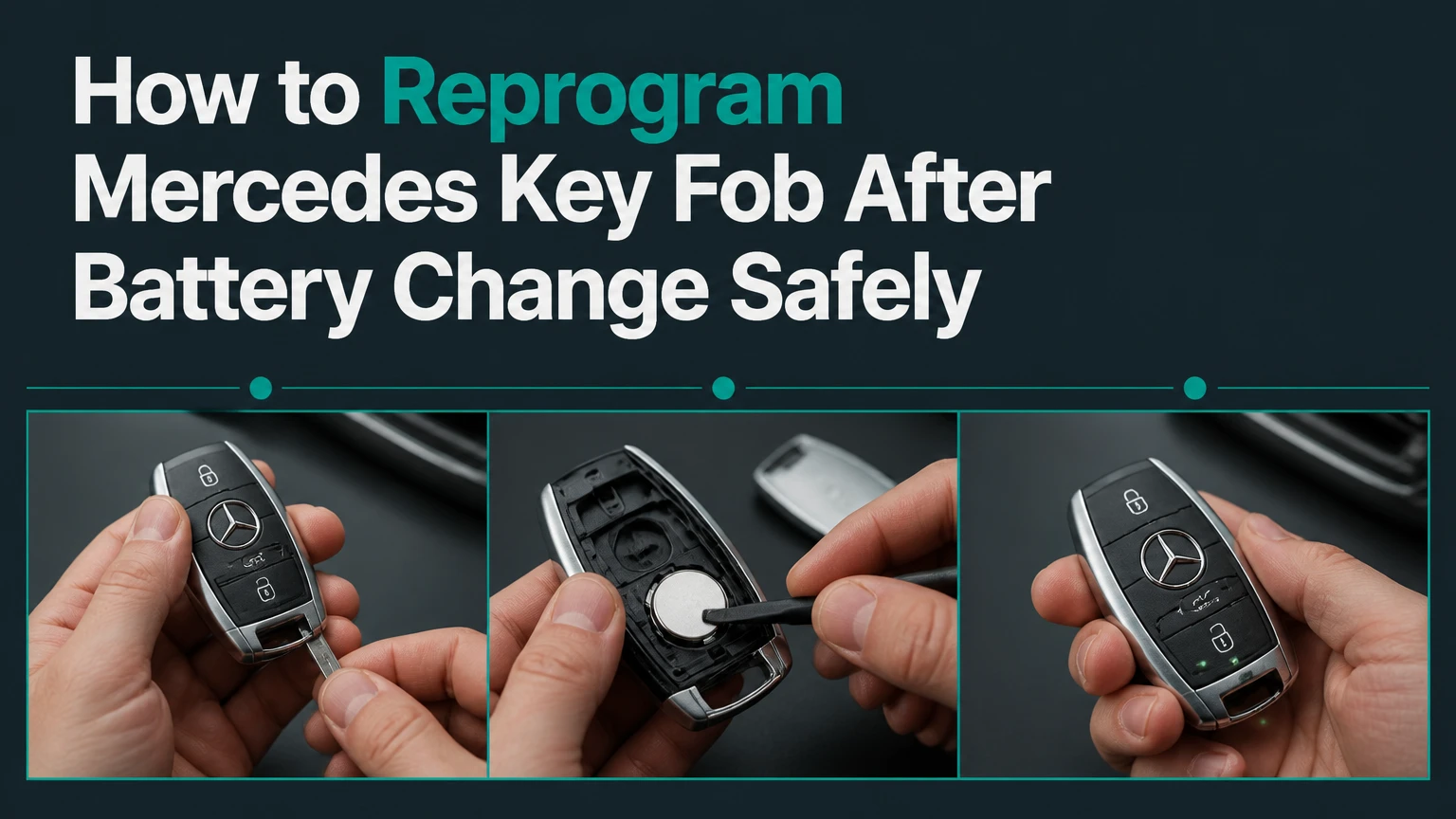
A Mercedes-Benz key fob normally does not need reprogramming after a routine battery replacement. If remote buttons stop responding, first install the correct battery, verify its polarity and contacts, then resynchronize the fob using the ignition slot or the model-specific lock and unlock sequence; a replacement key requires dealer or specialist programming.
Key Facts
A Mercedes-Benz battery change usually affects remote transmitter power, not the immobilizer authorization stored in the key.
A key that starts the car but cannot lock or unlock it usually has a battery, contact, or transmitter problem.
A key that operates the locks but cannot start the car may have an immobilizer, EIS, infrared, or vehicle-side fault.
Older Mercedes-Benz keys may resynchronize through the ignition slot or a lock-button sequence.
Modern Keyless-GO vehicles use a designated backup location, and procedures vary by model and model year.
A blank or previously used Mercedes-Benz key cannot normally be added with a simple button sequence.
Before You Start
The basic procedure takes about 5-10 minutes and costs $3-$10 if the existing key and vehicle are otherwise healthy. The main factor determining success is key generation, because a 2002 black SmartKey and a 2023 Keyless-GO transmitter do not use the same synchronization process.
| Requirement | Typical specification | Why it matters |
|---|---|---|
| Replacement battery | CR2025 or CR2032, 3 volts | The wrong thickness can create poor contact |
| Work area | Dry, well-lit surface | Prevents lost clips and contamination |
| Vehicle state | Parked, unlocked, transmission in Park | Prevents accidental movement during testing |
| Procedure time | 5-10 minutes | Includes battery inspection and testing |
| Service cost if needed | $150-$800+ typical | Depends on generation, location, and key availability |
Use the battery marking inside the key housing, the removed battery, or the Mercedes-Benz owner’s manual to identify the replacement. Do not assume every chrome Mercedes key uses one CR2032. Several earlier designs use two CR2025 cells, while some later designs use one CR2025 or one CR2032.
Have the vehicle key, the replacement battery, a clean nonmetallic pry tool, and the owner’s manual available. Avoid opening the fob over carpet, where a spring, cover, or physical blade release can disappear.
Does a Mercedes Key Need Programming After a Battery Change?
A Mercedes-Benz key normally retains its vehicle authorization while the battery is removed, so a standard battery change does not erase programming. Remote locking can still require synchronization if the transmitter lost timing with the vehicle, if the old battery was completely discharged, or if buttons were pressed repeatedly while the fob had no usable power.
Mercedes-Benz combines several functions in one key. Radio-frequency communication controls remote locking on many models, infrared communication supports selected convenience and close-range functions, and the transponder or electronic authorization system permits starting. These functions can fail independently.
The distinction matters. A remote that does not flash its red LED has a power problem before it has a programming problem. A remote with a flashing LED that cannot unlock the vehicle may need synchronization, but it may also have a damaged transmitter, radio interference, or a vehicle-side receiver fault.
What Is Synchronization Rather Than Reprogramming?
Synchronization reconnects the existing remote transmitter’s rolling-code sequence with the vehicle. Programming adds or authorizes a key in the vehicle’s electronic drive authorization system, which requires security-controlled diagnostic equipment or a Mercedes-Benz replacement-key process.
The familiar lock-and-unlock sequence is therefore a resynchronization procedure, not a way to create a new authorized key. Pressing buttons cannot turn a used internet key into a valid replacement for the vehicle’s immobilizer.
Step 1: Identify the Mercedes Key Type
Identify the key shape and the vehicle’s starting system before selecting a procedure. The table gives practical starting points, but the owner’s manual and model-specific instructions take priority because Mercedes-Benz changed key hardware across overlapping years.
| Key design | Common period | Typical battery | Starting interface | Likely first procedure |
|---|---|---|---|---|
| Long black plastic SmartKey | 1997-2005 | 2 × CR2025 | EIS ignition slot | Button resync, then slot |
| Early chrome-sided key | 2006-2011 | 2 × CR2025 | EIS ignition slot | Ignition-slot sync |
| Later chrome-sided key | 2011-2015 | 1 × CR2025 or 2 × CR2025 | EIS ignition slot | Ignition-slot sync |
| Slim chrome key | 2016-2020 | 1 × CR2032 | Push-button or slot, model-specific | Backup location or slot |
| Teardrop or flat Keyless-GO key | 2021-present | 1 × CR2032 | Push-button start | Designated backup location |
Model year alone is not enough. A C-Class, E-Class, GLE, and Sprinter from similar years can have different key designs, while regional equipment packages can change the starting interface.
Look for a removable metal blade, a chrome rail, a red indicator LED, a removable start button, and a marked key tray. Photograph the battery orientation before removal if the old markings are difficult to read.
Step 2: Install and Test the New Battery
Install the specified 3-volt coin cell with the same orientation as the removed battery and keep the battery surface clean. A fingerprint, bent contact, incorrect thickness, or loose cover can prevent the transmitter from delivering enough power even when the battery measures close to 3 volts.
- Remove the mechanical blade if it blocks the battery cover.
- Open the housing at its designed seam using a plastic tool.
- Note the positive and negative orientation before lifting the cell.
- Install a reputable CR2025 or CR2032 from a sealed package.
- Press the battery fully under the retaining tab without bending it.
- Refit the cover until every clip is seated.
- Press a button and observe the red LED, if the key has one.
You will know the power check passed when the LED flashes consistently and the buttons feel normal. The LED only confirms transmitter power; it does not confirm that the vehicle received the signal or that the immobilizer can authorize starting.
The most common mistake at this step is selecting a battery by appearance rather than specification. CR2025 and CR2032 batteries share a 3-volt rating but differ in thickness, approximately 2.5 millimeters versus 3.2 millimeters, so an incorrect cell can create unreliable spring pressure.
Step 3: Resynchronize an Ignition-Slot Mercedes Key
Use the ignition-slot procedure first on Mercedes-Benz keys that insert into an Electronic Ignition Switch, or EIS. The procedure is low risk, takes approximately 1-2 minutes, and often restores remote locking when the key still starts the vehicle.
- Sit in the vehicle with all doors closed.
- Insert the key into the EIS slot.
- Turn the key to position 2, where the instrument cluster and electrical systems turn on without cranking.
- Leave the key in position 2 for approximately 10-30 seconds.
- Return the key to position 0 and remove it.
- Point the key toward the driver’s door handle.
- Press lock and unlock once each, then test the vehicle.
You will know the synchronization worked when the lock and unlock buttons operate the vehicle from a normal distance, commonly 5-20 meters in an unobstructed area. Exact range varies with the key, vehicle, battery condition, nearby radio signals, and body position.
Some online instructions prescribe exactly 30 or 60 seconds in position 2. Mercedes-Benz does not use one universal timing rule across every SmartKey generation, so a shorter 10-30-second cycle is a sensible first attempt; consult the manual if the vehicle specifies another sequence.
The common mistake is turning the key far enough to crank the engine or repeatedly cycling it while pressing buttons. Use position 2 only, and keep the button test after removing the key unless the model’s instructions explicitly combine the actions.
Step 4: Try the Older Button-Combination Sequence
Use the lock-button sequence mainly on older black plastic SmartKeys when the ignition-slot cycle did not restore remote operation. The sequence is not a universal Mercedes-Benz programming command, and it cannot authorize a new key.
- Point the key at the driver’s door handle or its infrared receiver.
- Press and hold the lock button.
- Press the unlock button five times in succession.
- Release both buttons.
- Insert the key into the ignition slot within approximately 10 seconds.
- Turn the key to position 2, wait about 10 seconds, then return to position 0.
- Remove the key and test lock and unlock.
You will know it worked when the vehicle responds to both remote buttons immediately after the cycle. If the LED never flashes, stop repeating the sequence and return to battery orientation, contact pressure, and transmitter inspection.
Button-combination instructions differ by key generation and market. Repeating an incompatible sequence usually does no permanent harm, but it wastes time and can confuse diagnosis by masking a damaged fob.
Step 5: Use the Keyless-GO Backup Location
Modern Mercedes-Benz Keyless-GO vehicles generally provide a backup location that lets the car recognize a weak or dead transmitter. The location may be a marked recess in the center console, a cupholder area, a dashboard slot, or another model-specific position described in the owner’s manual.
- Remove the removable start-button cap only if the manual identifies it as removable.
- Find the marked emergency recognition area or backup slot.
- Place the SmartKey in that location with the buttons facing as shown.
- Press the brake pedal and press the start button.
- Leave the key in place during the starting attempt.
- Remove the key only after the vehicle starts or the manual permits removal.
You will know the backup recognition function worked when the engine starts despite a low remote battery. Starting the car this way does not necessarily repair remote locking, because the backup receiver and the remote RF transmitter are separate diagnostic paths.
Do not pry at a fixed start button or console trim. If the cap does not release with light, even pressure, use the vehicle manual rather than a screwdriver.
Which Mercedes Key Procedure Fits Your Situation?
The correct first action depends more on the starting interface and symptom than on the calendar year. Use this decision table before ordering a key or paying for programming.
| Vehicle and key condition | First action | Expected time | Escalate when |
|---|---|---|---|
| Key starts car, buttons stopped after battery change | Battery and ignition-slot sync | 5 minutes | LED works but locks remain silent |
| Black plastic key, remote dead after long storage | Button sequence, then slot sync | 5-10 minutes | No LED after a verified battery |
| Keyless-GO starts only in backup area | Replace battery and inspect contacts | 5 minutes | Backup area also fails |
| LED flashes, vehicle does not respond | Re-sync near driver door | 2 minutes | Second key also fails |
| Key will not start vehicle, remote works | Security and EIS diagnosis | 15-60 minutes | Warning message or no key recognition |
| All keys lost | Dealer or qualified automotive locksmith | 30 minutes to several days | Ownership documents unavailable |
Why Does the Key Start the Car but Not Unlock It?
A Mercedes-Benz key that starts the car but does not unlock the doors usually has a remote-power or transmitter fault, not a lost immobilizer authorization. The EIS can energize the key’s transponder when the key is inserted, allowing starting without relying on the coin-cell battery.
Check the battery orientation, contact tabs, housing pressure, red LED, and physical damage. Clean visible battery contacts with a small amount of isopropyl alcohol on a lint-free swab, then allow the housing to dry completely.
A failed RF transmitter, cracked circuit board, liquid intrusion, or damaged antenna can produce the same symptom. If the LED flashes strongly and synchronization fails at close range, professional fob testing is more useful than another battery.
Why Does the Key Unlock the Car but Not Start It?
A Mercedes-Benz key that unlocks the vehicle but will not start it has a working remote transmitter but may have a transponder, infrared, EIS, steering-lock, or vehicle-voltage problem. Remote locking and drive authorization are related systems, not one single function.
Try the spare key if available. Check whether the instrument cluster displays a key-recognition, ignition-switch, or steering-lock message, and measure the vehicle battery if electrical behavior is abnormal. A weak vehicle battery can cause misleading electronic symptoms.
Do not attempt to solve this condition by repeating the five-button sequence. A valid replacement key must be electronically authorized to the vehicle, and a remote resynchronization cannot repair an EIS or transponder failure.
What If the Red LED Does Not Flash?
A red LED that remains dark when a button is pressed indicates a power delivery or circuit problem, although some Mercedes-Benz key designs may not expose an LED in the same way. Confirm the battery specification, polarity, seating, and contact pressure before assuming the key needs programming.
Inspect for flattened spring contacts and corrosion. The battery should be held firmly against its contacts when the cover is closed, but the tabs must not be forced upward so far that the housing cannot latch.
If a known-good battery produces no LED and the key has no water or impact history, a locksmith or electronics specialist can test current draw and the transmitter board. A dealer is not automatically required for a failed case or battery contact.
What If the Key Still Fails After Synchronization?
A failed synchronization after correct battery installation points to one of five conditions: incompatible procedure, defective transmitter, damaged infrared window, vehicle receiver fault, or a low vehicle battery. Test the second key and test the failed key close to the driver’s door before choosing a service provider.
| Observed result | Most likely area | Practical next test | Likely remedy |
|---|---|---|---|
| No LED, no starting | Fob power or circuit | Verified new cell and contact inspection | Repair or replace fob |
| LED, no lock response | Sync, RF, or receiver | Test at 1 meter with spare key | Sync, receiver diagnosis |
| Locks work, no starting | EIS or transponder | Try spare key and read cluster message | EIS or key authorization service |
| Starts in backup slot only | Key battery or RF path | Replace cell and inspect contacts | Battery, fob repair |
| Both keys fail remotely | Vehicle receiver or central locking | Check vehicle battery and fuses | Vehicle-side diagnosis |
| Intermittent operation near buildings | Radio interference | Test in open area | Relocate vehicle, then diagnose |
Clean the small infrared window at the key tip and the receiver area near the door handle. Infrared communication is line-of-sight and is more sensitive to dirt and positioning than ordinary remote-button testing.
An expert rule of thumb is to stop after two correct synchronization attempts. Endless button sequences rarely repair a hardware fault and can delay finding a weak vehicle battery or failed receiver.
Can a Locksmith Program a Mercedes Replacement Key?
A qualified automotive locksmith may program or supply keys for some older Mercedes-Benz systems, but service capability depends on the exact FBS generation, model, market, equipment, and whether a working key remains. Newer encrypted systems often require an authorized Mercedes-Benz process or a specialist with approved security access.
A locksmith can usually diagnose an existing fob, replace its shell, repair contacts, and handle some older key systems. A dealer can order a VIN-linked key and verify ownership, but the vehicle may need towing when no usable key remains.
Never buy a used Mercedes-Benz key expecting a five-minute self-programming procedure. Key authorization data, mechanical blade compatibility, frequency, transponder status, and vehicle security architecture all matter.
Dealer Versus Locksmith
| Service path | Typical price | Typical time | Best fit |
|---|---|---|---|
| DIY battery replacement | $3-$10 | 5-10 minutes | Existing fob with power fault |
| Fob inspection or repair | $50-$180 | 30-90 minutes | Contacts, shell, or board issue |
| Mobile specialist, older system | $150-$400 | 30-120 minutes | One working key, compatible FBS |
| Mercedes-Benz dealer key | $450-$800+ | 1-3 days | Newer system or secure replacement |
| All-keys-lost recovery | $300-$1,200+ | 1-5 days | No usable key, towing or mobile service |
These are typical North American ranges, not fixed Mercedes-Benz prices. Taxes, travel charges, model rarity, regional labor rates, proof-of-ownership checks, and key availability can change the final amount substantially.
Ask a locksmith whether the quoted price includes the key, cutting or blade, programming, mobile travel, VAT or sales tax, and an operational guarantee. Ask a dealer whether the replacement is ordered by VIN and whether all existing keys must be present.
What the AI Overview Gets Wrong or Overstates
The statement that every key should remain synchronized after a battery change is directionally correct, but it does not guarantee remote operation. Battery removal can expose a pre-existing transmitter fault, and a fully discharged cell can coincide with a synchronization issue without causing immobilizer data loss.
The claim that every chrome key uses the ignition for synchronization is also too broad. Some push-button Mercedes-Benz vehicles use a console recognition area, while some older models use a button sequence. The visible key shell is evidence, not proof of the vehicle’s electronic architecture.
The claim that locksmiths cannot program vehicles after a particular year is not universal. Capability varies by FBS generation, market, security credentials, diagnostic equipment, and whether the service concerns an existing key, an additional key, or an all-keys-lost situation.
The most reliable distinction is functional: synchronization concerns an existing remote; programming concerns a key’s authorization; diagnosis concerns the vehicle’s EIS, receiver, wiring, battery, or central-locking modules. Treating all three as “reprogramming” leads to unnecessary key purchases.
How Long Should a Mercedes Key Battery Last?
A Mercedes-Benz coin-cell battery commonly lasts 2-4 years, although heavy button use, frequent Keyless-GO proximity detection, temperature extremes, and storage near the vehicle can shorten that interval. No universal Mercedes-Benz replacement interval applies because usage and transmitter design differ.
Replace the battery when range becomes intermittent, the vehicle reports a low-key-battery message, or the fob requires repeated presses. Keep the spare key away from the vehicle during long-term storage if proximity detection is continuously active.
Do not store loose coin cells with metal objects. A shorted lithium coin cell can heat rapidly and may become unsafe.
FAQ
Can I drive my Mercedes if the key fob battery is dead?
Usually, yes, if the key’s immobilizer and the vehicle battery work. Insert the key into the EIS slot on slot-start vehicles, or place a Keyless-GO fob in the model-specific backup recognition area before pressing the brake and start button. A dead remote battery does not automatically mean a dead transponder.
Do I need to reset the car after replacing the key battery?
Most Mercedes-Benz vehicles do not require a vehicle reset after a coin-cell replacement. If the remote buttons fail, perform the correct synchronization procedure, then inspect contacts and test the spare key. Disconnecting the vehicle battery is not a recommended first step because it can create additional electronic faults.
Can I program a Mercedes key myself with the ignition?
You may resynchronize some existing keys using the ignition slot, but you cannot normally program a blank or used replacement key yourself through the ignition. The ignition procedure aligns an existing remote’s rolling-code communication; immobilizer authorization uses security-controlled procedures.
Why does my Mercedes say key not detected?
A “key not detected” message can result from a dead fob battery, incorrect battery seating, radio interference, a damaged Keyless-GO antenna, a weak vehicle battery, or an unauthorized key. Place the fob in the backup location and test the spare key. The comparison identifies whether the fault follows the fob or remains with the vehicle.
Should I replace the fob shell after a battery change?
Replace the shell when broken clips, a loose battery cover, damaged buttons, or water entry prevents reliable battery pressure. A shell replacement does not replace the electronic circuit board, transponder, or authorization data. Transfer the original electronics carefully, and verify that the replacement shell matches the blade and board layout.
The Bottom Line
A Mercedes-Benz battery replacement normally does not erase key programming. For the query how to reprogram mercedes key fob after replacing battery, start with the correct battery and contact inspection, then use ignition-slot synchronization for compatible keys, the older button sequence only when appropriate, or the Keyless-GO backup location for modern push-button vehicles.
If the key starts the car but remote buttons fail, diagnose the battery and transmitter. If the remote works but starting fails, investigate the transponder, EIS, vehicle battery, or authorization system. A new key is a separate security procedure, so use a qualified Mercedes-Benz locksmith or dealer rather than relying on a generic online programming claim.