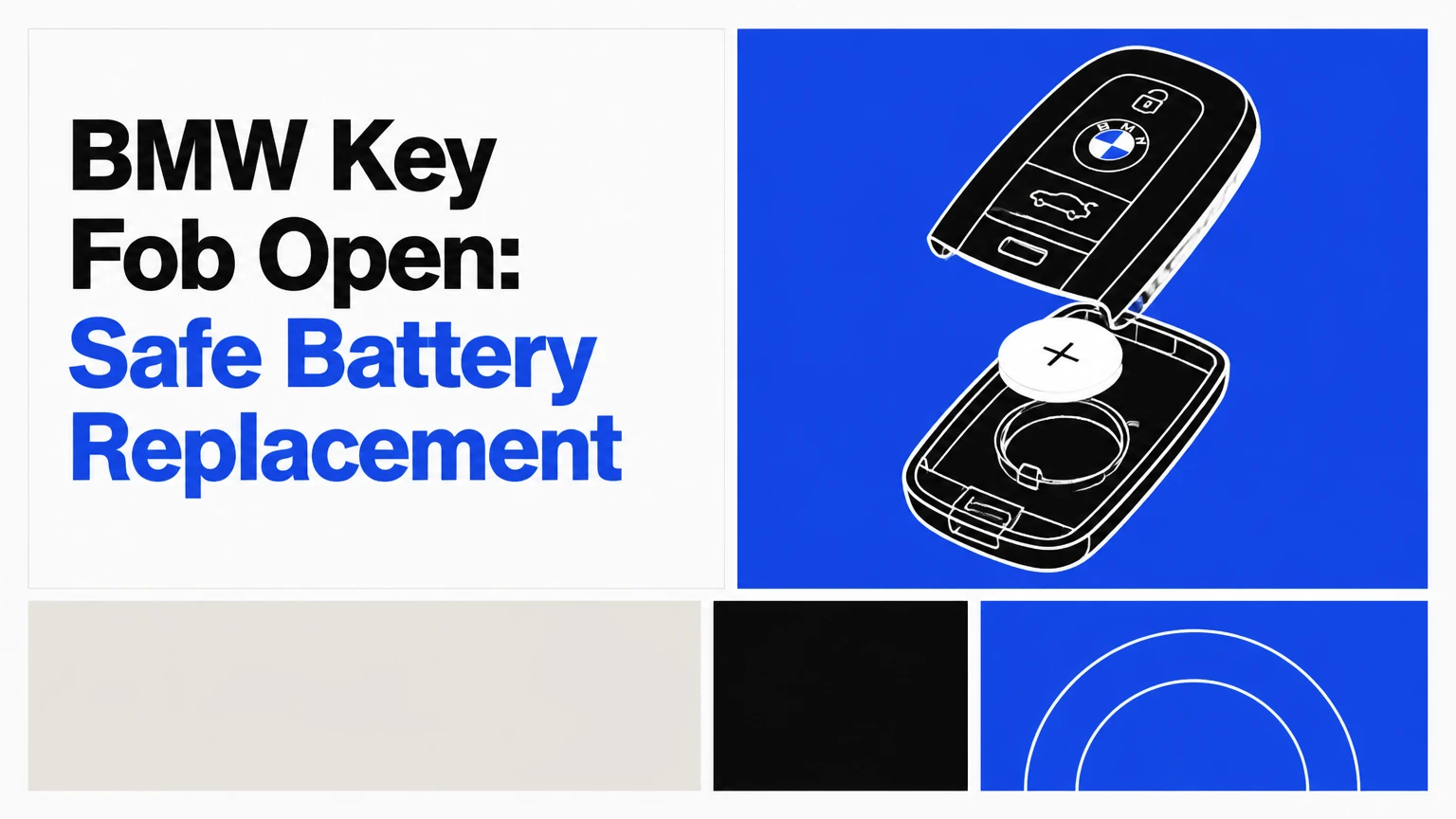
To open a BMW key fob, remove the integrated mechanical blade, use the blade or a protected flat tool at the casing seam, and gently separate the rear cover. Most newer openable BMW fobs use a replaceable CR2032 or CR2450 coin cell, while many older diamond-shaped keys contain a soldered rechargeable VL2020 battery and should be handled by a specialist.
Key Facts
A BMW key fob battery replacement normally does not require key programming.
Battery type depends on the fob design, production year, Comfort Access equipment, and chassis.
A CR2032 and CR2450 coin cell are different sizes and are not interchangeable in every housing.
A sealed diamond key may require shell cutting and battery soldering rather than a simple cover removal.
A dead remote battery does not necessarily mean the immobilizer authorization has failed.
A replacement BMW key usually requires vehicle-specific programming or initialization by BMW or a qualified automotive locksmith.
BMW Key Fob Open: Which Method Applies?
The correct opening method depends on whether the BMW key has a removable rear cover or a factory-sealed shell. Insert-style keys, trapezoid F-Series remotes, and many later G-Series remotes have a release button and a casing seam intended for controlled separation; older diamond keys with rechargeable cells may be sonic-welded shut.
Inspect the fob before inserting a tool. Look for a small rectangular blade-release button, a removable metal key, a recessed slot inside the blade channel, and a visible seam around the rear cover. If the shell has no release feature or opening recess, do not assume that a screwdriver will reveal a battery door.
BMW used several access systems, including EWS, CAS, FEM, and BDC modules. The physical shell, battery, radio board, and immobilizer transponder are related parts, but they are not identical components. Opening the housing carefully protects the circuit board and does not normally disturb the vehicle’s stored key authorization.
What tools and materials do you need?
A typical coin-cell replacement requires one correct battery, the integrated mechanical blade, and a small plastic pry tool. A tiny flat-blade screwdriver can work, but wrapping its tip with electrical tape reduces scratches and accidental contact with circuit-board components.
| Item | Typical specification | Purpose | Typical cost |
|---|---|---|---|
| Replacement coin cell | CR2032 or CR2450, 3 V lithium | Power the remote | $2-$10 |
| Plastic pry tool | Nylon, 2-5 mm tip | Separate casing seam | $2-$8 |
| Small flat screwdriver | 2-3 mm tip, protected | Backup opening tool | $3-$10 |
| Nitrile gloves | One pair, powder-free | Reduce oil on contacts | $0.25-$1 |
| Clean work surface | Tray or folded microfiber cloth | Prevent lost parts | $0-$5 |
Do not use a knife on an openable casing. A blade can cut the shell, slip into the printed circuit board, or damage the antenna and transponder area.
How Do You Open a BMW Key Fob?
Opening a replaceable-battery BMW key fob takes about 2-5 minutes when the correct seam and battery are identified. The process is mechanical: extract the emergency key, release the rear cover, remove the old cell, install the matching replacement, and test every button before closing the vehicle.
Step 1: Remove the mechanical key blade
Press and hold the small release button on the side or rear of the fob. Pull the metal emergency key straight out of its storage channel without twisting it sideways.
The blade may be called the integrated key, valet key, emergency key, or manual key in BMW documentation. Place it on the work surface after removal. You will use the blade tip on some designs to release the back cover.
Success checkpoint: The metal blade comes out cleanly, and the plastic release button returns to its original position.
Common mistake: Pulling the blade before fully pressing the release button can wear the retaining latch. If the blade resists, push it inward slightly, press the release again, and pull straight.
Step 2: Release the rear casing
Inspect the empty blade channel for a small recessed opening or pry point. Insert the blade tip into that recess, or use a protected plastic tool at the designated casing notch, then rotate gently until the rear cover releases.
Work around the intended seam rather than forcing one corner upward. Some BMW shells have alignment hooks on one side and snap clips on the other, so prying randomly can break the hooks even when the cover appears loose.
Success checkpoint: The cover separates with a controlled click and no white stress marks, gouges, or broken retaining tabs.
Common mistake: Inserting a screwdriver deep into the housing can scratch the circuit board or damage the small copper antenna structure. Keep the tool shallow and apply only enough force to release the cover.
Step 3: Identify and remove the battery
Read the marking on the existing battery before removal. A CR2032 is 20 mm wide and 3.2 mm thick, while a CR2450 is 24 mm wide and 5.0 mm thick; the larger cell cannot safely replace a CR2032 merely because both provide approximately 3 volts.
Hold a thumb over the cell while releasing it from its retaining clips. Use a plastic tool to lift the edge, starting at the side designed for removal. Avoid levering against surface-mounted components.
Success checkpoint: The old cell leaves the clips without bending them, and the holder remains attached to the board.
Common mistake: Touching both battery faces with a metal tool can create a short path. Use plastic where possible, and remove the cell by its edge rather than bridging the positive and negative surfaces.
Step 4: Install the matching replacement cell
Insert the new battery in the same orientation as the old one unless the holder markings specify otherwise. In many BMW coin-cell remotes, the positive side faces upward, but the plus mark on the holder is the final authority.
Slide one edge beneath the retaining tab first. Press the opposite edge down until the remaining clip holds the cell firmly. Do not crush, bend, or stretch the contacts.
Success checkpoint: The battery sits flat, does not rattle, and remains captured when the fob is turned over.
Common mistake: Installing a low-quality, previously used, or incorrectly sized cell can produce intermittent range and repeated low-battery warnings. Use a fresh lithium cell from a reputable manufacturer.
Step 5: Refit the cover and test the remote
Engage the casing’s alignment hooks first, then press the cover around its perimeter until all clips close. Reinsert the mechanical blade and test lock, unlock, trunk, panic, and Comfort Access functions where equipped.
Test the remote beside the vehicle before closing the doors. If the buttons work only after squeezing the shell, a battery clip or casing alignment problem remains.
Success checkpoint: The cover is flush, the blade locks into place, and the vehicle responds consistently from several metres away.
Common mistake: Closing the shell before checking the battery orientation makes troubleshooting slower. A five-second button test can prevent reopening the housing.
Which BMW Key Fob Battery Does Your Fob Use?
BMW key fob battery selection cannot be determined reliably from the vehicle year alone. The same chassis may have different batteries for standard remote access, Comfort Access, or a different key housing, so the existing cell marking, fob part number, and BMW owner’s manual provide stronger evidence than a generic year-based chart.
| BMW key style | Common examples | Typical battery arrangement | Opening expectation |
|---|---|---|---|
| Diamond-shaped legacy key | E39, E46, E53, late 1990s to 2000s | Rechargeable VL2020 soldered to board | Sealed shell on many versions |
| Insert or slim key | E60, E70, E90, mid-2000s to early 2010s | CR2032 on Comfort Access versions; rechargeable cell on some non-Comfort versions | Rear cover or sealed variant |
| Trapezoid F-Series remote | F10, F15, F30, approximately 2011-2019 | Often CR2450, but verify housing | Usually removable rear cover |
| Silver-trim G-Series remote | G20, G30, G05 and related models | Often CR2032, depending on key | Usually removable rear cover |
| BMW Display Key | Selected 7 Series, 5 Series, X5 and other models | Internal rechargeable lithium-ion battery | Display-specific housing and charging design |
Model-year ranges are approximate because BMW introduced equipment and key revisions during production. A vehicle’s chassis code narrows the answer, but the physical battery marking settles it.
Why do some BMW keys contain VL2020 batteries?
Many older BMW keys used a rechargeable VL2020 lithium-vanadium coin cell connected to the printed circuit board. The vehicle’s ignition-slot charging system replenished the cell in compatible designs, so the battery was not intended to be removed through a consumer battery door.
A VL2020 is not a drop-in substitute for a CR2032. The charging circuit, battery tabs, polarity, physical connection, and cell chemistry must match the board. Replacing a soldered rechargeable cell requires opening the welded shell, desoldering the old component, and installing a compatible tabbed cell.
A soldering mistake can lift a circuit-board pad or damage the immobilizer electronics. Professional repair is appropriate when the shell is sealed, the battery is soldered, or the key has water damage.
How Does a BMW Key Fob Communicate With the Car?
A BMW key fob uses short-range radio communication for button commands and, on equipped vehicles, a passive keyless-entry exchange for Comfort Access. The immobilizer authorization is a separate security function, while EWS, CAS, FEM, or BDC modules manage authorization according to the vehicle generation.
Button-operated remotes commonly transmit in regional radio bands such as 315 MHz in North America or 433 MHz in many European applications, but exact implementation varies. Comfort Access uses vehicle antennas to detect a nearby authorized key, and the vehicle then validates the response before unlocking.
Rolling-code and cryptographic authentication prevent a previously recorded button transmission from being reused as a normal unlock command. The exact algorithms and module implementation are BMW security details, not universal specifications that can be inferred from the fob’s appearance.
The key fob may also identify a stored driver-profile association, but the fob is not a general-purpose data logger holding complete real-time diagnostic records. Vehicle preferences are principally stored and managed by the vehicle’s access and infotainment systems.
Does opening the fob erase its programming?
Replacing the battery normally does not erase the BMW key’s authorization or require programming. The immobilizer data is stored in protected electronics, while the coin cell powers the remote-control functions.
A new replacement key is different. BMW or a qualified automotive locksmith must usually obtain, cut where applicable, and program an authorized key for the specific vehicle. Instructions found online that claim every modern BMW key can be paired by holding it against the steering column are not universal and may describe a backup-start procedure rather than authorization programming.
What If the BMW Key Fob Is Sealed?
A sealed BMW diamond key should not be opened with a kitchen knife or casual razor work. The normal repair involves cutting along the factory-welded seam, protecting the printed circuit board, replacing a correctly tabbed rechargeable cell, testing the charging circuit, and bonding the housing again.
| Key condition | Likely cause | Appropriate next action | DIY risk |
|---|---|---|---|
| No visible battery door | Sonic-welded housing | Automotive electronics technician | High |
| Battery is soldered | Rechargeable VL2020 design | Tabbed-cell replacement | High |
| Shell has cracks | Impact or previous opening | Replace shell or complete key | Medium |
| Board has corrosion | Water or battery leakage | Electronics inspection | High |
| Buttons are worn through | Rubber membrane or switch failure | Shell repair or key replacement | Medium |
A sealed-key repair may cost less than a new dealer key, but the result depends on board condition and the technician’s soldering quality. A repaired shell may not retain its original water resistance.
What Should You Do When the BMW Key Battery Is Dead?
A BMW with a dead remote battery can often be unlocked with the mechanical blade and started using the vehicle’s backup key-recognition position. The exact recognition position differs by model, so the owner’s manual should take priority over generic online instructions.
Remove the emergency blade and use it in the concealed driver-door lock cylinder. Many BMW models hide that cylinder beneath a trim cap on the exterior handle; release the cap carefully according to the manual rather than prying the painted handle.
After entering the vehicle, hold the key against the marked steering-column area or the model-specific emergency-detection location while pressing the brake and Start/Stop button. Some BMW vehicles recognize the key through a passive transponder even when the coin cell cannot operate the remote radio.
A weak vehicle battery can imitate a key failure. If two known-good keys fail simultaneously, inspect the vehicle’s 12-volt battery and relevant fuses before buying replacement remotes.
Why Does a BMW Key Still Fail After Battery Replacement?
A BMW key that remains unresponsive after a correct battery installation usually has a contact, circuit-board, synchronization, vehicle-power, or antenna problem. Battery replacement is a useful first test, but it cannot repair a broken button switch, corroded board, detached contact, or failed receiver.
| Symptom after replacement | Most likely area | Practical check | Typical remedy |
|---|---|---|---|
| No buttons work | Polarity or contact | Confirm plus side and clip tension | Refit cell or repair holder |
| One button fails | Worn microswitch | Compare lock, unlock, trunk response | Board or switch repair |
| Very short range | Weak cell or antenna damage | Test with fresh name-brand cell | Cell replacement or electronics repair |
| Car starts but remote fails | Remote circuit or synchronization | Use emergency start, then test buttons | Remote diagnosis |
| Several keys fail | Vehicle battery or receiver | Check 12-volt voltage and fuses | Vehicle electrical diagnosis |
| Comfort Access fails only | Handle antenna or passive system | Test button unlock separately | Antenna or vehicle diagnosis |
BMW key buttons can wear from repeated pressure long before the immobilizer transponder fails. A remote that starts the car but cannot lock the doors is not automatically a programming failure.
How do you restore driver-profile settings?
Driver-profile assignment is separate from opening the fob and separate from immobilizer programming. In iDrive, look for vehicle settings related to profiles, keys, or automatic driver recognition, then associate the active profile with the intended key where the vehicle software supports that option.
Seat, mirror, climate, and convenience settings may not transfer if the profile is stored locally, connected to a BMW ID, or configured for a different driver. Menu names differ across iDrive generations, so the vehicle’s software version matters.
OEM BMW Key or Aftermarket Replacement?
An OEM BMW key is usually the safer choice for guaranteed vehicle compatibility, while a reputable automotive locksmith can reduce cost and waiting time when the locksmith supports the exact chassis and security module. An unverified online shell or cloned transmitter is the riskiest option because fit, frequency, transponder compatibility, and programming support may be wrong.
| Decision factor | OEM dealer key | Qualified locksmith key | Unverified online key |
|---|---|---|---|
| Typical North American price | $400-$800 or more | $150-$300 | $30-$200 before programming |
| Typical availability | 2-5 business days | 30-60 minutes if supported | 2-10 delivery days |
| Vehicle compatibility | VIN-specific | Chassis and module dependent | Frequently uncertain |
| Programming responsibility | Dealer system | Locksmith diagnostic equipment | Usually purchaser’s problem |
| Return risk | Low after VIN verification | Moderate | High |
| Shell and button quality | Consistent OEM specification | OEM or aftermarket dependent | Highly variable |
Prices are typical practitioner ranges, not BMW’s universal published schedule. Location, model, Display Key equipment, key count, and proof-of-ownership requirements can change the final bill.
Do not buy a blank key solely because its shell resembles the original. BMW keys may require encrypted authorization data, specific radio hardware, and programming equipment that a hardware store cannot provide.
Common Mistakes When Opening a BMW Key
The most expensive mistakes happen when owners force the wrong housing or diagnose a remote problem as programming. These failure modes are avoidable with visual identification and a controlled battery test.
- Using the wrong battery size: A CR2450 may not fit a CR2032 holder, and forcing it can deform contacts. Match the printed cell designation.
- Reversing polarity: The plus mark on the holder determines orientation. If the buttons remain dead, check polarity before assuming board failure.
- Prying at the wrong seam: Use the blade-channel recess or molded pry point. Random leverage can break alignment hooks.
- Touching the circuit board: Keep tools away from coils, switches, and solder joints. A damaged board may cost more than the original battery.
- Cutting a sealed rechargeable key casually: VL2020 replacement requires soldering and a compatible tabbed cell. A CR2032 conversion is not automatically safe.
- Programming a key after a battery swap: A routine battery replacement normally needs no programming. Programming applies to a new or previously unauthorized key.
An additional practitioner rule matters: photograph the battery orientation before removal. The image preserves polarity information even when the holder markings are difficult to read.
When Should You Use a Dealer or Locksmith?
Use a BMW dealer for a VIN-specific replacement when security documentation, warranty support, or unusual Display Key hardware matters most. Use a qualified automotive locksmith when speed and cost matter, provided the locksmith confirms support for the exact chassis, module generation, frequency, and key type before accepting payment.
Choose professional service when the key is sealed, the board is corroded, the vehicle cannot recognize the emergency transponder, or every replacement battery fails. Ask for the total price, programming charge, cutting charge, warranty period, and whether the key is new, refurbished, or aftermarket.
A dealer normally requires proof of ownership and identification because BMW keys are security-related components. A locksmith should also verify ownership before programming, regardless of price.
FAQ
Can I open a BMW key fob without the metal key?
Many openable BMW remotes can be separated with a small protected plastic pry tool, but the integrated blade is often designed to fit the release recess more precisely. Removing the blade first exposes the intended access point and reduces casing damage. Do not force a sealed diamond key merely because no battery door is visible.
Does a BMW key fob charge while driving?
Some older BMW keys with rechargeable VL2020 cells charged through an ignition-slot system. Modern replaceable CR2032 and CR2450 remotes do not recharge while driving. BMW Display Keys use their own rechargeable battery and charging method, such as a cable or compatible wireless pad, depending on equipment.
How long does a BMW key fob battery last?
A replaceable coin cell typically lasts about 1-3 years, depending on button use, Comfort Access polling, temperature, and cell quality. A rechargeable legacy cell may last many years but can lose capacity or fail at the soldered connection. Short range and intermittent response are early warning signs.
Can a BMW key fob be repaired after water damage?
A water-damaged BMW key can sometimes be recovered if power is removed quickly and corrosion has not reached the circuit board. Remove the battery, do not repeatedly press buttons, and have the board inspected by an automotive electronics technician. Drying alone does not remove conductive residue or repair corroded traces.
Can a locksmith program a BMW replacement key?
A qualified automotive locksmith can program some BMW replacement keys, but capability depends on the chassis, CAS, FEM, BDC, market, and available diagnostic equipment. Confirm support before purchasing a key. A locksmith should verify ownership and explain whether the supplied key is OEM, refurbished, or aftermarket.
The Bottom Line
To open a BMW key fob safely, remove the mechanical blade, use the molded recess or a protected plastic tool, identify the exact battery, and avoid force around the circuit board. Most CR2032 and CR2450 replacements take under five minutes and do not require programming. A sealed VL2020 diamond key requires specialist repair, while a genuinely new BMW key requires vehicle-specific authorization.
The phrase BMW key fob open usually describes a battery task, not a programming task. Verify the fob design first, because that single distinction determines the correct tool, battery, cost, and risk.