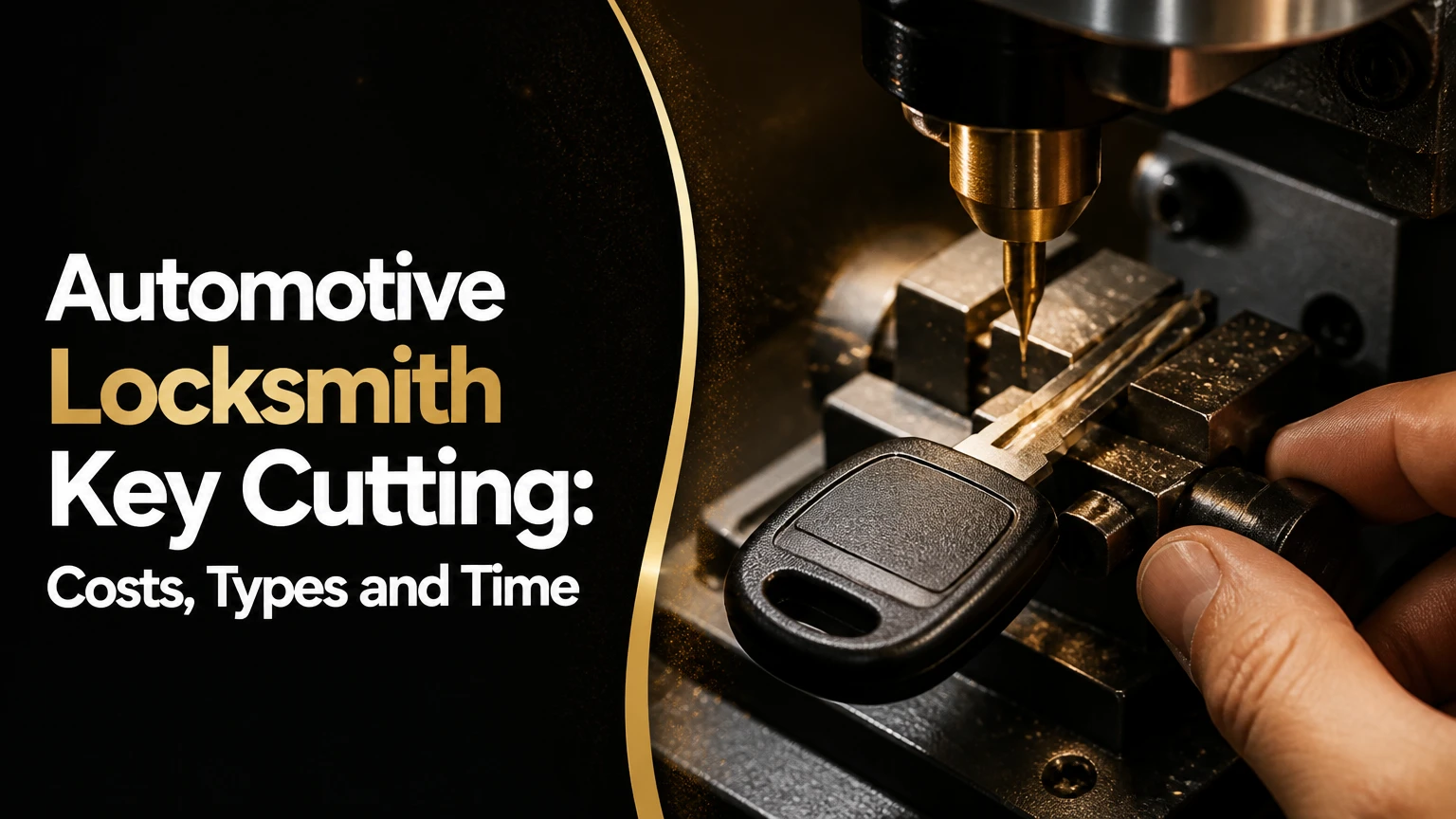
Automotive locksmith key cutting is the professional process of creating a vehicle key blade by duplicating an existing key, decoding a lock, or retrieving a manufacturer key code. The finished key may also require transponder, remote, or proximity programming before it can start or operate the vehicle.
Key Facts at a Glance
- Mechanical key cutting creates the blade shape, but it does not automatically authorize a vehicle immobilizer.
- A VIN identifies the vehicle, while a manufacturer key code identifies the mechanical cut pattern.
- A worn original key can produce an inaccurate duplicate because the cutting machine copies existing wear.
- Typical locksmith prices range from $15-$40 for a basic edge-cut duplicate to $250-$600 or more for a programmed proximity fob.
- Mobile automotive locksmith service usually takes 5-75 minutes after the technician arrives, depending on key technology and security procedures.
- A key that turns the ignition but does not start the engine usually has a programming, chip, or immobilizer problem rather than a cutting problem.
What Is Automotive Locksmith Key Cutting?
Automotive locksmith key cutting is the shaping of a metal key blade so its cuts match the wafers or pins inside a vehicle’s door, trunk, or ignition cylinder. The locksmith uses an existing key, a manufacturer code, or a physical lock decode to determine the required cut depths and spacing.
The process applies to traditional metal keys, transponder keys, flip keys, internal-track keys, and emergency blades hidden inside smart fobs. Cutting creates the correct mechanical fit. Programming creates electronic permission where the vehicle uses an immobilizer.
The distinction matters because a perfectly cut blade can unlock a door while a vehicle still refuses to start. Conversely, a correctly programmed transponder cannot turn an ignition if the metal blade has the wrong profile or bitting.
What Do Bitting, Keyway, Shoulder, and Tip Mean?
A bitting code records the cut depths at specific blade positions, while a keyway describes the blade’s cross-sectional profile and the lock path into which the blade must enter. The shoulder or tip establishes the machine’s reference point, so incorrect alignment shifts every cut.
A typical code such as 2-4-1-3-2 represents depth values at five positions, although coding conventions vary by manufacturer. The code is not universal, and a locksmith must use the correct vehicle-specific data card, blank, and machine setup.
A key can have the correct bitting but the wrong keyway. That key will either fail to enter the cylinder or enter without rotating it.
How Does Automotive Locksmith Key Cutting Work?
Automotive locksmith key cutting follows a controlled sequence: verify ownership, identify the vehicle and key system, obtain or decode the mechanical information, select the correct blank, cut and finish the blade, then test and program the key when required. The mechanical portion may take 5-25 minutes, but electronic programming can extend the appointment.
Step 1: Identify the Vehicle and Key System
The locksmith records the make, model, exact model year, body style, and current key type before choosing equipment. A 2014 Ford may use a different blade, transponder, or programming procedure from a visually similar 2013 model.
The technician also checks whether the vehicle has a conventional ignition, a push-to-start system, a remote-head key, a high-security internal track, or a specialized profile such as Ford or Jaguar Tibbe. Vehicle identification prevents an incorrect blank from being cut.
The National Highway Traffic Safety Administration identifies a VIN as a 17-character vehicle identification number. A locksmith may use that VIN for vehicle and code research, but the VIN alone does not physically reveal every mechanical cut on every vehicle.
Step 2: Obtain the Key Code or Decode the Lock
A working key can be read with a code-cutting machine or used as a reference after its wear is evaluated. When all keys are lost, a locksmith may obtain a manufacturer code through an authorized database after verifying ownership, or decode an accessible lock cylinder with specialist equipment.
The door and ignition do not always share the same code. Ignition cylinders experience more rotation and may have been replaced during an earlier repair, so a door-derived code can produce a key that opens the door but fails in the ignition.
For that reason, a technician may decode the ignition cylinder directly when the new blade fits one lock but not another. A lock decoder can provide mechanical information without relying on a visibly worn key.
Step 3: Select the Correct Blank
A key blank must match the vehicle’s keyway, blade length, thickness, shoulder position, and cut style. The locksmith also checks whether the blank contains a compatible transponder capsule, remote board, or emergency-blade format.
| Blank characteristic | What the locksmith checks | Failure if incorrect |
|---|---|---|
| Keyway profile | Cross-section and entry path | Blade will not enter or rotate |
| Blade thickness | OEM specification in millimeters | Binding or excessive movement |
| Shoulder position | Clamp reference and stop location | Cuts shift along the blade |
| Transponder type | Chip family and vehicle compatibility | Engine cranks or remains disabled |
| Fob housing | Button layout and board fit | Remote functions do not synchronize |
OEM blanks generally provide consistent metallurgy, fit, and electronic compatibility. Quality aftermarket blanks can work for many applications, but the cheapest unbranded blanks may have inaccurate profiles, weak flip hinges, poor button membranes, or incompatible chips.
Step 4: Cut the Mechanical Blade
Edge-cut keys use a milling wheel or duplicator to form grooves and teeth along the blade edge. High-security or laser-style keys use a computerized cutter to create a sidewinder or internal track through the blade face or edge.
A code cutter uses manufacturer specifications for depth, spacing, angle, and reference position. A tracing machine follows an existing blade, but tracing is only reliable when the source key is straight, correctly cut, and minimally worn.
The machine should use the correct jaw and reference method for the blank. A shoulder-stop blank clamped by the tip, or a tip-stop blank clamped by the shoulder, can create a consistent positional error across every cut.
Step 5: Deburr, Clean, and Test the Blade
The technician removes burrs and metal fragments with a brush, light file, or finishing wheel suited to the blade. Excessive filing can change a cut depth, so finishing should remove sharp residue rather than reshape the working surfaces.
The finished key should enter and withdraw smoothly from each intended cylinder. A professional test checks the door, trunk, ignition, steering lock, and emergency blade function where those components are accessible.
A key that requires force is not finished. Repeatedly forcing it can damage wafers, pins, the ignition plug, or the key blade.
Step 6: Program the Electronic Security System
Transponder programming pairs an electronically identified chip with the vehicle’s immobilizer system. Remote synchronization pairs lock, unlock, trunk, or panic buttons, while proximity-key registration teaches the vehicle to recognize a smart fob near the vehicle.
Programming methods vary by make, model, year, security level, and available keys. Some vehicles permit onboard procedures under specific conditions, while others require a diagnostic programmer, security PIN, manufacturer gateway access, or an approved online connection.
OBD-II access alone does not guarantee programming success. The programmer must support the vehicle’s immobilizer protocol, and the vehicle may reject a damaged, locked, previously paired, or incompatible chip.
Which Automotive Key Types Require Cutting?
The main automotive key types are edge-cut, high-security internal-track, Tibbe, flip, transponder, and proximity keys. Their appearance does not reliably identify their security system, because a flip key can contain either a basic blade or a chip-equipped high-security blade.
| Key type | Mechanical profile | Electronic component | Typical equipment |
|---|---|---|---|
| Edge-cut metal key | External teeth on one or both edges | None or separate chip | Manual duplicator or code cutter |
| High-security sidewinder | Internal serpentine track | Often transponder chip | Computerized milling machine |
| Tibbe key | Cylindrical multi-sided shaft | Vehicle-dependent | Tibbe-specific cutter and adapter |
| Flip key | Folding edge or laser blade | Remote board, often transponder | Code cutter and key programmer |
| Transponder key | Edge or internal-track blade | Immobilizer chip in head | Mechanical cutter and programmer |
| Proximity smart key | Hidden emergency blade | RF circuit and immobilizer ID | Smart-key programmer and blade cutter |
Edge-Cut Keys
Edge-cut keys remain common on older vehicles and simple fleet equipment. Their teeth are visible along the edge, and a correctly calibrated duplicator can reproduce them quickly when the original has little wear.
A mechanical duplicate may unlock doors and turn an ignition without any electronic programming. If the vehicle includes a separate immobilizer chip, however, the key head still needs compatible programming.
Laser-Cut and Sidewinder Keys
Laser-cut and sidewinder are common consumer terms for high-security blades with internal or centrally milled tracks. The name does not mean the locksmith must use a laser; many machines use rotary carbide cutters.
These blades are thicker and less tolerant of incorrect machine references. A basic hardware-store duplicator usually cannot produce the profile accurately, especially when the track includes multiple depths and angled transitions.
Tibbe Keys
Tibbe keys use a cylindrical, multi-faceted blade associated with certain older Ford and Jaguar applications. The cutter rotates the blank through defined positions, then creates the required angular cuts.
A standard edge duplicator is unsuitable for Tibbe keys. The correct adapter and vehicle-specific cutting data are necessary.
How Much Does Car Key Cutting Cost?
Typical automotive locksmith key cutting costs range from $15-$40 for a basic mechanical duplicate and $250-$600 or more for a programmed proximity fob. The final invoice depends on blade technology, vehicle security, whether all keys are lost, location, travel, after-hours dispatch, and the price of the electronic key.
| Service type | Typical locksmith price | Typical production time | Programming status |
|---|---|---|---|
| Basic edge-cut duplicate | $15-$40 | 5-10 minutes | None or separate chip |
| High-security blade | $60-$130 | 15-25 minutes | Usually separate |
| Transponder key | $120-$250 | 20-40 minutes | Cut and programmed |
| Remote-head or flip key | $180-$350 | 30-45 minutes | Remote and chip may apply |
| Proximity smart fob | $250-$600+ | 45-75 minutes | Immobilizer and remote |
These are typical US market ranges, not fixed prices. A spare made while a working key is available usually costs less than an all-keys-lost service because the technician can avoid vehicle entry, lock decoding, emergency code recovery, or additional security steps.
Ask for a written total before work begins. The estimate should identify the blade or fob type, programming fee, mobile dispatch fee, tax, warranty, and any charge for key extraction or lock repair.
Is a Locksmith or Dealership Better for Key Cutting?
A mobile automotive locksmith is usually the most practical option for a stranded vehicle, while a dealership is strongest when factory documentation, unusual security authorization, or a warranty requirement determines the job. Hardware stores are suitable mainly for simple mechanical duplicates.
| Provider | Typical price position | Mobile service | Programming capability | Best use |
|---|---|---|---|---|
| Automotive locksmith | $15-$600+ | Common | Common, vehicle-dependent | Lost keys and roadside replacement |
| Main dealership | Often highest | Rare | Factory equipment | Complex authorization or OEM-only needs |
| Hardware store | Lowest for basic copies | No | Rare | Older mechanical spare keys |
| Automated kiosk | Low for simple blanks | No | Limited | Simple household-style vehicle blades |
| DIY online kit | $20-$250 before tools | No | Vehicle-dependent | Owners comfortable with compatibility risk |
A hardware store can cut a compatible mechanical blank, but most stores cannot decode a lock, repair a damaged ignition, or program a modern immobilizer. A key that physically fits may still fail to start the vehicle.
A dealership may require proof of ownership, a registration document, identification, and a vehicle visit or tow. A locksmith may also require the same documents, particularly for all-keys-lost service, because key creation affects vehicle security.
When Should You Choose a Mobile Locksmith?
Choose a mobile locksmith when the vehicle is parked at home, at work, or roadside and you need cutting, programming, lock decoding, or ignition service at the same location. Mobile equipment can often complete the job without towing the vehicle.
Verify the business name, physical contact details, total estimate, technician identification, and vehicle-specific capability before authorizing work. Ask whether the quoted price includes programming and whether the replacement key carries a functional warranty.
When Is the Dealership Worth the Extra Cost?
A dealership may be worthwhile for a newer vehicle with restricted gateway access, an unusual smart-key system, an active warranty, or a manufacturer requirement that an independent programmer cannot satisfy. Dealership service is less convenient when the vehicle is immobile and towing is required.
The dealership is not automatically more accurate at mechanical cutting. Both providers still need the correct blank, code, machine calibration, and final fit test.
What Should You Prepare Before Booking Service?
Prepare the vehicle’s exact year, make, model, VIN, registration, government identification, location, and every key currently available. Tell the locksmith whether the vehicle has a metal key, remote-head key, flip key, or push-to-start fob.
Also report symptoms precisely:
- Key turns the door but not the ignition.
- Key turns the ignition but the engine will not start.
- Key is broken inside the cylinder.
- Remote buttons work, but the blade is damaged.
- All keys are lost.
- Vehicle battery is dead.
- Ignition cylinder was recently replaced.
The symptom changes the workflow and price. A dead fob battery may need a battery replacement, while a dead vehicle battery may require the hidden emergency blade to unlock the door before programming can begin.
What Mistakes Make a New Car Key Fail?
The most common failures are copying a worn key, choosing the wrong blank, using an incorrect machine reference, skipping deburring, and confusing mechanical fit with immobilizer authorization. Each failure produces a different symptom, so diagnosis should precede replacement.
Copying a Worn Original
A worn key has reduced shoulders, rounded cut peaks, and altered depth surfaces. Tracing that key transfers its errors to the duplicate, creating a second-generation key that may work worse than the source.
A code-cut replacement is preferable when the original shows visible wear or the lock already feels loose. The locksmith should compare the key with factory specifications rather than assuming the original remains accurate.
Using the Wrong Keyway or Chip
A blade may look identical while its groove profile or chip family differs. The result can be a key that enters the lock but binds, or a key that turns the cylinder while the immobilizer rejects it.
Confirm the exact vehicle year and part compatibility before purchasing an online blank or fob. Visual similarity is weak evidence.
Incorrect Shoulder or Tip Referencing
The cutting machine must reference the blank from the specified shoulder, tip, or gauge line. A small longitudinal error changes the position of every cut, especially on short automotive blades.
The practical rule is simple: the technician should use the machine jaw specified for that blank, not the jaw that happens to hold it.
Failing to Finish the Blade
Burrs can scratch or bind wafers and pins, while loose filings can contaminate a small cylinder. A new blade should feel smooth at the edges and should not require force during insertion or withdrawal.
Programming the Wrong Electronic Component
A remote can lock and unlock the doors while the immobilizer chip remains unregistered. The reverse can also occur, with a programmed chip starting the engine while remote buttons remain unsynchronized.
Test engine authorization and remote functions separately. They are related systems, but they do not always share the same pairing procedure.
Why Does the New Key Turn but Not Start the Car?
A key that turns the ignition but does not start the engine usually has an unprogrammed, incompatible, damaged, or locked transponder chip. Mechanical cutting controls cylinder rotation, while the immobilizer separately checks the electronic identity before enabling engine operation.
If the engine cranks normally but does not run, inspect the immobilizer warning light and test the original key if available. If the original starts the vehicle, the new key needs programming or a compatible chip rather than a new mechanical cut.
If neither key starts the vehicle, the fault may involve the vehicle battery, immobilizer antenna, ECU communication, fuse, or fuel and ignition systems. Recutting the blade will not repair those faults.
What If the Key Works in the Door but Not the Ignition?
A door-working key that fails in the ignition often indicates ignition-cylinder wear, a replacement ignition, or different door and ignition codes. The locksmith should test the ignition directly and decode or repair the ignition cylinder instead of repeatedly recutting the door key.
Do not force a blade that stops halfway or requires excessive torque. Broken keys are harder to remove and can turn a cutting job into an extraction or ignition-repair appointment.
What If the Key Is Stuck in the Lock?
Do not twist violently, pry with a metal tool, or spray an unsuitable lubricant into the cylinder. Lightly reduce tension on the steering wheel, return the transmission to the correct park or neutral position, and attempt gentle movement only if the key is not visibly bent.
A bent blade, damaged wafer, worn ignition, or burr can trap the key. A locksmith should extract the blade when gentle movement fails, because broken fragments can obstruct the cylinder and increase repair cost.
Should You Delete Old Keys After Buying a Used Car?
Ask the locksmith or dealer whether the vehicle supports erasing previously registered keys and adding only the keys you possess. Deleting old registrations reduces the risk that a missing key from the previous owner can still authorize the immobilizer.
Mechanical door access and electronic start authorization are separate concerns. Rekeying a door cylinder may be necessary if a former owner could still possess a mechanical key, even after the immobilizer memory is updated.
How Can You Avoid an Emergency Key-Cutting Call?
Create a spare while one working key remains, store it away from the vehicle, and replace a visibly worn blade before it damages the lock. Proactive duplication usually reduces labor because the technician can copy or code-cut from a usable reference instead of decoding a vehicle with no keys.
Keep the key code, VIN, registration, and replacement-key details in a secure record. Do not store the key code publicly with the vehicle documents.
Classic vehicles often benefit from brass or manufacturer-quality blanks because soft, poorly formed blades can twist or break in tight vintage cylinders. Modern proximity systems require a different plan, including fob battery care and emergency-blade testing.
Frequently Asked Questions
Can a Locksmith Cut a Car Key From the VIN?
A locksmith can often use the VIN to identify the vehicle and request or retrieve a manufacturer key code through an authorized source, but the VIN does not universally encode the physical bitting. Ownership verification, database access, regional restrictions, and the vehicle’s lock history determine whether VIN-based code cutting is available.
Can I Get a Car Key Cut Without the Original?
Yes, an automotive locksmith can often create a key without the original by retrieving a valid code or decoding a lock cylinder. All-keys-lost service may require vehicle access, proof of ownership, ignition or door decoding, and immobilizer programming, so it generally costs more than a spare made from a working key.
Does Every Replacement Car Key Need Programming?
No. A purely mechanical key does not need programming, but a key with a transponder, remote circuit, or proximity function usually requires electronic registration or synchronization. A blade can be mechanically correct and still fail to start the vehicle when its immobilizer chip is absent or unrecognized.
Can I Duplicate a Worn Car Key?
A worn key can sometimes be duplicated, but tracing it may reproduce its wear and create an unreliable copy. A locksmith should inspect the source key and use a manufacturer code or decode the lock when the blade has rounded cuts, damaged shoulders, or inconsistent operation.
How Long Does Mobile Car Key Service Take?
Typical production takes 5-10 minutes for a basic edge-cut key, 20-40 minutes for a transponder key, and 45-75 minutes for a proximity fob. All-keys-lost jobs, damaged locks, restricted programming, poor access, and after-hours conditions can extend the appointment.
Is an Aftermarket Key Fob Safe to Use?
A quality aftermarket fob can work when its frequency, board, chip, buttons, blade, and vehicle application match exactly. The lowest-cost fobs carry higher compatibility and durability risk, so confirm programming support, return terms, battery condition, and warranty before purchase.
The Bottom Line
Automotive locksmith key cutting creates the correct mechanical blade, but modern vehicle service often also requires transponder or smart-key programming. Choose a mobile automotive locksmith for on-location cutting, decoding, and programming, use a dealership when manufacturer authorization is necessary, and make a spare before the only working key becomes worn or lost.