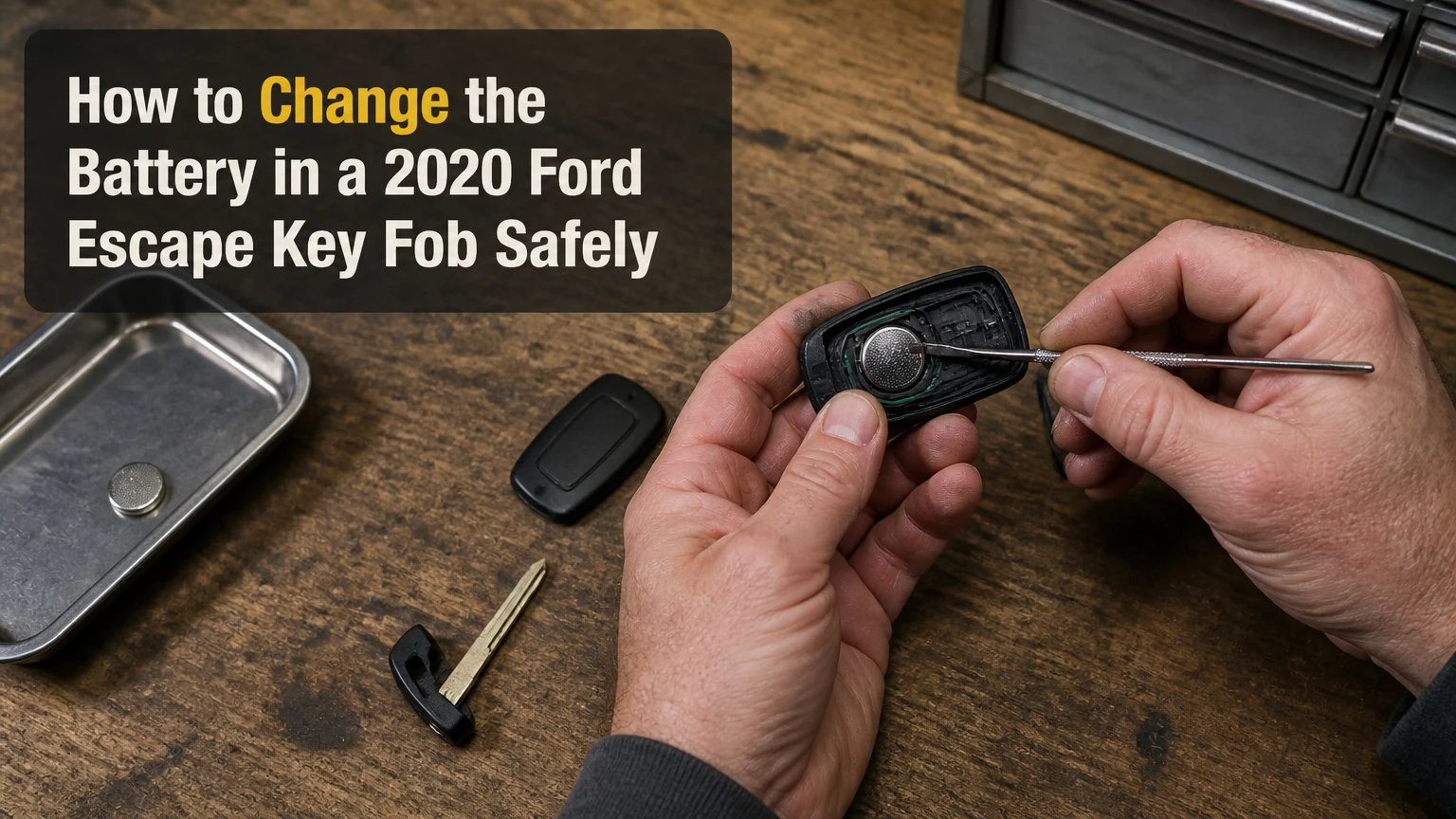
To change the battery in a 2020 Ford Escape key fob, remove the emergency key, use the exposed pry slot to split the housing, and replace the coin cell with a CR2032 3V lithium battery. The job normally takes 2-5 minutes and does not require key reprogramming when the fob circuit board remains undisturbed.
Key Facts at a Glance
- The 2020 Ford Escape Intelligent Access key fob typically uses one CR2032 3V lithium coin battery.
- The emergency key blade releases before the plastic fob housing can be opened safely.
- The new battery normally installs with the positive side facing upward and visible.
- A battery replacement usually preserves the fob’s programming because programming is stored electronically, not in the removable coin cell.
- A DIY replacement typically costs $2-$7 and requires no specialized automotive diagnostic tool.
- A weak battery can affect remote buttons, passive entry, and passive starting at different times.
What You Need Before Starting
The 2020 Ford Escape battery replacement requires one CR2032 battery and a small non-damaging pry tool. A small flathead screwdriver can work, but the removed emergency key blade is often preferable because its shape fits the intended opening notch and reduces the chance of cutting the plastic case.
Before You Start
| Requirement | Typical specification | Why it matters |
|---|---|---|
| Replacement battery | 1 CR2032, 3 volts | Matches the common Intelligent Access transmitter cell |
| Working time | 2-5 minutes | Includes opening, replacement, and testing |
| Tool | 1 emergency key or small flathead screwdriver | Opens the case at the molded pry point |
| Work surface | Clean, dry, flat surface | Prevents lost clips or battery contamination |
| Difficulty | Low, with moderate care | The retaining clips and contact tabs can be damaged |
Buy a reputable CR2032 from a sealed package. Duracell, Energizer, Panasonic, and other established manufacturers are reasonable choices when the package is fresh and undamaged. Do not assume that a CR2025, CR2016, or rechargeable coin cell is interchangeable: those batteries differ in thickness, capacity, or chemistry.
Keep the old battery away from children and pets. The U.S. Consumer Product Safety Commission treats button and coin batteries as a serious ingestion hazard, so place the removed cell in a secure container immediately and recycle or dispose of it according to local requirements.
How to Change the Battery in a 2020 Ford Escape Key Fob
Replacing the 2020 Ford Escape key-fob battery involves seven short actions: release the mechanical key, locate the internal notch, open the shell, remove the old cell, install the new CR2032, close the case, and test every function. The factor that most determines success is using the molded pry point instead of forcing the seam or buttons.
Step 1: Remove the Emergency Key
Slide the mechanical-key release switch and pull the metal emergency key blade out of the fob. Hold the fob with the buttons and key-ring end under control so the blade does not fall onto a hard surface.
Checkpoint: You will know the blade is fully removed when the internal cavity is open and the metal key no longer blocks the housing seam.
Common mistake: Do not pry around the outer seam while the emergency key remains installed. The blade blocks access to the designed opening point and makes shell damage more likely.
Step 2: Find the Pry Slot
Look inside the cavity that held the emergency key. The cavity contains a small notch or recessed opening intended to separate the two halves of the fob.
Insert the tip of the emergency key blade into that notch. If the blade does not engage cleanly, use a small flathead screwdriver with a narrow, blunt tip rather than a knife or razor.
Checkpoint: The tool should sit in a defined recess, not against a rubber button, circuit board edge, or random part of the case.
Common mistake: A kitchen knife is a poor substitute. Its thin, sharp edge can gouge the housing, slip into the transmitter electronics, or damage the sealing surface.
Step 3: Separate the Fob Housing
Twist the emergency key or screwdriver gently until the retaining clips release. Work around the opening only as far as necessary, then separate the back cover with your fingers.
The case should open with controlled pressure. If the plastic flexes heavily, stop and reposition the tool because a clip or internal ledge may still be engaged.
Checkpoint: The back cover separates without a cracked corner, torn gasket, or loose button membrane.
Common mistake: Do not twist the tool deeply. The opening tool needs to split the shell, not reach toward the circuit board.
Step 4: Remove the Old CR2032
Observe the old battery’s orientation before lifting it from the holder. Use a fingernail or the tool tip at the battery’s edge, applying upward pressure away from the metal contact tabs.
Avoid bending the spring contacts beneath or beside the coin cell. Flattened contacts may fail to press firmly against the replacement battery even when the battery itself is new.
Checkpoint: The old cell comes out while the contact tabs remain raised, aligned, and visibly intact.
Common mistake: Do not stab the center of the battery or lever directly against a contact tab. Lift from the edge and use the holder’s clearance point.
Step 5: Install the New Battery
Place one CR2032 into the holder with the positive (+) side facing upward unless the polarity marking inside your particular transmitter clearly indicates otherwise. The side with the printed text and plus symbol should normally remain visible after installation.
Press the cell into the holder evenly. Do not force it beneath a retaining clip at an angle, because that can deform the holder or push the battery against the wrong contact.
Checkpoint: The battery lies flat, the positive marking is visible, and the cell cannot shift when the fob is tilted gently.
Common mistake: Installing the battery upside down is the most common immediate failure. Recheck the plus and minus symbols before closing the case.
Step 6: Close the Housing
Align the back cover with the front assembly and press around the perimeter until every retaining clip snaps into place. Check the button edges and the seam before applying pressure to the center.
Checkpoint: The seam is even on all sides, no corner lifts when pressed, and the buttons move with their original resistance.
Common mistake: Do not close the fob with the battery partly outside its holder. A raised cell can prevent the clips from locking and may damage the cover.
Step 7: Reinstall the Emergency Key and Test
Slide the emergency key blade back into its channel until it locks. Stand beside the vehicle and test lock, unlock, liftgate release, and any other button shown on your transmitter.
Then test passive entry by touching the door handle with the fob nearby and test push-button starting inside the vehicle.
Checkpoint: The remote buttons respond, the vehicle recognizes the fob, and the fob sits securely in the vehicle’s storage location.
Common mistake: Testing only one remote button can hide a damaged membrane or intermittent contact. Test each button and passive functions separately.
Which CR2032 Battery Should You Buy?
A fresh, name-brand CR2032 is the correct practical choice for a 2020 Ford Escape key fob. Brand differences matter less than correct size, sealed packaging, recent manufacture, and proper storage, because a high-quality cell cannot compensate for an incorrect battery type or bent fob contact.
| Battery option | Nominal voltage | Typical retail price | Practical consideration |
|---|---|---|---|
| Duracell CR2032 | 3 volts | $2-$6 for 1-2 cells | Widely available in retail stores |
| Energizer CR2032 | 3 volts | $2-$7 for 1-2 cells | Common choice for seasonal temperature changes |
| Panasonic CR2032 | 3 volts | $2-$6 for 1-2 cells | Frequently available in electronics suppliers |
| Generic CR2032 | 3 volts | $1-$4 for 2-5 cells | Quality and shelf age vary significantly |
Avoid touching both flat faces of the new battery unnecessarily. Skin oils rarely destroy a coin cell instantly, but wiping the cell with a clean, dry cloth removes contamination that could interfere with a marginal contact.
A CR2025 may fit the diameter of the holder but is thinner than a CR2032. The thinner cell can create weak spring pressure and intermittent operation, so it is not a reliable substitute merely because the fob closes.
How Much Does Replacement Cost?
A DIY 2020 Ford Escape key-fob battery replacement typically costs $2-$7 and takes 2-5 minutes. A parts store may install a battery at little or no labor charge, while an automotive locksmith or Ford dealership generally costs more because the price includes labor, handling, and service overhead.
| Replacement method | Battery or service cost | Typical time | Best use |
|---|---|---|---|
| DIY at home | $2-$7 | 2-5 minutes | Intact case and comfortable tool handling |
| Automotive parts counter | $3-$10 | 5-15 minutes | Quick battery purchase and basic assistance |
| Automotive locksmith | $15-$30 | 5-15 minutes | Damaged clips, uncertain fob design, or no tool |
| Ford dealership | $20-$50 | 15-45 minutes | Warranty concerns or broader key-system diagnosis |
Prices are typical consumer ranges rather than fixed Ford charges. A dealership may charge more if the technician diagnoses a transmitter, vehicle battery, or passive-entry fault instead of performing a simple coin-cell replacement.
The battery replacement itself does not normally require a new key code. Reprogramming becomes relevant when the transmitter is lost, replaced, electronically damaged, or no longer recognized after other causes have been ruled out.
What If the New Battery Does Not Work?
A 2020 Ford Escape key fob that remains inactive after battery replacement usually has an orientation, contact, seating, or case-assembly problem. Check those physical causes first, then determine whether the vehicle recognizes the transmitter for passive starting and entry.
| Symptom after replacement | Most likely cause | Corrective action |
|---|---|---|
| No buttons work | Battery reversed or dead | Recheck polarity and try a fresh CR2032 |
| Buttons work intermittently | Bent contact or loose cell | Restore contact pressure and reseat the battery |
| Remote works but passive start fails | Weak signal, fob location, or vehicle issue | Use the backup location and check the vehicle battery |
| Case will not close | Battery tilted or shell misaligned | Remove the cell, align the holder, and inspect clips |
| Red indicator does not flash | Battery contact, board, or transmitter fault | Inspect contacts, then seek locksmith or dealer diagnosis |
Check Polarity and Battery Quality
Open the housing again and confirm that the positive side is facing outward. Test with a second sealed CR2032 if the first battery has unknown storage history, visible damage, or a loose package.
Do not stack two coin cells. The fob is designed for one 3-volt battery, and stacking cells can damage the transmitter or create a short circuit.
Inspect the Contact Tabs
The contact tabs must touch the battery firmly. If a tab was flattened during removal, use a wooden toothpick or similarly nonconductive tool to lift it slightly, then reinstall the battery without excessive force.
Do not use metal pliers inside an energized fob. A conductive tool can bridge contacts and short the coin cell.
Check the Housing and Buttons
A case that is not fully clipped together can prevent a button membrane from contacting its switch. Press each button after closing the shell; a button that feels recessed, stuck, or unusually soft indicates misalignment rather than a programming problem.
Inspect for a cracked shell, missing retainer, or water contamination. Battery replacement is not a good repair for a transmitter with a damaged circuit board, corroded contacts, or liquid exposure.
Try the Backup Starting Position
If the remote buttons work but the 2020 Ford Escape displays a key-not-detected message, place the fob in the vehicle’s designated backup pocket or slot and press the start button while holding the brake. Ford used specific transmitter backup locations that can vary by console design and equipment, so confirm the exact position in the vehicle owner’s manual.
This procedure helps the vehicle read the transmitter at close range. It does not repair a damaged fob, replace a discharged 12-volt vehicle battery, or permanently reprogram a transmitter.
What Other Situations Require a Different Approach?
Most owners can replace the battery without changing the key’s programming, but several situations call for a different response. A replacement shell, an aftermarket transmitter, a missing emergency blade, or a fully damaged fob can change the procedure and the cost.
Different Fob Shape or Button Count
Compare the replacement process with the physical transmitter in your hand, not only with a photograph online. Some 2020 Ford Escape vehicles may have equipment or market variations, and an aftermarket replacement shell may use a different seam or battery holder.
If the battery marking inside the fob differs from CR2032, follow the marking on the installed transmitter and verify the part through the Ford owner’s manual or a Ford parts source before buying a cell.
Damaged Case or Loose Emergency Key
A cracked case can expose the circuit board to moisture and may fail to hold the battery against its contacts. Replace the shell or have a locksmith transfer the electronics if clips, the key retainer, or the sealing surfaces no longer secure the assembly.
A locksmith can also cut or replace the mechanical emergency blade. A coin-cell change will not solve a missing blade.
Completely Dead Vehicle or Multiple Fobs
Test the spare fob if available. If both fobs fail at the same time, inspect the vehicle’s 12-volt battery, central locking behavior, and dashboard messages before assuming both coin cells failed.
Two simultaneous dead fobs are less typical than a vehicle-side power or receiver issue. That distinction prevents unnecessary transmitter replacement.
How Long Should the Battery Last?
A CR2032 in a 2020 Ford Escape key fob commonly lasts about 2-4 years, although heavy button use, frequent passive-entry detection, extreme temperatures, and storage near the vehicle can shorten that range. Battery life is usage-dependent rather than a fixed Ford service interval.
Passive entry can consume power even when the driver rarely presses a button because the transmitter participates in proximity detection. A low-battery warning, reduced remote range, delayed unlock response, or intermittent passive start can appear before complete failure.
Keep a spare CR2032 in its original package at home rather than loose in a glovebox with metal objects. Loose metal can bridge the battery terminals and discharge the cell.
Expert Rules That Prevent Fob Damage
Experienced key technicians use three practical rules during coin-cell replacement. Each rule addresses a failure that a new battery cannot fix.
- Use the emergency key as the first pry tool. The blade is already sized for the fob and avoids introducing a sharp kitchen utensil into the housing.
- Photograph the old battery before removing it. A quick orientation photo prevents confusion if the polarity symbol on the holder is difficult to see.
- Test the transmitter before discarding the old cell. If the new battery fails, retaining the old cell briefly helps distinguish a bad installation from a separate fob fault.
- Do not wash the circuit board. Moisture, alcohol residue, and aggressive scraping can create a larger failure than the original weak battery.
- Close the shell evenly. Pressing one corner repeatedly can break a retaining clip while leaving the opposite side unseated.
The fob battery is a power source, not a memory backup. Removing it for a few minutes normally does not erase the transmitter’s identity, remote settings, or vehicle pairing.
Frequently Asked Questions
Does changing the 2020 Ford Escape key fob battery erase programming?
No, replacing the CR2032 normally does not erase the 2020 Ford Escape key fob’s programming. The transmitter’s electronic identification remains stored on its circuit board. Reprogramming is generally associated with a replacement or damaged transmitter, not ordinary removal of the coin cell.
Can I use a CR2025 instead of a CR2032?
A CR2025 is not the preferred substitute for a 2020 Ford Escape key fob. Both cells are 3 volts and have the same diameter, but the CR2025 is thinner, which can reduce contact pressure and cause intermittent operation. Use the battery size marked for your transmitter.
Why does my Escape say No Key Detected after replacement?
A No Key Detected message can result from reversed polarity, weak contact tabs, a poorly closed housing, a damaged transmitter, a discharged vehicle battery, or an out-of-range fob. Recheck the battery first, then use the owner’s manual to locate the backup transmitter pocket for starting.
Will the remote start stop working after a battery change?
A normal CR2032 replacement should not disable remote start or other programmed functions. If remote start fails afterward, verify that the lock sequence is accepted, the vehicle has no active warning condition, the hood and doors are closed, and the fob battery is seated correctly.
How do I dispose of the old Ford key fob battery?
Keep the removed CR2032 away from children and place it in a battery-recycling collection point or follow local household hazardous-waste instructions. Do not leave a loose coin cell in a drawer, cup holder, or trash where it can contact metal or be swallowed.
Should I replace the battery in both Ford Escape fobs?
Replace the second fob only if it shows reduced range, delayed responses, or similar age and usage. If both fobs were purchased and used at the same time, replacing both with fresh CR2032 cells can prevent a second failure, but each transmitter should be opened and tested separately.
The Bottom Line
To change the battery in a 2020 Ford Escape key fob, remove the emergency key, pry open the case at the internal notch, install one CR2032 with the positive side normally facing up, and test every remote and passive function. The job costs about $2-$7, takes 2-5 minutes, and usually requires no reprogramming.