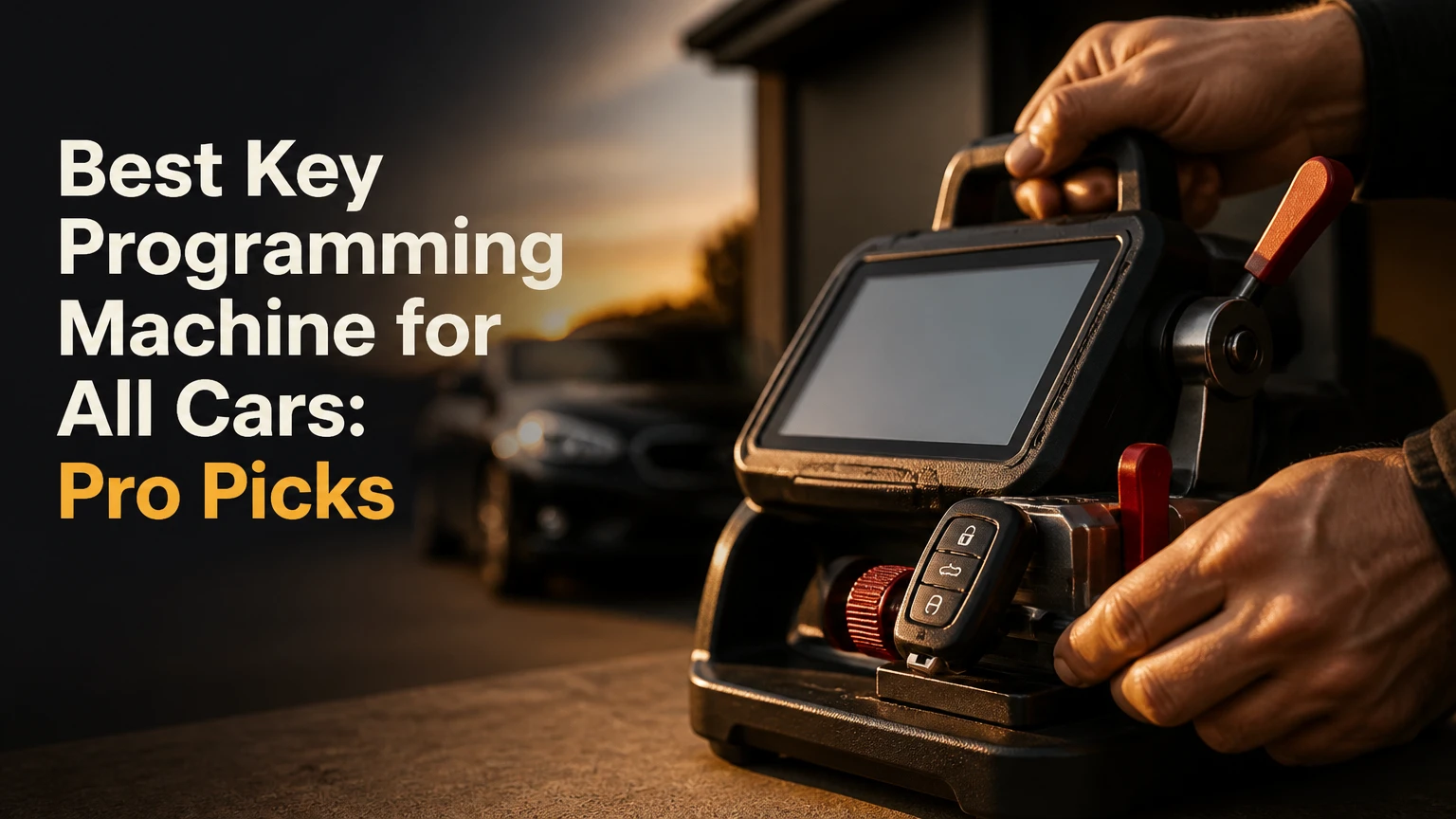
The Autel MaxiIM IM608 II is the best overall key programming machine for broad professional coverage because it combines immobilizer functions, EEPROM work through the XP400 Pro, and advanced vehicle diagnostics. No machine programs every car, however, so locksmiths should match coverage by make, year, region, key type, security gateway, and required online authorization.
Key Facts at a Glance
- No aftermarket programmer supports 100% of vehicles because immobilizer protocols, encryption, and online authorization vary by manufacturer and model year.
- The Autel MaxiIM IM608 II is the strongest all-round choice when key programming and full diagnostic capability must share one platform.
- The Xhorse VVDI Key Tool Plus Pad is better suited to locksmiths who generate, test, and clone aftermarket remotes frequently.
- The Autel IM508S reduces the purchase price while retaining substantial IMMO coverage, but it does not replace the IM608 II for advanced diagnostics.
- Typical programming time ranges from 2-5 minutes for a straightforward transponder key to 30-90 minutes for complex European module work.
- A stable battery maintainer, correct key blank, legitimate security credentials, and verified vehicle coverage matter more than a tool’s advertised vehicle count.
What Is the Best Key Programming Machine for All Cars?
The best key programming machine for all cars does not exist as a literal universal device. For a professional who needs the broadest practical combination of immobilizer programming, diagnostics, EEPROM capability, and guided procedures, the Autel MaxiIM IM608 II is the most defensible overall choice; the Xhorse VVDI Key Tool Plus Pad is stronger for locksmith production work.
“Universal” describes a coverage strategy, not a guarantee. A programmer may support key learning on a 2018 Toyota in one region but require an active subscription, seed-key calculation, secure gateway access, a specific cable, or an OEM account for a related model. Coverage databases also change as manufacturers revise security systems.
The correct buying question is therefore: Which platform covers the vehicles, key types, and security procedures I actually encounter? A repair shop may value Autel’s bidirectional diagnostics, while a mobile locksmith may earn more from Xhorse’s remote and transponder ecosystem.
How Do Automotive Key Programmers Work?
An automotive key programmer authenticates with the immobilizer system, then enrolls an authorized transponder or smart key through a vehicle-specific procedure. The vehicle’s antenna receives the key’s radio signal, the immobilizer validates its cryptographic response, and the engine controller permits starting when the stored authorization matches.
Older transponder systems commonly use a fixed or encrypted chip identity. Newer proximity systems combine a low-frequency wake-up signal, a radio-frequency response, rolling codes, body-control modules, and sometimes a separate digital key credential. The remote lock function and engine-start authorization can use different data, so a key may start the engine while its buttons remain unsynchronized.
Programming can occur through the OBD-II diagnostic connector, a bench connection, or direct reading and writing of EEPROM or microcontroller memory. OBD procedures are faster and less invasive when supported. EEPROM work may be necessary when all keys are lost, a module has been replaced, or the vehicle’s security architecture blocks normal diagnostic learning.
OBD, EEPROM, and Online Authorization
OBD programming communicates with the vehicle while the immobilizer module remains installed. EEPROM or MCU work reads nonvolatile security data from a removed or connected module, which requires suitable adapters, correct pin identification, and electronics competence.
Online authorization is a separate category. Some late-model vehicles require a manufacturer server, registered professional account, timed security access, or a paid calculation service. An aftermarket tablet cannot legitimately replace every OEM credential. Any workflow that claims to “bypass” security without ownership verification should be treated as unsafe and potentially unlawful.
Which Features Determine Real Vehicle Coverage?
Real coverage depends on supported make, model, year, region, immobilizer generation, key type, and procedure depth. A tool that lists a vehicle in its menu may support only duplicate-key learning, while all-keys-lost recovery, smart-key reset, remote synchronization, or module replacement may require extra hardware or an online service.
Evaluate these attributes before comparing brands:
- IMMO procedure depth: Check duplicate key, all-keys-lost, add-key, erase-key, remote learning, and smart-key reset functions separately.
- EEPROM and MCU support: Confirm supported memory families, adapters, clips, solder-free methods, and bench cables.
- Security-gateway access: Determine whether FCA, Renault, Mercedes-Benz, Volkswagen Group, or other protected vehicles need credentials or a bypass cable.
- Key generation ecosystem: Verify compatible transponder chips, universal remotes, proximity fobs, blade profiles, and regional frequencies.
- Diagnostic functions: Look for full-system scanning, active tests, coding, adaptations, and topology rather than an IMMO menu alone.
- Update economics: Include annual software, tokens, cable kits, replacement adapters, and online service charges.
- Support quality: A searchable coverage report and responsive technical support are more useful than a large vehicle-count claim.
Our Top Picks for Professional Key Programming
1. Autel MaxiIM IM608 II: Best Overall
The Autel MaxiIM IM608 II is the best overall platform for a repair business or locksmith that needs advanced diagnostics alongside immobilizer programming. Its IMMO software, XP400 Pro programmer, guided procedures, and broad diagnostic environment make it more versatile than a dedicated handheld cloner.
The IM608 II is particularly useful when a key complaint overlaps with a body-control, CAN, battery, or communication fault. Bidirectional tests and full-system scans can show whether a no-start condition actually results from key authorization. That prevents a technician from replacing a key when the real fault is a failed antenna, body module, fuse, or wiring network.
The XP400 Pro expands transponder, infrared, EEPROM, and MCU functions, although exact support varies by software version and vehicle. European vehicles with FEM, BDC, MQB, or gateway-related systems may still require careful research, stable power, module-specific adapters, and sometimes OEM or specialist services.
Drawback: The initial price and recurring software subscription are high. The tablet is also excessive for a technician who performs only occasional duplicate-key jobs.
Choose this if: You operate a mixed repair and locksmith business, need active diagnostics, or handle newer vehicles with multiple control-module systems.
Skip it if: Your work is limited to cloning a small number of existing transponder keys.
2. Xhorse VVDI Key Tool Plus Pad: Best for Mobile Locksmiths
The Xhorse VVDI Key Tool Plus Pad is the strongest choice for a mobile locksmith whose daily workflow centers on transponder identification, universal remote generation, key preparation, and specialized immobilizer work. Its advantage is the connected Xhorse ecosystem rather than diagnostic breadth.
Xhorse supports a wide range of universal remotes and transponder products, and its built-in coils and related tools can streamline identification and preparation. Token-based functions can reduce dependence on a traditional annual subscription for some operations, but tokens are still a business cost and may be tied to specific services or products.
The platform is attractive for technicians who already use Xhorse remotes, key cutting equipment, and VVDI software. It can also fit a production-oriented workflow where the programmer prepares a key and a separate scan tool diagnoses engine, ABS, or airbag problems.
Drawback: The VVDI Key Tool Plus Pad is not a replacement for a high-end general diagnostic tablet. Users may also encounter ecosystem dependence, token requirements, and inconsistent aftermarket-key quality.
Choose this if: You generate many aftermarket keys, carry stock in a van, and already understand transponder and EEPROM procedures.
Skip it if: Customers expect one device to perform advanced coding, system diagnostics, and key work across every manufacturer.
3. Autel MaxiIM IM508S: Best Lower-Cost Professional Gateway
The Autel MaxiIM IM508S is the best lower-cost professional option when immobilizer work matters more than advanced vehicle diagnostics. It provides a more accessible entry into Autel’s IMMO environment, while the IM608 II remains the better choice for broad coding and bidirectional service functions.
The IM508S suits used-car operations, independent garages, and mobile technicians who mostly add keys, perform basic all-keys-lost procedures, and verify immobilizer faults. Its smaller format can be easier to carry, and its purchase cost is typically lower than the flagship platform.
The savings require qualification. Advanced EEPROM or MCU work may need an XP400-class programmer, adapters, or separate bench equipment. Coverage also depends on the software package and active update status, so buyers should test their most common vehicles before committing.
Drawback: The IM508S has less diagnostic depth and may require external accessories for complex memory operations.
Choose this if: You need credible IMMO capability for domestic and Asian vehicles without buying a full premium diagnostic platform.
Skip it if: You regularly service high-security European systems or need advanced coding and active tests every day.
4. TOPDON T-Ninja Platform: Best for Selective Value Buying
A TOPDON T-Ninja device can be a sensible value option when its verified coverage matches a defined fleet or regional market. It should not be treated as a universal substitute for Autel or Xhorse solely because the hardware costs less.
TOPDON’s value depends heavily on the exact model, software package, accessory bundle, and country support. A buyer handling common domestic or Asian vehicles may obtain adequate add-key capability, while a locksmith facing frequent European all-keys-lost jobs may need EEPROM equipment and separate security services.
Ask the seller for a current coverage report, supported key procedures, update terms, and examples for your actual vehicle identification numbers. Test communication before purchasing if a return policy allows it.
Drawback: Coverage depth, regional availability, and documentation can be less predictable than established premium ecosystems.
Choose this if: You have a known vehicle mix and can validate each required procedure before purchase.
Skip it if: You want a single platform for unpredictable nationwide locksmith work.
How Do the Leading Machines Compare?
The following comparison uses functional positioning rather than unsupported global coverage percentages. Manufacturers publish compatibility by vehicle and software version, so no honest table can assign one permanent percentage to every car on the road.
| Platform | Primary strength | EEPROM or chip capability | Diagnostic depth | Typical ownership issue |
|---|---|---|---|---|
| Autel IM608 II | IMMO plus full diagnostics | XP400 Pro, adapters vary by job | Advanced scans, active tests, coding | High hardware and subscription cost |
| Xhorse Key Tool Plus Pad | Remote and transponder production | Strong Xhorse ecosystem, model-dependent | Limited compared with full scan tablets | Tokens and Xhorse-compatible stock |
| Autel IM508S | Professional IMMO at lower entry cost | External accessories may be needed | Basic to moderate | Less coding and diagnostic depth |
| TOPDON T-Ninja | Targeted value coverage | Depends on exact kit and vehicle | Model-dependent, generally narrower | Coverage and regional support must be verified |
Which Platform Has the Lowest Total Cost?
The lowest purchase price is not always the lowest operating cost. A realistic budget must include the tablet, VCI, chip programmer, adapters, battery maintainer, key stock, software updates, tokens, online credentials, and occasional specialist support.
| Cost category | Typical professional range | What changes the figure |
|---|---|---|
| Mid-tier IMMO tablet | $800-$1,700 | Brand, bundle, display, included programmer |
| Premium IMMO tablet | $2,000-$3,500 | Diagnostics, XP400-class hardware, software scope |
| Annual software access | $300-$1,000+ | Brand, region, promotions, renewal year |
| EEPROM or bench accessories | $150-$800 | Adapters, cables, clips, soldering equipment |
| Battery maintainer | $120-$500 | Output current, voltage regulation, professional duty cycle |
| Key and remote inventory | $500-$3,000 | Fleet size, OEM versus aftermarket stock, region |
These are typical market ranges, not fixed quotations. Manufacturer pricing, taxes, exchange rates, regional distributors, and subscription promotions can change the final amount substantially.
A technician performing two or three paid smart-key jobs weekly may recover a professional tool investment quickly, but revenue is not profit. Blank-key cost, travel, failed attempts, insurance, subscriptions, taxes, and callbacks reduce the margin. Calculate break-even from completed jobs, not quoted jobs.
What Should You Check Before Buying?
Start with your job history, not a generic “all cars” claim. List the last 50 vehicles you serviced, then mark make, model year, key type, duplicate or all-keys-lost status, and whether the job required EEPROM, PIN retrieval, gateway access, or an OEM account.
Use this buying sequence:
- Download the current coverage report for every shortlisted platform.
- Search the exact year and regional variant, not only the model name.
- Confirm whether the procedure is add-key, all-keys-lost, remote learning, or module replacement.
- Identify required programmers, cables, adapters, tokens, and online credentials.
- Price three years of updates, not only the first-year bundle.
- Verify the return policy and technical support before opening software subscriptions.
- Budget for a regulated battery maintainer and a second diagnostic method.
- Check local laws, licensing, proof-of-ownership rules, and data-retention obligations.
A tool with 10,000 listed models can be less useful than a tool with 3,000 models if the latter supports the exact vehicles entering your workshop. Coverage depth wins over menu size.
How Is a Key Programmed Safely Through OBD-II?
A typical authorized OBD-II key-learning job takes 2-15 minutes after vehicle identification, while complex European EEPROM or module procedures commonly take 30-90 minutes. The most important success factor is uninterrupted power, followed by correct key compatibility and an approved security procedure.
Before You Start
| Requirement | Typical specification | Purpose |
|---|---|---|
| Battery maintainer | 13.2-14.5 V regulated output | Prevents voltage collapse during writing |
| Vehicle identification | Make, model, year, region, VIN | Selects the correct immobilizer routine |
| Key verification | Transponder, frequency, blade, FCC or regional code | Prevents partial or failed learning |
| Work authorization | Ownership or documented customer authorization | Supports lawful security work |
| Diagnostic connection | Clean 16-pin OBD-II port and secure VCI | Maintains CAN or K-Line communication |
Step 1: Confirm Authorization and Vehicle Identity
Verify the customer’s identity, ownership or work authorization, VIN, model year, region, and requested key function. Record whether an existing working key is available, because duplicate-key programming is often materially different from an all-keys-lost procedure.
You will know this step worked when the tool’s identified VIN, dashboard VIN, registration information, and vehicle physically present all agree. The common mistake is selecting a similar model year or a North American variant for a vehicle built for another market.
Step 2: Stabilize Vehicle Power
Connect a regulated battery maintainer before entering the immobilizer menu. Measure battery condition and inspect the vehicle’s charging system if voltage falls during the session.
You will know the setup is adequate when the voltage remains stable under the programmer’s stated operating limits. The common mistake is using a low-current trickle charger that cannot maintain voltage while modules wake and communicate.
Step 3: Verify the Key or Fob
Confirm the transponder family, remote frequency, blade profile, proximity-fob part number, and regional certification. A 315 MHz remote and a 433 or 434 MHz remote may look identical while remaining incompatible.
You will know the key is suitable when the programmer identifies its chip or the supplier confirms exact vehicle compatibility. The common mistake is assuming that a key that fits the ignition must also contain the correct immobilizer electronics.
Step 4: Run the Approved Learning Procedure
Connect the VCI, identify the vehicle, open the immobilizer function, and follow the tool’s displayed procedure without interrupting communication. The machine may request a PIN, server authorization, security wait period, ignition cycles, or multiple keys in a specified order.
You will know the learning stage succeeded when the tool reports completion and the immobilizer stores the authorized key. The common mistake is disconnecting the VCI, switching the ignition incorrectly, or ignoring a warning about an active security lockout.
Step 5: Test Every Function
Test engine authorization, lock and unlock buttons, panic or trunk functions, proximity detection, emergency-start behavior, and any existing keys. Scan for immobilizer and body-module faults after programming.
You will know the job is complete when every requested function works and the vehicle starts repeatedly after a sleep-and-wake cycle. The common mistake is testing only the engine and returning a fob whose buttons remain unsynchronized.
What Causes Programming Failures?
Programming failure usually results from wrong key data, unstable voltage, incorrect vehicle selection, blocked security access, or an underlying communication fault. Repeating the same failed procedure can increase lockout time or create a module recovery problem.
| Symptom | Likely cause | Safe diagnostic response |
|---|---|---|
| No communication with vehicle | Blown fuse, damaged OBD pin, weak power, wrong VCI | Check pin 16 power, grounds, fuses, connector condition |
| Security access denied | Wrong PIN, expired credential, gateway lockout | Verify data, wait according to vehicle instructions, use authorized access |
| Key starts vehicle but buttons fail | Wrong frequency or incomplete remote sync | Confirm regional frequency and perform remote procedure |
| New key rejected | Incorrect transponder, used locked chip, wrong key profile | Test chip identity and replace with a verified compatible key |
| Module becomes unresponsive | Voltage interruption during writing | Stop further attempts and use a qualified recovery procedure |
| Existing keys stop working | Erase-all or incomplete learning sequence | Relearn every authorized key in the required order |
A fuse check deserves special attention because some vehicles share OBD power with the accessory circuit. A dead cigarette-lighter circuit can therefore create a misleading “programmer failure” message.
Expert Insight: A Successful Start Does Not Prove a Successful Key Job
Engine start authorization, remote locking, proximity detection, and emergency-start operation can use separate data paths. A technician who tests only ignition may deliver a vehicle with a working transponder but a dead remote, which creates an avoidable callback.
Expert Insight: All-Keys-Lost Is a Different Risk Class
An add-key job often preserves an existing security path. All-keys-lost work can require PIN retrieval, key erasure, EEPROM data handling, gateway authorization, or module replacement procedures. Price and schedule these jobs separately rather than treating them as duplicate-key work.
Expert Insight: Stable Power Is a Data-Integrity Requirement
A battery maintainer is not merely a convenience. A voltage interruption while security data is being written can leave a body-control or immobilizer module in an incomplete state, turning a short key job into a recovery or replacement event.
Which Alternatives Make Sense?
OEM diagnostic subscriptions remain the most authoritative option for late-model vehicles that require manufacturer server access. They are usually expensive and make less sense as a single universal investment, but they can be the correct route for a specific brand or gateway-protected platform.
A dedicated cloner is appropriate when a working key can be read and the vehicle’s transponder supports legitimate cloning. It cannot replace a full programmer for every all-keys-lost case, smart-key reset, remote generation job, or module replacement.
A local automotive locksmith may be the better option for one emergency key. Professional tools require training, subscriptions, compatible stock, power protection, and legal authorization, so buying a tablet for a single vehicle rarely makes economic sense.
Which Machine Should Each User Choose?
General Repair Shop
Choose the Autel IM608 II when key work is secondary to daily engine, transmission, ABS, airbag, body, and network diagnosis. The platform earns its premium when one technician must diagnose a no-start condition and complete authorized IMMO work without changing devices.
Mobile Automotive Locksmith
Choose the Xhorse VVDI Key Tool Plus Pad when most revenue comes from key generation, remote preparation, transponder identification, and field service. Add a separate high-quality diagnostic scanner if non-immobilizer troubleshooting is part of the service.
Used-Car Dealer or Fleet Operator
Choose the Autel IM508S or a verified TOPDON T-Ninja package when the fleet has a predictable make and year range. Fleet buyers should test representative vehicles before purchase and compare subscription cost against the number of duplicate keys produced annually.
European Vehicle Specialist
Choose a platform with proven EEPROM, MCU, bench, gateway, and module-replacement support for the exact brands served. The IM608 II or Xhorse ecosystem may form part of that setup, but no tablet removes the need for vehicle-specific research and electronics training.
Occasional Vehicle Owner
Do not buy a professional programmer for one replacement key. Use an authorized locksmith or dealer, especially when the vehicle is all-keys-lost, uses a proximity system, or requires online security authorization.
Is DIY Key Programming Worth the Risk?
DIY programming is reasonable only for a clearly supported duplicate-key procedure where the owner has verified the exact blank, maintained vehicle voltage, and accepted the possibility of a failed key or locked security system. All-keys-lost, EEPROM, MCU, gateway, and module-replacement work should go to trained professionals.
A cheap handheld device may identify a transponder or clone a working chip, but advertised vehicle coverage often excludes the difficult procedure that the owner actually needs. A $150 tool does not necessarily program a $900 smart key, and a successful chip read does not guarantee remote or proximity functionality.
DIY buyers should compare the tool price with a local programming quote, replacement-key cost, subscription fees, and the cost of recovery if communication fails. For a single job, professional service is usually the lower-risk decision.
How Should You Maintain a Professional Programmer?
Update software before scheduled jobs, but avoid updating immediately before a critical appointment unless the release is required. Record the tool version, successful procedure, key part number, vehicle region, security method, and any adapter used.
Keep the VCI cables clean and strain-free, inspect OBD pins, charge the tablet fully, and store EEPROM adapters in protective cases. Maintain a current backup scanner because a key programmer may not provide enough information to diagnose a damaged CAN network or body module.
Review update policies annually. Some brands use subscriptions, others use tokens, and some functions depend on online calculations. The cheapest renewal is not always the best value if it removes access to the vehicles generating most of your work.
Frequently Asked Questions
Can one programmer cover domestic, Asian, and European vehicles?
One professional tablet can cover many domestic, Asian, and European vehicles, but coverage is procedure-specific rather than absolute. A device may add a key on one model, require EEPROM work on another, and require OEM online authorization on a third. Check exact year, region, key type, and all-keys-lost support before buying.
What is the difference between key coding and key programming?
Key programming usually means enrolling a transponder or smart key with the immobilizer so the engine authorizes starting. Key coding can refer to remote-button configuration, vehicle coding, or control-module configuration, depending on the manufacturer. A programmer may complete one function while leaving the others unfinished.
Do key programmers need internet access?
Some basic functions work offline, but modern vehicles may require internet access for software updates, security calculations, gateway authorization, token validation, or manufacturer credentials. Confirm connectivity requirements before arriving at a customer’s location, particularly for late-model European and gateway-protected vehicles.
Can a programmer make a car key without the original?
Many supported vehicles permit authorized all-keys-lost programming, but the process may require PIN retrieval, online credentials, EEPROM work, or a security wait period. The required method depends on the immobilizer generation and vehicle condition. A compatible blank alone cannot guarantee recovery without the original key.
How long does smart-key programming take?
A straightforward smart-key procedure typically takes 5-15 minutes after preparation and vehicle identification. All-keys-lost work, security lockouts, gateway authorization, module removal, or EEPROM processing can extend the job to 30-90 minutes. Cutting, key sourcing, travel, and troubleshooting add separate time.
Should I buy Autel or Xhorse?
Buy Autel when advanced diagnostics and immobilizer programming must coexist in one device. Buy Xhorse when remote generation, transponder preparation, and locksmith production speed are the primary requirements. Compare exact vehicle coverage and three-year operating costs before choosing, because neither brand programs every car.
Conclusion
The Autel MaxiIM IM608 II is the best key programming machine for all cars in the practical professional sense, because it combines broad IMMO capability, XP400 Pro chip work, and advanced diagnostics. Xhorse is the better locksmith-production platform, while the IM508S and selected TOPDON T-Ninja packages reduce entry cost for defined vehicle fleets. No tool replaces exact coverage checks, stable power, correct keys, lawful authorization, and vehicle-specific training.