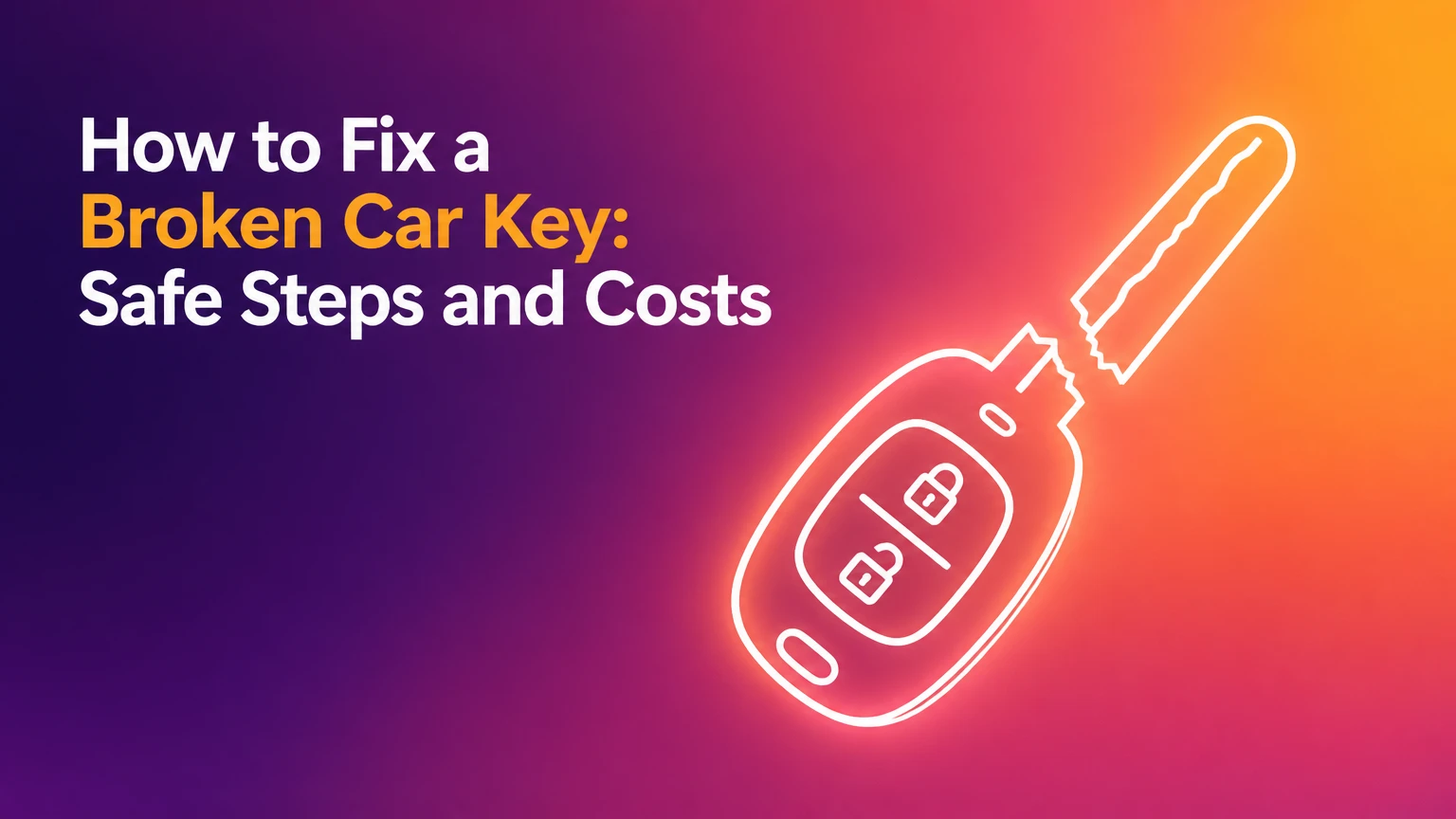
To fix a broken car key, first identify whether the failure affects the metal blade, plastic shell, remote electronics, or immobilizer transponder. Extract a snapped blade without turning or forcing the lock, replace a damaged shell only after preserving every electronic component, and use an automotive locksmith or dealer when cutting or programming is required.
Key Facts
A replacement metal blade does not automatically replace or program the vehicle’s immobilizer transponder.
A cracked key-fob shell can often be repaired for $10-$30 if the circuit board and chip still work.
Typical automotive locksmith replacement costs range from $50 for a simple duplicate to $600 for some proximity fobs.
Superglue is unsuitable for a key blade because the joint can break inside the ignition cylinder.
A remote that stopped locking the doors may have a dead battery, while an engine that will not start points toward immobilizer recognition or another vehicle fault.
Keep the broken key, shell, circuit board, chip, and emergency blade until the replacement works.
What Counts as a Broken Car Key?
A broken car key has either a damaged mechanical component or an electronic fault that prevents entry, ignition, remote operation, or immobilizer authentication. The visible symptom matters because a replacement shell, a new cut blade, a coin-cell battery, and a programmed fob are different repairs.
A key that turns the lock but will not start the engine usually has a transponder or immobilizer issue, not a simple blade problem. A key that starts the engine but no longer locks the doors usually has a remote-control fault. A key that will not enter or turn the ignition may have a bent blade, worn cuts, a seized cylinder, or steering-wheel pressure.
Do not discard any fragment before diagnosis. Automotive locksmiths can sometimes decode a broken blade from both pieces, and the original electronics may be needed to create a working replacement.
Diagnose the symptom before buying parts
| Symptom | Most likely fault | First action | Replacement needed |
|---|---|---|---|
| Blade snapped in ignition | Broken metal key | Stop turning and extract fragment | New cut blade |
| Shell cracked, car still starts | Damaged housing | Transfer board and chip | Empty matching shell |
| Buttons stopped working | Coin-cell battery or contacts | Fit the specified battery | Battery or fob repair |
| Engine cranks but will not start | Transponder not recognized | Test spare and immobilizer light | Programming or diagnosis |
| Key will not turn | Worn cut, lock, or steering pressure | Relieve wheel tension and inspect | Cut key or lock repair |
| Proximity fob is intermittent | Weak battery, water, or antenna fault | Replace battery and dry fob | Fob repair or replacement |
How Does a Modern Car Key Work?
A modern car key combines a cut mechanical blade with one or more electronic security systems. The blade operates a door lock or ignition cylinder, the transponder authenticates the key to the immobilizer, and the battery-powered remote sends commands for locking, unlocking, alarm control, or remote start.
The passive transponder normally receives energy from an antenna around the ignition switch, so it may continue starting the vehicle even when the remote battery is dead. A proximity fob uses a larger electronic system that detects the fob near the vehicle and may contain an emergency blade for manual entry.
Remote frequencies vary by market and vehicle. Frequencies around 315 MHz and 433.92 MHz appear in many systems, but frequency alone does not make a replacement compatible. The vehicle’s manufacturer, model year, encryption system, transponder type, button layout, and programming status all matter.
Which component failed?
- Mechanical blade: The key is bent, cracked, worn, or snapped. It needs extraction, duplication, or cutting.
- Housing or shell: Buttons, hinge, loop, or plastic body failed. The original board and chip may remain usable.
- Remote transmitter: Lock and unlock commands fail. Battery, switch, solder joint, water damage, or synchronization may be responsible.
- Transponder: The engine does not authorize startup. A new or transferred chip may need programming.
- Vehicle lock or ignition: A good spare key also fails. The problem may be the cylinder, ignition switch, antenna ring, or steering lock.
How to Fix a Broken Car Key Safely
The correct repair depends on the failure, but most owners can safely perform diagnosis, battery replacement, and shell transfer. Blade extraction, key cutting, transponder programming, and ignition-cylinder repairs require more care because a failed attempt can immobilize the vehicle or damage the lock.
Before you start
| Requirement | Typical value | Why it matters |
|---|---|---|
| Diagnosis time | 5-10 minutes | Separates key failure from vehicle failure |
| Shell replacement time | 15-30 minutes | Includes transfer and button testing |
| Battery replacement cost | $3-$10 | Uses the battery specified by the fob |
| Locksmith visit | 20-60 minutes | Depends on cutting and programming |
| Useful tools | Plastic pry tool, bright light, small screwdriver | Reduces board and casing damage |
| Prerequisite | Spare key or vehicle access | Helps confirm the fault |
Keep the vehicle owner’s manual, registration or title, government identification, and every key fragment available. A legitimate locksmith or dealer may require proof of ownership before cutting or programming a security key.
Step 1: Stop using a snapped blade
Remove pressure from the key immediately. Do not turn the ignition, push the fragment deeper, or insert another key beside it.
If the exposed section is easy to grip, use fine-nose pliers and pull straight along the keyway. Avoid twisting because a sideways load can damage delicate lock wafers. If the fragment sits flush or deeper than the face of the cylinder, use a dedicated broken-key extractor or call a locksmith.
You will know it worked when: the entire fragment comes out without metal filings or visible damage to the keyway.
Common mistake: applying superglue to the remaining key. Glue can bond the blade to the cylinder, contaminate the wafers, and turn a key extraction into an ignition repair.
Step 2: Extract a key fragment only when it is accessible
Park safely, switch off accessories, and make sure the cylinder is in the correct removal position specified by the vehicle manual. A small amount of lock-specific lubricant can help, but do not flood the ignition with oil or spray into an electronic fob.
Insert a broken-key extractor along the side of the fragment, hook a cut, and pull slowly. A thin jigsaw blade may work in some simple locks, but improvised tools can scratch the cylinder or push the fragment farther inside. Stop if the extractor does not engage after two or three controlled attempts.
You will know it worked when: both metal pieces are intact and the ignition keyway remains clean.
Common mistake: filing the broken edge while it remains in the ignition. Metal dust can interfere with the cylinder and makes later decoding less reliable.
Step 3: Preserve the original key for duplication
Place both blade pieces, the original shell, circuit board, rubber button pad, transponder, and emergency blade in a labeled bag. Do not rely on visual matching alone when purchasing a replacement.
A locksmith can cut a key from a working spare, decode the original blade, or use a manufacturer key code where available. Cutting from a badly worn key can reproduce its wear, so a key code or less-worn spare generally produces a more accurate duplicate.
You will know it worked when: the new blade enters and turns the lock smoothly before electronic programming is attempted.
Common mistake: testing a rough duplicate repeatedly in the ignition. A poorly cut key can bind and create a second broken-key problem.
Step 4: Replace a cracked key-fob shell
Buy an empty shell that matches the exact blade style, button arrangement, hinge, transponder location, and vehicle generation. Remove the old shell with a plastic pry tool, then photograph the interior before moving components.
Transfer the circuit board, rubber button membrane, battery contacts, transponder chip, screw, key ring, and blade pivot. Some transponders are separate glass capsules; others are integrated into the circuit board or molded into a specific section of the housing. Never assume the visible circuit board contains the immobilizer chip.
Close the new shell without pinching the rubber pad or battery contacts. Test every button, the mechanical blade, and engine starting before discarding the old housing.
You will know it worked when: the buttons operate normally and the vehicle starts with the transferred electronics.
Common mistake: buying a visually similar shell with a different internal layout. The buttons may fit while the transponder or blade hinge does not.
Step 5: Replace the remote battery
Read the old battery marking before removal. CR2032 and CR2025 cells look similar, but thickness and contact pressure can differ, so install the type specified by the fob or owner’s manual.
Open the case carefully, note the positive and negative orientation, and avoid touching the board unnecessarily. Clean light oxidation from accessible contacts with an appropriate electronics cleaner, then close the case firmly.
A battery replacement normally does not erase immobilizer programming, but some vehicles require remote synchronization after power loss. Follow the vehicle-specific manual rather than copying an ignition-cycle procedure from another model.
You will know it worked when: the lock and unlock buttons operate from the normal range and the fob’s indicator behaves as expected.
Common mistake: assuming a new battery fixes a broken microswitch, cracked solder joint, flooded board, or failed antenna.
Step 6: Program or replace the immobilizer key
A newly cut blade may unlock the door and still fail to start the vehicle because mechanical cutting and electronic authorization are separate operations. Programming requirements vary by model, year, region, number of existing keys, and whether an authenticated key is available.
Use the owner’s manual only for an officially supported procedure. Many newer vehicles require a diagnostic tool, security PIN, two existing keys, an online manufacturer account, or dealer-level authorization. An automotive locksmith can often cut and program compatible keys on site, while some manufacturers restrict programming access.
You will know it worked when: the immobilizer warning clears and the engine starts consistently with the replacement key.
Common mistake: buying an unverified online fob that has the wrong transponder, locked software, incompatible frequency, or an incorrect vehicle-protocol version.
Which Broken Car Key Repair Option Is Best?
An automotive locksmith is usually the best first call for a snapped blade, mobile emergency, duplicate key, or transponder programming. A dealership is the safer choice when the vehicle uses a restricted proximity system, all keys are lost, or the manufacturer requires proprietary authorization; DIY repair is best limited to batteries and shell transfers.
| Repair route | Typical cost | Typical time | Best use | Main limitation |
|---|---|---|---|---|
| DIY battery | $3-$10 | 5-10 minutes | Dead remote battery | Cannot repair board damage |
| DIY shell | $10-$30 | 15-30 minutes | Cracked casing with working electronics | Wrong shell can lose chip or blade fit |
| Automotive locksmith | $50-$350 | 20-60 minutes | Blade, duplicate, transponder, mobile service | Coverage and tool access vary |
| Dealership | $150-$600 | 1-5 hours or longer | New proximity fob and restricted systems | Higher labor and towing cost |
| Key kiosk or hardware store | $10-$80 | 10-30 minutes | Basic metal duplicate | Often cannot program modern keys |
| Used online fob | $20-$150 | Variable | Compatible shells or board parts | Compatibility and prior pairing risks |
Prices are typical United States consumer ranges, not guaranteed quotes. Luxury vehicles, encrypted proximity systems, all-keys-lost situations, towing, after-hours service, and replacement of a damaged ignition cylinder can increase the total.
Is a locksmith cheaper than a dealership?
An automotive locksmith often costs less because the service is mobile and the business may support aftermarket or OEM-compatible keys. A dealer has direct access to manufacturer systems and parts, which can matter for newer vehicles, lease vehicles, immobilizer resets, and keys that cannot be reliably programmed by independent equipment.
Ask both providers for a complete estimate covering the blade, shell or fob, programming, service call, tax, emergency surcharge, and disposal. Confirm whether the quote assumes that a working key remains.
What Should You Do for Each Key Type?
Traditional metal keys need accurate duplication, transponder keys need both cutting and authentication, flip keys commonly need a shell or hinge repair, and proximity fobs usually require a compatible programmed unit. Key type determines whether a low-cost repair is realistic.
| Key type | Recognizable feature | Typical repair | Typical total cost | Programming risk |
|---|---|---|---|---|
| Plain metal key | No buttons or chip | Duplicate from code or intact key | $10-$50 | Low |
| Transponder key | Plastic head, immobilizer chip | Cut blade and program chip | $70-$200 | Medium |
| Flip key | Folding blade and spring hinge | Replace shell or blade assembly | $50-$150 | Medium |
| Smart or proximity fob | Push-to-start, emergency blade | Program replacement fob | $150-$600 | High |
| Key card | Flat electronic card | Replace card and emergency insert | $150-$500 | High |
| Remote-head key | Buttons molded around blade | Cut blade and pair remote | $80-$250 | Medium |
The ranges above are typical, because vehicle generation and local labor rates create substantial variation. A 2005 compact car and a 2024 luxury SUV may use completely different security architectures even when both have a push-button remote.
Why Does the Replacement Key Turn but Not Start the Car?
A replacement key that turns the ignition but does not start the engine usually lacks a recognized transponder, has an incompatible chip, or has not completed immobilizer programming. The engine may crank normally while the immobilizer system prevents fuel or ignition authorization.
Check that the original transponder was transferred from the broken housing. If the old key used a separate glass capsule, it may be hidden in a corner of the shell and easy to overlook. Test the spare key, observe the immobilizer warning light, and consult the vehicle manual for the meaning of the indicator.
A no-start condition can also result from a weak vehicle battery, blown fuse, fuel problem, or starter fault. If both the old and replacement keys fail, stop treating the problem as a key-shell repair and obtain vehicle diagnosis.
Why Will the New Key Not Turn the Lock?
A new key that will not turn may have incorrect cuts, burrs, the wrong keyway profile, or a worn or damaged lock cylinder. A steering wheel under load can also hold an ignition lock in tension, especially after parking with the tires against a curb.
Remove the key and inspect it against the original. Do not grind the cuts casually because removing material can destroy the profile. Try the spare key, gently move the steering wheel while applying light key pressure, and use only a lubricant approved for the relevant lock.
If two known-good keys fail, the cylinder or ignition mechanism is more likely defective than the key. A locksmith can decode the cylinder and determine whether a new blade or lock repair is needed.
What If the Key Fob Works but Push-to-Start Does Not?
A remote that locks the doors while push-to-start fails may have a weak battery, failed passive transponder, incorrect fob programming, or a vehicle-side antenna fault. Remote locking and immobilizer authentication are separate functions, so one can work while the other fails.
Replace the coin cell with the specified type, then use the manufacturer’s emergency-start method. Many vehicles instruct the driver to hold the fob against a marked area or directly against the start button, but the location differs by make and model.
Do not repeatedly press the start button with an unrecognized fob. Test the spare, check the dashboard immobilizer message, and arrange programming or diagnosis if the emergency method also fails.
Can Water Damage or Heat Break a Car Key?
Water can corrode fob contacts and circuit-board traces, while heat can deform the shell, weaken solder joints, or damage the battery. A wet fob should be removed from service immediately, opened if practical, and dried without applying a heat gun or placing it in an oven.
Remove the battery and blot moisture with a lint-free cloth. Allow the components to dry fully in a ventilated location, then inspect for white or green corrosion. Rice does not remove corrosion and can introduce dust into buttons and connectors.
A professional electronics or automotive locksmith can determine whether cleaning is economical. Do not power a visibly wet board because current flowing through moisture can accelerate damage.
Common Mistakes and Recovery
| Mistake | Likely consequence | Recovery |
|---|---|---|
| Gluing a snapped blade | Blade bonds inside cylinder | Call a locksmith for extraction |
| Discarding the old shell | Transponder may be lost | Search shell and obtain chip identification |
| Installing wrong battery | Poor contact or fob damage | Match marking and polarity |
| Filing a new blade | Incorrect lock profile | Have blade recut from code |
| Buying incompatible fob | Programming failure | Verify part number and frequency |
| Repeatedly forcing ignition | Cylinder or key damage | Stop and test a spare key |
One practitioner rule matters more than most online repair shortcuts: never test a replacement key in the ignition until the blade has been checked in the door lock or by a locksmith. The door lock offers a cheaper failure point than an ignition cylinder, and rough cuts are easier to identify there.
Another counterintuitive point is that a dead fob battery does not necessarily mean the car cannot start. Passive immobilizer chips often operate without the coin cell, while a damaged transponder can prevent starting even when every remote button works.
A third rule is to order by vehicle identification number or verified part number whenever possible. Appearance, button count, and frequency do not prove compatibility.
How Can You Prevent Another Broken Key?
Replace a visibly cracked shell before the blade or circuit board becomes vulnerable. Keep the key away from heavy key rings, avoid twisting it sideways in the ignition, and use a spare key before the working key becomes badly worn.
Store a spare separately rather than attaching both keys to the same ring. Record the key-fob part number, battery type, and emergency-blade location in a secure place. For older vehicles, obtaining a duplicate while one working key remains is usually faster and less expensive than an all-keys-lost replacement.
When is DIY repair a bad idea?
DIY repair is unsuitable when the blade is stuck deeply, the ignition is damaged, the vehicle has no working key, the fob has water or corrosion damage, or the car uses a restricted smart-key system. It is also a poor choice when the vehicle is needed immediately and a failed attempt could require towing.
Shell replacement and battery changes are low-risk only when the owner can identify and preserve every internal component. Programming is not a universal sequence, and an incorrect procedure can erase existing keys on some systems.
Frequently Asked Questions
Can I start my car with a broken key?
You may start the vehicle if the blade still operates the ignition and the immobilizer transponder remains intact and positioned correctly. A snapped blade in the ignition should not be forced or glued. If the transponder is separated from the housing, hold or transfer it only according to the manufacturer’s emergency-start instructions.
Does a replacement car key need programming?
A plain metal key usually does not need programming, but a transponder, remote-head key, flip key, or proximity fob commonly does. Remote button pairing and immobilizer programming are separate procedures, so a fob may lock the doors without authorizing engine start.
Can a locksmith make a key from a broken one?
An automotive locksmith can often decode the blade from its fragments or use a vehicle key code, provided the lock and fragments are sufficiently identifiable. A worn or incomplete key may produce an inaccurate duplicate, making a code-based cut or cylinder decoding preferable.
How long does a broken car key repair take?
A battery change usually takes 5-10 minutes, a shell transfer takes 15-30 minutes, and a locksmith replacement commonly takes 20-60 minutes. Dealer service can take several hours or longer when the vehicle must be towed or the replacement fob must be ordered.
Should I buy a replacement fob online?
Buy online only after verifying the exact part number, vehicle generation, frequency, transponder type, and return policy. A cheap shell may be useful, but an already-paired or incompatible electronic fob may not be programmable and can cost more after unsuccessful attempts.
The Bottom Line
Fixing a broken car key starts with separating the mechanical blade from the shell, remote, and immobilizer functions. Replace a battery or shell yourself when the electronics remain intact, extract a snapped blade without force, and use an automotive locksmith for cutting and programming unless the vehicle’s security system requires dealership support. The safest answer to how to fix a broken car key is to preserve the original components, diagnose the exact failure, and test every function before discarding the old key.