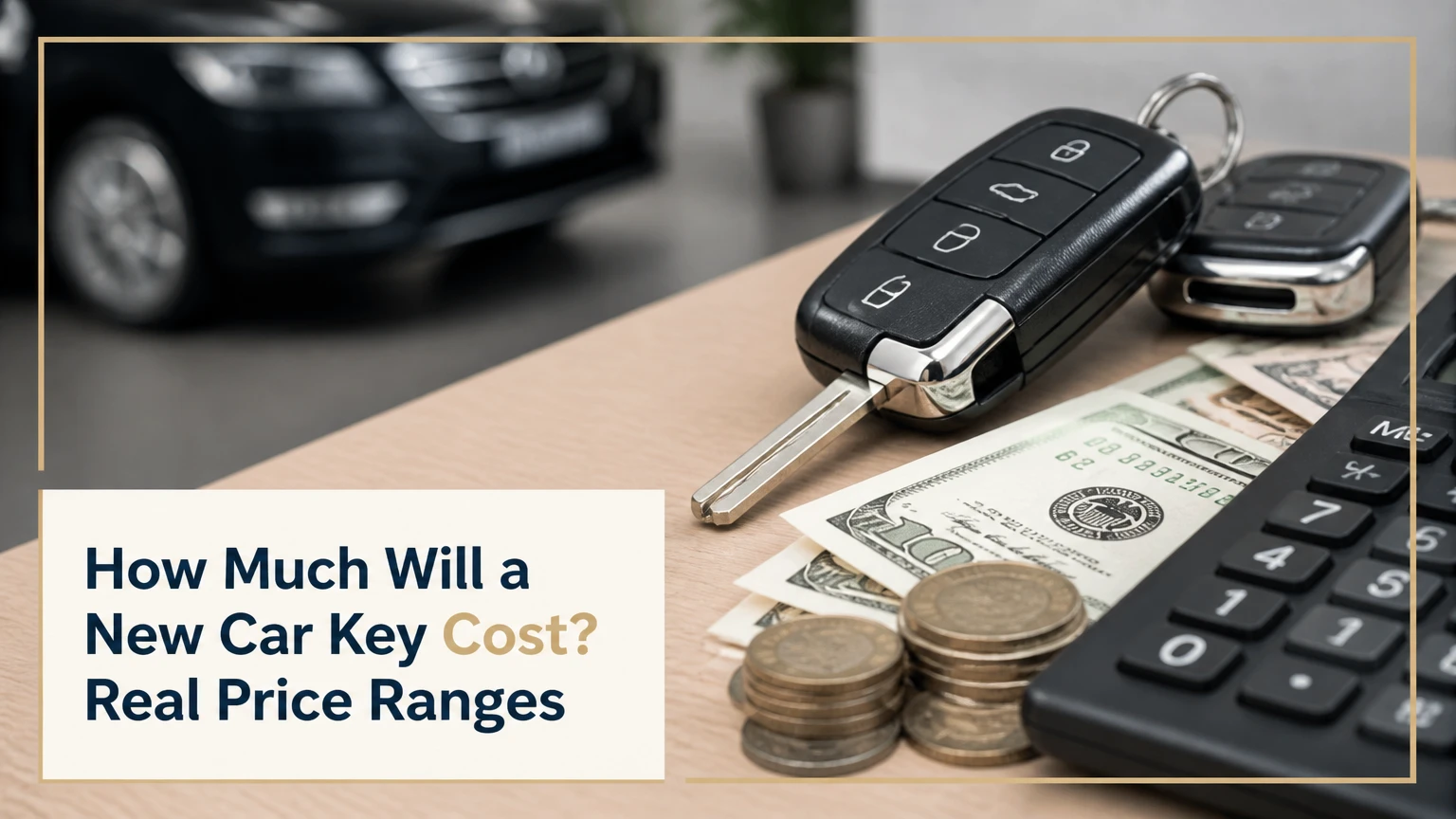
A new car key typically costs $50-$1,500 in the United States, including common replacement scenarios from a basic mechanical key to a luxury proximity fob. Most modern transponder keys cost $120-$350, while push-button-start smart keys commonly cost $250-$800, depending on the vehicle, key source, programming method, and whether another working key remains.
Key Facts at a Glance
A basic mechanical car key usually costs $50-$100 when cutting is the only service required.
A transponder key commonly costs $120-$250, including cutting and programming.
A smart or proximity fob typically costs $250-$800, with luxury models exceeding $1,000.
Replacing the only lost key usually costs $100-$250 more than adding a spare.
An automotive locksmith is often 20%-50% cheaper than a dealership for compatible vehicles.
A weak CR2032 or CR2025 battery costs about $3-$10, so battery testing should come before fob replacement.
How Much Will a New Car Key Cost?
A new car key costs about $50-$100 for a metal key, $120-$250 for a transponder key, $200-$450 for an integrated remote key, and $250-$800 or more for a smart fob. Dealership pricing, emergency mobile service, vehicle security software, taxes, and the difference between an OEM and aftermarket part determine the final invoice.
The quoted price can contain four separate charges: the key blank or fob, mechanical cutting, electronic programming, and travel or emergency labor. A low online price may cover only an uncut shell, while a mobile locksmith quote may include the complete key, on-site cutting, programming, and a warranty.
A useful estimate is:
Total replacement price = key or fob + cutting + programming + service call + tax
Typical programming charges range from $50-$150 for ordinary vehicles. A dealership may bundle programming into a larger parts and labor invoice, whereas a locksmith may quote each component separately. Ask for an itemized, all-in price before authorizing work.
Typical Car Key Prices by Type
| Key type | Typical total price | Typical service time | Main cost driver |
|---|---|---|---|
| Mechanical metal key | $50-$100 | 10-20 minutes | Key code and cutting |
| Transponder key | $120-$250 | 20-40 minutes | Immobilizer programming |
| Laser-cut key | $150-$350 | 30-60 minutes | High-security blade and chip |
| Remote-head key | $200-$400 | 30-60 minutes | Remote electronics and chip |
| Switchblade key | $250-$450 | 45-60 minutes | Folding mechanism and remote |
| Smart proximity fob | $250-$800+ | 30-90 minutes | Secure pairing software |
| Luxury display or specialty fob | $800-$1,500+ | 1-5 business days | OEM security and hardware |
These are typical US consumer ranges, not fixed national prices. A 2012 compact car with one working key can fall near the low end, while a 2024 European SUV with no working key can exceed the table because the provider may need manufacturer authorization, a tow, or replacement security modules.
Which Type of Car Key Do You Need?
The type of car key determines the baseline price because each design adds hardware and an authentication requirement. A mechanical key has a cut blade only, while a modern smart fob can contain radio transceivers, encrypted credentials, motion sensors, a rechargeable or coin-cell battery, and manufacturer-controlled programming.
| Key design | How to identify it | Electronic function | Replacement concern |
|---|---|---|---|
| Standard metal key | No buttons or plastic head | None | Correct blade profile |
| Transponder key | Plastic head, turn-key ignition | Starts immobilized engine | Chip must match vehicle |
| Remote-head key | Buttons attached to key head | Locks doors and authorizes start | Circuit board compatibility |
| Switchblade key | Blade folds into fob | Remote locking and transponder start | Hinge and spring durability |
| Smart key | Push-button ignition | Passive proximity authentication | Secure pairing and battery |
| Key card | Thin card or slot-operated device | Radio identification | Brand-specific replacement |
| Display fob | Screen, premium casing, many buttons | Proximity plus vehicle functions | High OEM parts cost |
A transponder key may unlock the door mechanically but still fail to start the engine if its chip is not programmed. A smart fob may unlock the vehicle through proximity detection but refuse to authorize ignition when its battery, internal antenna, or stored credential fails.
“Laser-cut” describes the blade profile, not a separate electronic security standard. A sidewinder blade often has a center groove and requires a specialized duplicator, but the vehicle may also require a transponder or remote programming step.
Why Are Smart Car Keys More Expensive?
Smart car keys cost more because the fob is an electronic security credential, not merely a remote control. The vehicle and fob exchange radio messages, verify an encrypted or rolling credential, and permit starting only when the immobilizer accepts the authentication sequence.
A conventional transponder usually communicates when the ignition system energizes the chip. A proximity system must detect the fob near the vehicle, distinguish it from other radio devices, and support functions such as passive unlocking, push-button starting, trunk release, and emergency backup access.
Manufacturers also restrict programming for theft prevention. Some vehicles require an online security account, a timed authorization token, a PIN, or a brand-specific diagnostic platform. Those requirements increase labor and can prevent an independent provider from completing the job even when the physical fob is available.
The battery is often misunderstood. A dead coin-cell battery can stop buttons or passive detection, but many vehicles retain a backup start method, such as holding the fob against a marked sensor or placing it in a designated slot. The owner’s manual identifies the exact method.
Is a Locksmith Cheaper Than a Dealership?
An automotive locksmith is typically cheaper for compatible vehicles because the locksmith can supply, cut, and program the key at the vehicle’s location without dealership facility costs. A dealership is usually the safer route when the manufacturer requires protected online programming, the vehicle has a complex European security system, or no qualified local locksmith supports the model.
| Replacement route | Typical total price | Typical time | Best fit |
|---|---|---|---|
| Mobile automotive locksmith | $120-$600 | 30-120 minutes | Most domestic and common Asian models |
| Brand dealership | $200-$1,000+ | Same day to 5 days | OEM parts and restricted programming |
| Online key plus local programming | $60-$350 | 1-7 days | Owners with compatibility confirmation |
| Insurance or roadside route | $0-$500 out of pocket | Policy dependent | Covered loss or roadside benefit |
| Used fob refurbishment | $80-$300 | 1-7 days | Supported older vehicles |
A locksmith may not be able to program every new BMW, Mercedes-Benz, Audi, Land Rover, or Porsche key. Some vehicles need a secure server transaction that a third-party provider cannot legally or technically bypass. Confirm capability before the technician travels.
A dealership is not automatically required for every smart key. Independent locksmiths often support common Ford, Chevrolet, Toyota, Honda, Nissan, Hyundai, and Kia models, but compatibility depends on the exact year, trim, immobilizer generation, and available key inventory.
What Should You Ask Before Booking?
Ask the provider for a written quote that names the vehicle and identifies every included service. The following questions expose the most common pricing surprises:
- Does the price include the complete key or only a shell?
- Is the part OEM, aftermarket, refurbished, or cloned?
- Does cutting include a factory key code or only a copy?
- Is programming included if all keys are lost?
- Are travel, night, weekend, tax, and emergency fees included?
- Will the provider erase missing keys from the vehicle’s memory?
- What programming and parts warranty applies?
- Will the technician verify remote buttons, proximity detection, and starting before payment?
A legitimate provider should request the VIN, vehicle location, photo identification, and proof of ownership. A business willing to program a security key without ownership verification creates a theft risk.
What Happens During Car Key Replacement?
Car key replacement normally involves vehicle identification, ownership verification, key sourcing, cutting, programming, functional testing, and optional deletion of missing credentials. The process takes 10-20 minutes for a simple metal key and 30-90 minutes for most electronic keys, assuming the correct part and software are available.
Step 1: Identify the Exact Vehicle
Provide the year, make, model, trim if known, ignition style, VIN, and current key status. Two versions of the same model year can use different fobs, blade profiles, or immobilizer systems.
The VIN appears on the dashboard near the windshield, the registration, the insurance document, and often the driver-side door label. Do not send a public online listing containing the full VIN and home address together.
Step 2: Confirm Ownership and Key Type
Bring government-issued identification, registration, title, or insurance documentation. Explain whether one working key remains, whether the key is damaged, and whether every key is missing.
The distinction matters financially. Adding a spare while one programmed key works is usually simpler than recovering a vehicle with no recognized credentials.
Step 3: Source and Cut the Key
The technician obtains a compatible blank or fob and cuts the blade using a code, database record, or an accurate existing key. Code cutting is preferable when an old blade is worn because copying worn cuts can transfer errors to the replacement.
A key that enters the lock smoothly can still be electronically incompatible. Mechanical fit and immobilizer authorization are separate tests.
Step 4: Program the Immobilizer and Remote
The technician uses a vehicle-specific diagnostic tool, often through the OBD-II port, or follows a manufacturer-approved procedure. The system pairs the transponder or fob credential with the immobilizer and may separately program remote-locking functions.
Some older vehicles allow owner programming when two working keys are already present. Many newer vehicles do not. A procedure that works for one model year can fail on another, so use the owner’s manual or a provider who verifies the procedure by VIN.
Step 5: Test Every Function
The completed key should unlock the door, operate remote buttons, start the engine, and activate proximity functions where fitted. Test the emergency blade and backup starting method before the technician leaves.
Ask whether lost keys were deleted. Deletion can prevent a missing fob from authorizing a start, although mechanical access and remote-lock behavior depend on the vehicle system and the technician’s procedure.
What If You Lost Every Car Key?
Replacing every lost car key usually costs $100-$250 more than making a spare, with common totals of $250-$900 and higher prices for luxury or restricted vehicles. The technician may need to retrieve security data, reset an immobilizer, program a new credential from scratch, decode a lock, or arrange a dealership tow.
The price increase is not simply for cutting another blade. With no working key, the provider cannot rely on an existing credential for duplication, and some vehicles require an all-keys-lost security procedure. Certain systems erase the old key list and register new keys during the same diagnostic session.
A missing key also creates a security question. Request removal of the lost electronic credentials from the vehicle memory where the system supports it. If the lost key contains a mechanical blade that can open the vehicle, consider rekeying the door or ignition when the vehicle’s theft exposure justifies the additional cost.
| All-keys-lost scenario | Typical added cost | Likely requirement | Common delay |
|---|---|---|---|
| Older domestic vehicle | $100-$200 | Mobile programming | 30-90 minutes |
| Common Asian push-start vehicle | $150-$300 | Smart-fob registration | 1-2 hours |
| New domestic smart key | $200-$400 | Secure diagnostic access | 1-3 hours |
| European luxury vehicle | $300-$800+ | Dealer or authorized server | 1-5 business days |
| Dealership-only situation | $100-$250 tow plus service | Vehicle at dealer | 1-7 days |
A tow is not always necessary if a capable mobile locksmith can perform the procedure at the vehicle. Ask that question first, particularly when the vehicle is disabled in a locked garage or remote location.
Can You Buy and Program a Car Key Online?
Buying a key online can reduce the parts cost to $30-$250, but online purchasing is worthwhile only when the exact part number, frequency, chip type, blade profile, and programming method are confirmed. A cheap fob that cannot be initialized by the local provider becomes an unusable part plus a second replacement bill.
| Online purchase type | Typical price | Programming risk | Appropriate use |
|---|---|---|---|
| Empty key shell | $10-$40 | No chip or electronics | Repairing a damaged case |
| Aftermarket transponder key | $25-$100 | Medium | Confirmed older model |
| Aftermarket remote fob | $40-$180 | Medium to high | Supported common vehicle |
| OEM online fob | $100-$400 | Medium | Dealer or locksmith confirmation |
| Used locked fob | $20-$150 | High | Only if refurbishment is supported |
A key shell replaces plastic housing but does not replace the transponder, circuit board, or battery. A used fob may remain paired to another vehicle and may be impossible to reset, particularly on newer systems.
The safest online workflow is to call the programmer first, provide the VIN and current fob part number, and ask whether the provider accepts customer-supplied parts. Confirm return terms because many sellers exclude electrical components from refunds after the package is opened.
Does the Key Need Replacing, or Is the Battery Dead?
A car key may need only a new coin-cell battery when the buttons work intermittently, the operating range shrinks, or the vehicle displays a low-key-battery warning. Battery replacement usually costs $3-$10 for the cell and takes 2-10 minutes, while a new electronic key is appropriate when the circuit board, transponder, casing, or internal antenna is damaged.
Replace the battery with the exact type specified by the fob, commonly CR2032 or CR2025. Installing the wrong thickness can damage contacts or prevent the case from closing properly.
Battery replacement will not fix a failed transponder, water-damaged circuit board, broken switch, crushed antenna, or vehicle-side receiver fault. If a spare key works normally, the original fob is the likely problem. If every key fails, inspect the vehicle battery, immobilizer warning light, receiver, and relevant fuses before buying multiple fobs.
A key that starts the engine but cannot lock the doors may have a remote-button or battery issue. A key that unlocks the doors but will not start the engine may have an immobilizer or transponder problem.
Can Insurance or Roadside Assistance Pay?
Insurance and roadside assistance may pay part of a replacement, but coverage depends on the policy, cause of loss, deductible, and service limit. Roadside plans often cover lockout assistance, while comprehensive auto insurance, rental coverage, or a dedicated key-protection endorsement may cover theft or replacement.
Check these policy details:
- Maximum key replacement benefit, such as $250 or $500.
- Deductible compared with the expected replacement cost.
- Whether lost keys are covered or only stolen keys.
- Whether OEM parts are required.
- Whether the insurer requires an approved locksmith.
- Whether towing and programming count against separate limits.
- Whether a claim affects premiums or renewal terms.
A $300 claim with a $500 deductible produces no payment. A $700 luxury-fob replacement may justify a policy benefit, but the owner should obtain authorization before paying a non-approved provider.
How Can You Reduce the Replacement Price?
The most reliable way to reduce cost is to make a spare while one programmed key still works. A working credential can allow duplication or a simpler registration procedure, avoiding all-keys-lost recovery, towing, and emergency labor.
Use these cost controls:
- Compare one mobile locksmith quote with one dealership quote.
- Ask for OEM and reputable aftermarket prices separately.
- Schedule daytime service instead of night or roadside emergency service.
- Confirm the fob battery before ordering a replacement.
- Buy a spare before the last working key becomes damaged.
- Verify online part compatibility with the programmer.
- Ask whether a refurbished OEM fob is supported.
- Request a written warranty for programming and electronics.
A practitioner rule of thumb is to treat a spare key as preventive maintenance when the replacement price exceeds $400. Spending $150-$300 on a confirmed spare can avoid a substantially higher emergency invoice later.
The cheapest part is not always the cheapest outcome. An incompatible aftermarket fob can require a second appointment, a new programming charge, and a replacement part that cannot be returned.
What Should Luxury and European Vehicle Owners Do?
Owners of luxury and newer European vehicles should obtain a quote from an authorized dealer and a locksmith with documented support for the exact model before choosing a provider. BMW, Mercedes-Benz, Audi, Porsche, Jaguar Land Rover, and some newer Volvo systems may require encrypted server access, pre-ordered keys, or identity verification that limits independent programming.
Expect $500-$1,500 or more for some premium proximity, display, or specialty keys. Delivery may take 1-5 business days because the key can be ordered to the vehicle’s VIN rather than selected from general inventory.
An independent specialist can still be appropriate when the business has current diagnostic equipment, a verifiable model-specific service history, and a clear warranty. A generic claim that the provider programs every European vehicle is not sufficient evidence.
Dealer service is usually a poor value for an older, common vehicle when a qualified locksmith can perform the same authorized programming at the vehicle. Dealer service becomes more defensible when security access, OEM-only hardware, warranty compliance, or immobilizer replacement is involved.
How Do You Get an Accurate Quote?
An accurate car-key quote requires the exact year, make, model, VIN or key part number, ignition type, key status, location, and required functions. A provider cannot responsibly quote a smart fob from the vehicle’s model name alone because trims and production changes can use different systems.
Send or state:
- Vehicle year, make, model, and trim.
- Turn-key ignition or push-button start.
- Number of working keys.
- Whether the key starts the engine.
- Whether remote buttons and proximity entry work.
- Vehicle location and service timing.
- OEM, aftermarket, or refurbished preference.
- Need for a blade, remote, transponder, or complete fob.
Request the total price before work begins. The quote should identify parts, cutting, programming, travel, emergency fees, tax, warranty length, and whether missing keys will be erased.
Do not choose a provider solely from the lowest advertised price. Compare the final tested, programmed key, not the online shell or blank.
FAQ
How long does a new car key take to make?
A mechanical key can take 10-20 minutes, while a transponder or remote-head key commonly takes 20-60 minutes. Smart keys usually take 30-90 minutes when the correct fob and programming tools are available. Dealer-ordered luxury keys can take 1-5 business days because the part may be VIN-specific.
Can a locksmith make a key if the original is completely gone?
An automotive locksmith can make a key with no original for many vehicles by using the VIN, a factory key code, lock decoding, or immobilizer data. The job usually costs more because the technician must create and register a new credential rather than duplicate an existing one. Some secure vehicles require dealer involvement.
Will an aftermarket car key work as well as an OEM key?
A reputable aftermarket key can work correctly when its frequency, chip, circuit board, blade, and vehicle software are compatible. OEM keys generally provide more predictable fit and programming support, while low-quality aftermarket products have higher compatibility and durability risk. Confirm the programmer’s warranty before buying an aftermarket fob.
Does a spare key need programming?
A spare key needs programming when the vehicle uses a transponder, remote-head system, or smart proximity credential. A plain metal key does not need electronic programming. Some older vehicles support owner programming with two existing keys, but many modern cars require a diagnostic tool or authorized security procedure.
What happens if the car key is locked inside the vehicle?
A lockout service may open the vehicle without replacing the key, commonly costing $75-$200 depending on location, timing, and vehicle complexity. If the fob is inside but the vehicle will not detect it, use the manufacturer’s backup detection location. Do not force a window or pry the door, because repair costs can exceed the lockout fee.
The Bottom Line
How much will a new car key cost? Plan on $50-$100 for a mechanical key, $120-$350 for most transponder or laser-cut keys, $250-$800 for a smart fob, and $800-$1,500 or more for some luxury systems. The best first step is to compare an itemized automotive locksmith quote with the dealership price, confirm whether one working key remains, test the fob battery, and verify that the final key will be cut, programmed, tested, and covered by a warranty.