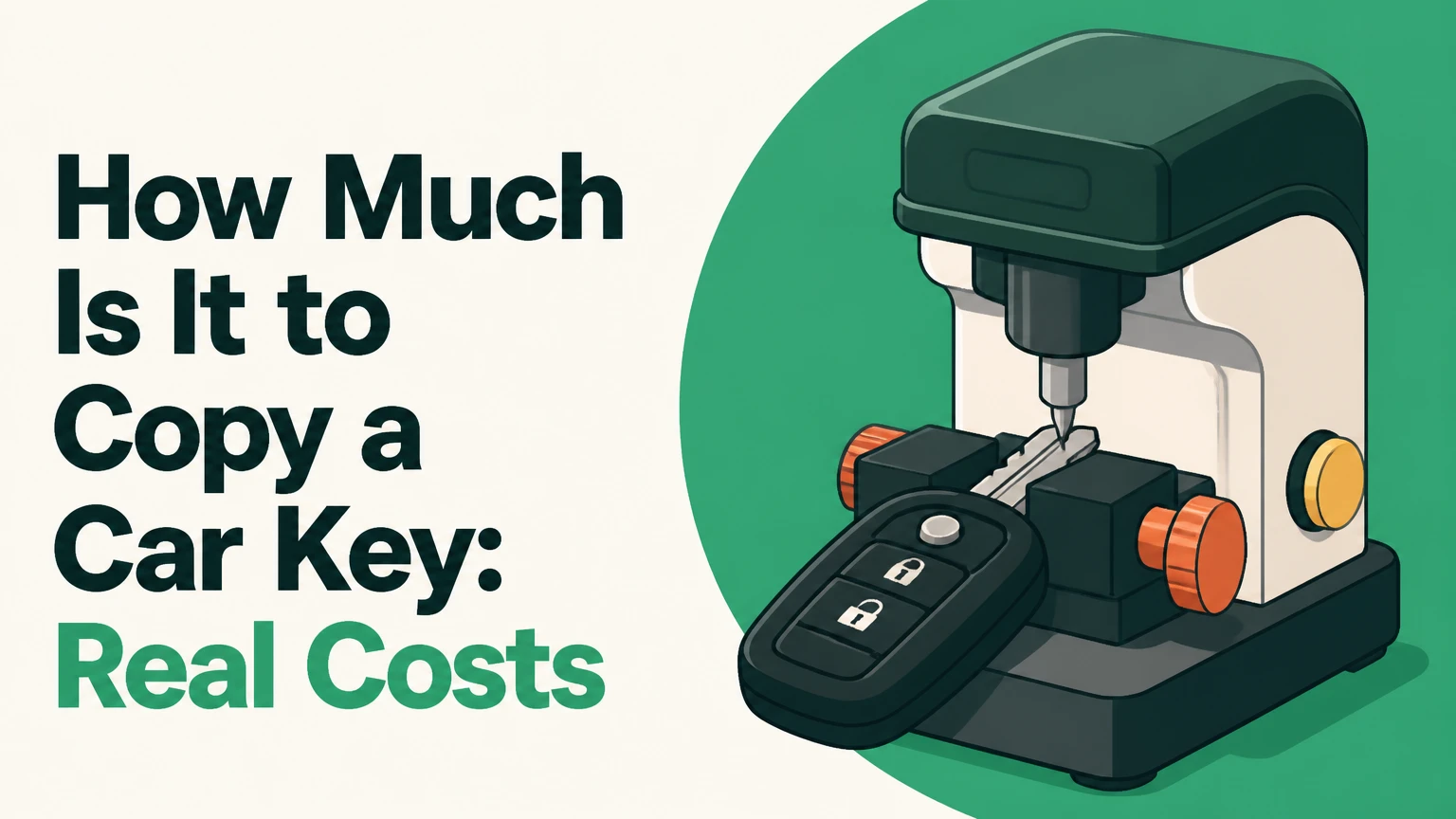
Copying a car key typically costs $10-$25 for a basic metal key, $60-$190 for a transponder key, $150-$350 for a remote-head key, and $150-$500 or more for a smart key. The final price depends on the vehicle’s make, model, year, key technology, programming method, provider, and whether you still have a working key.
Key Facts at a Glance
- A basic mechanical car key usually costs $10-$25 and takes 5-10 minutes to cut.
- A transponder key commonly costs $60-$190 because the security chip must match the vehicle immobilizer.
- A smart key or proximity fob commonly costs $150-$500 or more, including pairing and programming.
- A hardware store can usually cut a metal blade but cannot program most modern immobilizer keys.
- Copying a working key is normally cheaper than replacing a key when every key is lost.
- A mobile automotive locksmith often completes duplication in 15-60 minutes, depending on the key system and vehicle.
How Much Is It to Copy a Car Key by Type?
The type of car key determines the largest share of the copying price. A metal blade requires cutting only, while a transponder, remote-head key, or proximity fob may require a compatible electronic chip, remote circuitry, diagnostic software, and vehicle programming.
| Car key type | Typical copy price | Typical service time | Main work required |
|---|---|---|---|
| Traditional metal key | $10-$25 | 5-10 minutes | Duplicate blade |
| Transponder chip key | $60-$190 | 15-30 minutes | Cut blade and program chip |
| Laser-cut or sidewinder key | $70-$235 | 20-45 minutes | Mill high-security blade and program chip |
| Remote-head or switchblade key | $150-$350 | 30-45 minutes | Cut blade, pair remote, program immobilizer |
| Smart key or proximity fob | $150-$500+ | 30-60 minutes | Register fob and test proximity functions |
These are typical U.S. consumer price ranges, not fixed national tariffs. Parts, labor, local tax, mobile-service charges, vehicle security software, and the use of original-equipment manufacturer components can move the invoice outside the ranges.
A 2008 Toyota Corolla with a standard transponder key may fall near the lower end of the chip-key range. A recent BMW, Mercedes-Benz, Land Rover, or electric vehicle with a secure proximity system can exceed $500, especially when an authorized dealer must order an OEM fob.
What does a basic mechanical car key cost?
A basic mechanical car key usually costs $10-$25 when the key has no transponder, remote buttons, or proximity electronics. A hardware store, home-improvement retailer, or locksmith can duplicate the blade by tracing the original key onto a compatible blank.
This low-cost option applies mainly to older vehicles and certain specialty keys. A metal blade that looks simple may still contain a transponder capsule inside a plastic head, so visual inspection alone cannot confirm that cutting is sufficient.
The copy should turn smoothly in the driver’s door and ignition. Test both functions before leaving the store, because a poorly aligned blank can damage a worn ignition cylinder or fail to release the steering lock.
What does a transponder key cost?
A transponder-key copy typically costs $60-$190, including a compatible blank, blade cutting, and immobilizer programming. The key must transmit an approved electronic identity before the engine control system allows the vehicle to start.
A transponder key can unlock the doors while still failing to start the engine if the chip is absent, defective, or unprogrammed. That distinction explains why a $10 blade copy may appear successful but remains unusable as a driving key.
Some older vehicles support onboard programming when two already-programmed keys are available. Other vehicles require a locksmith diagnostic tool or dealer software, and some procedures require a security PIN, proof of ownership, or a secure connection to the manufacturer’s system.
What does a smart key or proximity fob cost?
A smart key copy usually costs $150-$500 or more because the fob communicates with multiple vehicle antennas and must be registered to the car’s security system. Push-button-start vehicles often need a specific fob frequency, encryption system, emergency blade, and model-compatible programming procedure.
A replacement fob may include door locking, trunk release, panic functions, passive entry, and push-button starting. A cheaper shell or remote may reproduce the buttons but lack a valid immobilizer chip or proximity credential.
Luxury vehicles produce the widest price variation. A locksmith with the correct software may offer an aftermarket fob at a lower price, while a dealership may charge more for an OEM unit, programming labor, and a vehicle-specific order.
Why Does a Copied Key Sometimes Need Programming?
Modern vehicle immobilizers separate the mechanical key cut from the electronic authorization. The blade controls a lock or ignition cylinder, but the transponder or proximity credential tells the engine computer that the key is permitted to start the vehicle.
When the key enters the ignition or approaches the start system, the vehicle reads its electronic identity through a radio-frequency signal. If the identity matches a credential stored in the immobilizer or engine control unit, the vehicle enables starting; if not, the engine may crank without running or remain disabled.
The National Highway Traffic Safety Administration identifies immobilizers as an anti-theft technology used across modern vehicles, but the exact design varies by manufacturer. Vehicle age alone cannot determine programming requirements, because some early-1990s vehicles used electronic security systems and some later base models still use simpler keys.
A successful duplicate therefore has two separate checkpoints:
- Mechanical checkpoint: the blade locks, unlocks, and turns the ignition correctly.
- Electronic checkpoint: the vehicle recognizes the chip or fob and permits starting.
A remote lock button is a third function. Remote buttons can work even when the immobilizer is not programmed, because remote entry and engine authorization may use separate circuits and registration procedures.
How Is a Car Key Copied?
A working car-key duplicate normally involves identification, cutting, electronic programming, and functional testing. A locksmith can often complete the service at the vehicle’s location, while a dealership may require an appointment and access to the vehicle identification number.
Step 1: Identify the vehicle and key system
The provider records the make, model, year, VIN when required, ignition style, number of existing keys, and key features. The provider also checks whether the vehicle uses a standard blade, sidewinder profile, transponder chip, remote-head design, or proximity fob.
Bring the current key, vehicle registration, and government-issued identification when requested. Automotive locksmiths and dealerships may refuse programming without proof that the customer is authorized to operate the vehicle.
Step 2: Match the blank or fob
The provider selects a blank with the correct blade profile, chip type, frequency, button layout, and compatibility data. Aftermarket blanks can cost less than OEM parts, but low-quality products may contain the wrong transponder, an incompatible circuit board, or a battery compartment that does not fit correctly.
A blank purchased online is not automatically programmable. Confirm compatibility by exact part number and vehicle application rather than by a similar photograph.
Step 3: Cut the blade
A standard duplicator traces the original key’s cuts and transfers them to the blank. A high-security sidewinder key requires a milling machine or CNC cutter that follows an internal or laser-style groove.
Tracing a worn key copies its wear. If the original key has rounded shoulders, shallow cuts, or visible damage, a provider should decode the key or use the vehicle’s key code rather than reproduce the defects.
Step 4: Program the electronic identity
The provider may clone a compatible transponder or register a new key through the vehicle’s diagnostic port. OBD-II programming uses a diagnostic tool to communicate with the immobilizer, and some models require a security code, time delay, internet access, or manufacturer authorization.
Programming methods are vehicle-specific. A sequence that works for one Ford, Toyota, Honda, or Volkswagen model may fail on another model year from the same brand.
Step 5: Test every function
Test the door locks, ignition or push-button start, remote buttons, trunk release, panic button, emergency blade, and dashboard security indicator. A duplicate is complete only when the functions required by the owner work reliably.
The most useful practitioner rule is simple: never pay for programming before confirming that the blank is physically compatible. Programming cannot correct the wrong blade profile, wrong radio frequency, or defective circuit board.
Which Provider Is Cheapest and Safest?
An independent automotive locksmith is usually the best balance of price, convenience, and technical capability for a working-key duplicate. A hardware store is cheapest for a genuinely mechanical key, while a dealership provides the most predictable OEM compatibility for newer or highly secured vehicles.
| Provider | Typical total price | Typical time | Best-fit vehicle |
|---|---|---|---|
| Hardware store | $5-$20 | 5-15 minutes | Mechanical blade, older vehicle |
| Key-copy kiosk | $5-$25 | 5-15 minutes | Limited metal-key profiles |
| Mobile automotive locksmith | $60-$350 | 15-60 minutes | Transponder, remote, many smart keys |
| Independent shop locksmith | $50-$350 | 30-90 minutes | Most non-luxury vehicles |
| Dealership service department | $150-$600+ | 1-5 business days | OEM keys, secure newer vehicles |
Should you use a hardware store or kiosk?
Use a hardware store or kiosk when the key is confirmed to be a non-electronic metal blade. These providers can offer an inexpensive duplicate, but their machines and blanks may not support sidewinder profiles, transponder chips, or vehicle-specific remote programming.
A hardware-store copy is not a practical solution for most push-button-start vehicles. The store may cut the emergency blade, but the fob still needs electronic registration through an automotive locksmith or dealer.
Is a locksmith cheaper than a dealership?
A locksmith often costs 30%-50% less than a dealership for comparable duplication, although the difference depends on the vehicle and whether the locksmith uses an aftermarket part. Mobile service can add a travel or after-hours charge, while dealerships may add parts markup, diagnostic labor, and programming fees.
Ask both providers for an itemized quote containing the key or fob, cutting, programming, mobile callout, taxes, and warranty. A low verbal quote that excludes programming is not comparable to an out-the-door dealership price.
When is a dealership the better choice?
A dealership is the safer choice when the vehicle uses a manufacturer-secured gateway, requires an unavailable software credential, or has a fob that must be ordered by VIN. Dealership service is also useful when the owner requires an OEM part and documented factory compatibility.
The trade-off is time and price. A dealership may need the vehicle present, proof of ownership, a scheduled appointment, and several business days for an ordered key.
What Changes the Final Copying Price?
The advertised key price is only one part of the total. The following variables frequently change a quote by tens or hundreds of dollars.
| Price variable | Typical effect on bill | Why it matters |
|---|---|---|
| Aftermarket versus OEM part | $40-$250 difference | OEM fobs and chips cost more |
| Mobile service | $0-$150 added | Covers travel, parking, and dispatch |
| Evening or emergency call | $50-$200 added | Labor demand increases outside hours |
| Blade cutting | $5-$40 | High-security milling costs more |
| Programming | $30-$150 | Diagnostic access and security steps |
| Dealer security authorization | $50-$200 added | Some models require paid software access |
| New battery or shell | $5-$35 | Restores fob operation or housing condition |
| Local tax and shop fees | Variable | Regional charges change the final total |
A second working key can reduce the job’s complexity on vehicles that support owner or locksmith programming with an existing credential. Conversely, an all-keys-lost situation may require security-code retrieval, vehicle decoding, towing, or immobilizer reset work.
The word “copy” also matters. A quote for duplicating a working key should not be compared with a quote for creating a key from a VIN when no key remains.
Is Replacing a Lost Key More Expensive Than Copying One?
Replacing a lost car key is usually more expensive than copying a working key because the provider must create an authorized key without using an existing credential. Typical all-keys-lost service can range from $150 to more than $800, depending on the vehicle, provider, security system, and towing requirement.
A duplicate uses the working key to identify the blade and may permit simpler chip programming. An all-keys-lost job may require decoding the locks, obtaining security information, erasing missing keys from memory, programming a new key, or recovering the vehicle at a shop.
The distinction protects both the owner and the vehicle. A provider should ask how many keys remain and whether the current key starts the engine before quoting the job.
The financially sensible time to make a spare is before the last key becomes unreliable. A backup made during a normal appointment is usually faster and less costly than an emergency call at a locked vehicle.
Can You Make a Spare Car Key Yourself?
You can sometimes reduce the cost yourself, but DIY success depends on the vehicle’s onboard programming capability. Some vehicles allow a new key to be added when two valid keys are already present, while many newer systems require professional diagnostic access.
| DIY route | Possible owner action | Common limitation | Typical cost |
|---|---|---|---|
| Metal blade copy | Buy or supply a blank and cut it | No immobilizer electronics | $5-$25 |
| Remote-only pairing | Follow owner-manual button sequence | Does not always program engine chip | $20-$100 |
| Onboard key programming | Add key with two valid keys | Model-specific and often restricted | $30-$150 |
| Online aftermarket fob | Purchase exact part number | Defective or incompatible fobs are common | $30-$200 |
| Professional programming | Have locksmith register the key | Requires compatible tool and ownership proof | $60-$350 |
Read the owner’s manual before buying a blank. The manual may specify a required number of working keys, a programming sequence, or a prohibition on self-programming.
An owner can often buy a compatible blank and pay a locksmith only for cutting and programming. The risk is that some providers refuse customer-supplied parts, or they charge labor even when the fob fails. Ask about that policy first.
DIY programming is a poor choice when the vehicle is immobilized, the only key is intermittent, the fob is encrypted, or the model uses a secure gateway. A failed attempt can leave the vehicle with no usable key and increase the eventual recovery cost.
What Is the Cheapest Reliable Backup?
The cheapest reliable backup is a properly cut valet-style mechanical or transponder key that performs the required emergency functions without unnecessary remote features. A valet key may open the driver’s door and start the vehicle while omitting trunk access or remote buttons.
For a vehicle with a chip immobilizer, a plain metal copy is not enough. The low-cost backup still needs a compatible transponder and programming, but it may cost less than a full remote-head fob.
Ask the provider whether the vehicle accepts a compact transponder key as a secondary credential. Some models require a complete remote fob, so a valet solution is not universally available.
A lower-cost backup is useful for emergency starting, but it may not operate every lock or comfort feature. Owners who regularly use passive entry should keep a fully functional smart fob as the primary key.
What Problems Occur After a Key Copy?
Most failed duplicates result from one of four causes: an inaccurate cut, an incompatible blank, missing immobilizer programming, or a weak battery. The remedy depends on which function fails.
| Symptom | Likely cause | Correct response | Expected test |
|---|---|---|---|
| Door opens, engine will not start | Chip missing or unprogrammed | Program a compatible transponder | Engine starts and security light behaves normally |
| Key sticks in ignition | Worn original copied inaccurately | Decode or cut by code | Key turns without force |
| Remote buttons fail | Wrong frequency or dead battery | Verify frequency and replace battery | Lock and unlock respond consistently |
| Proximity start fails | Fob not registered or weak battery | Reprogram and test emergency-start area | Vehicle starts with fob nearby |
| Trunk button fails | Incomplete remote pairing | Pair the complete button set | Trunk release responds |
| New key will not enter lock | Wrong blade profile | Replace blank and recut | Blade inserts fully and turns smoothly |
Do not force a stiff duplicate. Excessive torque can damage an ignition cylinder, and copying a damaged original usually repeats the defect rather than solving it.
A remote that locks the doors but cannot start the car indicates separate electronic systems. Replace the battery first, then have the immobilizer credential checked if the problem continues.
What Should You Ask Before Ordering a Copy?
Ask for the complete price and the exact work included. A provider should be able to state whether the quote covers the blank or fob, blade cutting, immobilizer programming, remote pairing, travel, taxes, and warranty.
Use this checklist:
- Does my key contain a transponder or proximity chip?
- Is the quoted part OEM, aftermarket, refurbished, or customer-supplied?
- Does the price include cutting and engine-start programming?
- Will you erase a lost key from the vehicle’s memory if necessary?
- Do you need the VIN, registration, photo identification, or all existing keys?
- Is mobile service included, and are evening fees separate?
- What happens if the supplied fob cannot be programmed?
- How long does the programming warranty last?
- Will the new key operate the trunk, remote start, panic button, and passive entry?
- Can you test the new key before accepting payment?
A legitimate provider should welcome ownership verification and explain compatibility limits. Avoid a quote that promises a universal smart-key solution without requesting the make, model, year, and key type.
When Should You Choose a Locksmith or Dealer?
Choose a mobile automotive locksmith for most working-key duplicates on mainstream vehicles because the service usually combines cutting, programming, and on-site testing at a lower price than dealer service. Choose a dealership when the vehicle’s security gateway, OEM requirement, or model-specific software prevents independent programming.
| Situation | Preferred provider | Reason | Typical budget |
|---|---|---|---|
| 1990s metal key | Hardware store | Cutting is the only task | $5-$20 |
| Working transponder key | Automotive locksmith | Mobile programming and lower labor | $60-$190 |
| Push-button-start spare | Locksmith with model coverage | Fob registration and testing | $150-$500 |
| 2023+ secure-gateway vehicle | Dealer or certified specialist | Authorized software may be required | $250-$700+ |
| No working keys remain | Locksmith first, dealer if required | Possible on-site recovery and programming | $150-$800+ |
| OEM warranty requirement | Dealership | Factory part documentation | $200-$600+ |
Vehicle brand is not enough to select a provider. Software coverage can differ by model year, trim, engine control module, and regional specification.
For BMW, Mercedes-Benz, Land Rover, newer Stellantis vehicles, and certain electric vehicles, call before arranging a mobile visit. Ask whether the provider can legally and technically program that exact year and immobilizer system.
FAQ
Can I copy a car key without the original?
A locksmith or dealership can usually create a car key without the original, but the service is replacement rather than ordinary duplication. The provider may use the VIN, decode a lock, retrieve a security code, or program a new credential, which commonly raises the price to $150-$800 or more.
How long does it take to get a spare car key?
A mechanical duplicate usually takes 5-10 minutes, a transponder key takes 15-30 minutes, and a smart-key copy takes 30-60 minutes when the part is in stock. Dealer orders for OEM fobs can take one to five business days.
Does AutoZone or Walmart program car keys?
Some retail stores sell compatible blanks, batteries, or replacement remotes, but programming availability varies by location and vehicle. A store may cut a metal blade while an automotive locksmith or dealership handles immobilizer registration and push-button-start pairing.
Are aftermarket car keys safe to use?
A correctly matched aftermarket key can work reliably when its blade profile, transponder type, radio frequency, and programming compatibility match the vehicle. The main risks are defective chips, incorrect frequencies, poor housings, and limited warranty support, so verify the part number before purchase.
Do I need to bring all existing car keys?
Bring every existing key when possible. Some programming procedures add a new credential while others erase keys that are not present, and a locksmith can test whether the vehicle recognizes each key after the appointment.
Will insurance pay for a copied car key?
Standard auto insurance often does not pay for a routine spare key, although roadside assistance, comprehensive coverage, key-replacement benefits, lease agreements, and manufacturer warranties may provide limited help. Check the policy for deductible, coverage limits, eligible providers, and proof requirements before ordering.
The Bottom Line
The answer to “how much is it to copy a car key” is usually $10-$25 for a metal blade, $60-$190 for a transponder key, $150-$350 for a remote-head key, or $150-$500 or more for a smart key. Confirm the key technology first, then compare an itemized automotive-locksmith quote with the dealership price.
A hardware store is appropriate only when the key is genuinely mechanical. For electronic keys, choose a provider that can cut the exact profile, program the immobilizer, test every function, and explain what happens if an aftermarket fob fails. Making the duplicate while one fully working key remains is normally the fastest and least expensive option.