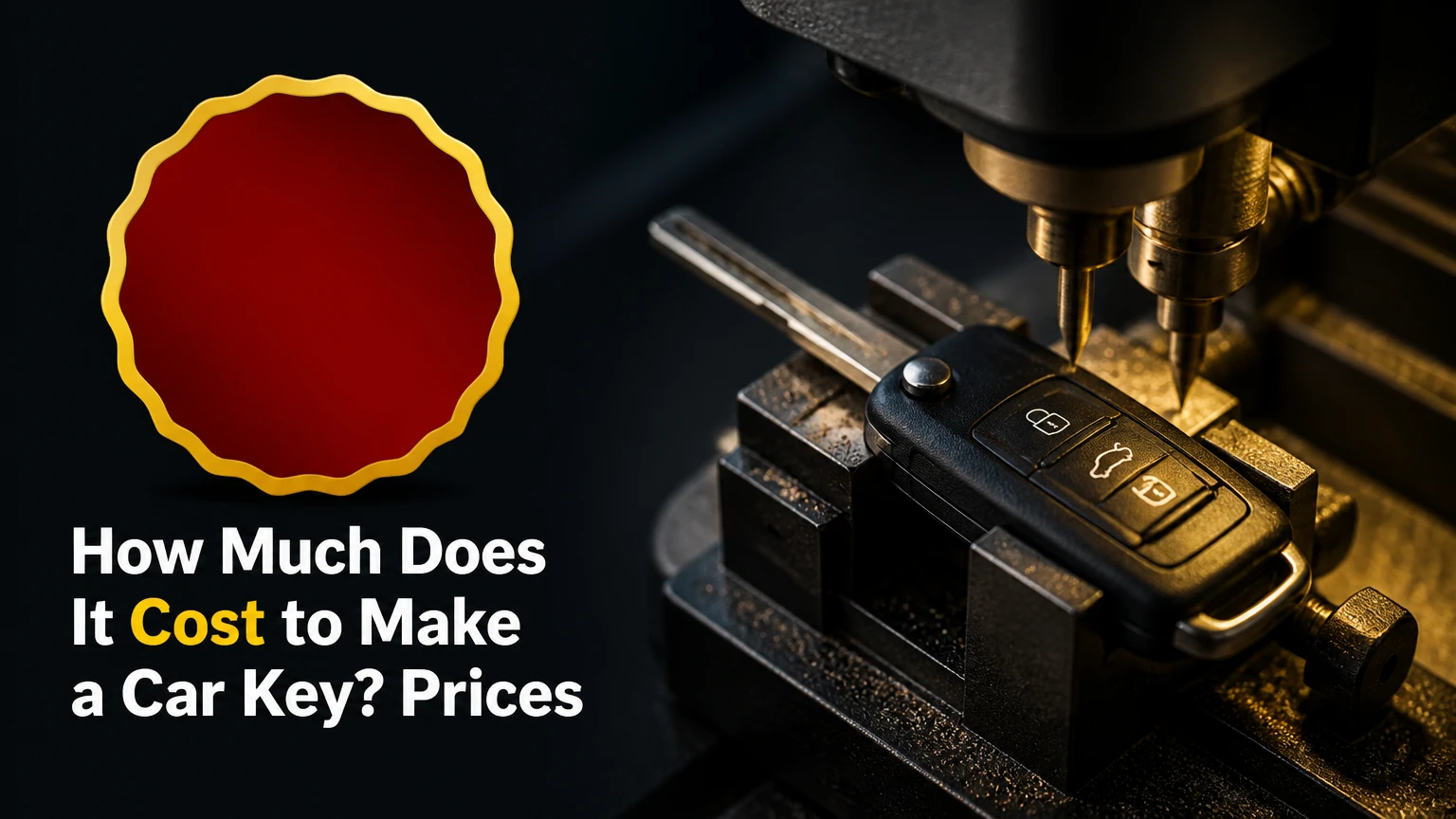
A new car key typically costs $5-$20 for a basic mechanical duplicate, $35-$120 for a transponder key, $80-$200 for a remote-head key, or $150-$500+ for a smart key. The final bill depends on the vehicle’s year, key technology, OEM or aftermarket parts, whether a working key exists, programming requirements, and the provider’s labor or mobile-service fee.
Key Facts
A working-key duplicate is usually cheaper than replacing a completely lost key because the locksmith can copy and test the original.
A transponder key must be electronically authorized by the vehicle’s immobilizer before the engine will start.
A remote fob’s lock and unlock buttons can fail while the immobilizer chip still allows the car to start.
Dealership replacement is usually the most expensive option, while a qualified automotive locksmith often costs less.
A smart-key replacement commonly costs $150-$500 or more for luxury, encrypted, or newly released vehicles.
A replacement key requires proof of ownership, the vehicle identification number, and accurate key-part information.
How much does it cost to make a car key?
A car key costs approximately $5-$500+, with most ordinary replacement jobs falling between $35 and $250. A simple metal duplicate may take minutes, while an all-keys-lost smart-key job can require vehicle access, security authorization, programming, and a second technician or dealer-level tool.
Prices below are typical consumer ranges in the United States and similar markets. Bangladesh, the United Kingdom, Australia, Canada, and other regions use different labor rates and currencies; the cited AI Overview’s Tk 500-Tk 50,000+ range is plausible as a broad Bangladesh-market estimate, but local quotes should replace currency conversion.
| Key or service type | Typical parts and labor price | Typical completion time | Programming required |
|---|---|---|---|
| Metal mechanical duplicate | $5-$20 | 5-10 minutes | No |
| Laser-cut mechanical blade | $20-$60 | 10-25 minutes | Usually no, unless a chip is embedded |
| Transponder key | $35-$120 | 20-40 minutes | Yes |
| Remote-head key | $80-$200 | 30-45 minutes | Usually yes |
| Smart or proximity fob | $150-$500+ | 45-90 minutes | Yes |
| All-keys-lost emergency job | $200-$1,000+ | 1-4 hours | Yes, plus access and security work |
A quote can exceed these ranges when the vehicle is a BMW, Mercedes-Benz, Audi, Land Rover, Jaguar, Porsche, or a newer model with encrypted key authorization. Parts availability, towing, nighttime dispatch, travel distance, and an extra key-memory reset can also change the total.
What determines the price of a replacement car key?
The biggest price factor is the key’s security technology, but five additional variables can move the quote substantially. The same vehicle may cost $60 for a duplicate made from a working key and $400 for an emergency replacement after every key is lost.
Key type and physical design
A metal key contains a cut pattern that operates the door, trunk, or ignition lock. Some older vehicles use only this mechanical layer, while many later vehicles combine a blade with an immobilizer transponder.
Laser-cut or sidewinder blades need specialized cutting equipment. Their central track and tighter tolerances make them more expensive than a basic edge-cut duplicate, although the blade itself may still require no electronic programming.
Immobilizer and transponder system
A transponder key contains a passive chip that communicates with the immobilizer. The chip does not normally use the small battery that powers the remote buttons, so changing the coin cell will not program an unauthorized key.
When the vehicle recognizes the transponder’s credential, the immobilizer permits engine operation. A key can therefore turn the lock or operate the remote buttons while still failing to start the engine.
Remote and proximity features
Remote keyless entry, push-button start, passive door handles, trunk release, panic alarms, and vehicle-memory functions add components and programming steps. A proximity fob may also contain an emergency blade for manual door entry.
A fob battery typically costs $2-$10 and can solve a button-range problem. Battery replacement cannot correct an incorrect FCC ID, incompatible frequency, locked aftermarket chip, damaged circuit board, or missing immobilizer authorization.
OEM versus aftermarket parts
An OEM key comes from the vehicle manufacturer or its approved supply chain. An aftermarket key is produced by another supplier and may function properly when its part number, frequency, transponder type, and vehicle software generation match.
Aftermarket parts often reduce the hardware cost by 30%-70%, but the apparent saving disappears if the locksmith cannot program the fob or the seller refuses returns. Used OEM fobs can also remain locked to a previous vehicle.
Duplicate versus all keys lost
A duplicate made while one original works is usually the lowest-cost route. When every key is missing, the technician may need to decode a lock, obtain security credentials, access the diagnostic port, erase old keys, and program new ones.
Some vehicles require an online security subscription or a manufacturer-authorized account. Others need a special cable, gateway unlock, PIN, or EEPROM-level procedure rather than a simple scan-tool command.
Which car key type do you have?
The visible shape does not always identify the security system. A flip key, for example, may contain both a remote transmitter and a separate immobilizer transponder, while a plain-looking metal key may contain a concealed chip.
| Key type | How to identify it | Main function | Common price |
|---|---|---|---|
| Mechanical edge-cut key | Flat metal blade with cuts along one edge | Opens lock and operates ignition | $5-$20 |
| Laser or sidewinder key | Groove or track cut through the blade | Precise mechanical operation | $20-$60 |
| Transponder key | Plastic head, often with no buttons | Authorizes engine start | $35-$120 |
| Remote-head key | Buttons molded into a key head | Starts vehicle and controls locks | $80-$200 |
| Flip key | Folding blade with remote buttons | Combines compact blade and remote | $80-$220 |
| Smart proximity fob | No ignition slot, push-button start | Passive entry and keyless start | $150-$500+ |
| Key card or digital key | Card, phone, or manufacturer app | Selected entry and starting functions | $50-$400+ |
Check the owner’s manual, original fob label, or vehicle documentation for a part number and frequency. In North America, the FCC ID printed inside many remotes helps identify radio hardware, but matching the FCC ID alone does not guarantee immobilizer compatibility.
Does a new car key need programming?
A new car key needs programming when the vehicle uses a transponder, remote-head key, smart fob, or proximity system. A purely mechanical key does not need programming, although its blade must be cut accurately enough to operate the lock and ignition.
Remote synchronization and immobilizer programming are separate tasks. Remote synchronization controls buttons such as lock, unlock, and trunk release; immobilizer programming authorizes the chip that allows the engine to run. Some vehicles combine both steps, while others require different procedures.
A professional replacement usually follows this sequence:
- Verify the vehicle and ownership. The technician records the VIN, make, model, year, registration, and government-issued identification.
- Identify the correct key system. The technician checks the key code, part number, frequency, transponder type, and vehicle security generation.
- Decode or obtain the blade pattern. With a working key, the technician can usually duplicate the blade; without one, the lock or manufacturer data may provide the pattern.
- Cut the physical key. A code machine, laser cutter, or duplicator produces the blade.
- Program the electronic credential. A compatible diagnostic tool or manufacturer system adds the transponder and remote to the vehicle.
- Test every function. The technician checks door operation, ignition, immobilizer authorization, lock buttons, trunk release, panic function, and emergency-start behavior.
The exact method varies by manufacturer. “OBD programming” is a broad industry term, not a universal bypass: newer vehicles may require secure gateway access, online authorization, or dealer-only credentials.
Where is the cheapest place to get a car key?
A hardware store or kiosk is usually cheapest for a basic mechanical duplicate, while an automotive locksmith is often the best value for transponder and remote keys. A dealership offers the strongest OEM support but commonly charges more for the part, labor, programming, and vehicle transport.
| Provider | Typical price position | Handles all-keys-lost jobs | Best use case | Main limitation |
|---|---|---|---|---|
| Hardware store | Lowest, $5-$25 | No | Basic metal duplicate | Usually cannot program immobilizers |
| Self-service kiosk | Low, $10-$40 | No | Simple compatible duplicate | Limited vehicle coverage |
| Automotive locksmith | Medium, $35-$500+ | Often yes | Mobile cutting and programming | Some new luxury systems need dealer access |
| Independent repair shop | Medium, $50-$400+ | Sometimes | Existing shop customers | May not have every key tool |
| Dealership | Highest, $150-$1,000+ | Yes, subject to model | OEM and complex vehicles | Parts delays, towing, higher labor |
An automotive locksmith is not automatically cheaper. Compare the complete out-the-door price, including service call, emergency surcharge, blade cutting, programming, taxes, key disposal, and warranty.
Ask for the following before authorizing work:
- Total price for the exact year, make, model, and trim
- OEM or aftermarket part identification
- Programming and cutting included in the quote
- Mobile-service, diagnostic, and nighttime charges
- Warranty period for the key and programming
- Whether lost keys can be removed from the vehicle’s memory
- Payment method and cancellation fee
Is a dealership or locksmith better for a replacement key?
A locksmith is usually better for a standard transponder, remote-head key, or smart fob when the technician has the correct equipment. A dealership is preferable when the vehicle needs manufacturer-only credentials, the key is covered by a warranty, the model is very new, or an independent technician cannot verify compatibility.
Automotive locksmith advantages
A mobile locksmith can cut and program a key at the vehicle, which avoids towing. Independent technicians commonly offer aftermarket and OEM-equivalent choices, and they may charge one combined price instead of separate parts and labor fees.
The limitation is model coverage. A locksmith who handles Ford, Toyota, Honda, Hyundai, and General Motors vehicles may not support the latest encrypted European system. Ask for the exact tool and model capability rather than relying on a general “we program all keys” claim.
Dealership advantages
A dealership can order the correct OEM key through the manufacturer’s parts system and access brand-specific programming infrastructure. This route is valuable for vehicles with restricted security credentials or keys that cannot be initialized by independent equipment.
The costs may include an ordered key, cutting, one hour of labor, programming, diagnostic charges, and towing when all keys are lost. Parts may take several business days, especially for uncommon trims or imported vehicles.
Hardware-store limitations
A hardware store can duplicate a metal blade and, at some locations, copy selected chip keys. It generally cannot create a new security credential for a proximity vehicle or recover a vehicle after every key has disappeared.
A blade that opens the driver’s door is not proof of a complete replacement. The engine-start test determines whether the immobilizer recognizes the electronic key.
Can a locksmith make a car key without the original?
A qualified automotive locksmith can often make a car key without the original, but the method and price depend on the vehicle’s lock design and electronic security. The technician may use VIN information, manufacturer key data, lock decoding, specialized diagnostic equipment, or a combination of those methods.
The owner should bring the VIN, registration or title, photo identification, and any remaining key shell or remote. Ownership verification protects against unauthorized vehicle entry and key creation.
For the mechanical portion, the locksmith may decode a door or ignition lock, read a key code, or remove and inspect a lock cylinder. For the electronic portion, the technician must identify the immobilizer generation and add the new credential to the vehicle.
All-keys-lost work carries additional risk. The vehicle may lock itself, the battery may discharge during programming, and an incorrect key may consume a limited programming attempt. A professional should explain the recovery plan before beginning.
If a key was stolen, request deletion of the missing key from the vehicle’s authorized-key list. Deleting a credential can prevent engine starting, but some vehicles may retain separate remote functions or physical access risks, so a security professional may recommend rekeying locks as well.
Can you program a car key yourself?
You can program some car keys yourself, but only when the vehicle supports an owner procedure and the required number of working keys already exists. Many vehicles do not permit DIY addition after all keys are lost, and some require a diagnostic tool or secure online authorization.
Owner programming commonly has strict conditions, such as two recognized keys, a charged vehicle battery, a specific ignition sequence, and a time limit. The procedure differs by model year, so use the vehicle’s official manual rather than a generic internet sequence.
DIY replacement becomes risky when you buy a fob before confirming:
- Vehicle year, trim, and immobilizer generation
- Part number and FCC ID
- Radio frequency, such as 315 MHz or 433 MHz
- Transponder type and chip status
- New, refurbished, or previously locked condition
- Return eligibility after cutting or programming
A self-programmed remote may operate the locks but fail immobilizer authorization. Conversely, a correctly programmed transponder may start the car while the remote buttons remain unsynchronized.
Why does a new key unlock the car but not start it?
A key that unlocks the doors but will not start the engine usually has a mechanical or remote function without a correctly programmed immobilizer transponder. The blade and buttons can work independently from the chip that authorizes engine operation.
Common causes include an incorrect transponder type, an unprogrammed key, a previously locked used fob, a damaged antenna coil, a weak vehicle battery, or an interrupted security procedure. A dead fob battery is less likely to prevent a conventional transponder from starting the car because the immobilizer chip is generally passive.
Use the emergency-start location described in the owner’s manual. Depending on the vehicle, holding the fob against the start button, placing it in a center-console slot, or inserting an emergency blade may allow operation when the remote battery is dead.
If the vehicle displays “key not detected,” test the spare key, replace the fob battery with the specified CR2032 or CR2025 type, and move other RFID devices away from the fob. If the problem remains, the technician should test the antenna, key data, and immobilizer status rather than cutting another blade.
What extra car-key charges should you expect?
The advertised key price may exclude labor, programming, travel, towing, emergency access, and taxes. A transparent quote separates each item so the customer can compare a locksmith with a dealership accurately.
| Possible charge | Typical range | When it applies | How to reduce it |
|---|---|---|---|
| Basic key blank | $5-$40 | Mechanical or laser blade | Supply verified part details |
| Transponder or fob hardware | $30-$350 | Electronic key replacement | Compare OEM and compatible aftermarket |
| Cutting | $5-$40 | Separate blade-cutting charge | Use a provider bundling cutting |
| Programming labor | $50-$200 | Immobilizer or smart-fob setup | Ask for total installed price |
| Mobile service | $25-$150 | Technician travels to vehicle | Schedule during normal hours |
| Emergency or nighttime fee | $50-$200 | After-hours dispatch | Use a spare or planned appointment |
| Towing | $75-$300+ | Vehicle must reach a dealer | Choose mobile service when supported |
| Security reset or key deletion | $50-$250 | Stolen or all-keys-lost case | Request it in the initial quote |
Insurance, roadside assistance, extended warranties, and some manufacturer assistance programs may cover part of a lost-key service. Coverage often excludes a second spare, cosmetic damage, or programming for a non-approved aftermarket fob, so check the policy before paying.
How can you reduce the cost?
The most effective saving is making a spare while the existing key still works. A duplicate avoids many all-keys-lost steps and lets the technician verify the cut, transponder, and remote before the original fails.
Use these cost-control steps:
- Photograph the original key label and record its part number.
- Obtain two written installed-price quotes from automotive locksmiths.
- Ask whether the quote uses OEM, aftermarket, or refurbished hardware.
- Confirm programming, cutting, travel, taxes, and warranty in writing.
- Compare the dealer’s complete price, not only the replacement-key price.
- Keep the spare outside the vehicle in a secure, labeled location.
- Replace a weak fob battery before the remote stops working.
- Report stolen keys and request key-memory deletion immediately.
A cheap online fob is a poor bargain when the seller cannot confirm compatibility. The correct comparison is total working cost, not the lowest unprogrammed part price.
What should you do if the key is stolen, broken, or locked inside?
The correct response depends on whether the vehicle remains secure and whether any authorized key still works. A stolen key requires a security response, a broken key may need extraction and a duplicate, and a locked-in key usually needs non-destructive entry rather than replacement.
If the key is stolen
Call a locksmith or dealership and request deletion of the stolen electronic credential. If the key may open the physical locks, consider rekeying or replacing vulnerable lock cylinders.
Do not assume remote deletion handles every security layer. Ask which immobilizer keys, remote IDs, digital keys, and physical locks were changed.
If the blade breaks
Stop turning the remaining fragment. A locksmith can extract a broken blade, decode the lock, cut a replacement, and transfer a compatible transponder or remote board when the electronics remain undamaged.
Do not glue the fragment into the ignition. Adhesive can damage the cylinder and turn a $30 extraction into a much larger repair.
If the key is locked inside
A roadside provider or automotive locksmith can usually open the vehicle without making a new key. Confirm that the service includes non-destructive entry, because a lockout and a replacement key are different jobs.
If the key is lost overseas or far from home
Contact the vehicle manufacturer’s assistance program, travel insurer, rental company, or local automotive locksmith. Imported vehicles may require parts shipping, local registration documents, or a dealer because regional frequency and security credentials differ.
How long does car-key replacement take?
A basic metal duplicate usually takes 5-10 minutes, while a transponder replacement takes 20-40 minutes and a smart-key job takes 45-90 minutes when the correct part is available. All-keys-lost, luxury, imported, and parts-order cases can take several hours or multiple days.
The cutting itself is rarely the longest step. Identification, security authorization, battery support, programming, testing, and troubleshooting determine the appointment length.
A dealer may complete programming in a short appointment after the key arrives, but an ordered OEM part can create a wait of several business days. A mobile locksmith may arrive quickly but need to return if the first part or tool does not match the vehicle.
Expert rules that prevent expensive mistakes
A working key is an asset, not merely a convenience. The price difference between a planned duplicate and an emergency all-keys-lost job can exceed $200, particularly for a push-button vehicle.
Remote operation does not prove immobilizer compatibility. Lock and unlock buttons transmit radio commands, whereas engine authorization depends on a separate security credential. Test engine start before accepting the job.
The cheapest fob is rarely the cheapest successful solution. A verified aftermarket fob from a reputable supplier can save money, but an unverified unit can add shipping, diagnostic, and second-programming costs.
Key deletion has a defined scope. Ask the technician whether deletion affects engine authorization, remote entry, digital keys, and physical locks. The answer varies by manufacturer and vehicle generation.
Frequently Asked Questions
How much does a spare car key cost?
A spare car key costs about $5-$20 for a purely mechanical key, $35-$120 for a transponder key, $80-$200 for a remote-head key, and $150-$500+ for a smart fob. A spare usually costs less than an all-keys-lost replacement because the working key supplies a pattern and allows immediate testing.
Can AutoZone or another parts store make a car key?
Some parts stores can cut basic metal keys or sell compatible replacement fobs, but programming coverage varies by store, vehicle, and key type. A parts store usually cannot replace a fully lost smart key for every vehicle. Confirm cutting, immobilizer programming, and testing before purchasing.
Is it cheaper to buy a car key online?
Buying a car key online can reduce hardware cost, but the final price is lower only when the part is fully compatible and a local professional will program it. Verify the part number, FCC ID, frequency, transponder status, vehicle generation, and return policy before ordering.
Does a car key battery need programming?
Replacing a coin-cell battery normally does not require immobilizer programming, although some vehicles require remote-button resynchronization afterward. A battery replacement cannot make an incompatible or previously locked fob work. Use the battery type specified by the manufacturer, commonly CR2032 or CR2025.
Can a car start without the key fob battery?
Many vehicles can start with a dead fob battery because the immobilizer transponder remains passive. The emergency method may require placing the fob in a designated console slot or holding it against the start button. Consult the owner’s manual because the backup location differs by model.
Should you replace every key after losing one?
Replace or reprogram every lost key when theft is possible, particularly if the missing key identifies the vehicle or can open its locks. If a key was simply misplaced and the vehicle has no security exposure, adding a spare may be sufficient, but key-memory policy differs by manufacturer.
The Bottom Line
The answer to how much does it cost to make a car key is usually $5-$20 for a metal duplicate, $35-$120 for a transponder key, $80-$200 for a remote-head key, or $150-$500+ for a smart fob. Get an installed-price quote using the exact VIN, year, make, model, and key type, then confirm whether programming, cutting, mobile service, taxes, and lost-key deletion are included.
A working spare from a qualified automotive locksmith is normally the best value. Choose a dealership when the vehicle requires manufacturer-only security access, and do not accept a key until the blade, remote functions, immobilizer, and emergency-start procedure have all been tested.