Automotive locksmiths, car dealerships, vehicle manufacturers, independent repair shops, and some hardware retailers make keys for cars. The best provider depends on the key technology, whether a working key remains, the vehicle’s security restrictions, and whether you need mobile emergency service or an OEM replacement.
Key Facts at a Glance
- Automotive locksmiths commonly cut and program replacement keys at the vehicle’s location.
- Dealerships supply OEM keys and can access manufacturer-controlled ordering or programming systems.
- Hardware stores usually duplicate simple metal or transponder keys when a working original is available.
- A remote that locks the doors does not prove that the immobilizer transponder can start the engine.
- Typical replacement prices range from $5-$25 for a mechanical key to $170-$400 for a smart fob.
- VIN-based key cutting may fail when a vehicle’s ignition or door locks were replaced.
Who Makes Keys for Cars?
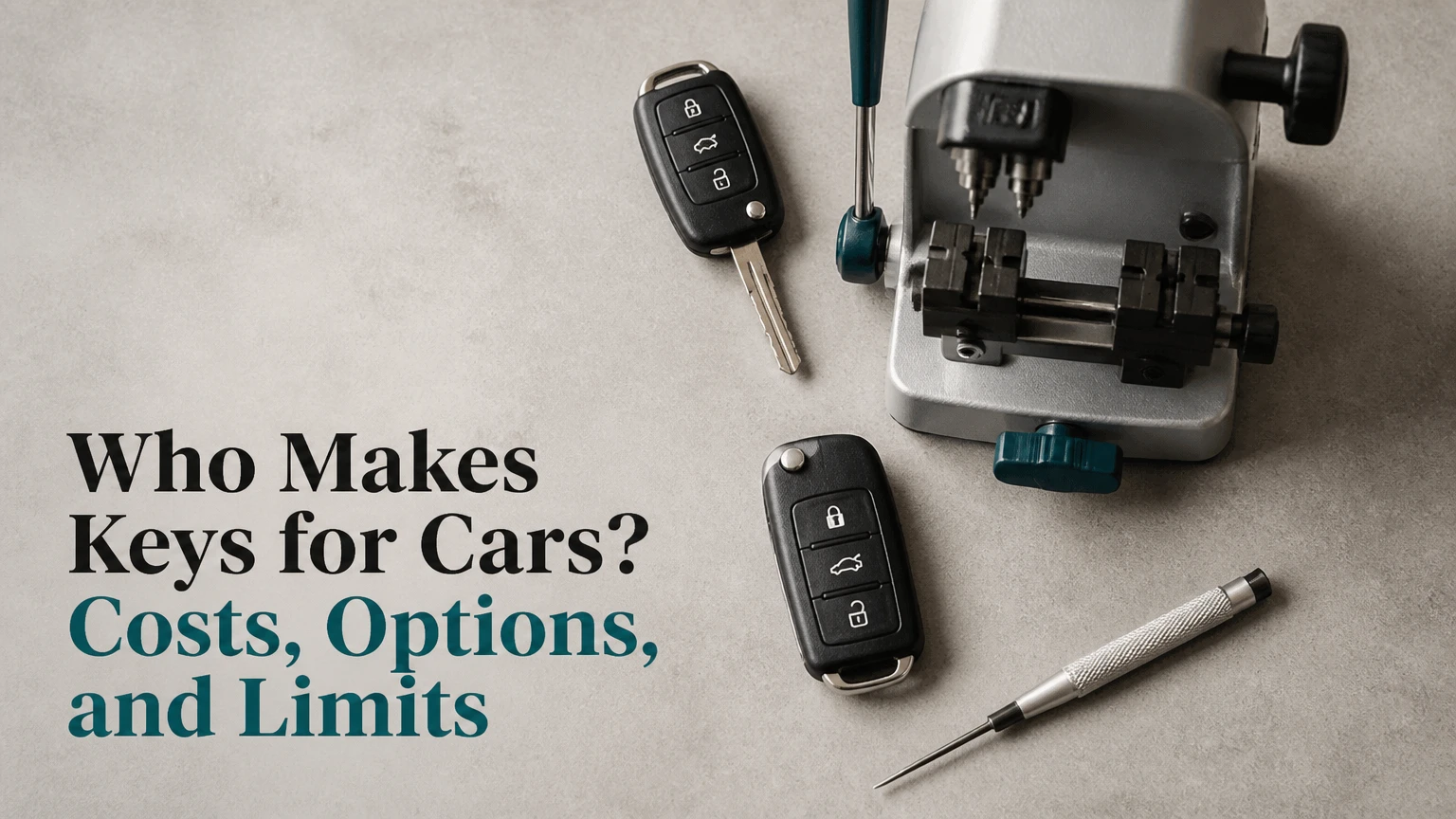
Automotive locksmiths make most replacement car keys, including mechanical keys, transponder keys, remote-head keys, and many proximity fobs. Dealerships make or order OEM keys for every supported model, while selected hardware chains duplicate simpler keys and some repair shops provide key programming.
The provider must match the vehicle’s security system. A key blade can be cut accurately and still fail because its transponder is not enrolled in the immobilizer. Conversely, a remote fob may operate the locks while its separate immobilizer chip remains unprogrammed.
The vehicle’s make, model, model year, key type, and key-loss situation determine the practical choice. A mobile locksmith is usually the fastest option for a stranded driver, but a dealer may be necessary for a newer vehicle whose key assignment requires a proprietary manufacturer server.
Automotive locksmiths
A qualified automotive locksmith can decode or originate the blade, supply a compatible shell or fob, program the transponder, erase a lost key from vehicle memory, and provide service at home or roadside. Many use code-cutting machines and diagnostic equipment that supports multiple manufacturers.
Ask for a written quote before work begins. Confirm the technician’s business registration, insurance, warranty, total price, programming charge, travel fee, and ability to provide a working key for the exact vehicle identification number.
Car dealerships
A dealership can order an OEM key by VIN, verify ownership, cut the blade when applicable, and program the key using factory equipment. Dealership service is the most predictable route for vehicles with restricted key systems, active warranties, or unusual factory configurations.
The trade-off is cost and logistics. The vehicle may need towing to the service department, and the final invoice can include the key, cutting, programming, diagnostic labor, and towing.
Mechanics and repair shops
Independent mechanics can sometimes program keys, especially when they already service the vehicle brand and own a compatible scan tool. Their capability varies more than a dealership’s because key programming depends on software subscriptions, security access, and model-specific hardware.
A mechanic is a practical choice when the key problem is part of a larger fault, such as an ignition switch, immobilizer antenna, body control module, or vehicle battery problem. A locksmith is usually better for a purely lost, damaged, or locked-in key.
Hardware stores and key kiosks
Hardware stores and automated kiosks can duplicate many basic keys and selected transponder products. They generally need a working key, because duplication equipment copies the blade and, on supported products, the existing electronic identity.
These retailers are poor choices for an all-keys-lost event, newer proximity systems, encrypted European keys, or a vehicle with a failed immobilizer. Call first with the exact year, make, and model.
How Does a Car Key Work?
A modern car key performs one or more separate jobs: opening a lock, controlling remote functions, and authorizing engine operation. The metal blade handles physical access, while a transponder or smart-fob credential communicates with the vehicle’s immobilizer system.
A conventional ignition cylinder reads the blade mechanically. A transponder system adds a passive chip near the ignition antenna, and a proximity system exchanges radio signals with antennas positioned around the cabin and exterior door areas.
The engine control module does not simply trust the presence of a cut key. It checks whether the electronic credential is recognized, and the immobilizer prevents starting when authentication fails.
Four common key technologies
| Key type | Main components | Typical vehicle era or use | Programming requirement |
|---|---|---|---|
| Mechanical key | Metal blade, no chip | Older cars, cabinet-style locks, some glove boxes | None for blade operation |
| Transponder key | Metal blade, passive RFID chip | Many vehicles from the mid-1990s onward | Immobilizer enrollment |
| Remote-head key | Blade, transponder, buttons, battery | Older and mid-generation keyless-entry vehicles | Remote pairing plus immobilizer enrollment |
| Smart or proximity fob | Battery, antennas, encrypted credential, emergency blade | Push-button-start vehicles | Vehicle-specific security registration |
The dates are approximate because manufacturers introduced technologies at different times. A 1998 vehicle may have a transponder, while a later base trim may still use a mechanical blade.
What is the difference between cutting and programming?
Key cutting creates the physical shape that turns a lock. Programming registers the key’s electronic identity with the vehicle, allowing the immobilizer or remote-entry system to recognize it.
A duplicated blade may unlock a door but fail to start the engine. A correctly programmed transponder may start the vehicle but have an incorrectly cut blade that cannot turn the ignition. Replacement requires both functions when the vehicle uses both systems.
Can a Locksmith Program a Car Key?
A locksmith can program many transponder keys, remote-head keys, and smart fobs when the technician has the correct manufacturer coverage and security credentials. Programming may require an onboard diagnostic connection, a PIN, an internet security subscription, two existing keys, or a manufacturer-specific procedure.
The word “program” covers several different operations. Remote-button pairing controls locks and trunk functions, while immobilizer programming authorizes engine starting. Some vehicles perform remote pairing manually; others require diagnostic access.
A professional should confirm compatibility before connecting a scan tool. Incorrect procedures can delete existing keys, trigger security lockouts, or leave the vehicle with no usable credential.
Typical replacement workflow
- Verify ownership and vehicle identity. Provide government photo identification, registration, title, or another document accepted by the provider. The VIN identifies the vehicle, but it does not by itself prove ownership.
- Identify the key system. The technician checks the blade profile, frequency, transponder type, buttons, proximity function, and model-specific programming method.
- Retrieve a key code when needed. The provider may obtain a mechanical code from manufacturer records, decode an existing lock, or originate a blade from the current lock.
- Cut the blade. A code cutter or high-security milling machine creates the specified bitting pattern. The technician tests the blade in the ignition and door cylinders.
- Connect diagnostic equipment. When required, the technician accesses the immobilizer through the vehicle’s diagnostic port, often the OBD-II connector beneath the dashboard.
- Enroll the credential. The new transponder or fob is added to the vehicle’s authorized-key memory. Lost keys may be removed, depending on the system.
- Test every function. The final test includes starting, locking, unlocking, trunk release, panic operation, proximity detection, and the emergency blade.
A working-key duplication commonly takes 10-30 minutes. An all-keys-lost job usually takes 30-90 minutes, while restricted luxury systems can require a factory order and several business days.
How Much Does a Replacement Car Key Cost?
Typical US replacement prices range from $5-$25 for a simple mechanical key, $70-$140 for a transponder key, $100-$210 for a remote-head key, and $170-$400 for a proximity fob. High-security or luxury replacements can exceed $400 when OEM ordering, security access, and towing are involved.
These figures are planning ranges, not universal quotes. Location, vehicle year, key availability, labor rate, emergency timing, number of keys, and whether all keys are lost can change the total.
| Replacement type | Typical hardware price | Typical service or programming | Typical total | Typical time |
|---|---|---|---|---|
| Mechanical blade | $5-$15 | $0-$10 | $5-$25 | 5-10 minutes |
| Transponder key | $20-$40 | $50-$100 | $70-$140 | 15-30 minutes |
| Remote-head key | $40-$90 | $60-$120 | $100-$210 | 20-40 minutes |
| Proximity smart fob | $90-$250 | $80-$150 | $170-$400 | 30-60 minutes |
| Restricted luxury key | $250-$600 | $150-$300 | $400-$900+ | 1-5 business days |
OEM versus aftermarket keys
OEM keys come from the vehicle manufacturer or an approved supply channel and normally provide the intended fit, frequency, buttons, battery contacts, and security credential. Aftermarket keys can cost less, but quality and compatibility vary by supplier and model.
A low price is not useful if the fob has the wrong radio frequency, an unsupported transponder, poor button alignment, or a locked used credential. Ask whether the quote includes a new key, cutting, programming, VAT or sales tax, travel, and a working guarantee.
Which Provider Is Best for Your Situation?
An automotive locksmith is usually the best value for a mobile replacement, a lost key, or a same-day duplicate. A dealership is the safest default for restricted systems, factory warranty concerns, and cases where the locksmith confirms that proprietary programming access is unavailable.
| Situation | Best first call | Why | Likely limitation |
|---|---|---|---|
| One working mechanical key remains | Hardware store or locksmith | Fast blade duplication | May not support electronic chips |
| One working transponder key remains | Automotive locksmith | Can cut and clone or program a spare | Coverage varies by model |
| All keys are lost roadside | Mobile automotive locksmith | Brings cutting and diagnostic tools | May need proof and security data |
| New luxury push-button vehicle | Dealer or specialist locksmith | Handles restricted credentials | OEM key may take days |
| Ignition or lock was replaced | Locksmith with lock-decoding skill | Matches the current hardware | VIN code alone may be wrong |
| Key issue plus no-start fault | Mechanic or dealer | Diagnoses vehicle-side electrical faults | Key service may not be mobile |
When is a dealership mandatory?
A dealership is not automatically mandatory for every Mercedes-Benz, BMW, Audi, or other luxury vehicle. The deciding issue is whether an independent provider has lawful access to the required security service and compatible equipment for that exact model and year.
Some newer vehicles use encrypted key assignments, online authentication, rolling credentials, or modules that cannot be reset with ordinary aftermarket tools. A specialist locksmith may support the vehicle, but the provider should state that capability before accepting payment.
Can a hardware store make a key when all keys are lost?
A hardware store usually cannot create a complete replacement when no working key remains, particularly for a transponder or proximity system. The store may cut a mechanical blade from a lock code, but the vehicle still needs an authorized electronic credential.
For all-keys-lost situations, contact a mobile automotive locksmith or the dealership. The provider will normally require the VIN, proof of ownership, vehicle location, and information about the ignition and locks.
What Documents and Information Do You Need?
Most legitimate providers require a government photo ID, vehicle registration or title, the VIN, and the vehicle’s exact location. Some businesses accept insurance documents or a lease agreement when those documents clearly connect the driver to the vehicle.
Prepare the following details before requesting a quote:
- Vehicle year, make, model, trim, and ignition type.
- VIN, usually visible through the windshield or on registration paperwork.
- Number of working keys currently available.
- Key symptoms, such as “remote works but engine will not start.”
- Whether the ignition, doors, or locks were replaced.
- Whether the vehicle is at home, roadside, a repair facility, or an impound lot.
- Whether the replacement must be OEM, mobile, same-day, or covered by insurance.
Do not post the complete VIN, registration, or key photographs publicly. Send sensitive information only through a verified provider’s secure channel.
What Can Go Wrong During Replacement?
The most expensive mistakes occur when a provider treats a car key as a simple metal object. Modern replacements combine fitment, radio behavior, immobilizer authorization, battery condition, and vehicle-module compatibility.
Buying an uncut key online
Online listings can show the right shell while containing the wrong transponder, frequency, blade profile, or locked used module. Confirm the FCC ID or manufacturer part number where applicable, but understand that matching the part number still does not guarantee programming compatibility.
A used smart fob may be permanently linked to another vehicle. Some models permit professional refurbishment, while others require a new credential.
Erasing the only working key
Some programming procedures erase authorized keys before adding replacements. If the tool loses power, the vehicle voltage drops, or the procedure fails, the original key may stop working.
An experienced technician checks battery voltage, keeps a stable power supply when required, and confirms the recovery procedure before deleting keys. Keep every working key present during programming.
Assuming the VIN matches the current ignition
VIN-based cutting assumes the vehicle retains its factory lock configuration. A previous owner may have replaced the ignition cylinder, door lock, or complete lock set, causing a VIN-cut blade not to turn.
When the new blade fits poorly, the technician should decode the existing cylinder or inspect the lock rather than repeatedly recutting a factory pattern.
Confusing a remote fault with an immobilizer fault
A remote button can work while the engine remains immobilized because remote-entry and start authorization are separate circuits. Replacing the coin-cell battery will not program a missing transponder.
Why Does a Remote Work When the Car Will Not Start?
A remote that locks and unlocks the doors while the engine will not start usually indicates an immobilizer, transponder, antenna, or vehicle-battery problem rather than a failed remote-button circuit. Door-lock commands and engine authorization often use separate electronic credentials.
Start with the least invasive checks:
- Replace the fob battery with the specified CR2032, CR2025, or another listed size.
- Try the vehicle’s emergency fob-detection position, which the owner’s manual identifies.
- Test a second programmed key if available.
- Check whether the dashboard displays a key, security, or immobilizer warning.
- Ask a locksmith or mechanic to scan the immobilizer and body-control systems.
Do not repeatedly attempt improvised programming sequences from unrelated vehicle models. A wrong procedure can create a lockout or drain the vehicle battery.
Common symptoms and likely causes
| Symptom | Likely area | First useful action | Typical resolution |
|---|---|---|---|
| Buttons work, engine will not start | Transponder or immobilizer | Try emergency detection position | Program key or diagnose antenna |
| No buttons work | Coin cell, contacts, fob board | Install correct battery | Clean contacts or replace fob |
| Key turns, dashboard stays dark | Vehicle battery, fuse, ignition circuit | Check battery voltage and fuses | Repair power or ignition circuit |
| New blade will not turn | Wrong bitting or changed lock | Stop forcing the cylinder | Decode current lock |
| Proximity entry is intermittent | Fob battery or antenna | Replace battery and test spare | Diagnose antenna network |
| New key starts car but remote fails | Remote pairing or wrong frequency | Verify part number and pairing | Pair or replace compatible fob |
Are Digital Car Keys an Alternative?
A digital car key can replace some physical-key functions by using an authorized smartphone, smartwatch, or manufacturer app, but availability depends on the vehicle, phone, subscription, region, and account permissions. Digital credentials do not necessarily provide a backup when the phone battery is dead or the vehicle’s 12-volt battery fails.
Digital keys commonly rely on Bluetooth, near-field communication, ultra-wideband, or a combination of technologies. Setup may require the owner’s account, an invitation from the vehicle, a compatible phone, and an active connection during initial authorization.
Keep a physical emergency key or manufacturer-approved backup credential. A phone-based key is an alternative access method, not a universal replacement for a lost smart fob.
How Should You Choose a Car-Key Provider?
Choose a provider by matching its confirmed technical capability to the vehicle, then compare the complete written price. The lowest advertised hardware price can become the most expensive option when programming, travel, towing, or a failed aftermarket fob is excluded.
Use this decision sequence:
- Identify the year, make, model, and push-button or keyed ignition.
- Establish whether one working key remains.
- Ask whether the provider supports the exact model year.
- Confirm OEM or aftermarket hardware before authorizing work.
- Request the all-in price and warranty in writing.
- Verify ownership requirements and expected completion time.
- Confirm that the final test includes engine starting and every remote function.
A locksmith should not promise universal compatibility. A dealership should not be the only quote when a qualified local specialist can lawfully perform the same job without towing.
Expert rules that prevent avoidable expense
Order the spare before the last key disappears. A duplicate made while one programmed key remains is often cheaper and faster than an all-keys-lost replacement because the provider may clone or use an easier enrollment path.
Keep the old key after replacement. A damaged shell may still contain a functioning transponder, and the blade or electronics can help identify the correct part. Dispose of an old key only after confirming that lost credentials were removed.
Diagnose the vehicle before buying another fob. If two known-good keys fail simultaneously, the fault may be the vehicle battery, immobilizer antenna, fuse, wiring, or control module. Another key will not repair a vehicle-side failure.
Frequently Asked Questions
Can a locksmith make a car key without the original?
Yes, an automotive locksmith can often make a key without the original by decoding the lock, obtaining a manufacturer key code, or generating a blade from the VIN. Electronic programming remains necessary for transponder and smart systems, and proof of ownership is normally required.
Can AutoZone, Walmart, or a parts store make a car key?
Some parts stores and retailers duplicate supported mechanical or transponder keys, but service varies by location and vehicle. Retailers usually need a working key and may not handle proximity fobs, all-keys-lost jobs, restricted credentials, or vehicle-side immobilizer faults.
How long does a locksmith take to make a car key?
A simple mechanical duplicate usually takes 5-10 minutes, while a transponder replacement often takes 15-30 minutes. Remote-head keys commonly take 20-40 minutes, and smart-fob or all-keys-lost work can take 30-90 minutes when the correct hardware is available.
Can car insurance pay for a replacement key?
Some comprehensive policies, roadside plans, manufacturer warranties, lease agreements, and vehicle-service contracts cover key replacement or lockout assistance. Coverage limits and deductibles differ, so check the policy before authorizing work and ask whether the insurer requires an approved provider.
Should I buy an OEM or aftermarket car key?
Choose OEM when fit, warranty support, or restricted security access matters most. Choose a reputable aftermarket key when the provider confirms the exact frequency, transponder, part number, and programming method, and when the total warranty-backed price is materially lower.
How many spare car keys should I have?
Keep at least one fully tested spare, and consider two for vehicles used by multiple drivers or difficult-to-replace models. Store a spare away from the primary key, record its battery type, and test its engine-start and remote functions every few months.
The Bottom Line
Automotive locksmiths, dealerships, mechanics, and selected hardware retailers all make keys for cars, but they do not provide equivalent services. Use a hardware store for a simple duplicate, a mobile locksmith for most replacement and all-keys-lost jobs, and a dealership or qualified brand specialist for restricted newer vehicles.
The right choice depends on key technology, remaining working keys, lock history, documentation, cost, and programming access. Before approving work, obtain a complete quote, verify exact model coverage, and confirm that the replacement starts the engine as well as operating the locks.