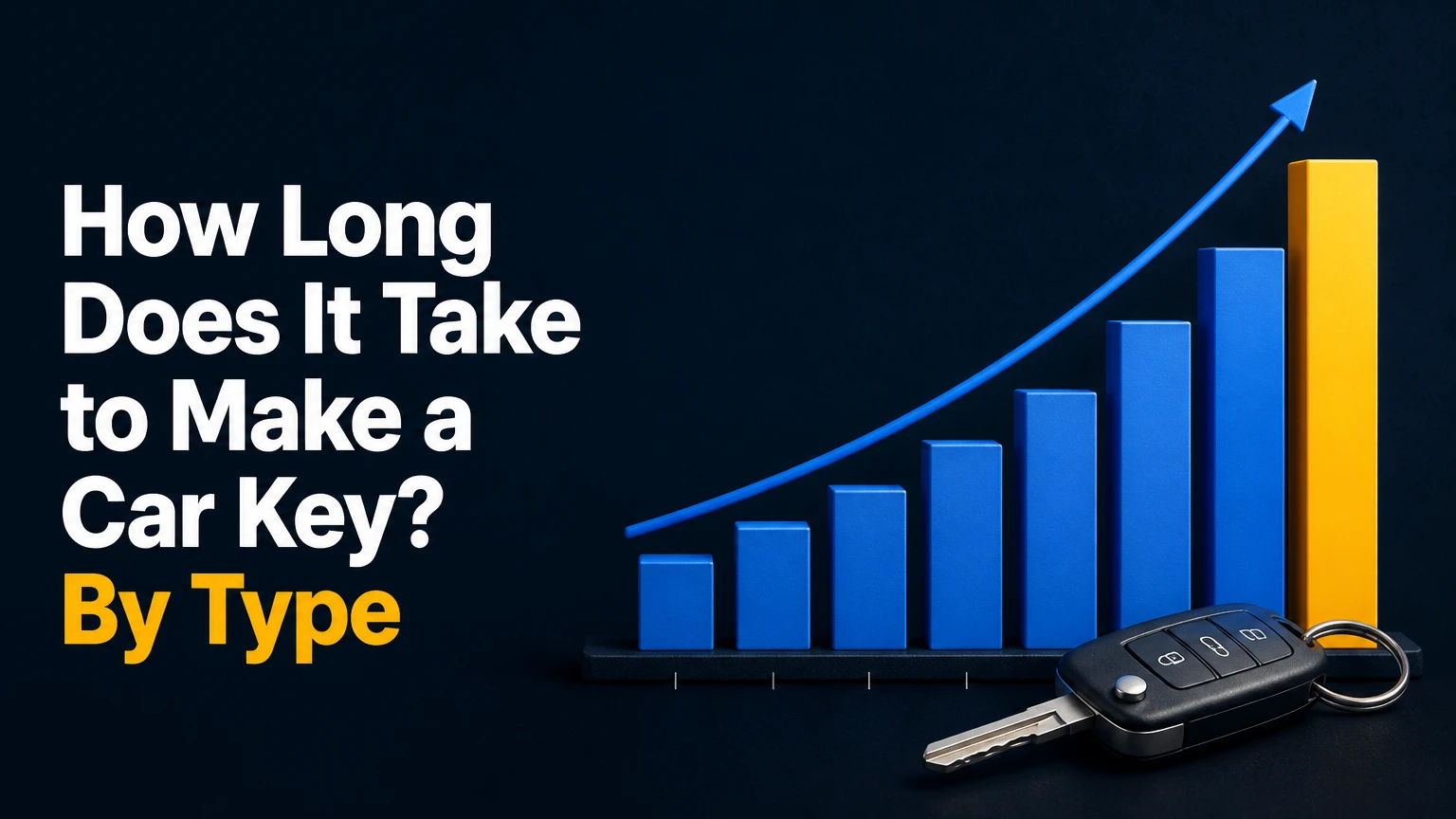
Making a car key usually takes 10-30 minutes when a working key is available and 30 minutes to 2 hours when the vehicle needs transponder or smart-key programming. A basic metal duplicate may take 5-10 minutes, while an all-keys-lost replacement can take longer because the technician must verify ownership, cut the blade, program security credentials, and test the vehicle.
Key Facts at a Glance
- A basic mechanical car key normally takes 5-10 minutes to cut and test.
- A transponder key commonly takes 15-30 minutes total when the correct blank is available.
- A smart or proximity key usually takes 30-90 minutes, including programming and testing.
- All-keys-lost service often takes 45 minutes to 2 hours, excluding travel and parts delays.
- A dealership may need one to several days if an OEM key must be ordered.
- The vehicle’s make, model, year, security system, and available keys determine the actual time.
How Long Does It Take to Make a Car Key?
A car key takes about 5-10 minutes for a non-electronic duplicate, 15-30 minutes for a transponder key, and 30-90 minutes for most smart-key replacements. Those figures describe hands-on service after the provider has the correct key blank or fob; mobile travel, ownership checks, software access, and unavailable parts can extend the appointment.
A working key makes the process faster because the technician can trace its blade and may be able to clone or authorize its electronic chip. When every key is lost, the technician must identify the correct mechanical code, access the vehicle, register a new credential, and often remove the missing keys from the immobilizer memory.
A same-day automotive locksmith usually completes common vehicles in one visit. Newer European vehicles, unusual imports, encrypted immobilizer systems, and vehicles requiring dealer-ordered parts can take several hours or multiple days.
Typical Time by Key Type
| Key type | Cutting or preparation | Programming and testing | Typical total |
|---|---|---|---|
| Traditional metal key | 5-10 minutes | None | 5-15 minutes |
| Transponder key | 5-10 minutes | 10-20 minutes | 15-30 minutes |
| Laser-cut sidewinder key | 10-20 minutes | 10-30 minutes | 20-45 minutes |
| Switchblade key | 10-20 minutes | 15-30 minutes | 25-50 minutes |
| Smart or proximity fob | 5-15 minutes | 20-60 minutes | 30-90 minutes |
| All-keys-lost replacement | 15-40 minutes | 20-80 minutes | 45 minutes-2 hours |
These are typical practitioner ranges, not a guaranteed service standard. A provider may quote only cutting time, whereas a vehicle owner usually cares about the complete appointment, including programming and functional checks.
What Actually Takes Time When a Key Is Made?
The physical cut is usually the fastest part of car-key service. Vehicle identification, security authorization, electronic programming, and troubleshooting consume most of the appointment when the key contains a transponder, remote, or proximity credential.
A mechanical blade uses edge cuts or a sidewinder groove to operate the lock cylinder. A transponder key adds an immobilizer chip that must be recognized by the engine control system. A remote fob adds buttons for locking functions, while a smart key communicates with the vehicle through proximity antennas and may include an emergency blade.
The technician may use a key duplicator, code-cutting machine, diagnostic tablet, manufacturer software, frequency tester, battery tester, and vehicle-specific programming procedure. The car’s immobilizer may reject an otherwise perfect blade if the electronic credential is missing, incompatible, or not registered.
What Is the Difference Between Cutting and Programming?
Cutting creates the physical blade that turns the door or ignition lock. Programming authorizes the transponder, remote, or proximity fob within the vehicle’s immobilizer and body-control systems.
A correctly cut key can unlock the driver’s door but still fail to start the engine. Conversely, a programmed transponder may allow starting while a badly cut blade cannot turn the ignition. A complete service must check both layers.
Programming time varies because some older vehicles accept a manual procedure, while others require an OBD-II connection, a security PIN, internet authorization, or brand-specific software. A low vehicle battery can also interrupt programming and create unnecessary repeat work.
How Is a Duplicate Car Key Made?
A duplicate car key is made by identifying the correct blank, cutting the blade from an existing key or factory code, programming its electronic credential when required, and testing every function. With a working key and an in-stock blank, a locksmith often completes the process in 15-30 minutes.
The technician first confirms the vehicle identification number, model year, key profile, transponder type, and remote frequency. The original key may be traced directly, or the blade may be cut by code for greater accuracy. Code cutting is useful when the original key is worn because copying worn cuts can reproduce the wear rather than the factory pattern.
The new key is then tested in the door, trunk, ignition, or start system. Remote buttons, panic functions, proximity unlocking, and dashboard security indicators should also be checked before payment.
What Changes When All Keys Are Lost?
All-keys-lost service commonly takes 45 minutes to 2 hours because the technician must gain lawful access, verify ownership, determine the key code, and program a new credential without relying on an existing key. Travel and vehicle location can add another 20-90 minutes.
A legitimate provider normally requests government identification and registration, title, insurance documentation, or another accepted proof of possession. The required documents differ by jurisdiction and provider. A VIN alone does not prove that the person requesting a key owns or controls the vehicle.
The technician may decode a door or ignition lock, retrieve a code through an authorized database, or use vehicle-specific diagnostic procedures. Some cars require an immobilizer reset, security PIN, online authorization, or replacement module procedure. If a key was stolen, request an all-keys-lost erase or key-memory reset rather than simply adding another key.
Which Car Key Types Take the Longest?
Smart and proximity keys usually take the longest because they combine a high-cost fob, multiple radio functions, immobilizer authorization, and vehicle-specific programming. A traditional metal key is fastest because it has no electronic credential to register.
| Technology | Main components | Common vehicle feature | Typical service time |
|---|---|---|---|
| Mechanical key | Steel blade | Older ignition cylinder | 5-15 minutes |
| Transponder key | Blade plus RFID chip | Key-start immobilizer | 15-30 minutes |
| Remote-head key | Blade, chip, lock buttons | Remote locking and ignition | 20-40 minutes |
| Switchblade key | Folding blade, chip, remote | Compact integrated fob | 25-50 minutes |
| Smart key | Proximity transmitter, buttons | Push-button start | 30-90 minutes |
| Digital key system | Smartphone or encrypted credential | App-based entry and start | 30 minutes-2 hours |
Key technology does not always match vehicle age exactly. Some late-1990s vehicles use simple transponders, while certain older luxury vehicles use advanced remote and immobilizer systems. Confirming the exact VIN and existing key shape is more reliable than estimating from the registration year alone.
Can a Hardware Store Make a Car Key?
A hardware store can usually cut a basic mechanical key and may support a limited range of transponder keys, but most stores cannot program modern smart keys or encrypted push-button-start fobs. The service is appropriate only when the required blank, machine, and programming capability match the vehicle.
Self-service kiosks often copy a blade from an existing key. They are not a practical solution for an all-keys-lost situation, a key that requires vehicle-side programming, or a damaged original that cannot provide an accurate pattern.
A hardware-store duplicate may open the door but fail to start the engine if the transponder is absent or unprogrammed. Ask what functions the provider guarantees before authorizing the cut.
Should You Use a Locksmith or a Dealership?
An automotive locksmith is usually faster and less expensive for common vehicles, especially when the vehicle is stranded or all keys are lost. A dealership is the safer choice when the vehicle requires proprietary software, a manufacturer-ordered fob, security-code access, or a system the local locksmith cannot support.
| Provider | Typical completion | Typical price range in the USA | Best use |
|---|---|---|---|
| Hardware store | 5-20 minutes | $5-$40 | Basic mechanical duplicate |
| Automotive locksmith shop | 15-60 minutes | $80-$350 | Common transponder or remote key |
| Mobile automotive locksmith | 30 minutes-2 hours | $120-$500 | Stranded vehicle or all keys lost |
| Dealership with stocked key | 30-120 minutes | $200-$600 | OEM replacement and supported programming |
| Dealership with ordered key | 1-7 days | $250-$1,000+ | New, luxury, or restricted systems |
Prices vary by region, vehicle brand, key type, labor rate, and whether a service call or tow is included. European luxury vehicles, proximity fobs, and vehicles requiring an OEM-only part can exceed these typical ranges.
A dealership may also require the vehicle on-site, particularly for all-keys-lost programming. A mobile locksmith can often cut and program at the vehicle’s location, avoiding a tow, but the locksmith may still need to refer the job when manufacturer authorization is mandatory.
What Should You Ask Before Booking?
Ask the provider for the complete price and expected elapsed time, not only the blade-cutting fee. Confirm whether the quote includes the key or fob, programming, emergency blade, battery, service call, tax, and testing.
Provide the make, model, year, VIN if requested, key type, current location, and whether any working key remains. Ask whether the replacement is OEM, aftermarket, refurbished, or compatible aftermarket equipment. A low quote based on the wrong fob can become more expensive after failed programming attempts.
A professional should also explain accepted ownership documents and whether stolen or missing keys can be deleted from vehicle memory. That conversation prevents two common failures: arriving without the required proof and leaving an old stolen credential active.
How Much Does a New Car Key Cost?
A new car key typically costs $5-$40 for a basic mechanical duplicate, $80-$250 for a transponder key, $150-$400 for a remote or switchblade key, and $200-$600 or more for a smart fob. All-keys-lost service costs more because access, decoding, programming, and mobile labor may be added.
| Replacement type | Parts estimate | Labor and programming | Typical total |
|---|---|---|---|
| Mechanical duplicate | $5-$20 | $0-$30 | $5-$40 |
| Transponder key | $30-$120 | $50-$150 | $80-$250 |
| Laser-cut remote key | $70-$220 | $80-$200 | $150-$420 |
| Switchblade key | $80-$250 | $70-$180 | $150-$430 |
| Smart or proximity fob | $100-$400 | $100-$300 | $200-$700 |
| All keys lost, mobile service | $50-$400 | $150-$500 | $200-$900+ |
Online fobs may reduce the parts price but create compatibility risks. The FCC frequency, transponder type, button configuration, board generation, and vehicle software must all match. Some vehicles also require a pre-registered or dealer-supplied part.
The least expensive key is not always the least expensive completed solution. A failed aftermarket fob can require a second service call, and a blade cut from a worn key may damage an ignition cylinder by binding or turning unevenly.
Can You Program a Car Key Yourself?
Some older vehicles allow owner programming when two working keys are already present, but many modern vehicles require a diagnostic tool, security PIN, internet authorization, or dealer software. DIY programming is therefore practical only after checking the exact owner’s manual procedure for the vehicle.
Manual procedures can include cycling the ignition, operating the door locks, or pressing remote buttons in a defined sequence. These procedures often add a remote transmitter but do not program an immobilizer transponder. A car that turns over but will not start may still need professional key registration.
Do not rely on generic instructions that claim every vehicle uses the same ignition-cycle sequence. Incorrect attempts rarely damage the car, but repeated failed programming can lock out the system temporarily or waste the cost of an incompatible key.
Why Does Car-Key Programming Fail?
Car-key programming fails most often because the replacement key is incompatible, the vehicle battery is weak, the wrong procedure or software is used, or the immobilizer has reached a credential limit. A perfect blade cannot compensate for an incorrect chip, frequency, or security protocol.
Common symptoms provide useful clues:
- The key turns but the engine will not start: the blade works, but the transponder is not authorized.
- The remote does not lock the doors: the fob may need synchronization, a battery, or a compatible frequency.
- The security light remains illuminated: the immobilizer still rejects the credential.
- The diagnostic tool cannot communicate: the vehicle battery, OBD-II connection, gateway, or software access may be at fault.
- The fob programs but buttons fail: the part may have the wrong board, frequency, or button layout.
Replace a dead CR2032 or equivalent battery before purchasing a new remote. A weak fob battery can prevent lock-button operation, although it usually does not erase the immobilizer transponder’s programmed identity.
What If the Key Works but the Car Will Not Start?
A key that turns the ignition but does not start the vehicle usually has a transponder or immobilizer problem rather than a cutting problem. The technician should verify chip compatibility, inspect the security indicator, and confirm that the new credential appears in the vehicle’s programmed-key list.
If a replacement key was added without deleting a stolen key, request a complete key-memory review. Deleting missing credentials improves security, but the procedure varies by manufacturer and may require all legitimate keys to be present for reauthorization.
Do not keep repeatedly turning the ignition while diagnosing the issue. Low battery voltage and repeated failed authentication can complicate programming and make a straightforward appointment longer.
How Can You Reduce the Waiting Time?
The fastest route is to book a provider that has the correct key in stock, supports the vehicle’s security system, and can work at the vehicle’s location. Prepare the VIN, registration, identification, vehicle location, key photos, and information about any remaining working keys before the appointment.
Use this preparation sequence:
- Photograph the front and back of the existing key or fob.
- Record the make, model, year, trim, and VIN.
- Test the vehicle battery and replace the fob battery if necessary.
- Ask for a total quote covering parts, programming, travel, and tax.
- Confirm whether the provider can erase lost or stolen keys.
- Keep every working key available during programming.
A spare key made before the last key fails is normally faster and cheaper than emergency replacement. The technician can duplicate a functioning credential without decoding locks or performing an all-keys-lost procedure.
How Long Does a Mobile Locksmith Take to Arrive?
A mobile automotive locksmith may arrive in 20-90 minutes in a populated service area, while rural, overnight, holiday, and severe-weather calls can take longer. The arrival estimate is separate from the 15-120 minutes needed to make and program the key.
Traffic, technician availability, vehicle location, and key inventory control arrival time. Ask for two estimates: the expected arrival window and the expected on-site completion time.
A locksmith who arrives quickly may still need to order the correct fob or refer the vehicle to a dealership. Arrival speed is not proof that the provider can complete encrypted programming.
Which Option Fits Your Situation?
Choose a hardware store for a simple metal duplicate, an automotive locksmith for most transponder and smart-key replacements, and a dealership for restricted, new, or high-security vehicles. The deciding factors are the key technology, whether a working key remains, parts availability, and the consequences of waiting or towing.
| Situation | Fastest likely option | Expected time | Main limitation |
|---|---|---|---|
| One working metal key remains | Hardware store | 5-15 minutes | No electronic programming |
| One working transponder remains | Locksmith | 15-30 minutes | Correct chip must be stocked |
| All keys lost at home | Mobile locksmith | 45 minutes-2 hours | Ownership verification required |
| Push-button start vehicle | Locksmith or dealer | 30-90 minutes | Security software compatibility |
| New luxury vehicle | Dealership | 1-7 days | OEM ordering or authorization |
| Stolen key or fob | Locksmith or dealer | 45 minutes-2 hours | Old credential should be erased |
What Is the Best Choice for an Older Car?
A hardware store or local locksmith is usually the economical choice for an older vehicle with a mechanical ignition key. A dealership’s diagnostic fee and labor minimum can exceed the value of a basic replacement, although the dealership remains useful when the key code is unavailable locally.
For an older transponder vehicle, use a locksmith that names the exact immobilizer system it supports. Vehicle age alone does not prove that a key is non-electronic.
What Is the Best Choice for a New or Luxury Car?
A dealership is often the most predictable choice for a new or luxury vehicle when the system requires manufacturer authorization or an OEM fob. A qualified automotive locksmith may still complete the work faster if the provider has current software access and the correct part in stock.
The honest limitation is important: aftermarket tools do not bypass every encrypted immobilizer system. A locksmith who promises universal programming without checking the VIN is a risk, even when the advertised price is low.
FAQ
Does a VIN let someone make a car key?
A VIN can help an authorized provider identify the vehicle, key profile, and factory code, but a VIN alone does not automatically create a usable key. The provider normally needs ownership documentation, and the vehicle may still require physical lock decoding, a compatible blank, and immobilizer programming.
Is making a spare key faster than replacing a lost key?
Making a spare key is usually faster because a working key provides the blade pattern and an authorized electronic credential. A typical spare takes 15-30 minutes for a transponder vehicle, while all-keys-lost replacement commonly takes 45 minutes to 2 hours.
Can a locksmith make a key without the original?
A qualified automotive locksmith can often make a key without the original by decoding a lock, using an authorized VIN-based code, or accessing vehicle-specific diagnostic data. The service takes longer and requires proof of ownership, particularly when the vehicle has an immobilizer or proximity system.
How long does a dealership take to replace a key?
A dealership may complete a stocked-key replacement in 30-120 minutes, but an ordered OEM key commonly takes 1-7 days. Programming may require the vehicle at the dealership, especially when all keys are missing or manufacturer authorization is required.
Should missing keys be removed from the car’s memory?
Missing or stolen keys should be removed from the vehicle’s authorized-key memory whenever the manufacturer’s system supports that procedure. Adding a replacement key without deleting a stolen credential may leave the missing key able to unlock or start the vehicle.
How early should I make a spare car key?
Make a spare when one working key remains, rather than waiting for the last key to fail. A duplicate made in advance usually avoids emergency travel charges, lock decoding, towing, and the longer programming process associated with an all-keys-lost appointment.
The Bottom Line
The answer to “how long does it take to make a car key” ranges from 5 minutes for a basic metal duplicate to 2 hours for an all-keys-lost smart-key replacement. The fastest accurate estimate requires the vehicle’s make, model, year, key type, location, and confirmation of whether a working key is available. Preparing ownership documents and choosing a provider with the correct programming equipment can reduce both waiting time and cost.