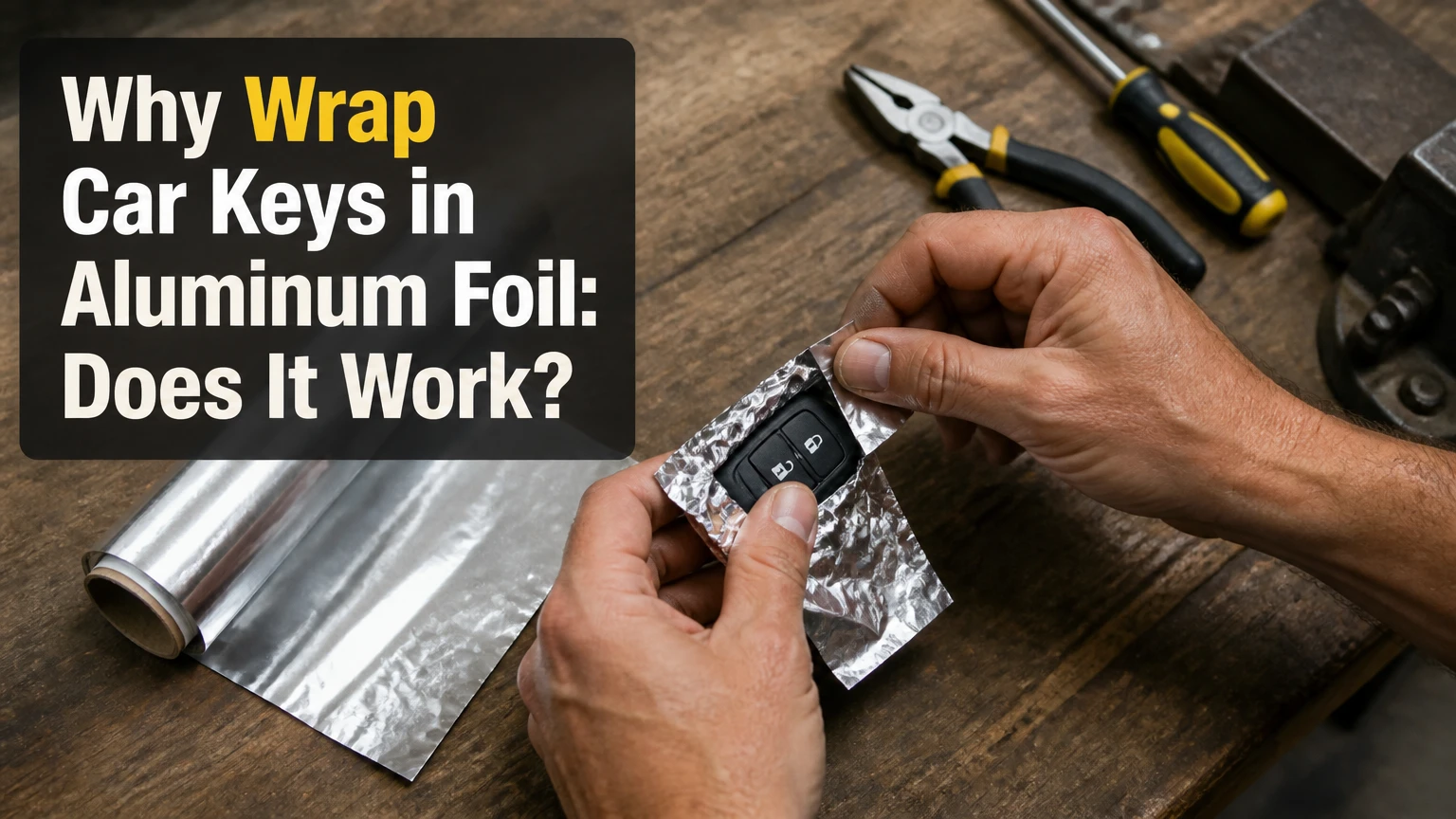
People wrap car keys in aluminum foil to reduce the radio communication that enables some keyless-entry relay attacks. Aluminum foil can block a key fob when it forms a continuous, intact conductive enclosure, but foil is temporary and unreliable if seams, tears, or openings remain. A tested Faraday pouch is usually more practical.
Key Facts at a Glance
- A relay attack extends communication between a vehicle and key fob; it usually relays a legitimate signal rather than permanently cloning the key.
- Aluminum foil can provide radio-frequency shielding when it completely surrounds the fob without gaps.
- The number of foil layers has no universal guarantee; coverage, construction, frequency, and testing determine performance.
- Passive keyless-entry fobs often respond to a vehicle challenge instead of transmitting continuously at full strength.
- A Faraday pouch should be tested with the actual vehicle before daily use and after visible wear.
- Signal blocking protects against one electronic attack path, not glass breaking, key theft, conventional theft, or every form of vehicle compromise.
Why Wrap Car Keys in Aluminum Foil?
Aluminum foil is used because its conductive metal surface can attenuate radio-frequency energy from a key fob. A fully enclosed foil wrapper behaves like a crude Faraday enclosure, reducing the signal available to a relay device and preventing the vehicle from detecting the key at normal operating range.
The idea applies mainly to vehicles with passive keyless entry or passive start. These systems let a driver unlock the door by touching a handle and start the vehicle while the fob remains nearby. The convenience depends on short-range wireless communication, which creates an opportunity for attackers to extend that communication over a much longer distance.
The practice has a narrow purpose. Aluminum foil does not make the vehicle invisible, disable its immobilizer, or prevent a thief from taking the physical key. It also does not automatically protect a smartphone-based digital key, because a phone may use Bluetooth, ultra-wideband, NFC, an internet account, or an app-specific authentication process.
How Does a Keyless Relay Attack Work?
A keyless relay attack uses two or more electronic relay units to extend the apparent distance between a vehicle and its authorized key fob. One unit operates near the fob, often outside a home, while another operates beside the vehicle; the equipment passes messages between both locations quickly enough for the vehicle to accept the fob as nearby.
The communication sequence
Many passive-entry systems use a low-frequency, or LF, signal from the vehicle to determine whether a fob is close. The fob then answers through a higher-frequency radio link, commonly in the ultra-high-frequency range, although exact frequencies and protocols vary by manufacturer and market.
The fob does not necessarily broadcast continuously in the way a radio station broadcasts. A conventional remote-control fob may transmit when a button is pressed, while a passive-entry fob may wake and respond to a vehicle challenge. That distinction matters because a relay attack targets the communication exchange, not always a constantly active beacon.
The relay equipment does not need to understand or decode every message. It can forward the exchange, making the vehicle believe the authorized fob is within the expected few feet even when the fob is inside a house.
| Component | Typical role | Approximate location | Security consequence |
|---|---|---|---|
| Vehicle LF antenna | Sends proximity challenge | Door, cabin, trunk | Wakes or queries the fob |
| Key fob receiver | Detects vehicle challenge | On the fob | Responds without button press |
| Key fob transmitter | Returns authentication data | On the fob | Enables passive unlock or start |
| Relay unit A | Captures or extends fob communication | Near home wall or door | Makes the fob appear closer |
| Relay unit B | Communicates with vehicle | Beside parked car | Makes the vehicle accept the relay |
Does a relay attack clone the car key?
A relay attack often does not create a permanent clone of the key fob. It relays a live exchange between the genuine fob and vehicle, although criminals may combine relay equipment with other tools to capture credentials or exploit separate weaknesses.
This difference explains why a vehicle can be stolen without the owner losing the key or noticing a button press. A valid response may have been transmitted while the fob remained in a hallway, bedroom, or coat pocket.
How Does Aluminum Foil Block a Key Fob Signal?
Aluminum foil blocks or attenuates radio signals through conductive shielding, not through a magical cancellation effect. When electromagnetic energy reaches a conductive enclosure, electric charges redistribute on the metal surface, reducing the field that penetrates into the enclosed space; the result depends on frequency, thickness, continuity, geometry, and openings.
Michael Faraday’s experiments established the practical principle behind a conductive enclosure. In Experimental Researches in Electricity, Faraday wrote that an electrical charge “resides entirely on the surface” of a conductor under the relevant electrostatic conditions. Radio-frequency shielding is more complex than static electricity, but the quotation captures the surface-charge behavior that makes metal enclosures useful.
A foil wrapper works only when the fob is surrounded. A sheet with an open end, a loose fold, a puncture, or a large unsealed seam can provide a path for electromagnetic energy. A plastic bag inside the foil can protect the fob from abrasion, but plastic itself does not block the signal.
Why do layers matter?
Additional foil layers can improve durability and reduce the chance that a tiny tear reaches the entire enclosure, but “three layers” or “five layers” is not a scientifically universal threshold. A single unbroken metal enclosure may shield better than several poorly folded layers with an open seam.
Shielding effectiveness is normally expressed in decibels, or dB, and measured with the relevant source, receiver, frequency, and orientation. Household foil packaging does not provide a verified dB rating, so the reliable field test is whether the actual vehicle responds when the fob is enclosed.
How Should You Wrap and Test a Car Key?
A temporary foil shield takes about 2-5 minutes to make and costs less than a dollar in materials, but the success factor is complete coverage rather than a specified number of layers. Wrap the entire fob, compress the seams, and test every passive-entry function with the vehicle’s spare key kept well away.
Before you start
| Requirement | Typical value | Practical note |
|---|---|---|
| Aluminum foil | 30 x 30 cm sheet | Heavy-duty foil is easier to handle |
| Optional inner protection | 1 small plastic bag | Prevents scratches and moisture |
| Preparation time | 2-5 minutes | Longer if the fob has a separate emergency key |
| Test time | Under 2 minutes | Test unlock, lock, trunk, and start functions |
| Material cost | Less than $1 | Cost varies by roll size and local prices |
Step 1: Inspect the fob
Remove loose dirt and check that the fob has no exposed damage before wrapping it. Keep the mechanical emergency key accessible if the key blade separates from the electronic housing.
Do not wrap the fob while it is wet. Moisture can accelerate corrosion at damaged buttons, seams, or battery contacts, although the foil itself does not normally harm a dry, functioning key fob.
Step 2: Create a complete enclosure
Place the fob in the center of the foil and fold the material around every face. Crimp the folds tightly, then add another sheet if the first wrapper is fragile or difficult to close without gaps.
A plastic sleeve may sit between the fob and foil, but the sleeve must not replace the metal layer. Avoid relying on a folded square with an open flap, because that configuration is a shielded pad rather than an enclosure.
Step 3: Test passive entry
Lock the car with the unwrapped fob, then place the wrapped fob at the normal storage location. Approach the driver door without pressing the remote button and touch the handle.
The shield passes this test when the vehicle does not unlock through passive entry. Repeat the test at the passenger door and trunk if those areas have touch sensors.
Step 4: Test passive start
Place the wrapped fob in the location where it will normally be stored, then attempt to start the vehicle using the manufacturer’s normal procedure. Do not drive during the test.
The shield passes when the vehicle reports that no key is detected or otherwise refuses passive starting. Some vehicles may still start briefly after a valid key was detected earlier, so perform the test from a fully locked, inactive state and consult the owner’s manual for the exact behavior.
Step 5: Test the remote buttons
Press lock and unlock while the fob remains wrapped. A working shield should prevent the vehicle from receiving those button commands at ordinary test distance, although button behavior and vehicle antennas differ.
If the vehicle responds, unwrap and refold the fob, inspect every seam, and repeat the test. Replace damaged foil rather than trusting a wrapper that worked once.
Which Signal-Blocking Option Is Most Practical?
A Faraday pouch is the best everyday option for most drivers, aluminum foil is the cheapest temporary option, and a rigid Faraday box is most convenient for storing several fobs at home. A metal tin can work, but its lid seam and paint, lining, or hinge may create inconsistent shielding.
| Option | Typical price | Portability | Main failure point | Best use |
|---|---|---|---|---|
| Household aluminum foil | Under $1 | High after wrapping | Tears and open folds | Emergency or short-term use |
| Faraday pouch | $5-$20 | High | Worn lining or incomplete closure | Daily individual fob |
| Faraday box | $15-$40 | Low | Lid gap or poor internal contact | Multiple keys at home |
| Steel or aluminum tin | $0-$5 | Medium | Lid seam and nonconductive coating | Tested low-cost storage |
| Manufacturer setting | Usually $0 | None required | Not available on every vehicle | Disabling passive functions |
Prices are typical retail ranges rather than fixed market prices. A product’s marketing label does not prove performance; a pouch should be tested with the actual fob and vehicle combination.
What should a Faraday pouch contain?
A useful pouch has a fully enclosed metallic lining, a flap that closes across the opening, durable stitching, and a way to separate the fob from other keys. Some products use two shielded compartments, allowing the driver to store a fob in one section and an unshielded phone or access card elsewhere.
Do not assume a pouch remains effective for a stated period such as 6-12 months. Lining life depends on folding, abrasion, moisture, and closure design. Retest the pouch monthly and after any visible damage.
How Do Foil, a Pouch, and a Tin Compare?
Aluminum foil wins on immediate cost, while a manufactured Faraday pouch wins on repeatable daily handling. A tin or rigid box can be effective for home storage, but only if the lid closes tightly enough to maintain shielding around the entire key.
| Decision factor | Aluminum foil | Faraday pouch | Metal tin or box |
|---|---|---|---|
| Initial cost | Under $1 | $5-$20 | Free-$40 |
| Setup time | 2-5 minutes | Less than 1 minute | 1-3 minutes |
| Normal capacity | 1 fob | 1-2 fobs | 2-6 fobs |
| Wear resistance | Low | Medium-high | High |
| Daily carry | Awkward | Convenient | Bulky |
| Verification method | Vehicle test | Vehicle test | Vehicle test |
| Access speed | 20-60 seconds | 2-5 seconds | 5-15 seconds |
The table shows why the cheapest material is not always the lowest-friction security choice. Repeatedly opening and resealing foil increases the chance of an exposed fold, while a pouch can maintain a predictable closure if its lining remains intact.
What Mistakes Make a Foil Wrapper Fail?
The most common shielding failures come from incomplete enclosure, damaged material, and testing only one vehicle function. A wrapper can stop a button signal while still allowing passive entry through an exposed seam, so the complete test must cover every relevant antenna and access feature.
- An open end remains folded loosely: Rewrap the fob until foil contacts or overlaps around the opening.
- The wrapper has pinholes or tears: Discard it and use a fresh sheet; microscopic damage is difficult to inspect reliably.
- The driver tests only remote unlock: Test passive handle entry, trunk access, and passive start separately.
- The spare fob remains near the vehicle: Move both keys away during testing, because one unshielded key can invalidate the conclusion.
- The fob is stored beside a phone or access card: Separate devices if the pouch has compartments, because shielding and access needs may differ.
- The owner trusts a product without retesting: Test after drops, heavy folding, moisture exposure, or six months of frequent use.
A practitioner rule is simple: treat every opening as a potential antenna. The closure deserves more attention than the foil brand or layer count.
Where Should You Store Car Keys at Home?
Store shielded car keys away from exterior doors, windows, and thin walls, preferably in a tested container placed in a central interior location. Distance reduces the chance that an attacker’s relay equipment can establish a strong connection, while shielding reduces the key’s usable radio output.
The best location depends on the building. In a detached home, an interior hallway or central cupboard is usually preferable to a key hook beside the front door. In an apartment, a key stored near a corridor-facing door may be closer to a thief than one kept deeper inside the unit.
Do not place the container where the fob can be forgotten. A shielded key that is routinely left on a kitchen counter defeats the security intention, and a container that blocks emergency access may encourage unsafe workarounds.
Can You Disable Passive Keyless Entry?
Many vehicles let owners disable passive keyless entry, reduce the detection range, or activate a sleep mode, but the available setting varies by make, model, model year, and market. The owner’s manual or authorized dealer is the correct source for the vehicle-specific procedure.
Some fobs enter a low-power sleep state after inactivity, while others require a button sequence. A vehicle may also offer a dashboard setting that disables touch-to-unlock but leaves button-operated remote locking active.
| Vehicle feature | Possible control | What it changes | Verification |
|---|---|---|---|
| Passive door entry | Vehicle menu or dealer setting | Touch-handle unlocking | Test handle without button press |
| Passive start | Usually linked to vehicle design | Key-present starting logic | Attempt start with key shielded |
| Fob sleep mode | Button sequence on some models | Fob response while inactive | Follow model manual |
| Remote start | App or fob command | Engine start from distance | Check app and fob separately |
| Digital key | Phone settings or app account | Bluetooth/UWB/NFC access | Disable and test phone access |
Disabling passive entry can be more reliable than improvised foil for some owners, but it may remove the convenience feature rather than eliminate every wireless attack. Remote-start accounts, spare fobs, and connected-car credentials require separate protection.
Does Wrapping a Key Fob Damage It?
Dry aluminum foil normally does not damage a key fob because foil is electrically conductive but does not inject power into the fob. Damage is more likely when the wrapper causes moisture retention, presses buttons continuously, bends an emergency key, or traps a physically damaged battery compartment.
Keep the fob dry and avoid compressing it under heavy objects. If a pouch has a sharp metallic lining, place the fob in its intended compartment rather than forcing it into a seam.
Signal shielding can affect normal use. A wrapped fob cannot reliably unlock the vehicle, open a trunk, or communicate with a start system until it is removed, so drivers should keep the emergency key blade and the manufacturer’s backup-start procedure available.
What If the Car Still Unlocks With the Wrapped Key?
If the car still unlocks, assume the shield is incomplete or another authorized key is present until testing proves otherwise. Use a fresh enclosure, move all spare fobs away, test each vehicle access point, and verify that a phone-based digital key is not providing authorization.
Check these causes in order:
- Remove the fob from the wrapper and confirm that the vehicle responds normally.
- Rewrap it with overlapping foil on every face and no open flap.
- Move the wrapper several feet from the vehicle and keep all other keys elsewhere.
- Test the driver door, passenger door, trunk, and passive start separately.
- Disable the phone’s digital key temporarily if the vehicle supports one.
- Try a different tested pouch or box to isolate a defective wrapper.
A vehicle may respond to a previously issued command, a separate key, or a different access technology. The test must therefore control the entire environment, not only the visible key.
What Other Security Measures Reduce Car Theft?
Signal shielding reduces relay-attack exposure, but layered physical and electronic precautions address more theft methods. Lock the vehicle, remove visible valuables, use a steering-wheel lock where practical, keep keys controlled, and follow manufacturer security updates.
Useful layers include:
- Physical deterrence: A steering-wheel lock adds visible delay and may defeat attacks that bypass the key system.
- Parking choice: A locked garage, well-lit driveway, or monitored area reduces opportunity compared with an isolated street.
- Vehicle settings: Enable automatic locking, disable passive entry if acceptable, and install manufacturer-approved updates.
- Tracking and recovery: A manufacturer tracker or professionally installed system can assist recovery, but tracking does not prevent theft.
- Account security: Use a strong unique password and multifactor authentication for connected-car applications.
- Key control: Store every spare fob securely, including valet, service, and rarely used keys.
No single measure covers every attack. A Faraday enclosure blocks communication; it does not stop a thief who has already obtained the fob, breaks into the vehicle, or exploits a separate vulnerability.
Is Aluminum Foil Good Enough for Daily Use?
Aluminum foil is adequate as a short-term, tested barrier when cost and immediate availability matter, but a manufactured pouch is usually better for daily use. Foil loses reliability through repeated opening, crushing, tearing, and poorly closed seams, whereas a pouch provides a repeatable closure and faster access.
Choose foil when a driver needs an immediate temporary measure, is testing the principle, or wants a backup barrier during travel. Choose a pouch when one or two people use the vehicle daily and need quick, consistent access. Choose a box when several fobs remain at home and portability is unimportant.
A tin can be a sensible experiment, especially if its lid overlaps the body and the interior remains conductive at the closure. Paint, fabric, plastic inserts, and loose hinges can interrupt the enclosure, so the vehicle test remains mandatory.
FAQ
Can thieves steal a car without the key fob?
Yes, depending on the vehicle and attack method. Thieves may use relay equipment, exploit a diagnostic port, steal the physical key, compromise a connected account, or use equipment specific to a model. A shielded fob addresses relay communication only and does not guarantee that the vehicle cannot be stolen.
How far away should car keys be from the front door?
There is no universal safe distance because building materials, vehicle antennas, fob design, and relay equipment vary. Store keys in a tested shielded container in an interior location rather than relying on a precise distance such as 10 feet or 20 feet. Greater separation adds a useful layer.
Will a cookie tin block a car key signal?
A metal cookie tin may block a key fob if the lid and body form a reasonably continuous enclosure, but many tins have painted surfaces, loose lids, or gaps. Place the fob inside, close the lid, and test passive entry and passive start with every spare key away from the vehicle.
How often should a Faraday pouch be replaced?
Replace a Faraday pouch when it fails a vehicle test or shows torn lining, damaged stitching, a weak closure, or severe creasing. A fixed six-month or twelve-month replacement schedule is not universal. Frequent users should test monthly and after drops, moisture exposure, or visible wear.
Does a steering-wheel lock work against relay theft?
A steering-wheel lock does not block the radio relay, but it can stop or delay a thief after the vehicle is unlocked and started. Its value is complementary: the shield addresses wireless proximity abuse, while the physical lock increases the time and effort required to drive the vehicle away.
Should I wrap a spare key as well?
Yes. Every authorized passive-entry fob should be shielded or stored securely when it is not being used. An unprotected spare key in a drawer, coat pocket, garage, or guest room can still provide the relay path, even if the primary key remains wrapped.
The Bottom Line
Why wrap car keys in aluminum foil? The reason is to reduce the radio communication that a relay device could extend between a passive keyless vehicle and its fob. A complete, intact foil enclosure can work as a temporary Faraday shield, but layer counts do not guarantee performance and foil does not provide complete vehicle security.
Test the wrapped key against passive entry, trunk access, passive start, and remote buttons. For regular use, choose a tested Faraday pouch or box, store every spare key away from exterior walls, and combine signal blocking with physical deterrence, secure connected-car accounts, and vehicle-specific settings.