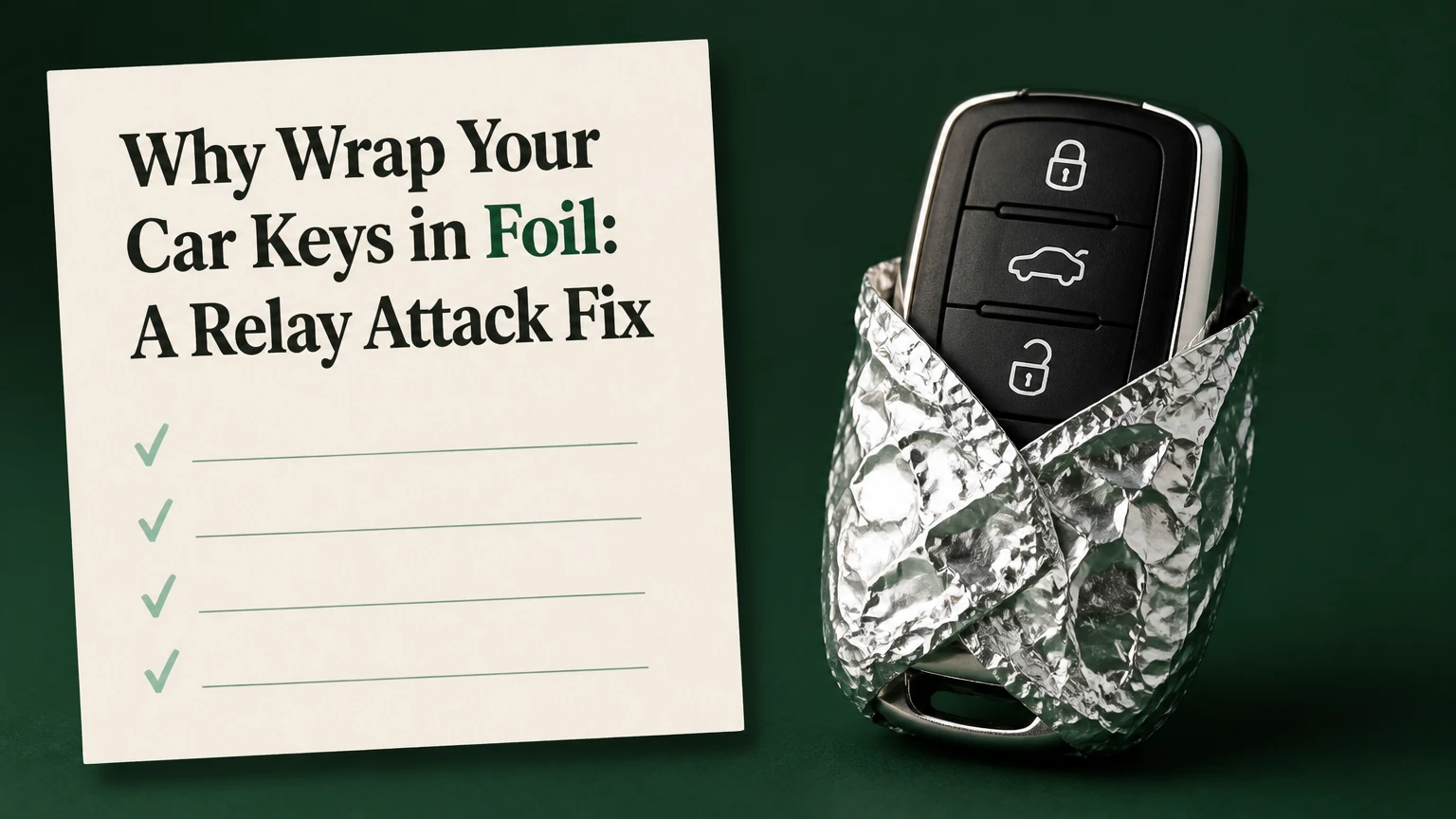
Wrapping a car key in aluminum foil can reduce the risk of a relay attack by shielding a compatible keyless-entry fob from radio communication. The method works only when the foil forms a continuous conductive enclosure, and it protects against signal relaying, not every form of vehicle theft, key cloning, or electronic attack.
Key facts at a glance
A relay attack extends communication between a keyless car and its nearby key fob.
Aluminum foil can act as a basic Faraday shield when it fully surrounds the fob.
One layer, an open seam, or a torn corner can allow enough signal leakage for the car to respond.
Foil is a temporary household workaround, not a measured or durable security product.
A tested Faraday pouch or box is more practical for daily use.
Protecting the spare key matters because an unshielded spare can remain an attack target.
What does wrapping car keys in foil prevent?
Aluminum foil is used to reduce the radio signal reaching or leaving a keyless-entry fob. A thief conducting a relay attack may place one device near a home’s entrance and another near the vehicle; the devices pass messages between the key and car, making the car behave as though the key is nearby.
The method applies mainly to passive keyless systems, often called Keyless Entry, Keyless Go, Intelligent Access, Comfort Access, or Smart Entry. Conventional remote fobs that require a button press are less exposed to passive relay attacks, although their radio transmissions can still be targeted by other techniques.
A foil wrap does not make a vehicle invisible to thieves. It does not stop a stolen physical key, a broken window, a recovered PIN, a compromised connected-car account, or a theft method that bypasses the key entirely. The immobilizer, steering lock, alarm, tracker, and parking choices still matter.
Which car keys are most relevant?
The highest-priority keys are proximity fobs that unlock the vehicle when a person touches the handle or start the engine when the fob remains inside the cabin. A useful test is simple: leave the fob indoors, approach the locked car, and see whether touching the handle unlocks it without pressing a button.
That test indicates passive proximity functionality, but it does not prove that a particular model is vulnerable to every relay device. Manufacturers change antennas, timing rules, motion sensors, ultra-wideband features, and authentication systems across model years.
How does a relay attack work?
A relay attack forwards the communication between a vehicle and its legitimate key without necessarily decrypting the underlying messages. One attacker positions a relay unit close to the key, while a second unit communicates with the car; the vehicle may then authorize unlocking and starting because the expected key response arrives within an acceptable time.
The attack exploits distance assumptions. The car is not always verifying that the key is physically beside the door. It is often verifying whether the key can respond through the vehicle’s radio challenge system within a permitted timing window.
The exact radio design varies by vehicle. Common low-frequency vehicle wake-up channels include approximately 125 kHz, while the fob-to-car response may use regional radio bands such as 315 MHz, 433.92 MHz, or 868 MHz. These figures describe common technologies, not a universal specification for every vehicle.
Is a relay attack the same as key cloning?
No. Relay theft forwards a live exchange between the genuine key and the car, whereas key cloning attempts to copy credentials or create a separate working key. Signal jamming is different again: a jammer blocks the locking command, which can leave a vehicle unlocked when the owner assumes the lock button worked.
This distinction affects the remedy. A signal-blocking pouch can interrupt a relay path from the key, but it cannot repair a copied credential or detect a jammer. Owners should confirm that the vehicle actually locks, keep software and connected-car accounts secured, and use physical deterrents where theft risk is high.
Does aluminum foil really block a key fob signal?
Aluminum foil can attenuate radio-frequency signals because its conductive surface redistributes electrical charge and reflects or absorbs part of the electromagnetic energy. A complete enclosure can therefore reduce the signal enough that the vehicle cannot wake, authenticate, or locate the fob.
The phrase “blocks the signal completely” is too absolute. Shielding performance depends on frequency, foil continuity, contact between folds, enclosure geometry, the distance between the fob and the car, and whether an opening remains around the key ring. A crumpled open pouch is not equivalent to a sealed conductive enclosure.
Faraday shielding also does not require four specific foil layers. Multiple layers improve the chance of covering pinholes and weak seams, but no layer count guarantees protection. A practical test is more reliable than counting folds.
Expert insight: The weakest point is usually the opening, not the center of the foil. A three-layer wrap with a folded, closed seam can outperform a thicker wrap left open around the key-ring hole.
What radio frequencies does a car key use?
Vehicle key systems use different frequency combinations by manufacturer, market, and model year. The table below shows common examples and why a single “key-fob frequency” answer is incomplete.
| System element | Common frequency or band | Typical role | Shielding implication |
|---|---|---|---|
| Vehicle low-frequency antenna | About 125 kHz | Wakes or locates a proximity fob | Enclosure must reduce low-frequency coupling |
| North American remote response | About 315 MHz | Lock, unlock, or fob response | Continuous foil coverage can attenuate radio energy |
| European and Asian remote response | About 433.92 MHz | Remote and smart-key communication | Seams and holes can still leak signal |
| Some European systems | About 868 MHz | Higher-frequency remote communication | Construction quality remains more important than foil thickness |
| Ultra-wideband systems | About 6.5-8 GHz | Precise ranging in some newer vehicles | Use the vehicle maker’s documented protection method |
How do you wrap a car key in foil correctly?
Use enough foil to create a closed conductive envelope around the entire fob, then verify the result at the vehicle. The practical procedure takes about two minutes, costs less than $1 when household foil is available, and succeeds or fails at the seal rather than at a prescribed number of layers.
Before you start
| Requirement | Typical value | Practical instruction |
|---|---|---|
| Aluminum foil | 30 x 30 cm sheet | Use a sheet large enough to fold around all sides |
| Layers | 2-4 folded layers | Treat this as a starting point, not a guaranteed rating |
| Preparation time | 1-2 minutes | Include wrapping and testing |
| Test distance | 1-2 metres from vehicle | Keep the fob inside the closed wrap |
| Replacement interval | After any tear or daily use damage | Do not rely on a visibly compromised wrap |
Step 1: Inspect the key fob
Remove bulky key rings, metal accessories, and loose objects that could puncture the foil. Check whether the fob has a mechanical key blade, because the blade may remain useful even when the electronic signal is shielded.
Do not press buttons while wrapping. A button held down inside the foil may drain the fob battery or create confusing test results.
Step 2: Fold the foil around the fob
Place the fob in the center of the sheet and fold every edge over the body. Add another layer if the foil tears easily, but close each seam rather than leaving a flap or open pocket.
The key-ring opening deserves special attention. Fold foil around that area and press the seam flat without crushing the fob’s buttons.
Step 3: Test the enclosure
Stand beside the locked vehicle while the fob remains fully wrapped. Try the passive door handle, then try the start procedure if the vehicle allows it; afterward, unwrap the fob and repeat the same test to confirm that the car and key were functioning normally.
You know the shield is effective against that test when the wrapped fob does not unlock the door or authorize starting, while the unwrapped fob works normally. Test the spare fob separately.
Step 4: Replace damaged foil
Discard the wrap when it develops a hole, split seam, loose opening, or heavy crease near the key-ring area. Daily unwrapping can damage kitchen foil within hours or days, so a reusable pouch is usually safer for routine use.
What mistakes make foil ineffective?
Most foil failures come from incomplete coverage, untested seams, or an incorrect assumption about what the wrap is supposed to prevent. A key fob that still unlocks the car while wrapped has either insufficient shielding, an opening, a different signal path, or a test procedure that does not match the vehicle’s operating system.
| Failure mode | Likely cause | Corrective action | Verification |
|---|---|---|---|
| Door unlocks beside car | Gap near seam or key ring | Add a closed outer fold | Handle remains locked |
| Remote works intermittently | Torn or wrinkled foil | Replace the entire wrap | Repeat five tests |
| Car starts with wrapped fob | Shield does not cover full fob | Use a larger sheet and seal all edges | Start authorization fails |
| Fob buttons become unreliable | Foil presses buttons | Add tissue between fob and foil | Buttons move freely |
| Spare car remains exposed | Spare fob left in drawer | Shield and test every spare | Each fob fails proximity test |
| Vehicle locks inconsistently | Jamming or unrelated fault | Confirm lock visually and diagnose vehicle | Handle and indicators confirm lock |
A tissue or paper layer can prevent scratches from sharp foil edges, but paper does not provide meaningful radio shielding. Keep the fob dry because condensation inside a tightly wrapped enclosure can damage electronics over time.
Practitioner rule: Never treat a failed foil test as proof that the car is safe because the car did not unlock once. Perform repeated unlock tests, a start test, and a separate spare-key test under the same conditions.
Which signal-blocking option is best?
A Faraday pouch is the best everyday option for one or two keys because it combines portability with a closable shield. Aluminum foil is the lowest-cost emergency option, while a Faraday box works better for several household keys kept in one place; disabling passive entry can be stronger when the manufacturer supports it.
| Option | Typical cost | Typical setup | Daily portability | Main limitation |
|---|---|---|---|---|
| Household foil | $0-$1 | 1-2 minutes | Low | Tears and requires repeated wrapping |
| Faraday pouch | $5-$20 | Under 1 minute | High | Flap must close completely |
| Faraday box | $15-$40 | Under 1 minute | None | Protects keys only at its storage location |
| Manufacturer sleep mode | $0 | 1-5 minutes | High | Availability varies by make and model |
| Passive-entry disablement | $0 | 2-10 minutes | High | May require button presses or menu changes |
| Steering lock | $25-$80 | 10 seconds | Vehicle-based | Does not shield the key signal |
Prices are typical retail ranges rather than guaranteed current prices. A pouch with a worn lining can fail without visible external damage, so owners should test it monthly and after buying a replacement.
How does foil compare with a Faraday pouch?
Foil provides immediate coverage but has no standardized shielding rating, closure mechanism, or durability guarantee. A quality pouch normally has a conductive lining, a flap or zip closure, and a construction that is easier to test and replace, although product quality varies widely.
Do not assume a pouch works because its packaging says “Faraday.” Put the fob inside, close the pouch, and test the vehicle’s handle and start authorization. If the car responds, the pouch is unsuitable, incorrectly closed, damaged, or not compatible with the relevant frequencies.
Is a Faraday box better at home?
A Faraday box is convenient for a household with several keys because everyone can place a fob in the same location after entering the house. The box must be closed, positioned away from doors and windows, and tested with every fob because decorative containers vary in shielding quality.
A box does not protect a key carried to work, stored in a hotel room, or left in a coat near an apartment corridor. Portable protection remains necessary outside the home.
Can you disable keyless entry instead?
Many vehicles provide a sleep mode, keyless-entry disablement setting, or alternative button sequence, but the exact function depends on the manufacturer and model year. Owners should use the vehicle manual or an authorized dealer’s instructions rather than copying a sequence from a different Toyota, Lexus, Ford, BMW, Kia, or Mercedes-Benz model.
Possible controls include a dashboard setting, a fob motion sensor, a double-button sequence, or a mechanical locking procedure. Some systems disable passive entry but retain remote-button unlocking; others disable only the fob’s motion response after inactivity.
| Vehicle feature | Typical owner action | Convenience effect | Confirmation method |
|---|---|---|---|
| Passive-entry setting | Select “off” in vehicle menu | Press button to unlock | Handle stays locked |
| Fob sleep mode | Follow model-specific button sequence | Wake fob before use | Test after 5-10 minutes |
| Mechanical key blade | Lock and unlock manually | Slower entry | Blade operates cylinder |
| Remote-button entry | Press lock or unlock button | Requires active command | Vehicle responds only to button |
| Dealer configuration | Request keyless feature change | Appointment may be needed | Dealer documents setting |
A software setting is not automatically “100% secure.” It may address passive relay exposure while leaving conventional radio attacks, physical theft, or account compromise untouched.
Where should you keep car keys at night?
Keep car keys in a tested pouch or box, away from exterior doors and windows, rather than on a hallway hook or table beside the front entrance. Distance reduces the opportunity for a relay device to reach the key, while shielding reduces the key’s ability to respond.
A practical home arrangement places the container in an interior room, closes it after every use, and stores spare fobs in the same protected location. A garage does not automatically provide security if the key is stored beside a door or if the garage has windows.
For apartments, avoid leaving keys in a coat pocket hung outside the flat’s main living area. In hotels, carry a pouch or use a box only after testing it; a foil wrap is a temporary fallback when no tested container is available.
Does foil protect a car from every electronic theft method?
Foil protects only against attacks that require radio communication with the key while the fob is inside the shield. It does not protect against stolen keys, key programming after vehicle access, relay equipment aimed at another unprotected key, a connected-car account takeover, physical forced entry, or theft of vehicle components.
Use layered security:
- Confirm that the doors actually lock after pressing the remote.
- Store every proximity fob in a tested shield.
- Use the manufacturer’s software disablement or sleep mode when available.
- Park in a well-lit, visible location and consider a steering lock.
- Keep vehicle software, phone accounts, and connected services protected.
- Record the vehicle identification number and retain insurer and police contact details.
The UK Metropolitan Police and other police forces commonly advise keeping keyless fobs away from doors and windows and using a signal-blocking pouch. That advice treats shielding as one risk-reduction measure, not as a complete replacement for physical security.
What should you do if the wrapped key still unlocks the car?
If a wrapped fob still unlocks the vehicle, stop relying on that wrap and diagnose the enclosure immediately. Replace it with a larger, fully closed wrap or a tested pouch, then repeat the handle and start tests with the spare key.
Check these causes in order:
- The foil has a pinhole, split, or open overlap.
- The key-ring hole remains uncovered.
- The fob extends beyond the folded edge.
- The pouch or box flap is not fully closed.
- The vehicle is responding to a second unshielded key nearby.
- The test used a remote button instead of passive proximity entry.
- The vehicle has a fault unrelated to shielding.
Move all other keys several metres away during testing. A second fob inside the house, another vehicle nearby, or a digital key on a smartphone can produce a misleading result.
Can a shielded key still start the vehicle?
A shielded fob may not authorize a normal passive start while enclosed, because the vehicle cannot complete its expected exchange. Many cars provide an emergency reader location where a dead or weak fob can be placed, but the location differs by model and should be identified in the owner’s manual.
Do not store the only mechanical key or emergency instructions inside a container that cannot be opened quickly. Shielding improves theft resistance but can add inconvenience during a battery failure or emergency departure.
How much does a practical protection setup cost?
A single household foil wrap costs approximately $0-$1, while a tested pouch typically costs $5-$20 and a multi-key box commonly costs $15-$40. A layered setup using one home box, two pouches, and a steering lock therefore typically costs $65-$160 before installation or dealer charges.
| Household situation | Items needed | Typical total cost | Best use |
|---|---|---|---|
| One driver, temporary risk | Foil or one pouch | $0-$20 | Hotel, travel, short-term exposure |
| Two drivers at home | Two pouches | $10-$40 | Separate daily carry |
| Family with three keys | Four-slot box and pouches | $35-$100 | Shared home storage and travel |
| High-theft-risk vehicle | Pouches, box, steering lock | $65-$160 | Layered deterrence |
| Manufacturer-supported disablement | Software setting | $0 | Permanent convenience trade-off |
These figures exclude insurance changes, trackers, dealer programming, and replacement fobs, which can cost hundreds of dollars depending on the vehicle. A shield is cheap compared with a replacement key, but it cannot recover a stolen vehicle.
Frequently Asked Questions
Does wrapping a key fob in foil drain its battery?
Wrapping a key fob in foil does not normally drain the battery by itself because the foil is passive and does not draw electrical power. A battery can drain if foil presses a button continuously, so keep the wrap loose enough to avoid button pressure and test the fob after wrapping.
Will foil stop a car key from being tracked?
Aluminum foil can reduce radio communication from a compatible fob, but “tracking” can mean several different things. It may interrupt proximity responses while the fob is enclosed, yet it does not remove a vehicle’s own cellular tracker, smartphone location data, Bluetooth records, or a separately installed tracking device.
Does a Faraday pouch work for house keys and RFID cards?
A Faraday pouch can shield electronic devices such as compatible car fobs, RFID cards, and some access badges, but ordinary metal house keys gain no meaningful benefit. Test each electronic item separately because pouch construction, frequency range, and closure quality determine performance.
Should both the main and spare car keys be wrapped?
Yes. Both the primary and spare keyless fobs should be shielded because an unprotected spare can still answer a relay device. Store spare fobs away from exterior doors and windows, and test the main and spare keys independently rather than assuming one successful test covers both.
Is foil better than turning off keyless entry?
Turning off passive keyless entry is usually more convenient and may provide stronger protection when the vehicle manufacturer supports the feature correctly. Foil remains useful as an immediate fallback, but owners should verify the setting because some vehicles disable passive unlocking while retaining other radio functions.
Can thieves steal a car if the key is inside a Faraday box?
A properly closed and tested Faraday box can prevent the key from answering a relay attempt while inside, but it cannot stop every theft method. Thieves may target an unprotected spare, use physical entry, exploit a vehicle or account weakness, or steal the car using a previously obtained key.
The Bottom Line
People ask why wrap your car keys in foil because aluminum foil can create a low-cost temporary signal shield around a compatible keyless-entry fob. The method is worthwhile only when the enclosure is continuous and tested, and it should be combined with secure key storage, confirmed locking, manufacturer settings, physical deterrents, and sensible parking.
Foil is an emergency workaround. A tested Faraday pouch is the better daily choice, while a closed Faraday box suits a household that stores several keys at home. None of these measures protects against every form of vehicle theft, but correctly shielding every proximity fob can remove one important route used in relay attacks.