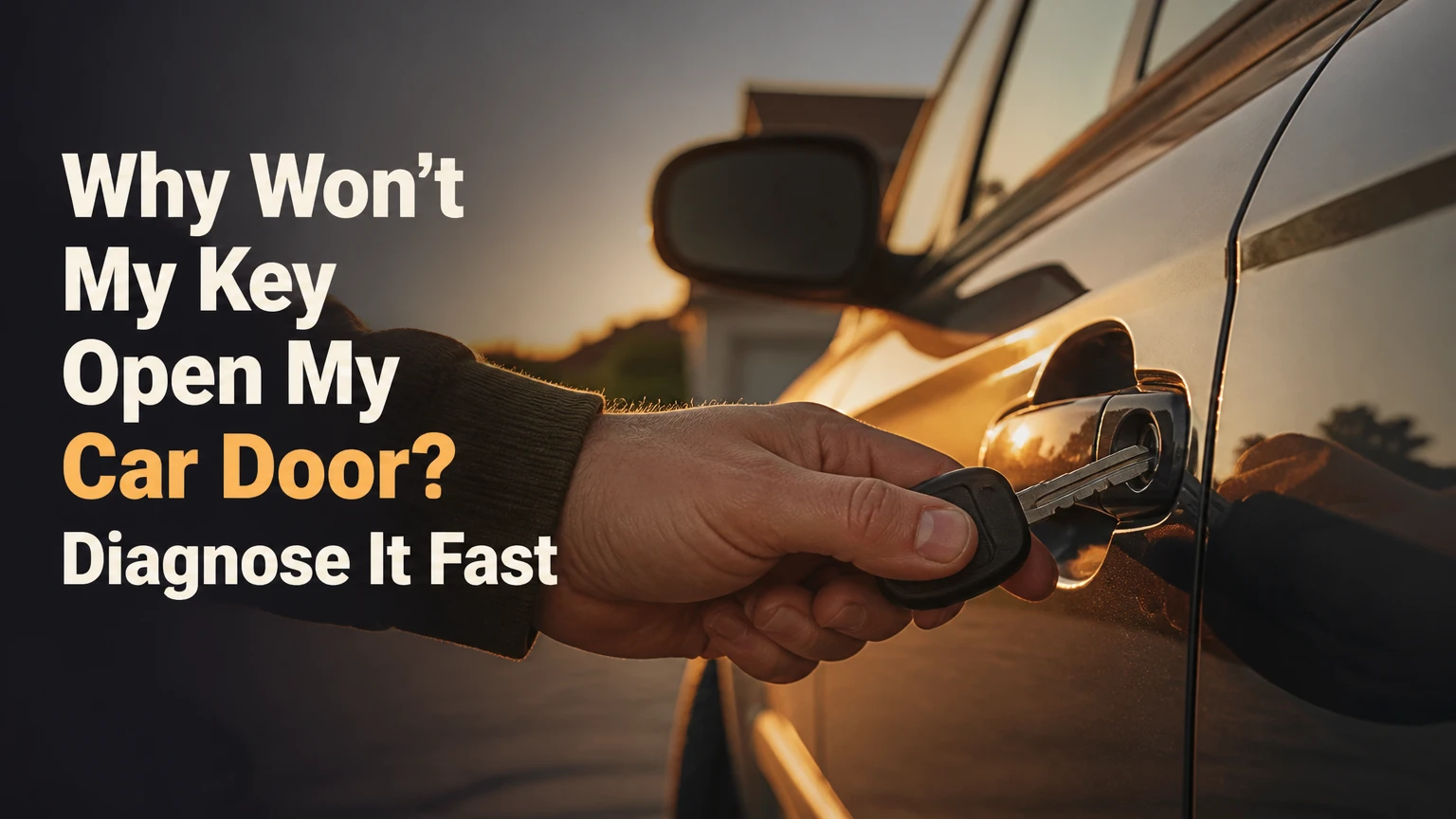
A car key usually fails to open a door because the key blade no longer matches the lock cylinder, the cylinder is seized or damaged, the key fob has lost power, or the door latch or actuator has failed. Test the spare key, another door, the trunk, and the vehicle’s electrical power before forcing anything.
Key Facts at a Glance
- A dead key-fob battery usually affects remote buttons, not a properly cut mechanical key blade.
- A key that will not insert or turn points to the blade or lock cylinder, not the door actuator.
- A key that turns smoothly without unlocking usually indicates a broken linkage, worn cylinder, or latch fault.
- A dead vehicle battery can disable powered locking, but many vehicles still allow entry through a mechanical key cylinder.
- The hidden emergency key blade is commonly released by a slider or button inside a smart key fob.
- Typical US repair costs range from $5 for a fob battery to $600 for a complex door actuator repair.
What should you test first?
Test the spare key, the affected door, another door, and the trunk in that order. This four-part sequence separates a key problem from a vehicle problem without removing a door panel or damaging the weather seal.
Step 1: Try the spare key
Insert the spare key gently and compare its fit with the primary key. If the spare works, the original blade is probably worn, bent, damaged, or incorrectly cut.
A spare that fails in exactly the same way shifts suspicion to the lock cylinder, latch, frozen moisture, or a vehicle-side electrical fault. Do not keep twisting a key that binds halfway, because a snapped blade can require extraction before the original problem is repaired.
Step 2: Try another entry point
Test the passenger-door cylinder, trunk cylinder, remote button, and interior unlock switch if anyone can enter the cabin. A single failed door usually indicates a localized mechanism. Every door failing suggests a shared power, fob, or central-locking issue.
Step 3: Check vehicle power
Look for dome lights, dashboard illumination, horn response, or a connected-app battery warning. No lights can indicate a discharged 12-volt battery, although a dim cabin light does not prove that the battery is completely dead.
Step 4: Record the exact symptom
The distinction between “will not turn,” “turns but does nothing,” and “remote clicks but the lock does not move” often identifies the failed component more accurately than the vehicle’s age.
Why won’t my key open my car door?
The most likely cause depends on the key type and the movement you feel. A physical key that will not turn usually has a worn blade, bent cuts, contamination, ice, or a damaged lock cylinder; a remote fob that does nothing usually has a weak battery, damaged buttons, interference, or a synchronization problem.
Symptom diagnosis table
| Observed symptom | Most likely cause | Safe next action |
|---|---|---|
| Blade will not enter fully | Wrong key, bent blade, debris, frozen cylinder | Compare with the spare and warm the key |
| Blade enters but will not turn | Worn cuts, seized wafers, damaged cylinder | Use approved lock lubricant and gentle pressure |
| Blade turns with heavy resistance | Ice, corrosion, cylinder wear | Stop before bending or snapping the blade |
| Blade turns freely with no unlock | Disconnected rod, failed cylinder tailpiece, latch fault | Arrange a locksmith or door inspection |
| Fob has no lights or response | Dead coin cell, damaged circuit board | Replace the battery with the specified type |
| Fob clicks but lock does not move | Actuator, fuse, wiring, or frozen latch | Test another door and listen for motor noise |
| All doors fail and cabin is dark | Discharged vehicle battery or central fuse fault | Use the emergency blade or roadside service |
| Unlock works only nearby | Weak fob battery, interference, antenna issue | Replace the battery and test in another location |
How does a mechanical car door lock work?
A mechanical car door lock uses the key’s cut pattern to align wafers or pins inside a lock cylinder. When the alignment reaches the cylinder’s shear line, the plug rotates and moves a linkage or electrical switch that releases the latch.
The door cylinder and ignition cylinder may use separate key codes, especially on older vehicles or cars with replacement locks. A key can therefore start the engine while failing at the driver’s door, or the door key can work while the ignition cylinder has a separate defect.
Why does the key insert but not turn?
A key that inserts but will not turn usually has worn bitting, a bent blade, a contaminated cylinder, or a binding wafer. A replacement key cut from a worn original may reproduce the same error, so a locksmith should cut from the vehicle code or a factory key number when available.
Key cuts become less distinct through repeated use. The original key may still start the vehicle because the ignition wafers tolerate more movement than the door cylinder, or because the two cylinders have different wear patterns.
Use only light rotational pressure. Pull the key out, inspect it for a bend or damaged shoulder, and compare it with the spare. Pliers create leverage that can twist the blade inside the cylinder.
How do you free a frozen or dirty lock?
Warm the key, remove visible ice, and apply a small amount of automotive lock lubricant rated for cylinders. A graphite or dry PTFE product is suitable for many traditional cylinders, while some manufacturers specify a particular lubricant in the owner’s manual.
Do not pour hot water into the lock. Water can refreeze inside the cylinder and leave the vehicle less usable after temperatures fall. A hair dryer on a low setting, held away from painted surfaces, is safer.
The blanket instruction to “never use WD-40” lacks precision. Standard WD-40 can displace moisture and may help a short-term frozen mechanism, but it is not the best long-term cylinder lubricant because its residue can collect dirt. Use the product specified by the vehicle manufacturer or a dry lock lubricant for routine maintenance.
Why does the key turn without unlocking the door?
A key that turns smoothly but does not unlock the door usually has a disconnected linkage, broken retaining clip, failed cylinder tailpiece, or damaged latch. The cylinder is rotating, but its movement is no longer reaching the release mechanism.
A loose exterior handle can support the linkage diagnosis. A key that feels unusually free, rotates farther than normal, or produces no resistance is more suspicious for a disconnected rod than for a worn key blade.
The repair normally requires removing the interior door trim, inspecting rods and plastic clips, and testing the latch before reassembly. Do not pry the door open with a screwdriver or inflate the weather seal, because paint, wiring, airbags, and weather barriers can be damaged.
A locksmith can often open the vehicle without destructive entry and determine whether the problem is a lock cylinder or latch. A body shop or automotive technician may be better suited when the latch, door shell, or wiring requires replacement.
Why does the key fob fail?
A key fob fails most often because its coin-cell battery is depleted, its buttons or circuit board are damaged, the vehicle cannot receive the radio signal, or the fob requires manufacturer-specific resynchronization. The remote transmitter and immobilizer transponder are related but separate functions.
A fob may still allow the engine to start while its lock buttons fail. On many vehicles, the immobilizer chip does not depend on the same battery used by the remote transmitter.
How do you replace a key-fob battery?
Open the fob at its designed seam, identify the existing battery number and orientation, install the same voltage and size, and press each housing section together until the clips seat. Common batteries include CR2032, CR2025, and CR1620, but the correct part varies by model.
| Fob issue | Typical specification | Typical time | Correct response |
|---|---|---|---|
| Standard coin-cell replacement | CR2032, 3 volts | 5-10 minutes | Match number and polarity |
| Small slim fob battery | CR2025 or CR1620, 3 volts | 5-10 minutes | Confirm clearance before closing |
| Broken rubber button pad | Model-specific housing | 15-30 minutes | Replace shell or fob assembly |
| Water-damaged circuit board | Model-specific electronics | 1-3 days | Obtain a replacement and program it |
| Lost synchronization | Manufacturer-specific procedure | 5-20 minutes | Follow the owner’s manual exactly |
Touching the battery’s flat surfaces briefly is generally harmless, but avoid bending the retaining contacts. Photograph the old battery before removal. Some vehicles retain settings automatically; others require a lock-button sequence or diagnostic programming after battery replacement.
How do you use the emergency key?
Press the release slider on the smart key, pull out the metal emergency blade, and locate the concealed key cylinder on the driver’s handle. A removable plastic cap often hides the cylinder, and the owner’s manual shows the release point without requiring force.
The emergency blade unlocks the door mechanically. It may not activate the alarm, interior lights, or powered locks in the same way as the remote, so keep the fob with you after opening the vehicle and follow the model’s alarm instructions.
Can a dead car battery prevent entry?
A dead car battery can prevent remote unlocking and powered latch operation, but it does not automatically disable every physical door lock. Conventional mechanical cylinders normally work without vehicle power, while some newer vehicles require a mechanical emergency key and a separate method for accessing the hood-release area.
The AI Overview’s claim that many modern drive-by-wire vehicles make a physical key unable to trigger the mechanism is too broad. Most vehicles with electronic central locking still provide a mechanical override for emergency access, although the location and operation vary.
If the mechanical blade will not work, do not assume the battery is the only fault. A seized cylinder, incorrect blade, hidden keyhole cap, or broken linkage can create the same result.
Roadside assistance can connect a portable power source through an approved access point, but technicians should follow the manufacturer’s procedure. Improvised connections can damage sensitive modules or create a short circuit.
What if the fob works only sometimes?
Intermittent key-fob operation usually indicates a weak battery, a damaged button contact, radio interference, a failing vehicle antenna, or excessive distance from the car. Test the fob close to the driver’s handle, then repeat the test in a different parking location.
Signal interference is possible near some industrial sites, military facilities, radio transmitters, or large buildings with electronic security equipment. A dashcam inside the vehicle is less likely to block a fob signal unless its wiring or aftermarket electronics are defective.
Repeated button presses outside the vehicle do not always desynchronize a rolling-code system. Many modern systems tolerate missed transmissions, while some older systems require a resynchronization procedure. Use the vehicle’s manual rather than applying a generic internet sequence from another model.
If a new battery changes nothing and the spare fob works normally, replace or reprogram the original fob. If both fobs fail at the same location, investigate the vehicle receiver, antenna, battery voltage, or local interference.
What does the failed door tell you?
One failed door points toward that door’s cylinder, actuator, latch, wiring, or linkage. Failure at every door points toward the fob, vehicle battery, fuse, body control module, receiver, or a shared central-locking circuit.
Localized versus vehicle-wide faults
| Failure pattern | Likely system area | Diagnostic value |
|---|---|---|
| Driver door only | Cylinder, linkage, actuator, latch | Strong evidence of a local fault |
| All remote buttons fail | Fob battery, fob electronics, receiver | Test spare fob and mechanical blade |
| Remote works, one power lock fails | Door actuator, wiring, fuse branch | Compare lock sound with other doors |
| Physical blade fails, remote works | Cylinder, key blade, linkage | Electronic system is probably functional |
| Every door and trunk fail | Vehicle battery, receiver, central module | Check cabin power and emergency access |
| Door unlocks from inside only | Exterior linkage or cylinder | Door latch remains partly functional |
A clicking sound inside the door does not prove that the actuator is healthy. A stripped gear can produce a click while failing to move the lock rod, and a disconnected rod can leave the motor audible but ineffective.
What will repair or replacement cost?
Typical US prices range from $5-$15 for a coin-cell battery, $75-$175 for a mobile automotive locksmith visit, $100-$300 for cylinder work, and $200-$700 for a door actuator or latch repair. Luxury vehicles, restricted key systems, towing, after-hours service, and regional labor rates can raise the total.
| Repair or service | Typical US cost | Typical time | Main price variable |
|---|---|---|---|
| Fob coin-cell battery | $5-$15 | 5-10 minutes | Battery type and housing access |
| Duplicate mechanical key | $10-$60 | 10-30 minutes | Basic cut versus high-security blade |
| Mobile lockout entry | $75-$175 | 15-45 minutes | Location, hour, and vehicle design |
| New programmed fob | $150-$500 | 30-90 minutes | OEM availability and programming |
| Lock-cylinder replacement or rekey | $100-$300 | 1-2 hours | Code availability and door trim |
| Door actuator replacement | $200-$700 | 1-3 hours | Part access and labor rate |
| Latch or linkage repair | $150-$600 | 1-3 hours | Broken clip versus complete latch |
| Dealer diagnosis and repair | $150-$900 | Same day to several days | Parts, software, and scheduling |
Prices are typical planning ranges, not a quote. Ask whether the estimate includes VAT or sales tax, emergency fees, programming, parts, entry damage, and a warranty.
Should you call a locksmith or a dealer?
Call a mobile automotive locksmith for a lockout, worn key, replacement blade, many fob-programming jobs, or a failed cylinder when the vehicle is stranded. Choose a dealer when the vehicle requires proprietary software, an immobilizer security code, a warranty repair, or a model-specific module diagnosis that local technicians cannot support.
| Situation | Best first choice | Reason | Expected delay |
|---|---|---|---|
| Locked out at home or roadside | Automotive locksmith | Mobile, non-destructive entry | 15-60 minutes |
| Worn mechanical key | Locksmith | Can cut by code or decode the lock | 15-60 minutes |
| New smart key for a common model | Locksmith or dealer | Both may have programming capability | Same day |
| New luxury or recently released model | Dealer | Proprietary security access is more likely | 1-7 days |
| Door actuator failure | Independent repair shop | Mechanical repair usually needs no key coding | Same day to 3 days |
| Warranty or recall-related fault | Dealer | Warranty documentation and factory parts | Appointment dependent |
Verify the technician’s business identity, ask for the total price before dispatch, confirm proof-of-ownership requirements, and request a parts and programming warranty. A low advertised lockout price may exclude mileage, nighttime labor, or difficult-entry fees.
Dealers provide factory records and OEM components, but a tow may be required and key orders can take several days. A reputable locksmith is often faster, although coverage for the newest models varies.
Which mistakes make the problem worse?
Forcing the key is the most expensive avoidable mistake because a snapped blade can leave metal inside the cylinder and require extraction. Other common errors include buying the wrong fob battery, replacing the fob before testing the spare, spraying unsuitable lubricant repeatedly, and prying the door frame.
Safe recovery rules
- Stop when the blade bends, twists, or binds sharply.
- Never use pliers to increase turning force.
- Do not insert a screwdriver into the keyway.
- Do not pour boiling water over an iced lock.
- Keep the original key if a replacement is cut, because it may contain useful code information.
- Photograph the fob battery orientation before removing it.
- Do not buy a used fob until the seller confirms compatibility and programming status.
- Call emergency services if a child, vulnerable adult, or animal is trapped inside.
A magnetic spare key hidden under the vehicle is not a dependable security practice. Thieves know common hiding locations, and modern theft-prevention guidance favors carrying a spare with a trusted person instead.
How do you prevent a repeat failure?
Replace the fob battery when range decreases or at the interval specified by the owner’s manual, keep a usable spare key, and lubricate a mechanical cylinder only with a compatible product. Have a replacement key cut from a factory code or an unworn original, not from a heavily used blade.
Test the spare key twice a year. Confirm that the emergency blade removes cleanly and that the hidden keyhole cap can be released without tools.
A key that starts the engine but feels rough in the door deserves attention before it fails completely. The door cylinder may be wearing faster than the ignition cylinder, and early duplication costs less than lockout entry plus emergency repair.
FAQ
Can a new car key start the car but not unlock the door?
Yes. The replacement blade may have been cut incorrectly, the door cylinder may have a different code, or the door mechanism may be damaged. A transponder can also be programmed for engine authorization while the metal blade remains incorrectly cut. Test the new key in every available mechanical cylinder before assuming programming is the problem.
Why does my valet key not open the car door?
A valet key may be designed to operate the door and ignition while excluding the trunk or glovebox, but configurations vary by manufacturer. If the valet key does not operate the driver’s door, compare it with the owner’s manual and spare key. The blade may be worn, incomplete, or intended for a different lock profile.
Can a locksmith make a car key without the original?
Usually, yes, if the locksmith can verify ownership and obtain the vehicle identification number, key code, or lock information. High-security blades and smart keys may require model-specific equipment or dealer software. A locksmith may also decode the cylinder, but that service costs more than copying an unworn key.
Why does the key work in the passenger door but not the driver door?
The driver’s lock receives much more use, so its wafers, plug, linkage, or latch commonly wear first. If the same key works smoothly in the passenger door, the blade is less likely to be the primary fault. Repair should focus on the driver-door cylinder and linkage.
Can rain make a car key stop working?
Rain itself rarely changes a correctly cut metal key, but moisture can freeze, corrode, or contaminate the lock cylinder. Water can also damage a key fob circuit board if the fob seal is worn. Dry the fob, replace its battery if needed, and use a manufacturer-approved cylinder lubricant rather than repeated household sprays.
Is a broken car door actuator safe to ignore?
A partially failed actuator can leave the door locked, unlocked, or inconsistent, so ignoring it creates an access and security risk. The vehicle may still drive normally, but a locked door can complicate emergency exit and a door that will not secure can expose the vehicle to theft. Schedule diagnosis promptly.
The Bottom Line
If you are asking, “why won’t my key open my car door,” begin with the spare key and identify whether the blade will not turn or turns without moving the latch. Replace the fob battery when remote buttons fail, use the hidden mechanical blade when the vehicle battery is dead, and avoid force. A localized lock, linkage, actuator, or latch fault usually needs a locksmith or repair technician rather than repeated key attempts.