To get a key fob for your car, identify the vehicle’s exact year, make, model, key type, and existing fob part number, then buy a compatible replacement from a dealer, automotive locksmith, or reputable parts seller. The fob may also require blade cutting and electronic programming, with typical total costs ranging from $30 to $700.
Key Facts at a Glance
- A replacement key fob usually needs both a compatible remote transmitter and vehicle-specific programming.
- Typical replacement cost is $30-$90 for an online fob with DIY programming, $150-$400 from a mobile locksmith, or $250-$700 from a dealership.
- A vehicle with push-button start generally needs a programmed proximity fob, not a basic keyless-entry remote.
- The vehicle identification number, or VIN, helps verify ownership and identify the correct key system.
- A dead fob battery can cause short range or complete button failure without requiring a new fob.
- A hidden emergency blade inside many smart keys still needs to be cut to the vehicle’s door lock.
What Is a Key Fob?
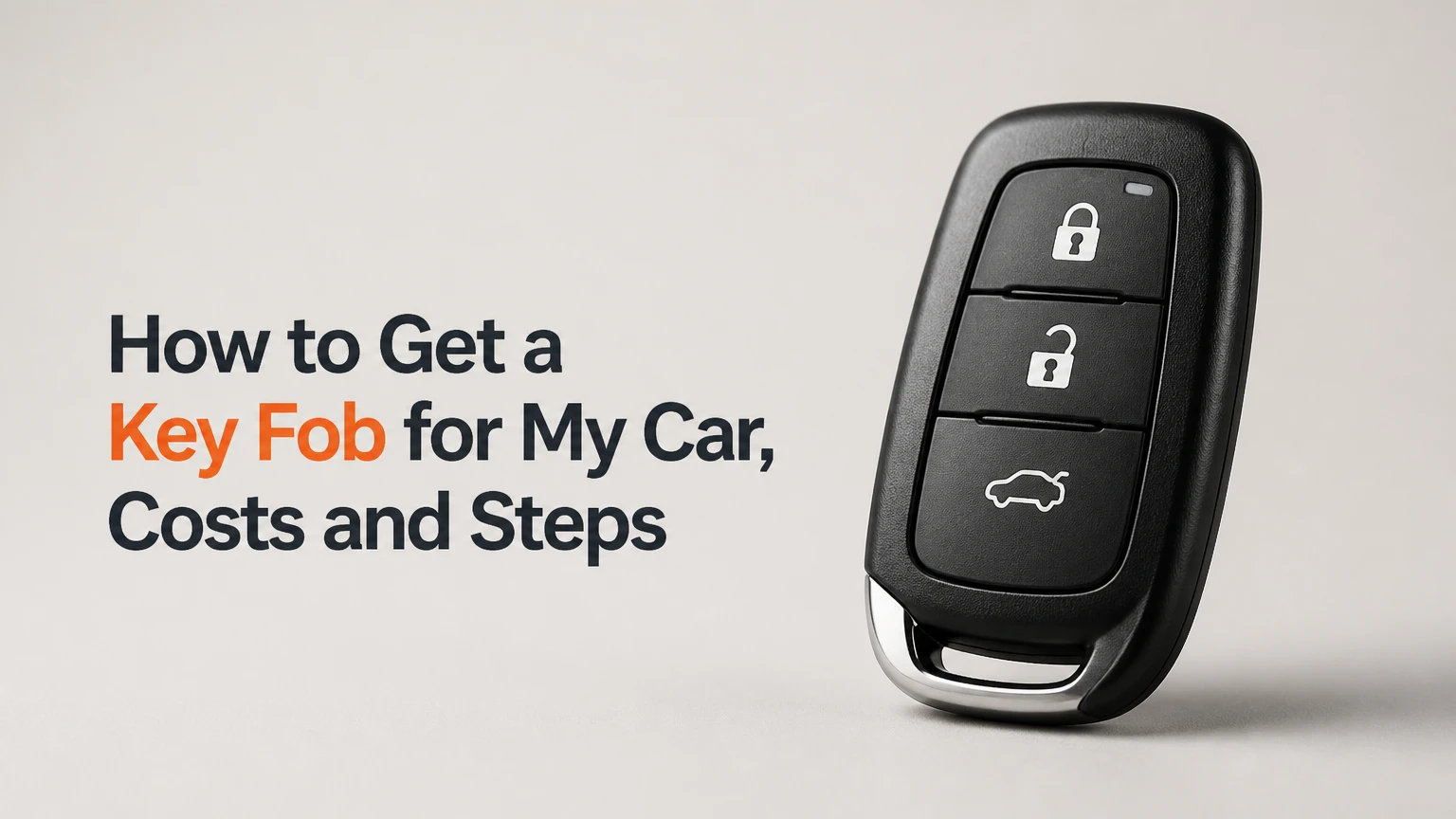
A key fob is a compact electronic device that sends commands to a vehicle’s security and body-control systems. Depending on the vehicle, the fob can lock doors, unlock doors, open the trunk, trigger an alarm, authorize keyless entry, or permit engine starting.
A traditional remote fob controls the locks but may not authorize the engine. A transponder key contains an immobilizer chip that communicates with the vehicle when the key is in the ignition. A proximity or smart key communicates with the car while it remains in a pocket or bag, allowing push-button starting.
The housing commonly contains a circuit board, battery, buttons, antenna, and security chip. The exact radio protocol, encryption method, transmitter frequency, and immobilizer technology vary by manufacturer and market. A fob that looks identical to yours can still be electrically incompatible.
Remote, transponder, and smart key differences
| Key system | How you identify it | Starts vehicle without separate key? | Typical replacement issue |
|---|---|---|---|
| Metal key with transponder | Metal blade and thick plastic head | No, ignition required | Chip must match immobilizer |
| Remote-head key | Metal blade with lock buttons | No, blade turns ignition | Remote and transponder may need separate programming |
| Switchblade key | Folding blade inside remote housing | No, ignition required | Blade cutting and hinge quality matter |
| Proximity smart key | Push-button start and passive entry | Yes, when detected | Vehicle-specific programming is usually required |
How Does a Key Fob Work?
A car key fob transmits a vehicle-specific radio signal to a receiver, and the vehicle accepts the command only after checking the fob’s identification and security data. Keyless-entry systems commonly use encrypted or rolling-code communication, while immobilizer systems separately verify a transponder or proximity credential before allowing the engine to run.
The often-cited 315 MHz North American and 433 MHz European frequencies are common examples, not universal identification rules. Some vehicles use other frequencies, regional variations, low-frequency proximity antennas, or manufacturer-specific protocols. Frequency alone cannot establish compatibility.
Rolling-code systems change an authentication value after button presses. A temporary communication problem can occur if a button is repeatedly pressed far from the vehicle, but a completely discharged vehicle battery does not automatically erase every fob from memory. Relearn procedures differ by year, make, model, and security module.
A useful diagnostic distinction is that door unlocking and engine authorization may fail independently. A fob can operate the locks while its immobilizer chip remains unprogrammed, or the buttons can stop working while the vehicle still starts when the fob is placed in its emergency detection position.
Which Key Type Does Your Car Use?
Your car’s key type is determined primarily by the ignition and entry system, not by the fob’s shape. A vehicle with a metal ignition cylinder may use a transponder or remote-head key, while a vehicle with push-button start normally uses a proximity smart key.
Check the owner’s manual, the original key, and the dashboard for reliable clues. Do not rely on a generic online listing that says “fits your make,” because one model year can use several transmitter part numbers.
Look for these compatibility identifiers
- FCC ID: A radio identifier printed inside or on the back of many North American fobs.
- Part number: The manufacturer’s replacement number, often printed on the housing or circuit board.
- Frequency: A supporting specification, never the sole matching criterion.
- Button layout: Useful for screening, but identical buttons do not prove compatibility.
- Blade profile: The emergency or ignition blade may use a standard, laser-cut, or manufacturer-specific profile.
- Immobilizer generation: A critical factor for engine starting and all-keys-lost programming.
Step 1: Gather the Required Information
Before ordering a replacement, record the VIN, exact vehicle configuration, key identifiers, and the number of working keys available. The VIN is a 17-character identifier commonly visible through the driver-side windshield, on the registration, and on the insurance documents.
Write down the following:
- Vehicle year, make, model, trim, and market.
- VIN, while protecting it when requesting online quotes.
- Whether the vehicle uses an ignition key or push-button start.
- Whether the original key has a remote, transponder, or proximity function.
- FCC ID, part number, button layout, and frequency from the old fob.
- Whether you have zero, one, or multiple working keys.
- Whether the emergency blade is present and already cut.
A dealer or locksmith may request government-issued identification, registration, title, or other ownership evidence before cutting or programming a key. A key code can help with blade cutting, but many providers can retrieve the required information through manufacturer systems or decode the lock.
Why does the number of working keys matter?
The number of working keys determines whether a vehicle permits owner programming. Some older systems allow a new transponder key to be added only when two already-programmed keys are present. Newer vehicles frequently require a diagnostic tool, security PIN, online authorization, or an all-keys-lost procedure even when one original key remains.
Step 2: Choose a Source
Choose a dealer for maximum factory assurance, a reputable automotive locksmith for speed and mobile service, or an online seller only when you can verify the exact part number and programming method. Hardware-store key services can handle selected older vehicles but often cannot support high-security or newer proximity systems.
| Source | Typical total cost | Typical time | Best fit | Main limitation |
|---|---|---|---|---|
| Vehicle dealership | $250-$700 | Same day-3 days | New, leased, luxury, complex vehicles | Highest labor and part price |
| Automotive locksmith | $150-$400 | 1-3 hours | Mobile replacement and lost keys | Capability varies by vehicle |
| Online fob plus DIY | $30-$90 | 3-7 days | Older vehicles with proven self-programming | Wrong part can be unusable |
| Hardware or key retailer | $90-$200 | 15-60 minutes | Supported common models | Limited diagnostic coverage |
| Used or refurbished fob | $25-$150 before labor | 1-3 days | Selected systems with confirmed reset status | May remain locked to another vehicle |
Ask for an itemized quote that separates the fob, blade cutting, programming, service call, emergency charge, tax, and key deletion or reprogramming. A $180 advertised key can become a $300 invoice after mobile labor and programming.
OEM versus aftermarket fobs
An OEM fob is produced for the vehicle manufacturer and usually offers the most predictable fit, button feel, antenna performance, and compatibility. An aftermarket fob can cost less, but quality ranges from reliable licensed replacement hardware to poorly matched products with incorrect chips or weak cases.
An aftermarket fob is reasonable when the seller provides the exact FCC ID, part number, return policy, compatibility list, and programming requirements. It is a poor choice when the listing relies only on a photograph or broad claims such as “works with most Toyota models.”
Step 3: Cut the Emergency Blade
Have the emergency blade cut if the replacement fob contains one, even when the vehicle normally unlocks and starts electronically. The blade provides access when the fob battery, vehicle battery, passive-entry system, or electronic receiver cannot operate.
A standard blade can often be duplicated from a working key or cut using a code. A laser or sidewinder blade has a precision groove and requires suitable cutting equipment. A hardware store may copy a conventional blade but may not have the equipment or blank for a high-security profile.
The emergency blade may unlock the driver’s door without starting the engine. That behavior is normal on many proximity vehicles because door access and immobilizer authorization are separate functions.
Success checkpoint: The blade should enter and turn the door cylinder smoothly without excessive force.
Common mistake: Assuming a blade that physically fits is correctly cut. A rough or incorrect cut can damage the cylinder.
Step 4: Program the New Fob
Program the replacement fob using the vehicle’s documented on-board procedure or a compatible diagnostic tool. Remote-button pairing, transponder programming, and proximity-key registration are different operations, so a procedure that makes the lock buttons work may not authorize engine starting.
Older vehicles sometimes support an owner procedure involving ignition cycles, door movements, or button presses. The exact sequence is manufacturer-specific, and many procedures work only when at least one valid key is present. The owner’s manual is the safest source.
Modern vehicles commonly require an OBD-II diagnostic connection under the dashboard. A locksmith or dealer may use a manufacturer scan tool or an aftermarket programmer, and some vehicles require an internet-connected security account or PIN.
| Programming situation | Likely method | Typical added cost | Practical difficulty |
|---|---|---|---|
| Older remote-only system | Manual button sequence | $0-$30 | Low, if documented |
| One working transponder key available | On-board or diagnostic addition | $0-$150 | Medium |
| Push-button smart key | Diagnostic registration | $100-$300 | High |
| All keys lost | Security access and new-key enrollment | $150-$500 | High |
| Luxury or late-model encrypted system | Dealer or advanced locksmith tool | $250-$700 total | Very high |
Success checkpoint: Every intended function should work: lock, unlock, trunk, alarm, passive entry, and engine starting.
Common mistake: Testing only the lock button and discovering later that the immobilizer was never enrolled.
What Does a Replacement Key Fob Cost?
A replacement car key fob typically costs $30-$90 for an online unit with successful DIY programming, $150-$400 through a mobile automotive locksmith, and $250-$700 through a dealership. Push-button-start vehicles, luxury brands, all-keys-lost situations, and encrypted late-model systems usually occupy the upper end of the range.
| Vehicle situation | Fob or key price | Programming or labor | Typical total |
|---|---|---|---|
| Older remote-only vehicle | $20-$60 | $0-$50 | $20-$110 |
| Remote-head transponder key | $40-$140 | $50-$180 | $90-$320 |
| Common proximity smart key | $80-$250 | $100-$250 | $180-$500 |
| Luxury proximity system | $180-$450 | $150-$350 | $330-$800 |
| All keys lost, mobile service | $80-$350 | $150-$400 | $230-$750 |
These are typical planning ranges, not guaranteed quotes. Regional labor rates, emergency hours, imported vehicles, key scarcity, and whether the car must be present can change the invoice substantially.
A locksmith can often reduce cost because the technician comes to the vehicle and may supply compatible aftermarket hardware. A dealer may be preferable when the car has warranty concerns, a recent security revision, a leased-vehicle requirement, or a system that independent tools cannot access.
Can the Existing Fob Be Repaired?
Replace the fob battery before ordering a new fob when the buttons work intermittently, the operating range has declined, or the vehicle reports a low-key battery. Common coin-cell sizes include CR2032 and CR2025, but the number printed in the old battery must be matched.
Inspect the casing after removing the battery. Bent contacts, cracked solder joints, corroded terminals, torn rubber buttons, and water intrusion can cause failure. A replacement shell can solve cosmetic damage when the original circuit board and immobilizer chip still function.
| Symptom | Likely cause | First action | Replacement needed? |
|---|---|---|---|
| Range reduced gradually | Weak coin-cell battery | Install specified new battery | Usually no |
| One button fails | Worn rubber pad or contact | Clean contact or replace shell | Usually no |
| No buttons work | Battery, corrosion, or board failure | Test battery and inspect board | Maybe |
| Car starts but remote fails | Remote transmitter issue | Re-sync or repair remote | Not always |
| Remote works but car will not start | Immobilizer issue | Use emergency detection position, then scan | Often requires programming |
Use the correct battery orientation and avoid bending tiny contacts. If the fob has been submerged, replacing the battery alone may energize a damaged circuit and create intermittent faults.
If You Lost Every Key
If you lost every key, contact a dealer or automotive locksmith that explicitly supports all-keys-lost programming for your vehicle. The technician will verify ownership, identify the immobilizer system, cut a key or supply a smart fob, program it, and often erase missing keys from the vehicle’s authorized-key list.
Do not order a random online fob first. All-keys-lost work can require the vehicle to be present, a charged vehicle battery, an accessible OBD-II port, security credentials, and a provider with the correct software.
Ask these questions before dispatch:
- Can you make this exact year, make, model, and trim?
- Can you perform all-keys-lost programming?
- Is the quoted price inclusive of the fob, cutting, programming, and service call?
- Will lost keys be removed from the vehicle’s memory?
- What ownership documents should I prepare?
- What happens if the supplied aftermarket fob fails?
A dead vehicle battery can prevent programming or communication. Jump-starting may restore power, but follow the manufacturer’s jump-start procedure because sensitive modules can be damaged by incorrect polarity or unstable voltage.
Common Mistakes and How to Fix Them
Buying by appearance alone
Two fobs can share a shell shape and button arrangement while using different FCC IDs, chips, or regional frequencies. Match the original identifier and vehicle application before buying.
Assuming frequency proves compatibility
Frequency is only one specification. The protocol, encryption, chip type, blade profile, and vehicle software must also match.
Buying a locked used smart key
Some used proximity fobs can be reset or refurbished, while others remain paired to the original vehicle or cannot be cleared economically. Ask the locksmith to verify reset status before purchase, and choose a returnable unit.
Forgetting that remote pairing is not immobilizer programming
A fob may lock and unlock doors while the engine remains disabled. Test engine authorization and all proximity functions before leaving the provider.
Expecting a hardware store to program every vehicle
Retail key-cutting services support specific models and functions. Call with the exact vehicle and part number rather than assuming a nearby store can program a smart key.
Ordering a second key for a two-key procedure
Some older vehicles require two valid keys before owner-added programming works. If you have only one key, confirm the procedure before spending money on another blank.
Which Replacement Option Is Best?
The best replacement path depends on vehicle complexity, urgency, and whether any working key remains. A locksmith is usually the most efficient choice for a mobile, same-day replacement, while a dealer provides the most predictable factory path for a new or technically complex vehicle.
| Driver situation | Recommended provider | Reasonable budget | Expected result |
|---|---|---|---|
| Pre-2010 vehicle with one working key | Online seller or local locksmith | $30-$180 | Low-cost spare if programming is supported |
| Push-button-start commuter | Automotive locksmith | $180-$500 | Mobile programming and emergency blade |
| New leased vehicle | Dealership | $250-$700 | OEM documentation and compatibility |
| Luxury imported vehicle | Dealer or specialist locksmith | $350-$800 | Correct security access and software |
| All keys lost at home | Mobile automotive locksmith | $230-$750 | On-site cutting and enrollment |
A dealer is not automatically better for every vehicle. Independent locksmiths often have the necessary tools and can avoid towing, but provider capability must be verified for the exact model year.
What Should You Do After Programming?
Test the replacement fob beside the vehicle before paying. Confirm the lock, unlock, trunk, panic, remote-start, passive-entry, emergency-blade, and engine-start functions that your vehicle supports.
Keep the new fob away from the original during testing so you can identify which device performs each function. Store the spare in a separate, secure location, and record its part number and programming date for future replacement.
If the car intermittently reports “key not detected,” replace the fob battery, move the fob away from phones and metal objects, and use the emergency detection location described in the owner’s manual. Persistent faults can indicate a vehicle antenna, low vehicle voltage, or security-module problem rather than a defective fob.
FAQ
Can I get a key fob without the original key?
You can obtain a replacement key fob without the original, but the provider will usually need the VIN, ownership documents, and the vehicle itself. All-keys-lost programming is more expensive because the technician must create and enroll a new authorized key rather than copy an existing credential.
How long does it take to get a car key fob?
A local locksmith can often supply and program a common replacement in 1-3 hours. A dealership may complete the work the same day, but special-order OEM fobs can take 1-3 days. Online purchases usually add 3-7 days for shipping before programming.
Can I program a key fob after replacing its battery?
Replacing a fob battery normally does not erase its programming. If the remote stops responding afterward, check battery polarity, terminal contact, and the correct battery type first. Some vehicles need a simple re-synchronization procedure, while others require diagnostic attention for a separate fault.
Is a key fob covered by car insurance?
Comprehensive auto insurance may cover lost or stolen keys under selected policies, and roadside or vehicle-service plans sometimes include limited key replacement benefits. Coverage, deductibles, provider restrictions, and maximum reimbursements differ, so check the policy before authorizing a $250 or higher replacement.
Should I make a spare key fob now?
Making a spare while one working key remains usually reduces risk and cost. A provider can often add a key more easily than when every key is lost, and a spare prevents an emergency towing or mobile-service charge when the original fails.
Where should I keep a spare smart key?
Keep a spare smart key in a secure location separate from the daily key, away from moisture, extreme heat, and unnecessary radio shielding. Do not leave both keys inside the vehicle, because passive-entry systems can create lockout or theft risks depending on the model.
The Bottom Line
To get a key fob for your car, first identify the exact key system and match the replacement by VIN, FCC ID, part number, and vehicle application. Use a locksmith for fast mobile service, a dealer for factory certainty, or an online unit only when the vehicle supports verified DIY programming. Include blade cutting, immobilizer enrollment, and full-function testing in the final quote. The right approach to how to get a key fob for my car is determined less by the fob’s appearance than by the vehicle’s security system and the number of working keys you still possess.