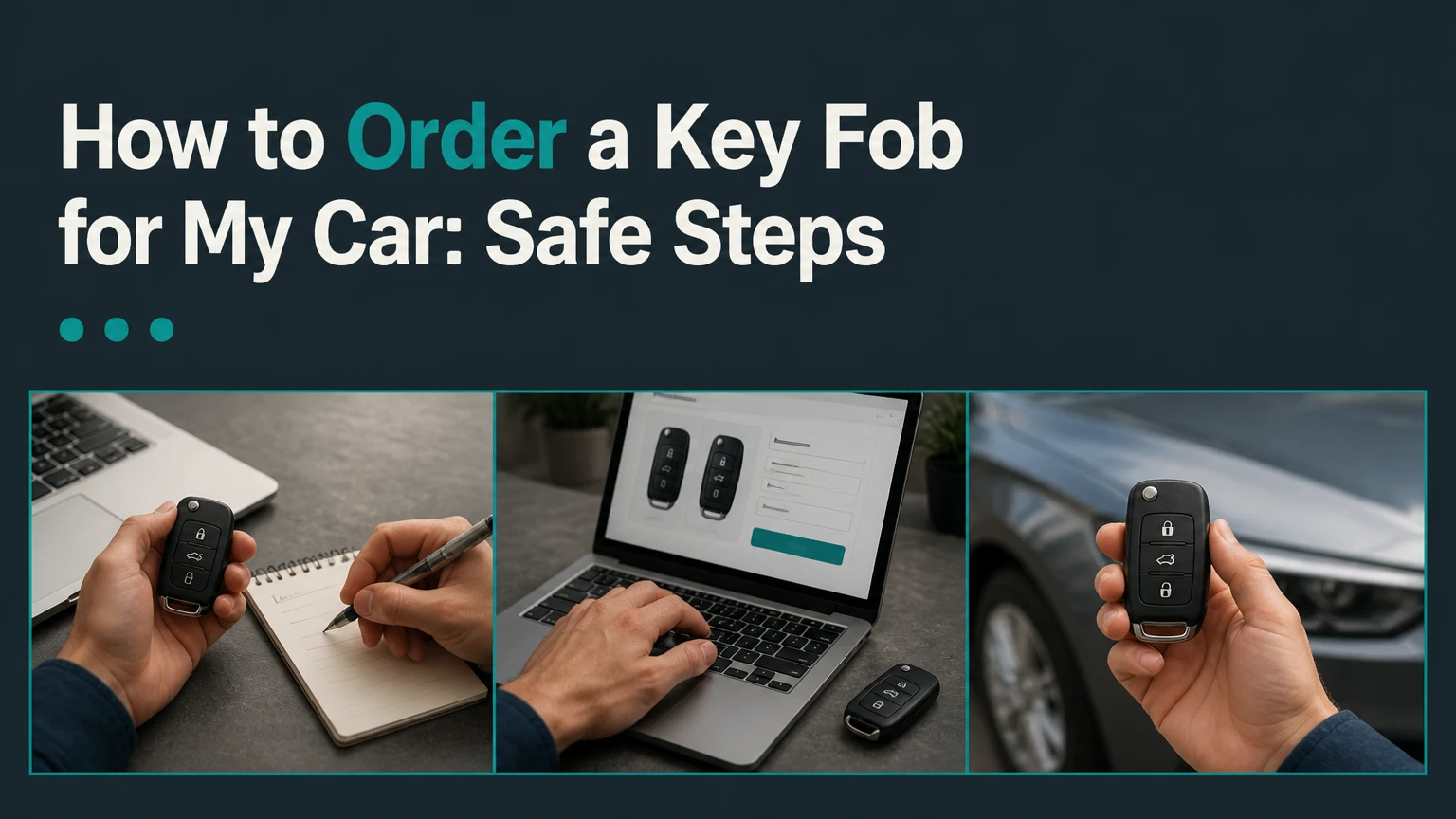
To order a key fob for your car, identify the vehicle’s year, make, model, VIN, key type, and matching part number, then buy from a dealer, automotive locksmith, or reputable supplier that can confirm compatibility and programming. Expect the process to take 30-90 minutes locally, or several days when a part must be shipped; the vehicle’s key system determines success.
Key Facts at a Glance
A key fob may control door locks, authorize engine starting, or perform both functions.
A VIN identifies the vehicle, but a VIN alone does not always identify the correct remote frequency, button layout, or immobilizer version.
A replacement fob usually needs electronic programming, while a remote-only transmitter may use a vehicle-specific pairing procedure.
A working spare key can reduce programming time and may lower the total cost.
A dealer supplies an OEM-matched part, while a qualified automotive locksmith often provides lower-cost mobile programming.
A used proximity key may remain permanently linked to another vehicle and may not be reusable.
What a Replacement Key Fob Actually Includes
A replacement key fob can contain four separate components: a remote transmitter, an immobilizer transponder, a mechanical key blade, and a rechargeable or coin-cell battery. The correct order depends on which components your car uses, because replacing a door-lock remote does not necessarily replace the chip that authorizes the engine.
A remote transmitter sends commands such as lock, unlock, trunk release, or panic through short-range radio communication. The car’s body control module receives those commands and verifies them before operating the locks. Frequency, encryption, button configuration, and software version must match the vehicle.
The immobilizer transponder performs a different job. It communicates with the vehicle’s immobilizer system when the key is near the ignition switch or start authorization module. A key can lock and unlock the doors yet still fail to start the engine if its transponder is absent or unprogrammed.
A smart key adds proximity detection. The car may recognize the fob while it remains in a pocket, permit touch-to-unlock entry, and authorize push-button starting. Some smart keys also contain an emergency blade that opens the door when the battery is depleted.
Remote keyless systems often use changing or encrypted codes, but not every vehicle uses the same rolling-code architecture. Radio frequency alone is therefore insufficient for identification. The FCC ID, manufacturer part number, frequency, transponder type, and vehicle-specific programming system matter together.
Which Key Type Does Your Car Use?
The fastest way to identify a key type is to compare the working key with the categories below, then verify the part number rather than relying on appearance. A physical blade, push-button start, and proximity entry each change what must be ordered and programmed.
| Key type | Vehicle feature | Mechanical blade | Electronic work usually required |
|---|---|---|---|
| Remote-only fob | Separate metal ignition key | No | Remote pairing, sometimes none |
| Integrated key | Blade attached to fob housing | Yes | Remote and transponder programming |
| Switchblade key | Folding blade inside housing | Yes | Cutting, remote pairing, immobilizer programming |
| Proximity smart key | Touch entry and push-button start | Emergency blade often included | Smart-key registration and sometimes security access |
Remote-only transmitters
A remote-only transmitter controls locks but does not physically start the vehicle. The ignition key may contain a separate transponder, so ordering only the remote can restore lock functions without replacing the starting key.
Integrated and switchblade keys
An integrated key combines the metal blade and remote housing. A switchblade version folds the blade into the casing. The replacement must use the correct blade profile, cut depth, transponder, and button arrangement. A visually identical shell can conceal a different circuit board.
Proximity smart keys
A proximity fob requires the closest match. Model year, trim level, regional market, immobilizer generation, and the number of previously registered keys can affect compatibility. Luxury vehicles may require manufacturer authorization or an online security token during programming.
Before You Order
Gather the vehicle and key information before calling a supplier. The minimum useful set is the year, make, model, trim if known, VIN, existing-key status, and a clear photograph of the front and back of the current fob.
| Information to gather | Where to find it | Why the supplier needs it |
|---|---|---|
| VIN, 17 characters | Dashboard, door-jamb label, registration | Confirms vehicle identity and market |
| Existing fob part number | Back label, inside casing, dealer records | Matches transmitter and electronics |
| FCC ID, where present | Fob label or circuit board | Helps identify radio hardware |
| Key type | Existing fob and vehicle controls | Determines blade and programming needs |
| Number of working keys | Your key ring and records | Affects programming procedure and security |
| Proof of ownership | Registration, title, insurance, government ID | Supports lawful key service |
The VIN is usually printed at the lower driver-side windshield or on the driver’s door-jamb label. A VIN does not always reveal every fob variation, especially when the same model used multiple suppliers or regional frequencies.
A key code may appear on an original tag or dealer record, but many modern replacement orders do not require the owner to know it. The dealer or locksmith can often retrieve cutting information through authorized systems after verifying ownership. Do not post the full VIN or key code publicly.
Is the FCC ID enough?
No. An FCC ID can help identify compatible radio hardware, but it is not a universal guarantee of vehicle compatibility. Some replacement keys use different internal identifiers, and some smart keys have no useful consumer-facing FCC label. Confirm the full part number and programming compatibility with the supplier.
Step 1: Decide Whether You Need Repair or Replacement
Test the existing fob before ordering a complete unit. Replace the coin-cell battery with the exact size printed inside the case, inspect for corrosion or water damage, and test every button near the vehicle.
Common batteries include CR2032 and CR2025, but those cells are not interchangeable in every housing. A battery with the wrong thickness can create poor contact or prevent the case from closing. The battery label and polarity marking provide the correct installation reference.
A damaged shell, worn rubber button pad, or cracked key ring does not always require new electronics. A replacement shell can preserve the original circuit board and immobilizer components, although a switchblade blade may still need cutting.
A fob that works intermittently may have a failing button membrane, fractured solder joint, water contamination, or a weak vehicle battery. Replacing the fob without diagnosing the car can leave the underlying receiver or body-control problem unresolved.
You will know repair is appropriate when: the original fob still locks and unlocks the vehicle, the transponder still starts the engine, and only the housing, buttons, or battery is damaged.
Common mistake: assuming a dead fob battery erased the key from the vehicle. A depleted battery usually stops remote transmission; it does not normally delete the immobilizer registration.
Step 2: Choose a Dealer, Locksmith, or Online Supplier
Choose an authorized dealer for a new vehicle, a complicated smart-key system, or a situation where factory warranty and OEM documentation matter most. Choose a reputable automotive locksmith when mobile service, same-day availability, and lower installed cost are more important.
| Purchasing route | Typical total cost in the USA | Typical time | Programming responsibility |
|---|---|---|---|
| Authorized dealer, remote-only | $80-$250 | 1-3 business days | Dealer |
| Authorized dealer, smart key | $200-$600+ | Same day to 3 days | Dealer |
| Automotive locksmith | $100-$400 | 30-90 minutes | Locksmith |
| Online part plus local programming | $40-$250 plus service | 2-7 days | Buyer and programmer |
| Shell or battery repair | $10-$100 | 10-45 minutes | Usually no vehicle programming |
These are typical US consumer ranges, not fixed prices. Brand, model year, regional labor rates, OEM availability, all-keys-lost status, and security access can move the total substantially. European, Canadian, Australian, and other markets use different currencies and pricing.
Before approving service, ask whether the quoted price includes the fob, cutting, programming, service call, taxes, emergency charges, and removal of old keys from the vehicle’s memory. Ask what happens if the supplied part cannot be programmed.
Online ordering is safest when a professional has already confirmed the exact part number. Many locksmiths will not warranty programming of customer-supplied electronics because counterfeit, cloned, locked, or incorrectly listed fobs create failures they cannot control.
Which purchasing route fits your situation?
| Situation | Preferred route | Reason | Main limitation |
|---|---|---|---|
| One working key remains | Locksmith or dealer | Existing key can simplify registration | Some systems still require security access |
| All keys are lost | Mobile locksmith or dealer | Provider can create and authorize a key | May require vehicle access and ownership proof |
| 2024-2026 luxury vehicle | Authorized dealer or brand specialist | New encryption and online authorization | Highest price and possible wait |
| Older remote-only vehicle | Verified online part plus programmer | Lower component cost | Compatibility and warranty risk |
| Lease or finance vehicle | Dealer or approved locksmith | Records and ownership checks are clearer | Lease terms may restrict modifications |
Step 3: Verify the Exact Replacement Part
Verify the part number, FCC ID where applicable, frequency, button count, blade profile, transponder type, and vehicle coverage before paying. The supplier should confirm whether the part is new, refurbished, aftermarket, cloned, or previously paired to another vehicle.
Use the existing fob as the primary reference. Photograph labels and compare the circuit-board marking if the case opens without damage. Search results that say “fits your model” can combine several years, trims, markets, and incompatible key systems on one listing.
Check these details:
- Vehicle range: Confirm the exact model year and body style.
- Button layout: Match lock, unlock, trunk, panic, remote-start, and hatch buttons.
- Part number: Match the complete manufacturer number, including suffixes.
- Frequency: Confirm the regional radio specification, not merely 315 or 433 MHz.
- Blade: Determine whether the blade is included, cut, or sold separately.
- Condition: Avoid used proximity keys unless a qualified programmer confirms reset capability.
- Return policy: Ensure returns cover an incompatible or unprogrammable part.
A remote-start button is particularly easy to overlook. A fob without that button cannot add a factory remote-start feature by itself, while a vehicle without the corresponding module may ignore the button.
You will know the part is verified when: the supplier has matched the vehicle, part number, key type, and programming method in writing rather than saying only that the housing looks correct.
Common mistake: ordering by photograph. Two fobs can share a shell shape while using different circuits, frequencies, transponders, or immobilizer generations.
Step 4: Arrange Cutting and Programming
Arrange programming with the same provider before ordering an electronic key whenever possible. A replacement with a metal blade needs cutting, while a remote-only fob may need remote synchronization and a proximity key normally needs immobilizer registration.
Key programming is not one universal procedure. Some older vehicles permit an owner-operated button or ignition sequence, while many newer vehicles require a diagnostic tool connected through the OBD-II port and security authorization. The owner’s manual may describe remote pairing without describing immobilizer programming.
A locksmith or dealer may need every existing key during registration. Certain vehicles erase previously stored keys when a new key-learning session begins, so a key left at home can stop working until it is added again.
Programming can fail because of an incorrect part, low vehicle voltage, a blocked security gateway, an unsupported tool, or a key that remains locked to another vehicle. A professional should stabilize the vehicle battery and verify the part before repeatedly attempting registration.
| Programming scenario | Typical procedure | Typical time | Failure risk |
|---|---|---|---|
| Remote-only pairing | Ignition or button sequence | 5-20 minutes | Low if procedure is supported |
| Transponder key | Diagnostic immobilizer registration | 20-60 minutes | Medium |
| Proximity smart key | Security-authorized scan-tool procedure | 30-90 minutes | Medium to high |
| All-keys-lost service | Key generation plus registration | 60-180 minutes | Higher |
| Luxury encrypted system | Dealer or authorized specialist access | 1-3 days | Part and access dependent |
Keep the vehicle’s battery charged during programming. If the car battery is flat, restore vehicle power first and do not assume that changing the fob battery will solve a no-start condition.
You will know programming worked when: every required button responds, the vehicle starts normally, the emergency blade opens the door, and all existing keys still operate if they were meant to remain active.
Common mistake: testing only the lock button. Test starting, proximity entry, trunk release, panic, remote start, and the mechanical blade when those features exist.
Step 5: Test, Document, and Store the Spare
Test the new key beside the vehicle and from several normal distances, then record the part number, programming date, supplier, and warranty terms. Keep the spare away from heat, moisture, strong impact, and unnecessary radio interference.
Verify these functions:
- Lock and unlock from the driver’s side and passenger side.
- Trunk, hatch, panic, and remote-start functions if equipped.
- Push-button starting with the fob in a pocket or bag.
- Emergency-blade removal and door-cylinder operation.
- Warning messages, such as “key not detected.”
- Operation of every remaining key after programming.
A spare key is cheaper before all keys are lost. When no original key remains, the service may require towing, vehicle-security access, additional ownership verification, and a longer appointment.
Record the battery type and keep one fresh replacement cell in a household battery container. Do not store a loose coin cell with metal objects, because accidental contact can discharge it and create a swallowing hazard for children.
How Much Does a Replacement Key Fob Cost?
A replacement key fob typically costs $40-$250 for a verified remote or integrated key and $150-$600 or more for a modern smart key, before unusual towing or security charges. Dealer pricing is usually higher than locksmith pricing, while an online part is cheaper but transfers compatibility and programming risk to the buyer.
| Replacement need | Part cost, typical USA | Service cost, typical USA | Total typical range |
|---|---|---|---|
| Coin-cell battery | $3-$15 | $0-$20 | $3-$35 |
| Replacement shell | $8-$40 | $10-$60 | $18-$100 |
| Remote-only fob | $30-$150 | $30-$100 | $60-$250 |
| Transponder key | $50-$250 | $50-$175 | $100-$425 |
| Proximity smart key | $100-$450 | $75-$250 | $175-$700 |
| All-keys-lost service | $100-$450 | $150-$500 | $250-$950 |
Published prices vary because “key fob replacement” may mean a shell, an unprogrammed transmitter, or a fully cut and programmed key. Request an itemized quote that separates the physical part from labor and security access.
The least expensive component is not always the least expensive solution. A $35 online fob that fails programming can cost more after return shipping, a second appointment, and a diagnostic charge.
What Are the Main Ordering Mistakes?
The most expensive mistakes involve confusing a housing with a complete key, buying by appearance, and failing to confirm who will program the part. Recovery is possible for some errors, but a locked smart key may be unrecoverable.
Buying a used smart key
A used proximity fob may contain a security credential permanently paired with another vehicle. Some brands and models support reset or refurbishment; others do not. Ask for a written compatibility and return policy before buying a used key.
Treating a VIN as a complete part number
A VIN identifies the vehicle but may not distinguish every transmitter revision. Suppliers may need the original fob number, production date, trim, region, and button arrangement.
Forgetting the emergency blade
A smart fob often has a concealed mechanical blade. Confirm whether the new key includes the blade and whether it will be cut. Without it, a dead fob battery can prevent normal door access.
Allowing programming to erase existing keys
Ask whether the learning process deletes stored keys. Bring every working key to the appointment when the provider requests them.
Ignoring ownership verification
Dealers and legitimate locksmiths commonly request government identification and registration, title, or insurance documents. Those checks protect the owner and prevent unauthorized vehicle access.
Assuming the car is the only possible fault
A weak 12-volt battery, damaged receiver antenna, blown fuse, or body-control fault can mimic a bad fob. If a known-good key also fails, diagnose the vehicle before buying another transmitter.
What If All Keys Are Lost?
Call a mobile automotive locksmith or authorized dealer and provide the VIN, exact location, vehicle model, proof of ownership, and the fact that no working key remains. Do not order a random online fob first, because all-keys-lost work may require a specific virgin key, security code, or manufacturer-authorized procedure.
A locksmith may cut a mechanical blade from vehicle data and program a new transponder at the vehicle. A dealer may require the vehicle at its facility, especially when online security authorization or brand-specific tools are necessary.
Prepare for additional requirements:
- Vehicle access, including a charged battery or recovery service.
- Registration, title, or insurance record.
- Government-issued identification.
- Proof of finance or lease authorization where applicable.
- The exact vehicle location and whether the steering lock is engaged.
- A request to delete missing keys from the vehicle’s memory.
Deleting lost keys can prevent their immobilizer credentials from starting the engine, but it may not prevent a thief from opening the doors with a physical blade or exploiting unrelated vehicle weaknesses. Report theft separately to the police and insurer.
Can You Order a Key Fob Online and Program It Yourself?
You can order and program some remote-only fobs yourself, but self-programming is model-specific and is not a reliable general solution for modern transponder or proximity keys. The owner’s manual is the safest source for an ignition or button pairing sequence; online instructions often combine different model years.
DIY ordering makes sense when the vehicle is older, the part number is confirmed, the manual provides an owner procedure, and a separate professional can handle cutting if needed. It is a poor choice when all keys are lost, the vehicle uses push-button start, or the supplier cannot guarantee returns.
Do not connect unknown software or inexpensive diagnostic equipment to immobilizer systems without understanding the procedure. Incorrect programming attempts can create lockouts, erase existing keys, or require dealer-level security access.
A shell replacement is a lower-risk DIY task because the original circuit board and transponder remain in place. Move the electronics carefully, preserve the transponder chip, and test the key before discarding the old housing.
What Should You Ask Before Paying?
Ask the dealer, locksmith, or online seller five questions before committing: Is the part new or used? Does the price include programming? Will all current keys remain active? What proof of ownership is required? What happens if the part fails compatibility or programming?
Use this short call script:
- “My vehicle is a [year, make, model, trim], and the VIN is available for verification.”
- “I have [number] working keys.”
- “The vehicle uses [remote-only, integrated, switchblade, or proximity] entry.”
- “Does your quote include the part, cutting, programming, service call, tax, and warranty?”
- “Will you verify the part number before ordering?”
- “Do you accept customer-supplied fobs, and who bears the programming risk?”
- “Will missing keys be removed from the vehicle’s memory?”
A provider who refuses to explain the part condition, programming coverage, or final price deserves caution. A low headline quote that excludes programming is not comparable with a fully installed quote.
FAQ
How long does it take to get a new key fob?
A stocked dealer or mobile locksmith can often complete a replacement in 30-90 minutes. Special-order OEM smart keys commonly take one to three business days, while an online order typically adds two to seven shipping days before programming.
Can a locksmith make a key fob without the original?
A qualified automotive locksmith can often create and program a replacement without the original, provided the vehicle supports the required equipment and ownership is verified. All-keys-lost work usually costs more and may take longer because the provider must generate the key and authorize it.
Does a new key fob need to be cut?
A remote-only fob does not need a metal blade. An integrated key, switchblade key, or smart key with an emergency blade needs the correct blade cut if you want physical door access or ignition operation.
Will changing the key-fob battery reprogram the key?
Changing the battery normally does not erase immobilizer programming. Some vehicles may require remote resynchronization after a prolonged battery failure, but the procedure varies by model and should come from the owner’s manual or a qualified technician.
Are aftermarket key fobs reliable?
Aftermarket fobs can work well when the exact part number, frequency, circuit, and transponder match the vehicle. Quality varies widely, so confirm return rights, programming support, battery quality, and warranty coverage before choosing a lower-cost part.
Should I make a spare key now?
Yes. Making a spare while one working key remains usually reduces diagnostic complexity and avoids the higher cost of an all-keys-lost service. Store the spare securely away from the vehicle, and test it periodically so its battery and buttons are ready when needed.
The Bottom Line
To order a key fob for my car, first identify the exact key system and part number, then compare an authorized dealer with a qualified automotive locksmith before buying online. Confirm programming, cutting, ownership documents, warranty, and existing-key handling in the quote. A verified part and a professional programming plan matter more than the lowest advertised price.