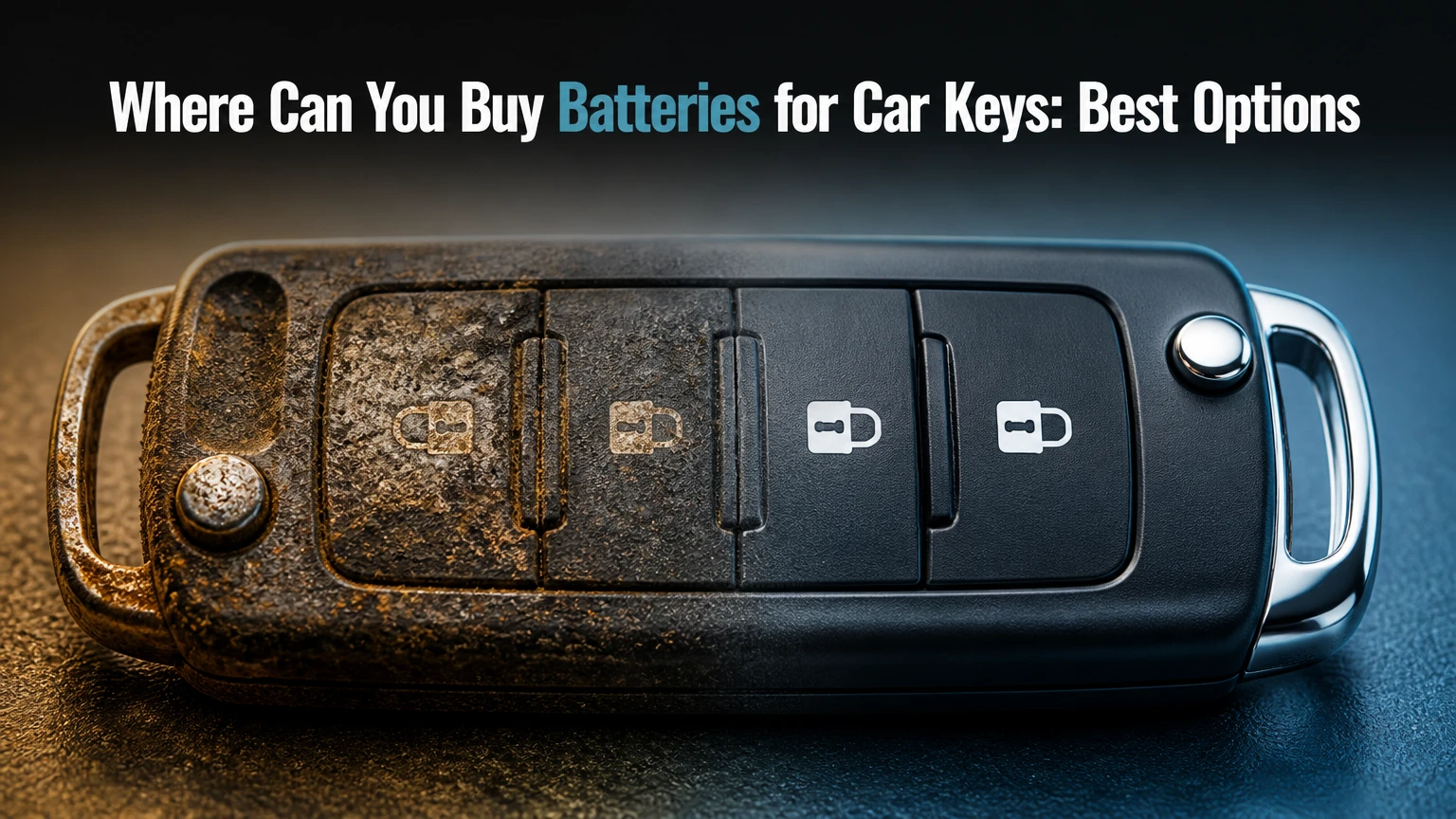
You can buy batteries for car keys at auto-parts stores, supermarkets, hardware stores, battery specialists, dealerships, locksmiths, convenience stores, gas stations, and online retailers. The correct battery is usually a 3-volt CR-series lithium coin cell, but the exact number must match the old battery or your vehicle’s owner’s manual.
Key Facts at a Glance
- Most remote key fobs use a 3-volt lithium coin cell such as CR2032 or CR2025.
- The battery number identifies size, so CR2032 and CR2025 are not automatically interchangeable.
- Auto-parts stores are usually the best local choice because staff can identify the cell and sometimes install it.
- Dealerships and automotive locksmiths can replace batteries, but their labor and parts prices are typically higher.
- A replacement normally takes 5-15 minutes and costs about $2-$15 for the battery alone.
- A key fob battery replacement usually does not erase the vehicle key code, but some models require resynchronization afterward.
Where Can You Buy Batteries for Car Keys?
The best place to buy batteries for car keys is usually a local auto-parts store, because it combines common CR-series stock, fitment assistance, and convenient opening hours. A supermarket or hardware store costs less for a standard CR2032, while a dealership or locksmith is preferable when the fob is difficult to open or the vehicle uses an unusual battery arrangement.
Retail availability varies by country, store size, and vehicle popularity. Common CR2032 and CR2025 cells are often displayed near checkout counters, electronics, automotive accessories, watches, or hearing-aid supplies. Less common CR1632, CR1620, and CR2450 cells are more reliably stocked by battery specialists and online sellers.
| Buying location | Typical battery price | Typical total time | Best use |
|---|---|---|---|
| Supermarket | $3-$8 for 1-2 cells | 10-20 minutes | Common CR2032 during daytime |
| Hardware store | $3-$10 for 1-4 cells | 10-25 minutes | Standard sizes and local pickup |
| Auto-parts store | $4-$15 for 1-4 cells | 5-20 minutes | Fitment help and possible installation |
| Battery specialist | $5-$20 for 1 cell | 10-30 minutes | Rare sizes, testing, careful installation |
| Gas station or convenience store | $4-$12 for 1 cell | 5-10 minutes | After-hours emergency replacement |
| Dealership | $10-$30 installed | 15-45 minutes | Model-specific service and documentation |
| Automotive locksmith | $10-$35 installed | 10-30 minutes | Difficult fobs or related key problems |
| Online retailer | $1-$5 per cell in multipacks | 1-7 days | Lowest unit price and planned replacement |
A practitioner rule is simple: buy locally when the car is needed immediately, and buy online when the battery number is confirmed and delivery can wait. The cheapest cell is not a bargain if a wrong size leaves the fob unusable overnight.
Which Stores Are Best for a Replacement?
Auto-parts stores offer the strongest overall balance of selection, speed, and assistance. Battery shops offer the most technical help, while supermarkets and hardware stores are generally cheapest for familiar battery numbers.
Auto-Parts Stores
AutoZone, O’Reilly Auto Parts, Advance Auto Parts, Halfords, NAPA, and comparable regional chains commonly stock CR2032 and CR2025 batteries. Some locations will identify the correct cell from the old battery and install it, although service policies differ by store and fob design.
Ask the employee to confirm the exact number, polarity, and whether the fob requires a separate programming procedure. Installation is often free or low-cost when the battery is purchased there, but call ahead if the fob is sealed, uses two cells, or contains a delicate proximity-key circuit.
Supermarkets and Hardware Stores
Walmart, Target, grocery stores, pharmacies, Home Depot, Lowe’s, Screwfix, and independent hardware stores commonly sell major-brand coin cells. These locations are practical when the old battery clearly says CR2032, CR2025, or another standard number and the fob opens without special tools.
Retail shelves may contain batteries that have been stored for several years. Check the expiration or best-before date, inspect the package for damage, and choose a sealed pack from Energizer, Panasonic, Duracell, Maxell, Sony, Varta, or another established manufacturer.
Battery Specialists
Batteries Plus and independent battery retailers are useful when the key fob uses CR1632, CR1620, CR2450, CR1616, or multiple cells. Staff may test the old cell, identify an equivalent part, and install the replacement without damaging the housing.
A battery specialist is particularly useful for a proximity fob with a hidden mechanical key, a rubberized casing, or a battery held by a retaining clip. The extra service cost can be cheaper than replacing a broken housing or dislodged circuit-board contact.
Gas Stations and Convenience Stores
Gas stations and convenience stores are the fastest after-hours option, but selection is narrow and prices are usually higher. Most carry CR2032, while CR2025 and less common sizes may be unavailable.
Use this option when the remote range has suddenly collapsed and no other retailer is open. Verify the number before opening the package, because return policies for opened coin-cell packs are often restrictive.
Can a Dealership or Locksmith Replace the Battery?
A dealership or automotive locksmith can replace most key fob batteries, but the service is rarely the lowest-cost option. Dealerships are best when the manufacturer specifies a model-specific procedure, while locksmiths are better when the fob needs opening, repair, synchronization, or broader key service.
A battery change is different from key programming. Replacing a coin cell normally preserves the transponder and remote programming, but a damaged fob, lost synchronization, or failed proximity circuit may require diagnostic equipment.
| Professional option | Typical installed cost | Typical time | Extra capability |
|---|---|---|---|
| Dealership service desk | $10-$30 | 15-45 minutes | Model procedure and OEM parts |
| Automotive locksmith | $10-$35 | 10-30 minutes | Battery, housing, remote diagnosis |
| Mall watch kiosk | $8-$25 | 10-20 minutes | Simple snap-open fobs |
| General repair shop | $10-$30 | 15-40 minutes | Basic replacement, limited programming |
| DIY replacement | $2-$8 | 5-15 minutes | No programming support |
A watch kiosk can handle a simple removable-back fob, but it may not recognize a vehicle-specific retaining clip or a high-voltage warning inside an unusual smart key. Ask what happens if the casing clip breaks before authorizing the work.
How Do You Identify the Correct Key Fob Battery?
Identify the correct key fob battery by reading the number printed on the old cell, checking the owner’s manual, or using the vehicle manufacturer’s parts information. The battery number is more reliable than the vehicle brand because the same manufacturer can use different cells across model years and key designs.
CR means a lithium manganese dioxide coin cell, and the following digits describe approximate dimensions in millimeters. CR2032 is about 20 mm wide and 3.2 mm thick; CR2025 has the same diameter but is approximately 2.5 mm thick.
| Battery | Approximate size | Nominal voltage | Common application examples |
|---|---|---|---|
| CR1616 | 16 mm x 1.6 mm | 3 V | Compact remote fobs and small electronics |
| CR1620 | 16 mm x 2.0 mm | 3 V | Some Mazda, Subaru, and Suzuki fobs |
| CR1632 | 16 mm x 3.2 mm | 3 V | Some Toyota, Lexus, and Scion fobs |
| CR2025 | 20 mm x 2.5 mm | 3 V | Various Mazda, Mercedes-Benz, and Volkswagen fobs |
| CR2032 | 20 mm x 3.2 mm | 3 V | Many Ford, Honda, Toyota, Nissan, and Chevrolet fobs |
| CR2450 | 24 mm x 5.0 mm | 3 V | Some BMW, Volvo, and larger proximity fobs |
Never choose a replacement only because it fits the circular recess. A CR2025 can fit the diameter of a CR2032 holder but may not press firmly against the contacts. A thicker cell can also prevent the case from closing or place excess pressure on a retaining clip.
The positive side is usually marked with a plus sign and printed text. Photograph the battery orientation before removal, because some fobs place the positive face downward.
How Much Do Car Key Batteries Cost?
A single car key battery typically costs $2-$8 at a supermarket, hardware store, or online retailer, while professional replacement commonly costs $10-$35 installed. Multipacks can reduce the unit price to approximately $1-$4, but the saving matters only when the batteries are genuine, correctly stored, and used before their shelf life expires.
Lithium coin cells commonly have a multi-year shelf life when sealed and stored at moderate room temperature. The exact life depends on brand, storage conditions, fob design, button usage, passive keyless-entry polling, and exposure to heat.
| Purchase type | Typical quantity | Typical price | Approximate unit cost |
|---|---|---|---|
| Emergency convenience-store pack | 1 cell | $4-$12 | $4-$12 |
| Branded retail pack | 1-2 cells | $3-$10 | $1.50-$10 |
| Online branded multipack | 4-10 cells | $8-$25 | $0.80-$6.25 |
| Battery-shop replacement | 1 installed | $10-$20 | $10-$20 |
| Dealership replacement | 1 installed | $15-$30 | $15-$30 |
Battery life is often about 2-5 years in ordinary remote fobs, but no universal interval applies. A proximity key may use more power because the vehicle and fob communicate periodically, especially when the fob is stored near the car.
How Do You Replace a Car Key Fob Battery?
Most car key fob batteries can be replaced in 5-15 minutes with the correct coin cell and a small plastic pry tool. The battery number, case-opening method, and polarity determine success; forcing the housing is the most common cause of avoidable damage.
Before You Start
- Time: 5-15 minutes.
- Difficulty: Easy for a snap-fit case, moderate for a sealed or clipped smart key.
- Materials: One exact-match coin cell, plastic pry tool, microfiber cloth, and the owner’s manual.
- Optional tools: Small flat screwdriver with tape over its tip, plastic spudger, or nonmetallic pick.
- Prerequisite: Confirm the vehicle still starts with the mechanical or transponder key if the remote has already failed.
Step 1: Confirm the Battery Number
Read the old battery or owner’s manual before opening the fob. Buy a sealed, undamaged replacement with the same code, voltage, and physical thickness.
You will know this step worked when the replacement number matches exactly, such as CR2032 replacing CR2032. A common mistake is treating CR2025 as a universal substitute for CR2032 because both cells are 20 mm wide.
Step 2: Remove the Mechanical Key
Press or slide the release catch and pull out the emergency key blade if the fob has one. The exposed slot often provides the intended leverage point for separating the casing.
You will know this step worked when the blade releases without bending the catch. Do not use the key blade as a lever if the manual identifies a separate opening notch.
Step 3: Open the Fob Casing
Insert a plastic pry tool into the designated seam or notch and twist gently until the clips release. Work around the perimeter rather than forcing one corner, because concentrated pressure can crack plastic clips.
You will know this step worked when the two halves separate evenly and the circuit board remains seated. A common mistake is inserting a screwdriver deep into the case and scraping the board or antenna.
Step 4: Remove the Old Cell
Note the orientation, then release the battery from its clip using a fingernail or plastic tool. Hold the coin cell by its edges and avoid bending the contact tabs.
You will know this step worked when the retaining spring remains straight and the battery slides out without scraping. Metal tools can bridge the positive and negative surfaces or damage delicate contacts.
Step 5: Install the New Battery
Place the new cell in the same orientation as the old one, usually with the positive side facing the marked plus symbol or the fob cover. Press the cell under the retaining lip until it sits flat.
You will know this step worked when the battery cannot move laterally and the contacts touch the intended surfaces. Skin oils are not normally an immediate failure cause, but clean handling reduces contamination on small contact areas.
Step 6: Close and Test the Fob
Align the casing halves and press around the perimeter until every clip clicks. Reinsert the mechanical key, then test lock, unlock, trunk, panic, and passive-entry functions near the vehicle.
You will know this step worked when the vehicle responds consistently from the expected range. Do not repeatedly press buttons for several minutes if the fob remains unresponsive, because that can conceal a polarity or contact problem.
What Should You Check Before Buying Online?
Online buying is usually the cheapest option when the exact battery number is known, but marketplace quality varies. Choose a sealed pack from a traceable manufacturer, compare the expiration date, and avoid listings with vague brand names, damaged packaging, or unusually low prices.
Counterfeit or old batteries can have reduced capacity even when their open-circuit voltage looks normal. Read seller feedback for the specific listing, confirm the shipping date, and check whether the retailer accepts returns on unopened packs.
| Online check | Acceptable sign | Warning sign | Consequence |
|---|---|---|---|
| Battery code | Exact CR number | “Fits most keys” only | Wrong thickness or diameter |
| Packaging | Sealed branded blister | Loose cells in a bag | Unknown age or contamination |
| Date | Several years remaining | Missing date information | Shorter usable storage |
| Seller | Authorized or established retailer | Unverified marketplace seller | Counterfeit risk |
| Quantity | 2-10 cells for planned use | Large surplus without need | Waste after storage |
| Delivery | 1-3 days when needed | Untracked economy shipping | Vehicle may remain inaccessible |
Store spare lithium coin cells in their original packaging at room temperature, away from loose metal objects. Do not place a bare cell in a glove box beside coins, keys, or tools, because accidental contact can cause heating or discharge.
What Are the Common Failure Modes?
The most common post-replacement failures are incorrect polarity, wrong battery thickness, poor contact pressure, a damaged circuit board, and a vehicle that needs resynchronization. A new coin cell does not repair a broken button, water-damaged circuit, failed antenna, or drained vehicle battery.
The Fob Works Only at Close Range
A short operating range usually indicates a weak cell, dirty contacts, a damaged antenna, radio interference, or a failing fob circuit. Measure the battery only as a clue: a nominal 3V cell may show around 3.0-3.3V with no load while still collapsing under demand if it has poor capacity.
Try the spare key if available. If both keys have short range, inspect the vehicle’s receiver or its 12V battery rather than replacing more coin cells.
The Fob Does Not Work at All
Reopen the case and verify polarity, seating, and contact pressure. Check that the battery’s insulating shipping tab has been removed if the cell arrived with one.
If the vehicle starts but the buttons do not work, the immobilizer transponder may be separate from the remote transmitter. If the vehicle does not start and displays a key warning, consult the manual for the emergency-start position rather than assuming the coin cell is the only problem.
The Battery Feels Loose
A battery that moves inside the holder may be too thin, incorrectly installed, or held by bent contacts. Do not stack two cells or add foil, because that can create unsafe pressure and short-circuit conditions.
With the battery removed, a technician can carefully restore a contact tab. Owners should avoid bending spring contacts repeatedly, since fatigued metal can break away from the circuit board.
The Vehicle Needs Resynchronization
Some vehicles require a resynchronization sequence after a battery change or extended period without a powered remote. The correct sequence is manufacturer-specific, so use the owner’s manual rather than copying instructions for a similar-looking model.
A dealership or automotive locksmith can determine whether the problem is synchronization, programming, or hardware. Battery replacement alone cannot program a new remote or restore a damaged transponder.
Can You Use a Different or Rechargeable Battery?
Use the exact non-rechargeable battery specified by the vehicle manufacturer unless the manual explicitly approves an alternative. A CR2032 is a 3V primary lithium cell, while rechargeable coin cells can have different chemistry, voltage, charging requirements, capacity, and discharge behavior.
Do not substitute LR-series alkaline cells, SR-series silver-oxide cells, or rechargeable LIR-series cells solely because their dimensions appear similar. Voltage and charging characteristics affect both the remote transmitter and the fob’s protection circuitry.
| Battery family | Typical chemistry | Nominal voltage | General key-fob suitability |
|---|---|---|---|
| CR2032 | Lithium manganese dioxide | 3.0 V | Common approved replacement |
| CR2025 | Lithium manganese dioxide | 3.0 V | Approved only when specified |
| LR2032 equivalent | Alkaline | About 1.5 V | Usually unsuitable |
| SR coin cell | Silver oxide | About 1.55 V | Usually unsuitable |
| LIR2032 | Rechargeable lithium-ion | About 3.6-3.7 V | Do not use unless approved |
Keep coin cells away from children and pets. The National Capital Poison Center warns that swallowed button batteries can cause severe internal injury quickly, so unused cells and removed batteries require secure disposal.
Which Buying Option Fits Your Situation?
Choose an auto-parts store for same-day help, a supermarket or hardware store for the lowest local price, an online retailer for confirmed multipacks, and a locksmith or dealership for difficult smart keys. The right option depends on urgency, certainty about the battery number, installation difficulty, and whether the vehicle has another fault.
If the Key Is Dead Tonight
Use a gas station, convenience store, or late-opening auto-parts retailer if the battery number is visible. If the vehicle cannot be unlocked or started after replacement, call an automotive locksmith rather than repeatedly buying cells.
If You Want the Lowest Cost
Buy a branded four-pack online or from a large retailer when the exact code is confirmed. Keep one sealed spare at home and avoid storing loose cells in the vehicle.
If You Are Unsure of the Battery Number
Visit an auto-parts store or battery specialist with the fob and owner’s manual. Staff can compare the old cell, but the vehicle manual remains the final authority for model-specific fitment.
If the Fob Is Expensive or Delicate
Use a dealership or automotive locksmith for a sealed proximity key, luxury vehicle fob, or housing with difficult clips. Paying $10-$35 for controlled installation can prevent a replacement fob costing hundreds of dollars.
Frequently Asked Questions
Where can I buy a CR2032 battery for a car key?
You can buy a CR2032 at most supermarkets, pharmacies, hardware stores, auto-parts stores, battery shops, gas stations, and online retailers. Auto-parts stores provide the best balance of price and assistance, while online multipacks usually provide the lowest unit cost when immediate replacement is unnecessary.
Can I buy a key fob battery at Walmart or a grocery store?
Yes, Walmart and many grocery stores sell common CR2032 and CR2025 cells near checkout lanes, electronics, automotive products, or household batteries. Store inventory is less predictable for CR1632, CR1620, and CR2450, so confirm availability online or use a battery specialist for uncommon sizes.
How do I know whether my car key uses CR2025 or CR2032?
Read the number printed on the old coin cell or check the vehicle owner’s manual. CR2025 and CR2032 share a 20 mm diameter, but CR2032 is 0.7 mm thicker, so substituting one for the other can produce loose contact, case pressure, or intermittent operation.
Will replacing a key fob battery erase the programming?
Replacing a key fob battery normally does not erase the immobilizer or remote programming. Some vehicle models can lose synchronization after power is removed, however, and a damaged or newly purchased replacement fob may require a separate manufacturer-specific programming procedure.
How long can a spare car key battery be stored?
A sealed lithium coin cell can commonly remain usable for several years when stored in its original package at moderate room temperature. Check the manufacturer’s date information, avoid heat and humidity, and keep the cell away from coins, keys, and children.
Should I replace the battery in both car keys?
Replace the second key battery only if it shows reduced range, has a similar age, or uses the same original battery batch. Proactively changing both fobs can prevent a second failure, but opening a working sealed fob unnecessarily creates a small risk of clip or contact damage.
The Bottom Line
For most drivers, the best answer to “where can you buy batteries for car keys” is a local auto-parts store with the old battery or owner’s manual in hand. Buy a branded, exact-match CR-series cell, pay a specialist when the fob is delicate, and use an online multipack only when delivery time and battery authenticity are acceptable.