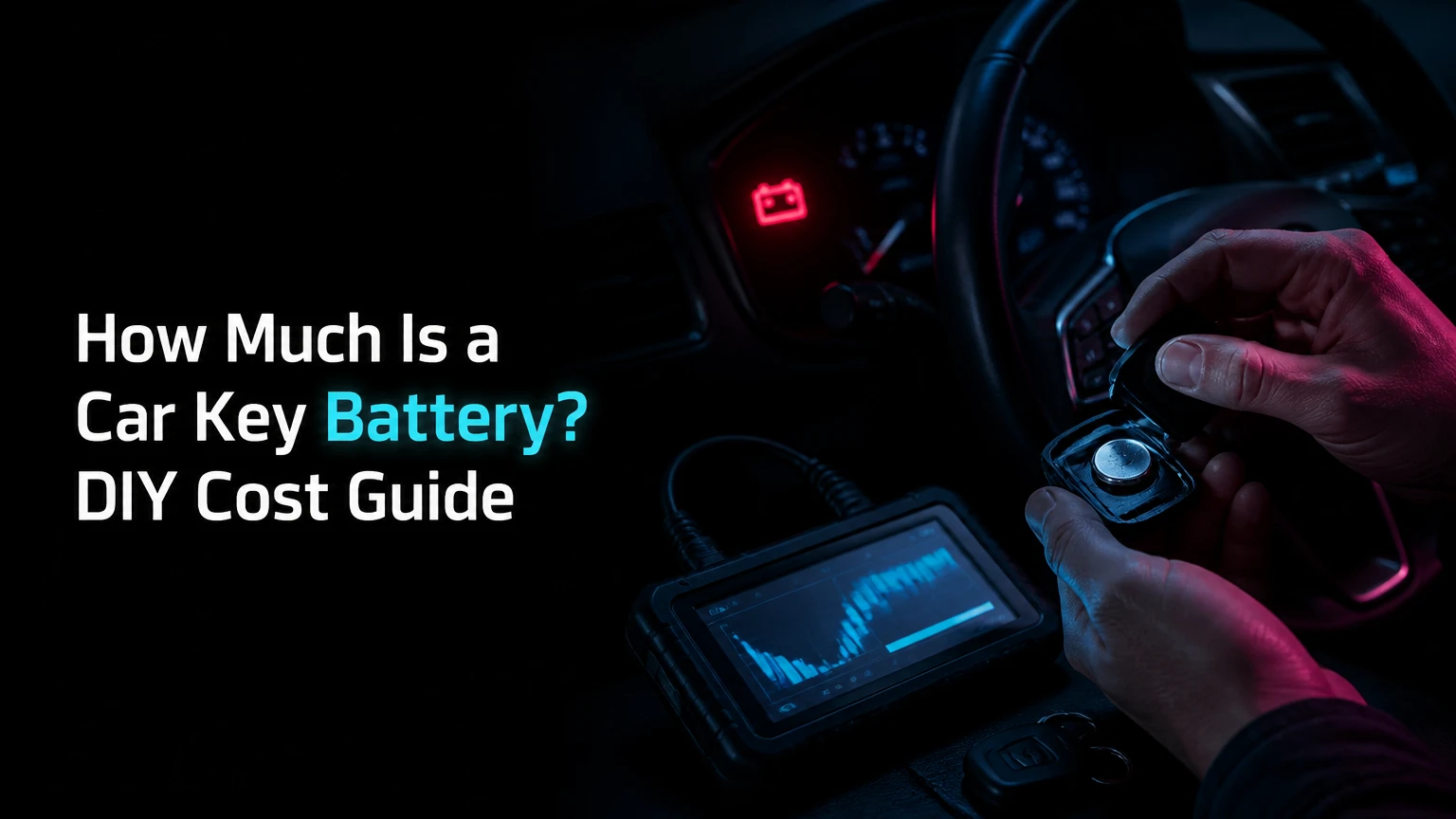
A car key battery usually costs $2-$10 for a replacement coin cell, while professional installation typically costs $25-$75 at an automotive locksmith or $50-$100 or more at a dealership. Most key-fob batteries are 3-volt lithium cells, and replacing one yourself generally takes 5-10 minutes if you install the correct size and polarity.
Key Facts at a Glance
- A standard car key-fob battery costs $2-$10, depending on brand, size, quantity, and retailer.
- Common battery numbers include CR2032, CR2025, CR1632, CR1620, and CR2450.
- The number identifies physical dimensions, so a battery with the wrong thickness may fit poorly even when its voltage matches.
- A locksmith usually charges $25-$75 for battery replacement, while dealership pricing commonly reaches $50-$100 or more.
- Most remote key fob batteries last 2-4 years; passive-entry smart keys often last 1-3 years, depending on design and usage.
- A battery replacement normally does not erase key programming, but some vehicles require a manufacturer-specific synchronization procedure.
How Much Is a Car Key Battery?
A car key battery costs about $2-$10 when purchased for DIY replacement, but the total price rises to $25-$75 with a locksmith and $50-$100 or more at many dealerships. The battery itself is inexpensive; labor, service fees, diagnosis, and convenience create most professional charges.
Prices vary by country, vehicle brand, retailer, and whether the key uses a standard replaceable coin cell. A supermarket or pharmacy may charge more for a single premium CR2032 than an online multipack, while an automotive locksmith may include installation in a small fixed fee. A mobile locksmith can add a call-out charge, particularly outside normal business hours.
| Replacement option | Typical total cost | Typical time | Best use case |
|---|---|---|---|
| DIY single cell | $2-$10 | 5-10 minutes | Standard replaceable fob |
| Auto-parts or battery retailer | $5-$20 | 5-15 minutes | Owner wants help opening the case |
| Automotive locksmith | $25-$75 | 5-20 minutes | Fragile, sealed, or difficult fob |
| Mobile locksmith | $40-$100 | 15-45 minutes | Dead key away from home |
| Dealership | $50-$100+ | 15-60 minutes | Warranty, inspection, or unusual key |
A dealer quote can be much higher if the service writer treats the visit as an electrical diagnostic appointment rather than a battery installation. Ask whether the quoted amount covers only the coin cell, or includes testing, programming, and labor.
What changes the price?
The battery code, brand, packaging quantity, fob construction, local labor rate, and service location determine the final price. A replaceable CR2032 in a two-piece plastic remote is a low-cost job, whereas a sealed smart key, damaged housing, or failed transmitter may require more than a battery.
A replacement battery is not the same service as a replacement key. Replacing an entire programmed key can cost $100-$600 or more, depending on the vehicle and key technology. Confirm the service before approving work.
What Is a Car Key Battery?
A car key battery is a small, non-rechargeable cell that powers a remote control or smart key. Most replaceable automotive fob batteries use lithium manganese dioxide chemistry and provide a nominal 3 volts to the key’s circuit board, radio transmitter, buttons, and sometimes proximity electronics.
The battery does not directly turn the engine on in most modern vehicles. Pressing a button activates the fob’s electronics, which send a coded radio-frequency signal to the vehicle. A passive-entry key may also communicate with the car while the key is near the vehicle, but the exact polling and sleep behavior differs by manufacturer.
CR coin cells have low self-discharge and can remain usable for years in storage. Capacity varies by size and manufacturer, commonly from roughly 70 mAh for smaller cells to more than 500 mAh for large CR2450 cells. Capacity is not a universal measure of lifespan because transmitter activity, temperature, battery quality, and the fob’s circuit design also affect consumption.
A key fob battery is usually not rechargeable. Do not place a standard CR2032, CR2025, or CR2450 in a charger.
Which Battery Fits Your Key Fob?
The correct battery is the exact code specified by the key fob, vehicle manual, or original cell. Common codes share a 3-volt rating, but their diameter and thickness differ, so voltage alone cannot determine compatibility.
The International Electrotechnical Commission naming convention provides a useful guide. In a code such as CR2032, C indicates lithium-based chemistry, R indicates a round cell, 20 indicates an approximately 20-millimeter diameter, and 32 indicates an approximately 3.2-millimeter height.
| Battery code | Diameter | Thickness | Typical capacity | Common application examples |
|---|---|---|---|---|
| CR2032 | 20 mm | 3.2 mm | About 210-240 mAh | Toyota, Honda, Ford, Subaru |
| CR2025 | 20 mm | 2.5 mm | About 150-170 mAh | Volkswagen, Mazda, Nissan |
| CR1632 | 16 mm | 3.2 mm | About 120-140 mAh | Toyota and Lexus smart keys |
| CR1620 | 16 mm | 2.0 mm | About 65-80 mAh | Some older Honda and European keys |
| CR2450 | 24 mm | 5.0 mm | About 500-620 mAh | Larger proximity remotes |
Vehicle examples are not universal. The same manufacturer can use different batteries across model years, trim levels, and key revisions.
Can a CR2025 replace a CR2032?
A CR2025 should not be treated as a direct replacement for a CR2032, even though both cells are approximately 20 millimeters wide and provide 3 volts. The CR2025 is 0.7 millimeters thinner, which can prevent reliable contact in a holder designed for the thicker cell.
A CR2032 forced into a holder designed for a CR2025 can put excessive pressure on clips, plastic retainers, or circuit-board solder joints. Use the specified code rather than stacking cells, bending contacts aggressively, or relying on a loose fit.
How do you verify the size?
Use the following order of evidence:
- Read the code printed on the old battery.
- Check the battery diagram in the owner’s manual.
- Inspect the fob housing for a molded battery marking.
- Compare the replacement cell with the original diameter and thickness.
- Ask a locksmith or parts retailer to verify the code if the old label is unreadable.
A VIN lookup may identify the vehicle, but it does not always identify the exact key revision. The original battery marking is often more reliable.
How Do You Replace the Battery?
Replacing a standard car key battery requires the correct coin cell, a small flat-head screwdriver or plastic pry tool, and approximately 5-10 minutes. The factor that most determines success is opening the fob at its intended seam without breaking retaining clips or separating the circuit board.
Before You Start
| Requirement | Typical specification |
|---|---|
| New battery | 1 exact replacement cell, such as CR2032 |
| Tools | 1 small flat-head screwdriver or plastic pry tool |
| Work surface | Dry, well-lit table |
| Time | 5-10 minutes |
| Difficulty | Easy for a replaceable two-piece fob |
| Safety | Keep loose coin cells away from children and pets |
Step 1: Remove the emergency key
Press or slide the release latch and pull out the mechanical emergency key if the fob has one. Removing the key often exposes the case seam or a small opening notch.
You will know this step worked when the emergency blade slides out without force and the fob halves remain closed. Do not pry randomly around the housing, because hidden clips can sit close to the release channel.
Step 2: Open the fob at the seam
Insert a plastic pry tool, coin edge, or small flat-head screwdriver into the designated notch. Twist gently rather than driving the tool deep into the case, then work around the seam until the halves separate.
The correct opening point usually leaves minimal marks. A common mistake is twisting one corner too far, which can crack the shell or deform the battery holder.
Step 3: Record the battery orientation
Look at the old cell before removing it and note whether the positive side, usually marked with a plus sign and printed text, faces upward or downward. Polarity is fob-specific, so do not assume the positive face always points up.
The checkpoint is a visible reference photograph or written note. This takes seconds and prevents the most common installation error.
Step 4: Remove the old cell
Release the coin cell from its retaining clip with a fingernail or plastic tool. If a metal tool is necessary, avoid bridging the top and bottom surfaces at the same time, because that can short the battery.
Do not bend the spring contacts. A flattened contact can cause intermittent operation even when the new battery has full voltage.
Step 5: Install the new cell
Slide the new battery under the fixed retaining edge, then press it into place with the same orientation as the original. Handle the cell by its edges when practical, and avoid scraping the printed surfaces against the circuit board.
You will know it worked when the cell sits flat, the holder retains it securely, and no contact tab is trapped underneath the battery.
Step 6: Close and test the key
Align the housing halves and press around the perimeter until every clip closes. Reinsert the emergency key, then test lock, unlock, trunk, panic, and passive-entry functions close to the vehicle.
Test each button separately. A working lock button does not prove that every switch or proximity function works.
DIY, Locksmith, or Dealership?
DIY replacement is the best value for an accessible fob, while a locksmith is the practical middle option for fragile housings or mobile emergencies. A dealership makes sense when the key has a sealed battery, an active warranty issue, or a separate programming fault.
| Decision factor | DIY | Locksmith | Dealership |
|---|---|---|---|
| Typical cost | $2-$10 | $25-$75 | $50-$100+ |
| Installation time | 5-10 minutes | 5-20 minutes | 15-60 minutes |
| Programming normally needed | No | No for battery-only work | No for battery-only work |
| Housing damage risk | Owner-dependent | Low | Low |
| Mobile availability | None | Often available | Rare |
| Best for | Replaceable cells | Difficult or damaged fobs | Warranty or diagnosis |
Who should choose DIY?
Choose DIY when the battery compartment has a clear seam, the original code is readable, and the fob is a common two-piece design. The total cost is usually below $10, and no remote-code reprogramming is normally required.
DIY is less suitable when the case is sealed, the battery is soldered to the board, or the key is the owner’s only method of entering and starting the vehicle.
When is a locksmith the better choice?
Choose an automotive locksmith when the shell is difficult to open, the battery contacts are damaged, or the vehicle is stranded away from home. A locksmith can also determine whether the failure involves the transmitter, immobilizer, or vehicle receiver rather than assuming the cell is responsible.
Mobile service can cost more than a shop visit because the call-out and travel are part of the price.
When is the dealership justified?
Choose the dealership when the key is covered by a service agreement, the battery is not user-replaceable, or the vehicle reports a communication fault after installation. Dealership staff can access manufacturer procedures, but a battery-only visit may cost disproportionately more than the part.
Ask for a battery-only price before authorizing diagnostic labor.
How Long Should the Battery Last?
A standard button-operated remote typically lasts 2-4 years, while a passive-entry smart key commonly lasts 1-3 years. Actual life depends on daily button presses, proximity-key polling, temperature, storage conditions, and whether the vehicle repeatedly searches for the key.
A smart key stored directly beside the vehicle can drain sooner if the vehicle continually detects its presence. Keeping the fob several feet away from the parked vehicle reduces unnecessary communication on some systems, although manufacturer designs differ.
| Usage condition | Typical service life | Main cause |
|---|---|---|
| Infrequent button remote | 3-5 years | Low transmission activity |
| Daily conventional remote | 2-4 years | Repeated lock and unlock signals |
| Daily passive-entry key | 1-3 years | Proximity communication |
| Key stored beside vehicle | Under 1-2 years possible | Repeated wake events |
| Extreme cold exposure | Shorter temporarily | Reduced available voltage |
Lithium coin cells can show lower output in freezing conditions without being permanently empty. Letting the fob return to room temperature can restore some performance, but a battery that repeatedly loses range should be replaced.
What Are the Warning Signs?
The first signs of a failing key-fob battery are reduced operating range, inconsistent button response, and a vehicle message such as “Key Battery Low.” A key may still unlock the car while already showing enough voltage loss to fail soon in cold weather.
Typical symptoms include:
- The remote works only within a few feet.
- One press produces no response, but repeated presses work.
- The vehicle recognizes the key intermittently.
- Passive unlocking becomes unreliable.
- The dashboard displays a low-key-battery warning.
- The fob LED becomes dim or stops flashing.
A weak signal does not prove the battery is defective. Radio interference, a damaged antenna, a stuck button, water intrusion, and a low vehicle battery can create similar symptoms.
Can a Dead Key Fob Start the Car?
Many push-button-start vehicles can start with a dead key-fob battery, but the backup location varies by manufacturer. The emergency procedure may require holding the fob against the START button, placing it in a marked console slot, or positioning it near a designated receiver.
A mechanical emergency key can usually unlock the driver’s door, but it does not by itself replace the electronic immobilizer authorization. Check the owner’s manual before the battery fails, and keep the manual procedure available in the vehicle or manufacturer app.
Do not assume every keyless vehicle uses the same backup position. Toyota, Ford, BMW, Hyundai, and other manufacturers place the passive transponder antenna in different locations.
Why Does the Key Still Not Work After Replacement?
A key that remains inoperative after a new battery usually has a polarity, contact, housing, synchronization, switch, or transmitter problem rather than a simple battery problem. Recheck the cell code and orientation first, then isolate the fob from the vehicle.
Use this diagnostic sequence:
- Confirm polarity: Match the original orientation, not a generic online diagram.
- Check contact pressure: Ensure the spring clips touch the battery firmly.
- Inspect the cell: Look for damaged edges, an expired date, or a protective film.
- Test close to the car: Stand within a few feet to separate range failure from total failure.
- Check every button: A failed switch can affect one function only.
- Try the spare key: If the spare works, the vehicle receiver is less likely to be the problem.
- Check the vehicle battery: Low vehicle voltage can disrupt keyless-entry behavior.
- Review synchronization instructions: Some models require a manual resynchronization sequence.
Battery replacement normally does not erase key programming because the code is stored in non-volatile memory. A synchronization procedure may still be required on particular models if the fob remains without power or loses rolling-code alignment. Follow the owner’s manual rather than applying a sequence from a different model year.
If corrosion is visible, disconnect or remove the battery where practical and clean contacts with a small amount of high-concentration isopropyl alcohol. Allow the board to dry completely. Do not flood the circuit board or scrape away plated contact surfaces.
Can You Substitute Another Coin Cell?
Use the exact battery type specified for the fob. A different 3-volt coin cell is not automatically safe because diameter, thickness, current capability, holder pressure, and terminal arrangement can differ.
A CR2025 may work temporarily in a CR2032 holder only when the holder maintains reliable pressure, but that is not a dependable repair. Stacking two cells is unsafe because it produces approximately 6 volts and can damage the fob electronics.
Do not substitute:
- Rechargeable LIR2032 cells for a CR2032 without manufacturer approval.
- Alkaline button cells with different voltage characteristics.
- Two thinner cells to imitate one thicker cell.
- Unmarked cells with no chemistry, voltage, or date information.
The lowest-cost correct battery is safer than an improvised substitute.
Where Should You Buy the Battery?
Buy a branded, correctly sized lithium coin cell from a retailer with reasonable stock turnover. Pharmacies, supermarkets, auto-parts stores, battery specialists, electronics suppliers, and reputable online sellers can all be suitable sources.
| Source | Typical price for one cell | Availability | Buying advantage |
|---|---|---|---|
| Pharmacy or supermarket | $4-$10 | Same day | Convenient emergency purchase |
| Auto-parts store | $3-$8 | Same day | Staff may verify fit |
| Battery specialist | $3-$10 | Same day | Broad size selection |
| Reputable online seller | $1-$4 per cell in packs | 1-5 days | Lowest unit price |
| Dealership parts counter | $5-$15 | Same day or order | Vehicle-specific assistance |
Check the expiration or best-before date and avoid loose cells with damaged packaging. A multipack is economical only when the cells will be used before their storage life becomes a concern.
How should old coin cells be handled safely?
Tape over the terminals of used coin cells and take them to a battery-recycling collection point where available. Do not place loose lithium coin cells in a pocket, drawer with metal objects, or household recycling bin unless local guidance specifically permits them.
Coin cells are a serious ingestion hazard for children and pets. Store new and used batteries in a closed container, never leave a removed cell on a workbench, and seek immediate medical help if ingestion is suspected.
Practical Rules That Prevent Repeat Failures
Rule 1: Photograph the open fob. A clear image records polarity, rubber-button placement, clips, and the correct position of the circuit board before anything moves.
Rule 2: Replace the battery before range disappears completely. A fob that works only beside the door can fail during cold weather or after a few additional transmissions, leaving the owner dependent on an emergency procedure.
Rule 3: Do not measure a coin cell by appearance alone. CR2025 and CR2032 cells look nearly identical from above, yet their 0.7-millimeter thickness difference can determine whether the key works intermittently.
Rule 4: Protect the only working key. If the vehicle has a single fob, verify the replacement immediately and do not discard the old battery until every function passes its test.
Rule 5: Separate battery work from key programming. A new cell restores power; it does not create a new key, add an immobilizer credential, repair a damaged transmitter, or solve a vehicle receiver fault.
Frequently Asked Questions
Does an OEM key-fob battery last longer?
An OEM-branded battery is not automatically longer-lasting than a reputable Panasonic, Energizer, or Duracell equivalent with the same chemistry and size. Manufacturing date, storage conditions, and genuine packaging often matter more than the logo on the cell. Match the specified code and buy from a reliable seller.
Will an auto-parts store install a key battery?
Some auto-parts, battery, and electronics retailers will install a readily accessible coin cell, sometimes at no labor charge when the battery is purchased there. Policies vary, and staff may decline sealed housings or keys that could be damaged during opening. Call first if the fob is your only key.
Does changing a car key battery require reprogramming?
Changing a replaceable coin cell usually does not require reprogramming because the key’s stored authorization remains in non-volatile memory. Certain vehicles may require synchronization after power loss, so consult the owner’s manual if buttons remain inactive after correct installation.
Can a key-fob battery drain while the car is parked?
A passive-entry key can drain faster when stored close to the vehicle because proximity systems may wake the fob repeatedly. The exact behavior depends on the vehicle and key design. Store the key away from the parked car, but do not place it in a metal container unless the manufacturer permits that practice.
Is a key battery warning urgent?
A key-battery warning is usually a prompt to replace the cell soon rather than an immediate vehicle failure. The remote may continue working for days or weeks, but cold temperatures and increased distance can expose the reduced reserve. Replace it before a long trip or when the spare key is unavailable.
How do I know whether the fob or car is defective?
Test the spare key, install a verified cell, and operate the fob close to the vehicle. If both keys fail, inspect the vehicle battery, receiver, and relevant fuses; if only one key fails, the fob’s contacts, switches, transmitter, or circuit board are more likely responsible. A locksmith can test the radio signal before dealer diagnosis.
The Bottom Line
A car key battery normally costs $2-$10, and most owners can replace the cell in 5-10 minutes without reprogramming the key. Verify the exact battery code, match polarity, avoid forcing the housing, and test every function afterward. Paying $25-$75 to a locksmith is reasonable for a difficult or stranded-key situation, while a dealership is mainly justified for sealed batteries, warranty work, or a fault that remains after correct replacement.