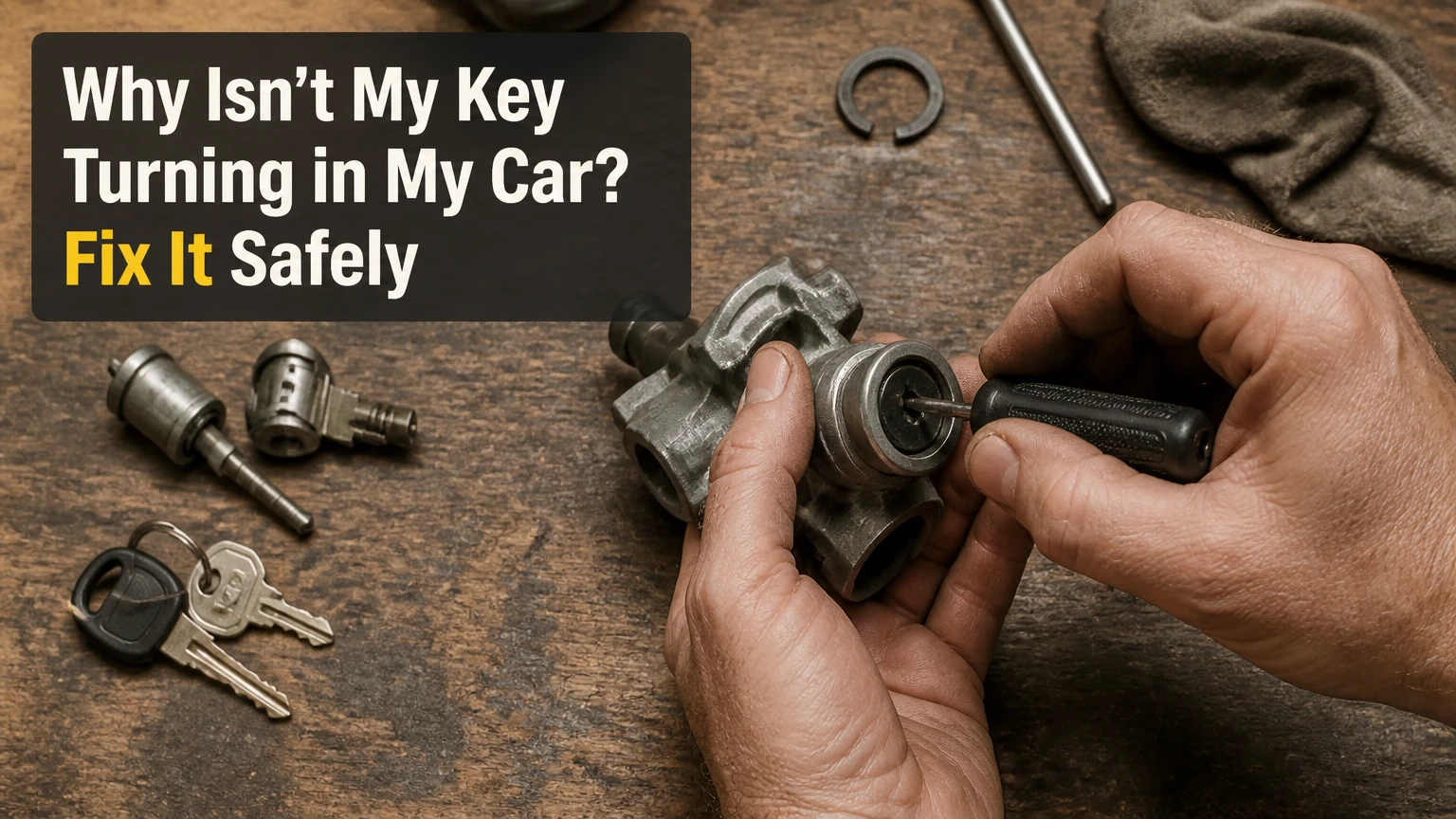
A car key usually will not turn because the steering-column lock is under tension, the key is worn or damaged, the automatic-transmission interlock is not recognizing Park, or the ignition lock cylinder is failing. On newer vehicles, a weak battery, immobilizer fault, or electronic steering-lock problem can create similar symptoms.
Key Facts at a Glance
- A steering wheel locked against its stop is the fastest and most common cause of a key that will not rotate.
- Holding the wheel toward the side with pressure while gently turning the key often releases a mechanical steering lock.
- If a spare key works, replace the worn primary key rather than replacing the ignition cylinder first.
- A transponder key normally authorizes the engine electronically, but it does not usually prevent a mechanically aligned key from rotating.
- Forcing a stuck key with pliers can bend or break the blade inside the ignition cylinder.
- Typical US repair costs range from about $50-$150 for a correctly cut key to $600-$1,500 for some electronic steering-lock repairs.
What Does the Ignition Lock Cylinder Do?
The ignition lock cylinder is the keyed mechanical assembly that accepts the blade, verifies its cuts, and allows the ignition switch to move through accessory, on, and start positions. The cylinder is separate from the electrical ignition switch on many vehicles, although both parts operate together.
Traditional cylinders use spring-loaded wafers or pins. Correct key cuts lift those pieces into alignment at a shear line, allowing the plug inside the cylinder to rotate. Dirt, worn key cuts, bent wafers, or a damaged plug can prevent that alignment.
A key that does not turn is therefore different from a key that turns but produces no electrical response. In the first case, the mechanical lock may not be releasing. In the second, the electrical switch, starter circuit, battery, or immobilizer may be at fault.
| Key symptom | Most likely area | First useful test | Typical result |
|---|---|---|---|
| Key will not rotate at all | Steering lock or key-cylinder wafers | Move wheel while applying light key pressure | Key may release immediately |
| Key turns only after jiggling | Worn key or cylinder | Test a factory-cut spare | Spare often turns more smoothly |
| Key turns to “on,” but starter is silent | Battery, neutral safety switch, starter circuit | Check dash brightness and gear position | Cylinder may be functional |
| Key turns, then springs back from “start” | Ignition switch or return spring | Observe key movement and dash power | Electrical switch may be worn |
| Key is hard to insert or remove | Debris, damaged keyway, cylinder wear | Compare blade and keyway visually | Lubrication may not solve damage |
| Security light flashes while key is inserted | Transponder or immobilizer system | Try a programmed spare key | Programming or antenna diagnosis needed |
Why Is the Steering Wheel Preventing the Key From Turning?
A mechanical steering-column lock can bind the ignition cylinder when the front wheels rest against the lock in a turned position. The condition often occurs after parking with the steering wheel turned sharply, especially beside a curb or on a slope.
The key may insert normally but refuse to move beyond the locked position. The wheel usually moves a few millimeters in one direction and feels completely rigid in the other. That rigid side is where the lock is loaded.
How do you release a locked steering wheel?
- Insert the correct key fully without forcing it.
- Turn the steering wheel gently left and right to identify the tighter direction.
- Hold the wheel firmly toward the tight side.
- Apply light, steady turning pressure to the key.
- Release both controls once the cylinder reaches accessory or on.
Do not use a steering-wheel-spoke as a lever, and do not twist the key harder to compensate for wheel resistance. The objective is to unload the locking pin, not overpower it.
You will know the procedure worked when the wheel moves normally and the key rotates without scraping, crunching, or repeated jiggling. If the wheel remains locked and the key does not move after several controlled attempts, the cylinder, lock pin, or electronic steering-lock module may be defective.
Could the Key Itself Be the Problem?
A worn, bent, or inaccurately copied key can fail to align the wafers even when the ignition cylinder is healthy. The most valuable diagnostic is a known-good spare key, especially one cut from the vehicle identification number, or VIN, rather than duplicated from a heavily used blade.
Remove the key and inspect its edge under bright light. Look for rounded peaks, uneven shoulders, a slight bend, deep scratches, or a blade that differs from the spare. A key that has worked intermittently for weeks often points to progressive wear rather than a sudden electrical fault.
A new copy made from a worn key can reproduce the same error. A locksmith or dealer can cut a key from the vehicle’s factory code, but availability and programming requirements vary by make, model, and year.
| Key condition | Rotation behavior | Recommended action | Typical cost |
|---|---|---|---|
| Factory spare turns normally | Primary key is worn | Retire worn key and copy spare | $10-$40 for a basic duplicate |
| Both keys resist rotation | Cylinder or steering lock likely | Diagnose lock assembly | $100-$400 typical mechanical repair |
| Blade visibly bent | Insertion may damage wafers | Stop using it and replace key | $50-$150 for many VIN-cut keys |
| New key inserts but will not start engine | Mechanical cut may be correct, chip may not be programmed | Program transponder | $50-$250 typical, vehicle-dependent |
| Key broke inside cylinder | Remaining blade obstructs wafers | Use an automotive locksmith | $75-$200 extraction, before further damage |
Does a new key need programming?
A metal key may need no programming to rotate the cylinder, while a transponder-equipped key may require programming before the engine will run. These are separate functions: the blade operates the mechanical lock, and the chip communicates with the immobilizer.
Some vehicles permit owner programming when two valid keys are already available. Others require manufacturer software, a security-code procedure, or an automotive locksmith’s programming equipment. The owner’s manual is the correct source for the vehicle-specific rule.
Is the Gear Selector Fully in Park?
An automatic vehicle may block key removal or starting when the transmission range sensor, shift cable, or park interlock does not confirm Park. The key may turn partially, remain stuck, or fail to rotate at all, depending on the vehicle design.
Press the brake pedal, move the selector firmly into Park, and try the key again. If the vehicle is on an incline, parking forces can load the drivetrain and make the selector difficult to seat. Keep the brake applied and try Neutral only if the owner’s manual permits starting in Neutral.
What does the brake-light test reveal?
Turn the ignition to the position available and press the brake pedal. If the brake lights do not illuminate, a failed brake-light switch, fuse, discharged battery, or wiring fault may prevent the shift interlock from releasing. This test does not prove the ignition cylinder is good, but it identifies an important control-system problem.
Do not crawl under a vehicle or bypass a shift interlock beside traffic. If the selector will not move, use the manufacturer’s emergency release procedure or request roadside assistance.
| Situation | Likely interlock issue | Safe check | Escalation point |
|---|---|---|---|
| Selector is not fully in Park | Shift cable or parking pawl load | Push selector into Park with brake held | Selector still not recognized |
| Vehicle parked on steep incline | Drivetrain tension | Apply parking brake before selecting Park next time | Vehicle cannot shift safely |
| Brake lights remain off | Brake switch, fuse, or battery | Check lamps and fuse | No brake-light function |
| Key stuck after shifting | Park-position signal absent | Cycle Park to Neutral to Park | Key remains trapped |
| Manual transmission vehicle | Clutch or ignition interlock | Depress clutch fully | Key still will not rotate |
Can a Weak Battery Stop the Key From Turning?
A weak battery can prevent an electronic shifter lock, electronic steering lock, or body-control module from releasing, but battery failure does not physically misalign ordinary mechanical wafers. The distinction matters because jump-starting will not repair a worn key or seized cylinder.
Switch on the headlights or dome light. Completely dead lights indicate a disconnected battery, discharged battery, blown main fuse, or poor terminal connection. Dim lights suggest low voltage, although a visual test cannot replace a meter reading.
A fully charged 12-volt battery typically measures about 12.6 volts at rest, while approximately 12.2 volts indicates a substantially discharged battery. During engine cranking, voltage commonly should remain above roughly 9.6 volts at about 70°F, though vehicle and battery specifications differ.
Clean, tight battery terminals and a proper jump-start may restore an electronic interlock. Do not repeatedly jump a vehicle with a suspected short circuit, damaged battery, or burning odor. If power returns but the key still will not rotate, continue mechanical diagnosis.
What If the Ignition Cylinder Is Worn or Dirty?
A failing ignition lock cylinder often begins with intermittent sticking, a key that turns only when lifted or pulled slightly, or a requirement to jiggle the blade. Internal wafers wear from repeated key cycles, while dust and metal particles increase friction inside the keyway.
A small amount of dry graphite or a manufacturer-approved lock lubricant may help a lightly contaminated cylinder. Some automotive locksmiths use a specific dry PTFE product. Product compatibility matters because excessive liquid lubricant can collect debris, and household oils can gum the mechanism.
Use only a small amount, then insert and remove the key several times without forcing rotation. Avoid spraying large quantities into the steering column, and avoid treating electrical connectors as though they were the mechanical keyway.
Is tapping the key a safe repair?
Light vibration can temporarily free a sticking wafer, but tapping is an emergency diagnostic, not a cylinder repair. If used at all, insert the key fully, apply gentle turning pressure, and tap the key head lightly with a plastic handle or similarly non-damaging tool.
Never strike the blade sideways, use a metal hammer, or combine tapping with pliers. Stop immediately if the key bends, the cylinder grinds, or the key becomes harder to remove. A temporary release can allow a locksmith to service the vehicle before the cylinder fails in a more inconvenient location.
Could the Immobilizer Be Blocking Rotation?
An immobilizer usually prevents fuel delivery, ignition authorization, or engine operation after the key turns; it does not commonly stop a conventional mechanical cylinder from rotating. Some newer vehicles combine an immobilizer with an electronic steering lock, so a control-module or antenna fault can prevent release on particular models.
The security indicator provides a useful clue. A rapidly flashing security light, a key-shaped warning, or a message such as “No key detected” points toward recognition or programming, especially when a second programmed key behaves differently.
Keep other transponder keys, wireless access cards, and strong aftermarket electronics away from the ignition area during testing. Replace a weak remote battery only when the vehicle design uses that battery for authorization; many immobilizer transponders operate independently of the remote battery.
| Immobilizer clue | Mechanical key behavior | Probable direction | Appropriate service |
|---|---|---|---|
| Security lamp normal, spare key turns | Cylinder releases with spare | Worn primary key | Cut replacement key |
| Security lamp flashes rapidly | Key may turn normally | Transponder recognition fault | Locksmith or dealer programming |
| “No key detected” message | Push-button vehicle may remain inactive | Key-fob battery, antenna, module | Follow manual emergency-start method |
| Steering wheel remains locked | No rotation permitted | Electronic steering lock possible | Brand-capable locksmith or dealer |
| Both programmed keys fail | Same symptom with multiple keys | Antenna, module, or power fault | Diagnostic scan and electrical testing |
What Should You Do First?
Use the following sequence because it starts with reversible causes and avoids damaging the key or cylinder:
- Unload the steering lock. Hold the wheel toward the tight side while applying light key pressure.
- Confirm the gear position. Select Park firmly, then try Neutral with the brake held if the manual allows it.
- Test electrical power. Check headlights, dome lights, battery terminals, and relevant dashboard warnings.
- Try the spare key. Compare its blade with the primary key and do not copy a visibly worn key.
- Inspect the keyway. Look for debris, a broken fragment, or a key that is not fully inserted.
- Apply compatible dry lubricant sparingly. Use the product specified for automotive lock cylinders.
- Stop before force is required. Arrange a locksmith or repair facility if the key still will not rotate.
This procedure normally takes 5-15 minutes and costs nothing unless a replacement key or battery is required. The strongest diagnostic result is not lubricant or tapping; it is a spare key that changes the symptom.
How Do You Distinguish a Key Fault From a Cylinder Fault?
A key fault follows the key, while a cylinder fault affects every correctly cut key. That simple comparison is more reliable than guessing from the vehicle’s age or the amount of force needed.
If the spare turns smoothly, the primary blade is worn, bent, or incorrectly cut. If both keys stick at the same rotational position, the cylinder wafers, plug, steering-lock pin, or related housing deserves inspection.
| Test result | Most likely diagnosis | Why it matters | Next action |
|---|---|---|---|
| Spare works immediately | Worn or damaged primary key | Cylinder can align correctly | Replace key |
| Key works after wheel movement | Steering-column tension | Mechanical lock is loaded | Adjust parking position |
| Both keys stick in all wheel positions | Cylinder wear or contamination | Key cuts are not the only variable | Locksmith inspection |
| Key turns but no dash power | Electrical switch or battery | Mechanical rotation exists | Electrical diagnosis |
| Key turns and dash powers, no crank | Starter, range switch, or battery | Cylinder has completed its job | Starting-circuit test |
One practitioner rule is especially useful: if changing the angle of the key changes the result, suspect wear in the key-cylinder interface; if changing the steering-wheel load changes the result, suspect the steering lock.
Which Repair Option Is Best?
A mobile automotive locksmith is usually the best first choice for a stranded vehicle with a mechanical key or ignition-cylinder problem. A dealership becomes the safer choice when the vehicle has a proprietary electronic steering lock, a security-module fault, or a programming requirement that local equipment cannot support.
| Repair option | Typical US cost | Typical time | Best fit | Main limitation |
|---|---|---|---|---|
| VIN-cut mechanical key | $50-$150 | 30-60 minutes | Worn or lost key | May require separate chip programming |
| Mobile automotive locksmith | $100-$400 | 1-3 hours | Stranded car, key or cylinder fault | Equipment varies by technician |
| Ignition-cylinder repair or rekey | $100-$250 | 1-2 hours | Worn wafers with matching keys desired | Not possible for every cylinder |
| Ignition-cylinder replacement | $150-$500 | 1-3 hours | Damaged or seized mechanical lock | New key may not match doors |
| Dealership key and programming | $150-$500 | 1-4 hours | OEM key, secure programming | Vehicle usually needs transport |
| Electronic steering-lock replacement | $600-$1,500 | 1-2 days | Confirmed ESL or module failure | Model-specific diagnostics required |
Prices are typical US consumer ranges, not a quote. Labor rates, vehicle security systems, parts availability, keyless-entry architecture, and whether the cylinder is already in a serviceable position can change the total substantially.
A locksmith can often rekey a replacement cylinder so one key operates the doors and ignition. An aftermarket cylinder may cost less but create separate door and ignition keys, and some vehicles require immobilizer synchronization after mechanical replacement.
What Mistakes Make the Problem Worse?
Force is the most expensive shortcut. The key blade is generally softer than the internal lock components, so pliers can twist the blade while leaving the underlying fault untouched.
Avoid these failure-producing actions:
- Do not use pliers to turn a resistant key.
- Do not drive with a key that requires increasing force or repeated jiggling.
- Do not copy a worn key onto another blank.
- Do not flood the keyway with oil, cooking oil, or general-purpose penetrant.
- Do not disassemble the steering column without the service procedure and airbag precautions.
- Do not bypass a neutral-safety or steering-lock interlock as a starting method.
- Do not keep a heavy bundle of tools and keys hanging from the ignition.
A heavy keychain is a contributor, not proof of cylinder failure. Its repeated downward movement can accelerate wear in some ignition assemblies, but a sudden no-turn condition still requires checking steering-lock load, the key, battery power, and the gear-position signal.
What If the Key Is Stuck in the Ignition?
A key stuck in the ignition usually indicates that the cylinder has not reached the lock position, the transmission is not reporting Park, or the steering-lock mechanism is under load. Keep the vehicle stationary, apply the parking brake, and avoid pulling the key with force.
Select Park firmly, move the steering wheel slightly, and try withdrawing the key with straight, gentle pressure. If the battery is dead, some vehicles need a manual shift-lock or key-release procedure described in the owner’s manual.
Do not lubricate a key that is already trapped unless the product instructions and access are clear. If the blade begins to bend, stop. A locksmith can extract a key before it breaks and can determine whether the cylinder or interlock caused the retention.
What If the Key Turns but the Car Does Not Start?
A key that turns normally has already passed the basic mechanical cylinder test, so the no-start diagnosis shifts to battery power, starter control, fuel, ignition, range sensing, or immobilizer authorization. The dashboard response separates several of these possibilities.
No dash lights suggests a battery or main-power fault. Normal lights with a single click suggest battery voltage, cable, starter, or relay issues. A rapidly flashing security lamp suggests immobilizer authorization, while a crank-no-start condition points toward fuel, spark, sensor, or engine-management systems.
Do not replace the ignition cylinder simply because the engine does not start. A technician should first identify whether the starter motor receives a command and whether the vehicle records an immobilizer or range-sensor code.
Does Cold Weather Cause a Car Key Not to Turn?
Cold weather can expose an existing keyway, wafer, or steering-lock problem, and frozen moisture can obstruct a cylinder in some climates. Cold also reduces battery output, which matters more on vehicles with electronic steering or shift interlocks.
Warm the key and lock area gradually with a vehicle-safe lock de-icer or dry heat from the cabin. Never pour boiling water into the cylinder, because refreezing can worsen the obstruction and water can damage nearby electrical components.
If the symptom appears only below freezing and disappears after warming, moisture or battery condition deserves attention. If it occurs in all temperatures, mechanical wear is more likely.
When Should You Call for Help?
Call an automotive locksmith when the spare key fails, the key is bent or broken, the cylinder grinds, or the vehicle is stranded in a parking lot. Request a dealer or brand-capable locksmith when an electronic steering lock, immobilizer module, or proprietary key-learning procedure is suspected.
Tow the vehicle rather than repeatedly attempting the key when:
- The key blade is visibly twisting.
- The ignition housing is loose or damaged.
- The steering lock remains engaged after battery power is restored.
- The vehicle is parked in a dangerous traffic position.
- The key broke inside the cylinder.
- The owner’s manual warns against manual interlock release.
Before authorizing work, ask whether the quoted price includes extraction, a replacement key, transponder programming, cylinder rekeying, towing, and taxes. Those items can turn a low advertised repair price into a much larger invoice.
Frequently Asked Questions
Can I start my car without turning the key?
No safe universal method exists for bypassing a key-operated ignition, steering lock, or immobilizer. A vehicle may have a manufacturer-approved emergency procedure, but connecting wires or defeating an interlock can damage security modules and create a theft or fire risk. Use the owner’s manual, roadside assistance, or an automotive locksmith.
Why does my key turn only when I wiggle it?
A key that turns only while wiggled usually indicates worn key cuts, worn wafers, contamination, or excess clearance inside the ignition cylinder. Test a spare key first. If the spare behaves the same way, replace or repair the cylinder before the key jams completely.
Can a dead key-fob battery stop a metal key from turning?
Usually no. A conventional metal blade operates the mechanical cylinder, while a transponder may authorize the engine separately. A dead remote battery can prevent remote locking and, on some keyless vehicles, passive detection, but it does not normally change the physical cuts of a key.
How long does an ignition-cylinder replacement take?
A straightforward mechanical ignition-cylinder replacement commonly takes 1-3 hours, including removal, installation, and key matching. Electronic steering-lock or security-module repairs can take one to two days when programming, calibration, parts sourcing, or dealer-level diagnostics is required.
Is graphite lubricant safe for every car ignition?
Graphite is suitable for some traditional mechanical lock cylinders, but it is not automatically appropriate for every ignition assembly. Follow the vehicle or lubricant manufacturer’s guidance, use a very small quantity, and avoid contaminating nearby electrical switches. A locksmith can recommend dry PTFE or another compatible product when graphite is unsuitable.
Should I replace the key or the ignition cylinder?
Replace the key first when a spare key turns normally or the primary blade is visibly worn. Suspect the ignition cylinder when multiple correctly cut keys stick, the key requires progressively more manipulation, or the cylinder feels rough even with steering pressure removed. Testing both keys prevents unnecessary parts replacement.
The Bottom Line
The fastest answer to “why isn’t my key turning in my car” is usually steering-wheel tension, a worn key, or a failing ignition lock cylinder, with Park interlock and electronic security faults requiring separate checks. Hold the wheel toward its tight side, confirm Park, test a spare key, inspect battery power, and stop before force damages the blade.
If both keys fail after those checks, arrange an automotive locksmith or qualified dealer diagnosis. A typical key replacement costs far less than a broken-key extraction or electronic steering-lock repair, so early intervention is the safer and cheaper decision.