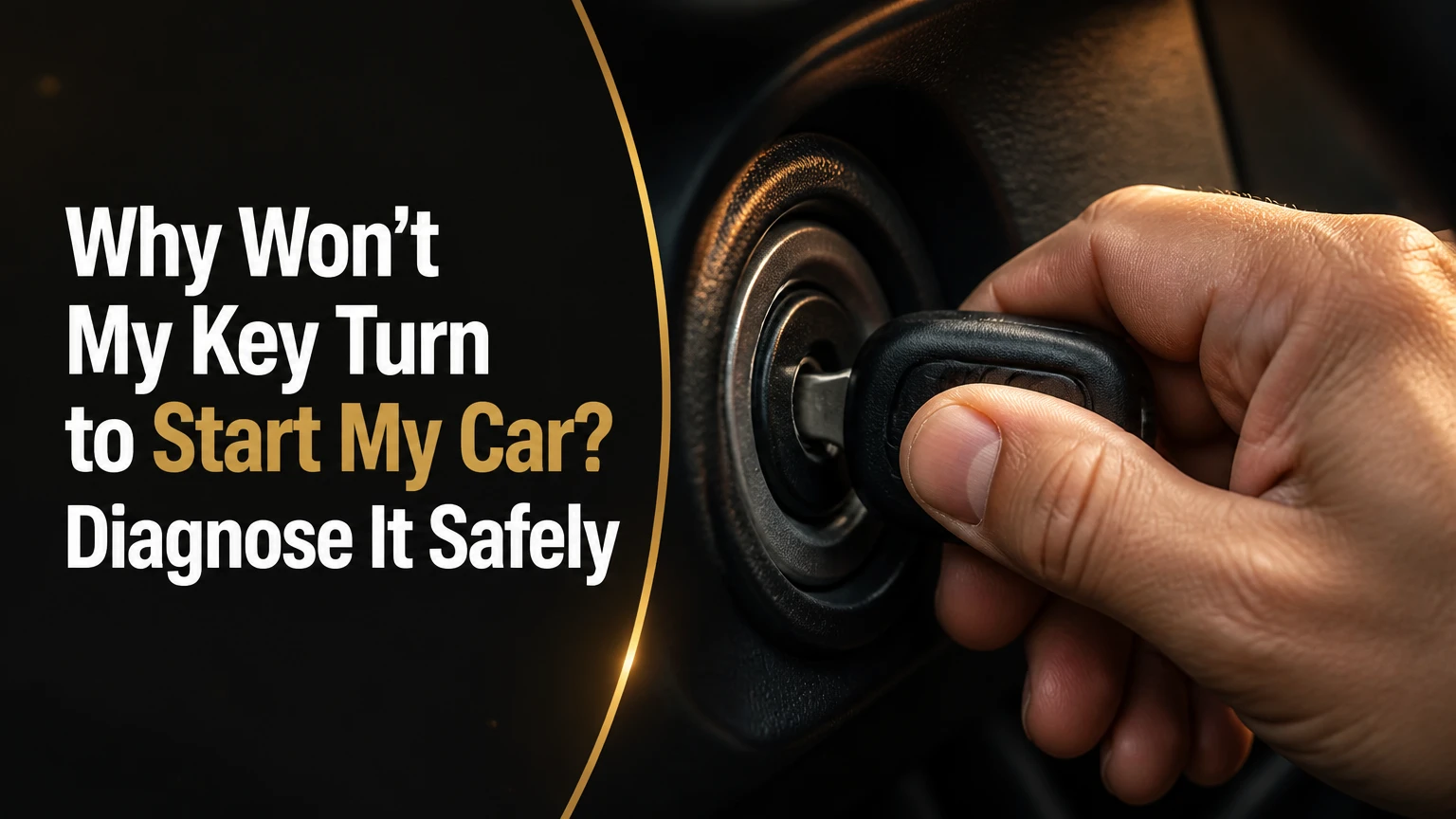
Your car key may not turn because the steering lock is binding, the transmission interlock is not releasing, the key or ignition lock cylinder is worn, or an electronic security system is not recognizing the key. Test the steering wheel, shifter, spare key, and battery in that order, without forcing the blade.
Key Facts
A steering-wheel bind is the fastest and most common no-parts check for a key that will not rotate.
A worn key blade can fail even when a spare key still works normally.
A transponder problem usually allows the key to turn but prevents the engine from running.
A dead vehicle battery affects electronic steering locks and smart-key systems, but not every conventional ignition cylinder.
Typical mobile automotive locksmith prices range from $150-$350, while dealer repairs often cost $400-$900 or more.
Pliers, excessive torque, and the wrong lubricant can turn a simple lock problem into a broken-key extraction or cylinder replacement.
Why Won’t My Key Turn to Start My Car?
A key that does not move at all usually has a mechanical problem, while a key that turns normally but produces no crank may have an electrical, starter, or immobilizer problem. The distinction matters because changing the battery will not repair a seized lock cylinder, and replacing the cylinder will not repair a failed park switch.
The ignition lock cylinder contains wafers or pins that match the cut pattern of the key. When the cuts align those internal parts at the shear line, the cylinder can rotate and operate the ignition switch. The steering-column lock and transmission interlock can also prevent rotation, even when the key itself is correctly cut.
Modern vehicles add an antenna, transponder, electronic steering lock, or push-button authorization system. Those systems change the symptoms, so identify whether the vehicle uses a traditional blade, a transponder blade, a slot-in fob, or a proximity fob before selecting a repair.
What does the ignition lock cylinder do?
The ignition lock cylinder accepts and mechanically validates the key, then transfers rotation to the electrical ignition switch. The cylinder is the part you insert the blade into; the ignition switch behind it controls accessory, run, and starter circuits. They can fail separately.
A cylinder failure commonly produces a key that sticks, turns only partway, or will not rotate in any position. An ignition-switch failure commonly allows normal key rotation but causes missing accessory power, no crank, intermittent starting, or electrical functions that cut out when the key is moved.
What should each key position do?
The ACC position powers selected accessories, ON or RUN powers the vehicle control modules and warning lamps, and START sends a temporary signal to the starter circuit. The exact labels vary by vehicle, but the sequence is broadly similar.
| Key position | Expected vehicle response | Likely fault if absent |
|---|---|---|
| LOCK/OFF | Key inserts and removes; engine and accessories remain off | Cylinder, key, or removal interlock |
| ACC | Radio or selected accessories receive power | Ignition switch or battery circuit |
| ON/RUN | Warning lamps illuminate; fuel and control modules wake | Ignition switch, battery, fuse, or immobilizer |
| START | Starter engages while key is held | Park switch, clutch switch, relay, starter, or switch |
A key that cannot reach ACC points toward mechanical resistance. A key that reaches RUN but does not crank requires a different diagnostic path.
What Type of Key and Ignition Does the Car Have?
Traditional blades, transponder keys, slot-in fobs, and push-button systems use different failure points. A transponder mismatch generally affects authorization after mechanical rotation, whereas an electronic steering-lock fault can prevent any rotation or starting command.
| System type | Mechanical blade | Electronic authorization | Typical no-start clue |
|---|---|---|---|
| Conventional key | Yes | None or minimal | Key physically will not rotate |
| Transponder key | Yes | Chip and antenna ring | Key turns; security lamp remains active |
| Slot-in smart fob | Sometimes | Fob, slot, steering-lock module | Fob is not released or cylinder stays locked |
| Push-button smart key | No ignition blade in normal use | Proximity fob and brake/clutch input | No start message or key-not-detected warning |
A vehicle built before widespread transponder adoption may have a purely mechanical fault, but model year alone is not conclusive. Check the owner’s manual for terms such as immobilizer, electronic steering lock, keyless access, or smart entry.
A spare key is especially useful because it tests the blade and the security system at the same time. If both keys produce identical mechanical symptoms, the vehicle-side cylinder or interlock becomes more likely.
How Can You Troubleshoot the Key Without Damaging It?
Perform the checks below in sequence. The complete process usually takes 5-15 minutes and costs nothing unless the battery needs charging or the cylinder requires service. The factor that most determines success is whether the key is mechanically stuck or turns freely but fails to command the starter.
Step 1: Relieve steering-wheel pressure
Pull the steering wheel firmly toward the side that has a small amount of movement while gently turning the key toward ACC. Do not wrench the key; maintain steady wheel pressure and light finger pressure on the blade until the steering lock releases.
The steering lock often engages when the front wheels rest against a curb or when the wheel is turned after the engine is switched off. One direction normally has slight play, while the opposite direction feels solid. Work with the direction that allows movement.
You will know the step worked when the key rotates into ACC and the steering wheel unlocks. The common mistake is turning the key harder instead of reducing the load on the locking pin.
Practitioner rule: If the steering wheel is completely rigid in both directions and the key has no movement, stop after several gentle attempts. A seized cylinder, broken lock pin, or column fault becomes more likely than ordinary steering bind.
Step 2: Verify Park or Neutral
Press the brake pedal, move an automatic transmission firmly into Park, and try the key again. If the key remains locked, select Neutral, keep the brake applied, and test the key while the vehicle is safely stationary.
The park-lock system can prevent key rotation or key removal when the vehicle does not report the correct gear position. A misadjusted shift cable, worn range sensor, weak interlock solenoid, or damaged shifter mechanism can create the same symptom.
You will know the step worked when the key rotates after reseating Park or when the vehicle starts in Neutral. Do not repeatedly force the shifter into position; a cable that has separated needs inspection rather than impact.
| Vehicle condition | Safe test | Diagnostic meaning |
|---|---|---|
| Automatic transmission in Park | Reseat Park, then test key | Interlock may have been marginal |
| Automatic transmission in Neutral | Brake held, wheels secured, test start | Range switch or Park signal may be faulty |
| Manual transmission | Depress clutch fully | Clutch-start switch may prevent cranking |
| Key stuck after shutdown | Confirm Park and apply brake | Removal interlock may not be releasing |
Step 3: Check battery and electrical symptoms
Turn on the headlights or dome light and observe brightness, then check whether the instrument cluster wakes when the key reaches ON. Dim lights, rapid relay clicks, or a blank cluster indicate low battery voltage or a poor battery connection.
A conventional mechanical cylinder can still rotate with a dead battery, so battery testing does not explain every stuck key. Electronic steering locks, slot-in systems, and push-button vehicles may require adequate vehicle voltage before they release authorization or operate an actuator.
A fully charged 12-volt battery normally measures about 12.6 volts at rest, although surface charge and temperature affect the reading. Around 12.2 volts indicates a substantially discharged battery, and voltage below roughly 10 volts during cranking suggests a weak battery or poor connection. These are diagnostic guidelines, not substitutes for the vehicle manufacturer’s specifications.
You will know the battery check helped when the cluster and accessories return after charging or a correct jump-start. If electrical power is normal and the blade still will not move, return attention to the key, cylinder, and interlocks.
Step 4: Inspect the key and test a spare
Remove the key ring and inspect the blade under bright light. Look for rounded cuts, flattened peaks, a bent blade, cracks near the shoulder, or aftermarket duplicates cut from a worn original.
Lay the blade on a flat surface. A visible gap beneath it indicates bending, but a visually straight key can still have worn cuts that no longer position the wafers correctly. Test the spare key without adding force.
You will know the key is the problem when the spare turns smoothly while the primary key sticks. Replace or duplicate the key from the manufacturer’s code or a clean original, rather than copying a visibly worn blade.
Expert insight: A second key that fails in exactly the same position is valuable negative evidence. It makes a single damaged blade less likely and shifts suspicion toward the lock cylinder, steering lock, or interlock.
Step 5: Clean and lubricate carefully
Use a small amount of lubricant specifically labeled for automotive lock cylinders, usually a dry PTFE or graphite product, and follow the product instructions. Insert and remove the key several times, then make gentle rotation attempts.
Do not flood the keyway with household oil. Liquid products can collect dust and metal particles, while excessive graphite can become messy or interfere with a tight mechanism. Some manufacturers specify a particular lubricant, so the owner’s manual takes priority.
You will know cleaning helped when the key begins moving consistently through the same positions rather than catching at random points. Lubrication cannot repair broken wafers, a distorted housing, or an ignition switch that has failed behind the cylinder.
Why Does a Worn Key Stop Rotation?
A worn key stops rotation because repeated contact rounds the cut edges and changes the height at which each wafer is lifted. The lock may still accept the key, but one or more wafers remain above or below the shear line, mechanically blocking cylinder movement.
The cylinder can also wear. A worn cylinder may allow the original key to turn only when lifted, pushed inward, or held at a particular angle. That behavior is a repair warning, not a reliable long-term workaround.
Heavy keychains contribute to wear by applying repeated leverage to the ignition lock while the vehicle moves. The effect is gradual, so owners often notice intermittent sticking before complete failure.
| Symptom | More likely cause | Useful confirmation |
|---|---|---|
| Spare key works normally | Worn or bent primary key | Compare both keys in the same cylinder |
| Both keys stick identically | Cylinder or steering lock | Test with wheel pressure relieved |
| Key turns only when lifted | Worn wafers or housing | Locksmith inspection |
| Key inserts halfway | Debris, damaged blade, obstruction | Do not push with force |
| Key breaks during removal | Brittle or overloaded blade | Professional extraction required |
Can a Security Chip Prevent the Car From Starting?
A failed or unrecognized transponder can prevent the engine from running, but it usually does not prevent a conventional blade from physically turning. The engine may crank and immediately stall, or the security indicator may remain illuminated or flash.
Possible causes include a damaged chip, an unprogrammed replacement key, an antenna-ring fault, low vehicle voltage, or a control-module communication problem. A key-fob battery is not always relevant to a passive transponder, because many transponder chips receive energy from the vehicle’s antenna.
Try the spare programmed key and remove other keys, metal tags, and aftermarket electronics from the key ring. Consult the owner’s manual for the security-light procedure, because some vehicles permit a temporary start sequence while others require diagnostic programming.
Do not confuse a security mismatch with a starter failure. If the engine does not crank and the key will not turn, diagnose mechanical and interlock faults first. If the engine cranks strongly but will not continue running, investigate immobilizer authorization, fuel, ignition, and engine-management faults.
What If the Key Turns but Will Not Come Out?
A key that turns but will not come out is usually being held by the key-removal interlock, an incorrect gear signal, a steering-column mechanism, or a damaged cylinder. Automatic vehicles generally require the shifter to be fully in Park before the lock releases.
Apply the brake, move the shifter through the positions, return it firmly to Park, and gently turn the key to LOCK while lightly moving the steering wheel. Never pull the key sideways or use pliers.
Some vehicles retain the key when battery voltage is low or when the electronic steering lock has not completed its shutdown cycle. If the key remains trapped, secure the vehicle and call a locksmith or mechanic rather than dismantling the column with the key inserted.
How Much Does the Repair Usually Cost?
Typical repair pricing is $150-$350 for a mobile automotive locksmith, $400-$900 or more through a dealership, and $20-$100 for a basic DIY cylinder kit before specialist programming or unexpected parts. Location, vehicle security design, after-hours service, towing, and whether the cylinder can be rekeyed determine the final invoice.
| Repair path | Typical parts and labor | Typical time after access | Best fit |
|---|---|---|---|
| Mobile locksmith diagnosis | $80-$180 | 30-60 minutes | Steering bind, key extraction, cylinder service |
| Mobile cylinder replacement | $150-$350 | 45-120 minutes | Mechanical cylinder failure |
| Dealership repair | $400-$900+ | 1-3 days | OEM module, programming, warranty work |
| DIY cylinder kit | $20-$100 | 1-3 hours | Older, accessible mechanical systems |
| Tow plus dealer programming | $500-$1,200+ combined | 1-3 days | Electronic steering-lock or smart-key fault |
These are typical North American consumer ranges, not guaranteed quotes. Ask whether the price includes diagnosis, key cutting, rekeying, programming, extraction, service-call fees, and tax.
A locksmith may preserve one-key operation by matching a replacement cylinder to the existing key. A dealer may be preferable when the vehicle needs immobilizer registration, electronic steering-lock initialization, or manufacturer-specific security access.
Which Repair Option Fits the Vehicle?
A mobile automotive locksmith is usually the first choice for a mechanically jammed cylinder because the technician can diagnose and repair the vehicle where it sits. A dealership is more appropriate for integrated electronic steering locks, module communication faults, warranty repairs, and keys that require proprietary programming.
| Option | Key advantage | Main limitation | Programming capability |
|---|---|---|---|
| Mobile locksmith | On-site repair without towing | Availability varies by model | Many transponder systems, not every module |
| Independent repair shop | Broader mechanical diagnosis | Vehicle may need transport | Model-dependent scan and programming |
| Dealership | OEM parts and factory procedures | Highest typical labor cost | Full manufacturer security access |
| DIY replacement | Lowest parts cost | Airbag and coding risks | Usually no advanced immobilizer coding |
Choose a locksmith when the key is physically stuck, a spare behaves the same way, or the vehicle is immobilized away from home. Choose the dealer when the instrument cluster displays a steering-lock or key-registration fault and the vehicle uses a complex security architecture.
Is DIY Cylinder Replacement Sensible?
DIY replacement is reasonable only when the service procedure is documented for the exact vehicle and the repair does not require steering-column airbag removal or immobilizer programming. Many vehicles use retaining pins, coded cylinders, or procedures that require the key to reach ACC before removal.
Disconnecting a battery does not make every airbag system safe by itself. Manufacturer procedures may specify waiting periods, connector handling, and special tools. A mistake can damage the clock spring, trigger an airbag warning, or leave the steering wheel misaligned.
| DIY requirement | Minimum condition | Stop and seek help when |
|---|---|---|
| Vehicle documentation | Exact year, model, engine, and trim procedure | Instructions conflict with the vehicle |
| Replacement part | Correct cylinder and key-code compatibility | Part number remains uncertain |
| Security system | No programming required, or equipment is available | Immobilizer registration is necessary |
| Steering column access | No hazardous airbag removal | Airbag or clock spring must be disturbed |
| Key position | Cylinder can reach specified release position | Existing cylinder will not rotate |
A DIY kit can create separate door and ignition keys unless the cylinder is rekeyed. That lower parts price may be offset by incorrect ordering, broken trim, or a later locksmith visit.
What Changes in Cold Weather or After Rain?
Cold weather can stiffen contaminated lubricant, freeze moisture inside the keyway, and make a marginal battery appear dead. Warm the key and lock gradually, use a vehicle-approved lock de-icer when appropriate, and never pour boiling water into the cylinder.
Rain itself rarely causes a healthy ignition cylinder to seize, but water can carry grit into the keyway or expose corrosion in an older mechanism. A key that sticks only below freezing points toward moisture, contamination, battery weakness, or a component with insufficient operating tolerance.
Do not heat a transponder key with an open flame or place it in a microwave. Heat the surrounding area safely and keep electrical connectors dry.
What Mistakes Make the Failure Worse?
The most expensive escalation is usually preventable. Stop testing when the key blade begins bending, the cylinder rotates unevenly, or a security component requires programming.
- Forcing the key with pliers: A snapped blade may require extraction and cylinder replacement. Use finger pressure only.
- Trying random household lubricants: Oil can retain grit and mask a worsening mechanical fault. Use a specified dry lock lubricant.
- Repeatedly cycling a weak battery: Low voltage can create misleading security and control-module faults. Charge or test the battery first.
- Copying a worn key: A duplicate made from a worn original reproduces the incorrect cuts. Use a code-based or locksmith-cut key.
- Removing steering-column trim casually: Airbag wiring and clock springs can be damaged. Follow the exact service procedure.
- Towing with locked steering: A wheel-lift tow can damage tires, steering, or driveline components when the front wheels cannot track. Request a flatbed when the manufacturer or tow operator specifies it.
Practitioner rule: Photograph the key position, warning lamps, and dashboard messages before disconnecting the battery. Those details can distinguish an interlock fault from an immobilizer fault after the vehicle’s temporary codes or messages disappear.
When Should You Call a Professional?
Call a professional when neither key turns, the blade is bent or broken, the lock catches in multiple positions, the steering wheel remains locked, or the vehicle displays a security or electronic steering-lock warning. Professional help is also appropriate when the repair requires programming or steering-column airbag access.
A mobile locksmith is often the fastest option for a conventional key and cylinder. A dealer or vehicle-specialist shop is safer for an electronic steering-lock module, integrated keyless system, or model-specific immobilizer problem.
Before authorizing work, provide the technician with the make, model, year, exact key type, whether the key reaches ACC, whether the engine cranks, and any security-light behavior. Those details reduce unnecessary parts replacement.
Frequently Asked Questions
Can a low car battery make a normal key hard to turn?
A low battery does not usually prevent a purely mechanical ignition cylinder from rotating. It can prevent electronic steering locks, slot-in fobs, and push-button authorization systems from releasing. Check battery voltage and dashboard power, but continue inspecting the key and cylinder when the blade physically will not move.
Should I wiggle the key while turning it?
Gentle, limited movement can help align a worn key or release a steering-lock load, but aggressive wiggling accelerates wafer and blade damage. Hold the steering wheel against the side with slight play, apply light rotational pressure, and stop if the key bends, catches sharply, or begins cracking.
Why does my car start with the spare key but not the original?
The original key is probably worn, bent, damaged, or incorrectly duplicated when the spare works smoothly in the same cylinder. Replace the key using the vehicle’s code or a clean original. If the spare turns but the engine will not run, the spare may also need transponder programming.
Can a locksmith make a new key from the ignition?
An automotive locksmith can often decode the cylinder, cut a replacement blade, extract a broken key, or rekey a replacement cylinder to match the vehicle’s existing locks. Electronic transponder registration depends on the make, model, year, equipment, and available security credentials.
Is WD-40 safe inside a car ignition?
WD-40 and household oils are poor long-term choices for most ignition cylinders because their residue can collect dust and metal debris. Use the lubricant specified by the vehicle manufacturer or a small amount of automotive dry PTFE or graphite product intended for lock mechanisms.
Can I drive if the key only turns when I push it inward?
Driving with a key that turns only under pressure is unsafe because the cylinder or key is already wearing abnormally. The mechanism may fail to reach the correct RUN or START position, trap the key, or leave the vehicle unable to restart. Arrange repair before relying on the car.
The Bottom Line
The answer to “why won’t my key turn to start my car” is usually steering-lock pressure, an incorrect Park or Neutral signal, a worn key, or a failing ignition lock cylinder. Test those causes gently, then evaluate battery voltage and immobilizer symptoms according to the vehicle’s key type.
A spare key that works points to blade wear; two keys that stick point to the vehicle-side mechanism. Use a mobile locksmith for many mechanical failures, a dealer or qualified specialist for electronic security faults, and a flatbed tow when the steering remains locked or the manufacturer requires one.