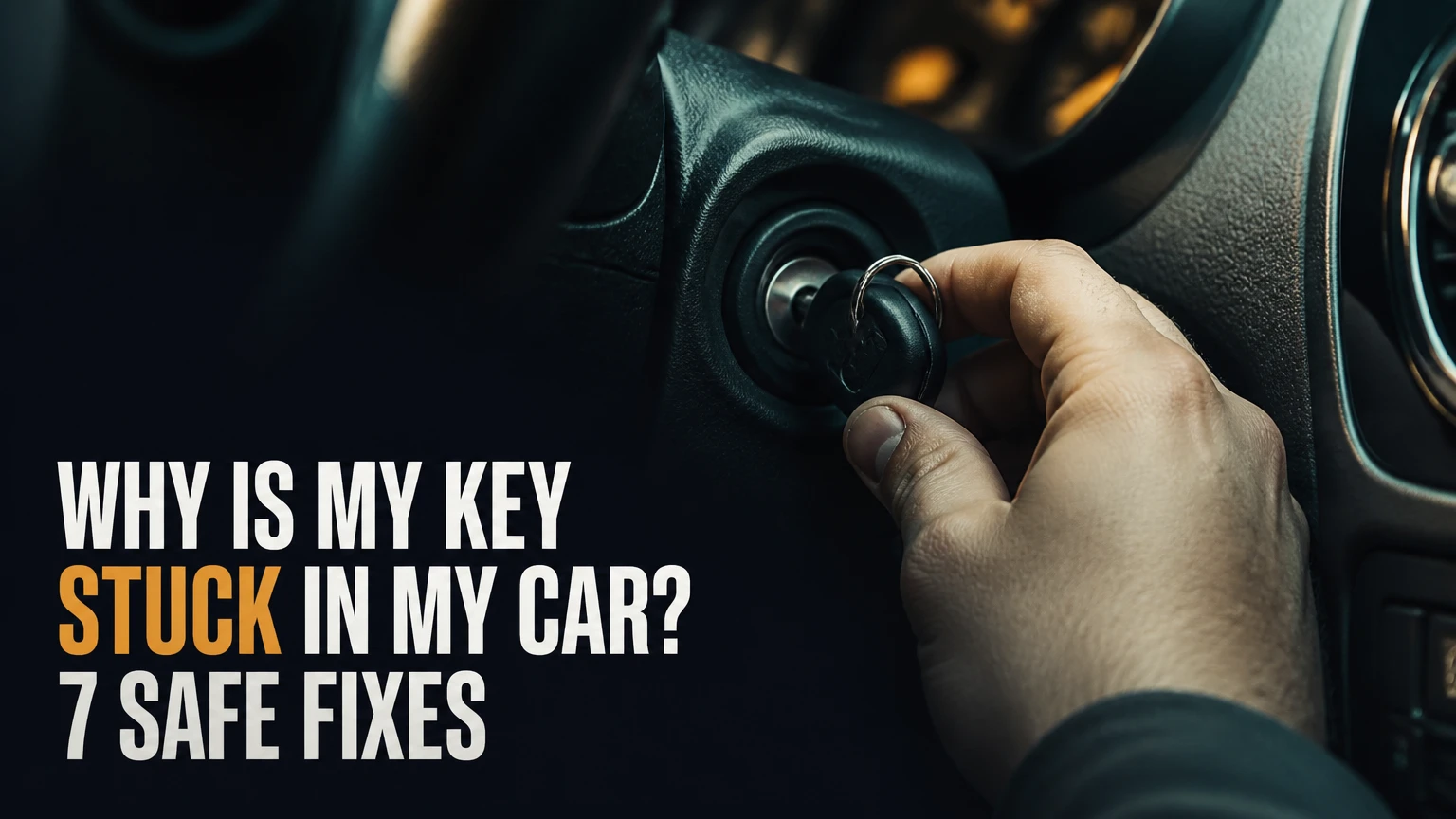
Your car key is usually stuck because the ignition interlock, steering-wheel lock, worn ignition cylinder, damaged key, or debris is preventing the key from returning to the release position. If the key is in a door lock instead, the likely causes are a misaligned lock, frozen mechanism, damaged key, or debris. Do not pull harder until you identify the location and symptom.
Key Facts
An automatic car often will not release an ignition key unless the transmission position sensor registers Park.
Steering-wheel pressure can bind the ignition cylinder even when the key and battery are working normally.
A spare key is a fast diagnostic test: if the spare works, the original key is probably worn or bent.
A dead battery can prevent some electronic release systems from actuating, but many vehicles provide a mechanical override.
A key that resists turning, feels bent, or has damaged grooves can break inside the cylinder if pulled with pliers.
Typical mobile automotive locksmith service costs range from $100-$250, while a shop repair commonly costs $200-$600.
Why Is My Key Stuck in My Car?
The most common reason an ignition key remains trapped is that the vehicle has not recognized the required release condition, usually Park, while a mechanically binding cylinder is the next major possibility. A key stuck in a door lock follows a different failure pattern and should not be diagnosed through ignition procedures.
An ignition lock cylinder contains wafers or tumblers that must align before the cylinder rotates. The cylinder also connects to an ignition switch and, in many automatic vehicles, a shift-lock system. When the key is turned toward Lock, the steering-column and transmission interlocks determine whether removal is permitted.
The exact design varies by make, model, year, and transmission. A 2010s automatic sedan may use a cable-operated shifter switch, while a newer vehicle may combine an electronic selector, body-control module, and steering-lock actuator. The owner’s manual is the authority for the vehicle’s emergency release procedure.
A door lock has no Park interlock. A key trapped in a door usually indicates a damaged or misaligned lock cylinder, a bent key, ice, contamination, or a key that has not returned to the correct vertical position.
How Does the Ignition Interlock Work?
The ignition interlock permits key removal only when the cylinder reaches the Lock position and the vehicle’s safety conditions are satisfied. In an automatic transmission, the shift interlock commonly depends on a Park signal from the shifter assembly or transmission range sensor.
The system prevents two unsafe outcomes. It reduces the chance of removing the key while the vehicle is still in gear, and it helps prevent an unattended vehicle from rolling. The steering lock adds another mechanical restriction after the key reaches the locked position.
A failed Park switch, damaged shifter cable, low system voltage, or worn cylinder can produce the same visible symptom: the engine is off, but the key will not come out. That is why replacing the battery or spraying lubricant is not a universal fix.
Is the Key Stuck in an Ignition or Door Lock?
Identify the lock location before attempting a repair. An ignition key that will not turn or release usually points toward Park recognition, steering tension, key wear, or cylinder wear; a door-lock key that will not withdraw usually points toward alignment, contamination, freezing, or lock damage.
| Symptom | More likely cause | Safe first check | Typical repair |
|---|---|---|---|
| Key will not leave ignition in an automatic car | Park interlock or shift-position signal | Push selector firmly into P while pressing brake | Adjust shifter, replace switch, or diagnose wiring |
| Key turns partly but binds near Lock | Steering tension or worn cylinder | Move wheel left and right gently | Release wheel load or service cylinder |
| Key enters door but will not rotate | Wrong, bent, or worn key | Compare with spare key | Use correct key or replace cylinder |
| Key rotates in door but will not withdraw | Cylinder not returned to vertical position | Turn gently to the normal removal angle | Repair or replace lock cylinder |
| Key suddenly stopped after rain or freezing temperatures | Ice, moisture, or debris | Warm the key and lock gradually | Dry and clean the lock |
| Key feels loose and gritty in ignition | Worn wafers or cylinder | Test an unused manufacturer-cut key | Re-key or replace ignition cylinder |
Do not assume the key itself is at fault because the vehicle has electrical power. Dashboard lights confirm some battery function, but they do not confirm that the shifter-position circuit, ignition actuator, or body-control module is operating.
How Do You Remove a Stuck Ignition Key Safely?
Use the following sequence before contacting a repair provider. The checks take about 5-15 minutes, require no disassembly, and work best when the key is still intact and the cylinder has not been forced.
Step 1: Stop Applying Force
Release pressure from the key and remove heavy key rings or accessories. A key ring pulling sideways can load the cylinder, especially when the key is already near the Lock position.
Keep the key aligned with the cylinder. Do not use pliers, screwdrivers, knives, or a second key as a lever. A snapped blade creates a second job, because the remaining fragment may require extraction before the cylinder can be tested.
You will know this step worked when: the key is straight, accessible, and no longer twisting under load.
Common mistake: pulling repeatedly because the key moved slightly. Partial movement can bend a thin blade without solving the underlying interlock problem.
Step 2: Confirm Park or Neutral
Press the brake pedal and move the selector firmly into Park. Keep light pressure toward the Park position while turning the key gently toward Lock and pulling it straight out.
If the vehicle is a manual transmission, place the transmission in neutral, apply the parking brake, and follow the vehicle manual’s key-release instructions. Manual vehicles do not normally use the same Park interlock, so a stuck key more often indicates steering tension, cylinder wear, or an ignition-switch fault.
You will know this step worked when: the instrument cluster shows P where applicable and the key rotates fully to Lock.
Common mistake: moving the selector rapidly through several gears. That can obscure whether the range switch is registering Park.
Step 3: Relieve Steering-Column Pressure
The steering lock can bind when the front wheels are turned against a curb or when the vehicle stopped with the steering wheel loaded. Apply gentle turning pressure to the key while moving the steering wheel several centimetres left and right.
Find the direction that allows slightly more wheel movement. Hold the wheel in that direction, without jerking it, and turn the key toward Lock. The goal is to remove load from the locking pin, not to overpower it.
You will know this step worked when: the wheel frees slightly and the key turns smoothly through the final position.
Common mistake: pulling the steering wheel and key in opposite directions with maximum force. That increases mechanical load and can damage the cylinder.
Step 4: Check Electrical Power
Turn on the interior light or headlights and observe the dashboard. If the lights are weak, absent, or rapidly clicking, measure the battery with a multimeter if available. A healthy, rested 12-volt battery typically measures about 12.6 volts; approximately 12.2 volts indicates substantial discharge, although voltage alone does not prove battery condition.
Use a correctly connected jump pack or jumper cables only when the vehicle’s manual permits it. Restoring voltage may release an electronic key interlock, but a jump-start will not repair a failed Park switch, broken shift cable, seized cylinder, or damaged steering-lock actuator.
Some vehicles have a small access cover near the shifter or ignition for a mechanical override. Read the owner’s manual before inserting a tool, because the release location and procedure differ substantially.
You will know this step worked when: the vehicle’s electrical systems return to normal and the key releases after Park is correctly recognized.
Common mistake: repeatedly jump-starting a vehicle with a key that is mechanically jammed. Power cannot realign damaged wafers.
Step 5: Test a Spare Key
Compare the stuck key with the spare from the same vehicle. Look for bent metal, rounded cuts, cracks near the shoulder, or excessive wear on the blade. A newly cut key made from the vehicle’s key code is more useful for diagnosis than a duplicate copied from a worn key.
If the spare key turns and releases normally, retire the old key. If both keys bind in the same way, the ignition cylinder, interlock, or steering lock becomes more likely.
A transponder key adds another distinction: the chip may be required to start the engine, but an immobilizer fault typically prevents starting rather than physically trapping a conventional blade. Smart-key systems can behave differently, so follow the manufacturer’s manual.
You will know this step worked when: the spare key operates the lock without abnormal resistance.
Common mistake: filing the key blade at home. Small changes to the cuts can make the key unsafe or unusable.
Step 6: Inspect and Clean the Keyway
Shine a flashlight into the ignition or door cylinder. Look for visible metal fragments, compacted lint, dirt, or ice. Do not insert paper, pins, knife tips, or cotton swabs, because they can leave fibres or push debris deeper.
For a conventional lock approved by the vehicle manufacturer, use a small amount of lock-specific dry lubricant or electrical contact cleaner that is explicitly suitable for the application. A brief one-second application is usually enough. Follow the product label and allow excess fluid to drain before gently cycling the key.
Avoid flooding the cylinder with penetrating oil or household lubricant. Oil can migrate into electrical contacts, collect grit, and create a sticky film. Graphite is also unsuitable for every modern lock, particularly systems with delicate electronic components or manufacturer-specific lubricant requirements.
You will know this step worked when: the key enters fully and moves through the cylinder with consistent resistance.
Common mistake: adding more lubricant after the first attempt fails. Additional fluid cannot correct a bent key or failed interlock.
Step 7: Stop and Arrange Extraction or Repair
Stop DIY work if the key bends, cracks, breaks, remains immobile after the checks, or requires force greater than gentle finger pressure. Also stop if the ignition housing is loose, the steering wheel will not unlock, smoke appears, or an electrical smell is present.
A mobile automotive locksmith can often extract a broken blade, decode or cut a replacement, and test the cylinder at the vehicle. A repair shop or dealership is more appropriate when the problem involves a damaged shifter assembly, steering-column lock, wiring fault, control module, or vehicle-specific programming.
Do not drive with a key partly inserted or with a steering lock that behaves unpredictably. Arrange transport when the steering, transmission-position signal, or ignition control cannot be verified.
Which Cause Matches Your Symptoms?
Symptom matching is more reliable than replacing parts at random. A key that suddenly sticks after parking against a curb points toward steering load, while gradual resistance over several weeks points toward key or cylinder wear.
| Observed pattern | Probable fault | Diagnostic clue | Recommended action |
|---|---|---|---|
| Key releases after selector pressure | Park switch or shifter alignment | P indicator changes when shifter moves | Inspect shifter circuit |
| Key releases when wheel moves one direction | Loaded steering lock | Wheel feels tight against stop | Use gentle wheel-load relief |
| Old key sticks, spare works | Worn blade | Spare has sharper cuts | Replace key and stop using old one |
| Both keys bind gradually | Worn wafers or cylinder | Resistance occurs at the same angle | Locksmith cylinder inspection |
| No dash power and no release | Low battery or power fault | Interior lights remain off | Test battery and manual override |
| Door lock fails in winter | Ice or moisture | Lock improves after gradual warming | Dry lock and use approved lubricant |
| Key spins without operating lock | Broken linkage or cylinder tailpiece | Little or no mechanical resistance | Remove trim only if trained, otherwise call locksmith |
Why Does a Worn Key Cause a Lockout?
A worn key can fail because its cut depths no longer position the cylinder wafers precisely at the shear line. The problem is often progressive: the key works in the morning, becomes sticky under a particular angle, then fails after the user applies more force.
The ignition cylinder can wear at the same time. If a replacement key improves the symptom only briefly, the cylinder may have already developed matching wear. A locksmith can determine whether the key, wafers, housing, or linkage is responsible without guessing from appearance alone.
A dealership-cut key may cost more than a generic duplicate, but copying a worn key reproduces its errors. Ask for a key cut from the vehicle identification or key code when the original blade is visibly worn.
Can a Dead Battery Trap the Key?
A dead battery can prevent key release in some vehicles that use an electrically controlled interlock, but battery failure is not a universal explanation. Many ignition systems retain a mechanical release path, and some vehicles allow the key to return to Lock without battery power.
Check the manual for a shift-lock or ignition-release override. Do not assume the battery is fully dead because the engine will not crank, since a weak battery may still illuminate the cluster while failing under load.
A battery replacement is reasonable when testing confirms low voltage, but it should not be the only repair attempt. If the key remains stuck after stable power returns, diagnose the Park signal, ignition cylinder, and steering lock.
What Lubricant Is Safe for a Car Lock?
Use only a lubricant or cleaner whose label identifies automotive lock-cylinder compatibility. The correct product depends on the cylinder’s materials, seals, and electronic design, so the vehicle manual and product instructions take priority over generic internet advice.
| Product type | Typical amount | Appropriate use | Main limitation |
|---|---|---|---|
| Dry lock lubricant | 1 short burst | Conventional key cylinder | May not suit every electronic ignition |
| Electrical contact cleaner | 1 brief spray | Contaminated electrical contact area, label permitting | Not a general cure for mechanical wear |
| Penetrating oil | Avoid flooding | Emergency corrosion treatment only if manufacturer permits | Can attract dirt and migrate into contacts |
| Household cooking or machine oil | 0 applications | Not recommended for vehicle locks | Leaves residue and traps grit |
| Water or de-icer | 1 small application for exterior lock | Temporary ice release when product is approved | Requires drying to reduce refreezing |
Never spray lubricant into a push-button starter. A push-button system may have no key cylinder at all, and a key fob that is not detected is an electronic authorization problem rather than a stuck blade.
Should You Call a Locksmith or a Mechanic?
Choose a mobile automotive locksmith when the key is physically trapped, broken, worn, or the lock cylinder needs extraction, decoding, or replacement. Choose a mechanic or dealership when the evidence points to vehicle wiring, a shift-position sensor, a steering-column actuator, a control module, or key programming that requires manufacturer equipment.
| Repair route | Best match | Typical cost | Typical time after arrival |
|---|---|---|---|
| Mobile locksmith extraction | Stuck or broken blade | $100-$250 | 20-45 minutes |
| Replacement mechanical key | Worn or damaged blade | $30-$150 | 15-60 minutes |
| Ignition-cylinder service | Worn wafers or seized cylinder | $150-$400 | 1-3 hours |
| Independent repair shop | Shifter, wiring, or actuator fault | $200-$600 | Same day to 2 days |
| Dealership diagnosis and repair | Integrated electronic or programmed system | $300-$1,000 or more | 1-3 business days |
These are typical North American ranges, not fixed prices. Emergency hours, vehicle security systems, luxury imports, replacement parts, programming, towing distance, and regional labor rates can change the total.
Ask the provider whether the quoted price includes the service call, extraction, replacement key, programming, cylinder parts, and tax. A low phone estimate may exclude the diagnostic fee or after-hours charge.
A locksmith is not always the cheapest answer. If the shifter indicator does not recognize Park, extracting the key may solve the immediate symptom without repairing the condition that caused it.
What Special Situations Change the Diagnosis?
Cold weather, aftermarket alarms, remote starters, valet keys, and push-button ignition systems create different failure paths. The correct repair depends on whether the physical blade, the interlock, or the electronic authorization system is preventing operation.
Cold Weather
Warm a frozen door lock gradually with the vehicle’s defroster, a lock de-icer approved for automotive use, or a warmed key. Never pour boiling water over the cylinder, because water can refreeze inside and thermal shock can damage surrounding finishes.
Aftermarket Alarm or Remote Starter
An aftermarket alarm or remote-start installation can interrupt ignition or starter circuits. If the problem began after installation or appears with alarm warning lights, have the installer or an automotive electrician inspect the wiring rather than repeatedly cycling the key.
Valet or Service Key
A valet key may open the driver’s door and start the vehicle while not operating the trunk, glovebox, or some secondary locks. Do not force a valet key in a lock that requires a different blade profile.
Push-Button Start
A push-button vehicle may have a hidden emergency mechanical key for the door and a separate backup procedure for starting when the key fob battery is weak. A fob that is not detected does not normally mean a key blade is stuck, so replace the fob battery and consult the manual before spraying any control.
Broken Key Inside the Cylinder
Leave the broken fragment undisturbed if it remains accessible. Do not push it deeper with another key or use superglue, because adhesive can permanently damage the wafers and make professional extraction harder.
What Mistakes Make the Repair More Expensive?
The most expensive mistake is applying increasing force to a key that has already shown abnormal resistance. A replacement blade is inexpensive compared with extraction, cylinder replacement, damaged trim, or a broken steering-column component.
Avoid these failure patterns:
- Using pliers on the blade: Pliers apply twisting force at a narrow point and can snap the key at the cylinder face.
- Spraying heavy oil repeatedly: Residue catches dust and may contaminate electrical contacts.
- Ignoring a failing spare-key test: Continued use of a worn key can damage a still-serviceable cylinder.
- Disconnecting the battery without checking the manual: Some vehicles require radio codes, window initialization, or security procedures after power loss.
- Bypassing the interlock: Jumping wires or forcing the shifter can create a rollaway risk and electrical damage.
- Towing with the steering locked: A flatbed may be required when the front wheels cannot turn safely.
A practitioner’s rule is simple: resistance that changes with steering-wheel position suggests load, resistance that changes with the key suggests blade wear, and resistance that remains identical with two keys suggests the cylinder or interlock.
How Can You Prevent Another Stuck Key?
Replace a visibly worn key before it becomes unreliable, and keep a properly cut spare outside the vehicle. Store the spare where it remains accessible during a lockout, rather than leaving both keys on the same ring.
Keep the key blade clean and avoid attaching heavy accessories. Inspect the key every few months for cracks, rounded cuts, and bending near the shoulder. On vehicles older than roughly 10 years, have a locksmith inspect recurring ignition resistance before the cylinder fails completely.
Use the parking brake every time, especially on an incline, even when the transmission is in Park. The parking brake reduces load on the parking pawl and can make selector and key-release problems less likely during a stop.
Record the vehicle identification number and keep the owner’s manual available digitally. The emergency override position, key type, and programming procedure can vary between two vehicles from the same manufacturer.
When Is Towing Necessary?
Tow the vehicle when the key is broken inside the ignition, the steering wheel will not unlock, the selector cannot reach a confirmed safe position, or the ignition housing has electrical damage. A flatbed is often the safest choice when the front wheels cannot be steered or the transmission cannot be placed in neutral.
A mobile locksmith is usually more efficient when the car is safely parked and the problem is limited to a key or cylinder. A repair shop becomes the better destination when diagnostic equipment is required or when an interlock, actuator, or wiring fault must be repaired.
Tell roadside assistance the exact condition: key stuck in ignition, key broken, steering locked, battery discharged, or key stuck in door. That description determines whether they send a locksmith, jump service, or flatbed.
Frequently Asked Questions
Can I drive if the key is stuck in the ignition?
Do not drive unless the key is fully seated, the steering lock operates normally, the transmission position is confirmed, and the key does not interfere with steering or controls. A key that remains in an accessory position can drain the battery, while a failing cylinder can prevent reliable shutdown or steering-lock operation.
Why is my key stuck after I turn the car off?
The usual reasons are incomplete Park recognition, steering-wheel load, or a cylinder that did not return fully to the Lock position. Press the brake, push the selector firmly into Park, relieve steering pressure gently, and avoid pulling until the key rotates to the normal removal position.
Will replacing the key fob battery release the key?
Replacing a key fob battery releases a physical ignition key only when the vehicle uses an electronic release that depends on fob authorization, which is uncommon for conventional blade systems. A weak fob battery more often causes a no-detection or no-start message, not a mechanically trapped key.
Can I use WD-40 on a stuck car key?
WD-40 or similar penetrating products should not be the default lubricant for a car lock. The product can leave residue and may not be compatible with the cylinder or electrical switch. Use a vehicle-approved dry lock lubricant or cleaner in a small quantity, following the label.
How long does a locksmith take to remove a stuck car key?
A mobile automotive locksmith typically needs 20-45 minutes after arrival for a straightforward extraction or cylinder assessment. Broken blades, security programming, seized cylinders, limited access, and replacement parts can extend the appointment to one or more hours.
The Bottom Line
Why is my key stuck in my car? Start by identifying whether the key is in the ignition or a door lock, then check Park, steering-wheel tension, battery power, key condition, and visible debris in that order. Use only gentle pressure, test a spare key, and stop before the blade bends or breaks.
A mobile locksmith is usually the right first call for extraction or key-cylinder problems. A mechanic or dealership is better for shift interlocks, wiring, steering-lock actuators, and integrated electronic faults. The safest repair is the one that diagnoses the release mechanism instead of forcing the key.