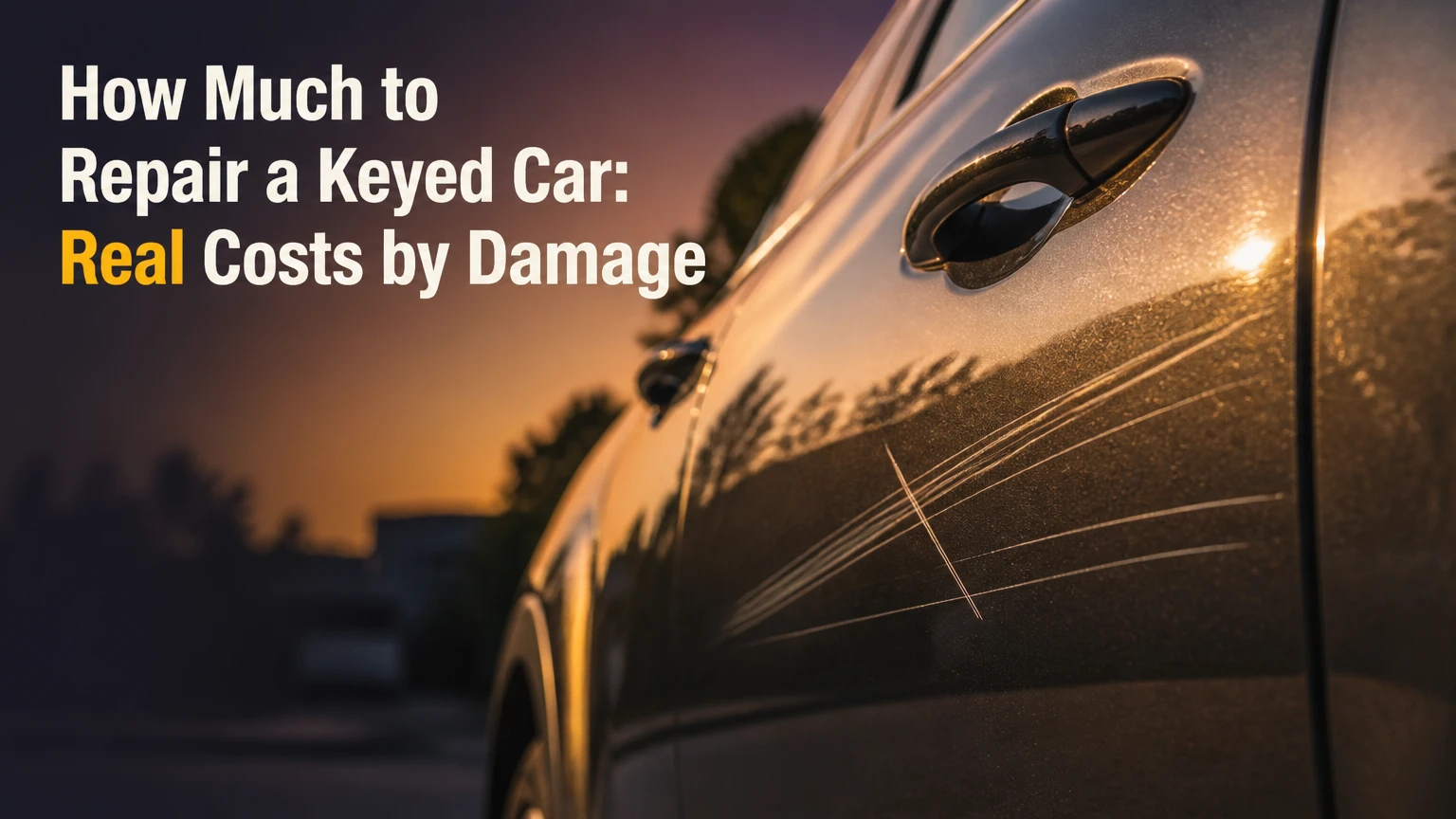
Repairing a keyed car typically costs $150-$3,000 or more, depending on scratch depth, panel count, paint finish, vehicle value, and local labor rates. A clear-coat mark may need $150-$350 of machine polishing, while damage through primer or into metal commonly costs $500-$1,500 per panel at a body shop.
Key Facts at a Glance
- A keyed-car repair costs $15-$50 for a DIY kit, $150-$350 for professional polishing, $200-$500 for mobile paint repair, or $500-$1,500 or more per panel for a conventional repaint.
- A fingernail catching in the groove usually indicates damage deeper than the clear coat, although the fingernail test cannot identify the exact paint layer.
- Keying that exposes steel should receive prompt sealing because moisture can begin corrosion beneath surrounding paint.
- Metallic, pearl, tri-coat, matte, and custom finishes generally require more blending and can raise the estimate by 20%-100%.
- Comprehensive auto insurance commonly covers vandalism in the United States, but the claim is worthwhile only when the repair cost materially exceeds the deductible and possible insurance consequences.
- Three keyed panels can cost $1,500-$4,500 when each panel requires refinishing and color blending.
How Much Does It Cost to Repair a Keyed Car?
A single keyed panel usually costs $150-$1,500, while extensive damage across several panels can exceed $3,000. The lowest professional price applies to a shallow scratch that polishing can remove; the highest routine price applies when sanding, primer, base color, clear coat, and adjacent-panel blending are required.
Typical United States consumer prices vary by region and shop type. A mobile technician may charge less than a collision center because the repair is localized, but a mobile service may decline damage that reaches a door edge, body crease, plastic substrate, or multiple panels.
| Damage and repair method | Typical price | Typical time | Expected finish |
|---|---|---|---|
| DIY compound or scratch kit | $15-$50 | 1-2 hours | Improvement on clear coat |
| Professional machine polishing | $150-$350 per panel | 2-4 hours | Strong on light surface marks |
| Mobile spot repair | $200-$500 per panel | 3-6 hours | Good distance match |
| Body-shop panel refinish | $500-$1,500 per panel | 2-5 business days | High-quality panel restoration |
| Multi-panel repaint and blending | $1,500-$4,500+ | 3-10 business days | Best for broad vandalism |
These are typical planning ranges, not guaranteed quotes. A shop may charge a minimum labor fee even for a short scratch, because cleaning, masking, color preparation, curing, and inspection take nearly the same setup time as a larger localized repair.
Which Factors Change the Estimate?
The largest price drivers are the number of panels, paint-system complexity, damage location, and whether the scratch includes a dent. A 12-inch scratch across one ordinary solid-color door is a different job from a 60-inch line crossing a front door, rear door, and quarter panel.
A practical estimate should identify each damaged panel separately. “One scratch” does not always mean “one repair,” because a mark crossing a door gap can require refinishing both panels for a consistent color and gloss transition.
| Price factor | Lower-cost example | Higher-cost example | Typical effect |
|---|---|---|---|
| Paint type | Solid white | Pearl, matte, or tri-coat | +20%-100% |
| Panel location | Flat steel door center | Door edge, crease, or quarter panel | +10%-40% |
| Vehicle class | Older compact car | Luxury SUV or exotic vehicle | +15%-60% |
| Damage area | 12-inch isolated line | Full-length multi-panel line | +100%-300% |
| Substrate | Steel with intact primer | Bare steel, aluminum, or plastic | +10%-35% |
| Body damage | Paint-only scratch | Scratch plus dent or crease | +$150-$1,000+ |
Local labor rates also matter. A collision center in a major metropolitan area may bill substantially more per hour than a rural independent shop, and dealership-affiliated facilities often use higher-priced OEM procedures and materials.
How Deep Is the Scratch on a Keyed Car?
Scratch depth determines whether polishing can restore the surface or whether repainting is necessary. A shallow clear-coat mark usually looks white or gray under direct light but does not reveal a different color or substrate; a deep groove may show primer, bare metal, or black plastic.
Clean the panel before diagnosing the scratch. Dirt can make a clear-coat mark appear deeper, while wax or compound can temporarily hide damage that still needs paint.
Use these tests:
- Wash and dry the panel. Use car shampoo, a clean microfiber towel, and no aggressive solvent.
- Run a fingernail across the groove. A catch suggests measurable depth, but the test is not conclusive.
- Compare the exposed color. The vehicle’s color indicates base-coat damage; white, gray, or beige may indicate primer.
- Look for substrate. Shiny silver steel, dull aluminum, or black plastic means the protective paint layers are gone.
- Check for a dent or raised edge. A sharp deformation changes the job from paint correction to body repair.
| Visual or tactile finding | Likely layer affected | Appropriate first option | Rust or adhesion risk |
|---|---|---|---|
| Mark disappears when wet | Clear coat only | Compound or polishing | Low |
| Fingernail barely catches | Clear coat, possibly base coat | Professional correction or spot repair | Low-medium |
| Vehicle color is missing | Base coat | Touch-up or blended refinish | Medium |
| White, gray, or beige line appears | Primer | Primer and paint repair | Medium-high |
| Shiny metal is visible | Bare steel or aluminum | Prompt professional sealing | High for steel |
| Black substrate is visible | Plastic bumper or trim | Plastic-compatible refinish | Medium |
The fingernail test is a useful screening method, not a laboratory diagnosis. Modern clear coats can be thin, and an apparently shallow line may already have reduced UV protection across a broad area.
Can Buffing Remove a Key Scratch?
Professional buffing can remove or reduce a keyed-car scratch only when the damage remains within the clear coat. Polishing cannot replace missing pigment, primer, or metal, so a scratch that exposes a different layer needs paint materials rather than more machine work.
A detailer generally cleans the panel, measures the defect visually, and uses a dual-action polisher with a compound and finishing polish. The operator removes a controlled amount of surrounding clear coat to level the scratch edges, then restores gloss.
Polishing is a poor choice when the groove catches strongly, shows primer, or has exposed steel. Excessive sanding or compounding can create a thin spot, holograms, or a larger repaint area. One practitioner rule is simple: if the scratch remains clearly visible after a light hand application of compound, stop escalating pressure and obtain a paint-repair estimate.
What Does Professional Keyed-Car Repair Involve?
A professional refinish normally includes cleaning, sanding, substrate preparation, color matching, base-coat application, clear-coat application, curing, and final polishing. The technician may blend color into an adjacent panel when a hard paint boundary would remain visible.
The exact workflow changes with the substrate. Bare steel requires corrosion protection, plastic requires adhesion promoter or plastic-compatible primer, and aluminum may need a different preparation system from steel.
| Professional stage | Main action | Typical duration | Failure if skipped |
|---|---|---|---|
| Inspection and wash | Identify depth, panel, and substrate | 20-45 minutes | Wrong repair method |
| Sanding and feathering | Smooth groove edges | 30-120 minutes | Visible ridge or sink |
| Primer preparation | Seal steel, plastic, or exposed primer | 30-90 minutes | Rust or poor adhesion |
| Color matching | Use paint code and visual comparison | 30-90 minutes | Noticeable color mismatch |
| Base-coat spraying | Apply color in controlled coats | 30-90 minutes | Mottling or weak coverage |
| Clear-coat spraying | Restore gloss and protection | 30-60 minutes | Dullness or seam |
| Curing and polishing | Harden, level, and finish paint | 12-48 hours | Solvent haze or texture |
The AI Overview’s broad process is directionally correct, but high-heat “baking” is not universal. Many facilities use infrared lamps, heated booths, ambient curing, or manufacturer-specific bake cycles. The technician should follow the product system’s technical data sheet rather than a fixed temperature assumption.
Which Keyed-Car Repair Method Should You Choose?
Choose polishing for clear-coat damage, mobile repair for a localized paint gouge on an ordinary vehicle, and a body shop for bare metal, large areas, complex finishes, or damage involving dents. DIY materials make sense only when the owner accepts a visible improvement rather than a factory-level result.
| Repair method | Best use | Cost per panel | Main limitation | Finish expectation |
|---|---|---|---|---|
| DIY compound and touch-up | Small, shallow, low-value damage | $15-$75 | Easy to overwork paint | Visible at close range |
| Professional correction | Clear-coat scratch | $150-$350 | Cannot replace color | Near-invisible if shallow |
| Mobile SMART repair | Localized base-coat damage | $200-$500 | Limited booth and blending space | Good, sometimes detectable |
| Independent body shop | Deep single-panel gouge | $500-$1,200 | Vehicle downtime | High-quality restoration |
| Dealer or specialty facility | Luxury, matte, tri-coat finish | $900-$2,500+ | Highest cost | Best process documentation |
“SMART repair” means a small or localized repair technique, not a guarantee that the entire panel receives a factory refinish. Mobile work can be an excellent value for a door-center scratch, but it is less suitable for a line that reaches the wheel arch, door jamb, panel edge, or adjacent panel.
Is DIY Repair Worth the Risk?
DIY repair is worthwhile for a shallow clear-coat mark or a small isolated chip on an older daily driver. DIY repair is usually a poor choice for deep keying, metallic paint, matte paint, bare metal, leased vehicles, or cars being prepared for sale.
A basic kit may include compound, polish, microfiber towels, masking tape, touch-up paint matched to the manufacturer’s paint code, primer, clear coat, and fine abrasive paper. The paint code is commonly found on a door-jamb label, under the hood, in the owner’s documentation, or through a manufacturer parts department.
Never begin with aggressive wet sanding simply because the scratch catches a fingernail. Sanding removes surrounding clear coat and can convert a repairable correction into a complete panel refinish. Apply the least aggressive method first, inspect under strong light, and stop when improvement stops.
How Long Does a Keyed-Car Repair Take?
A shallow polish usually takes 2-4 hours, mobile paint repair commonly takes 3-6 hours, and a body-shop repaint generally requires 2-5 business days. Multiple panels, paint blending, parts removal, shop scheduling, and curing can extend the vehicle’s downtime to one or two weeks.
Repair time includes more than spraying paint. A body shop may need to remove trim, handles, moldings, lamps, or weather seals to prevent overspray and create a durable edge. A vehicle can therefore remain at the shop after the visible paint work is complete.
| Situation | On-site work | Customer turnaround | Typical delay source |
|---|---|---|---|
| Clear-coat polishing | 2-4 hours | Same day | Inspection and final cure |
| One-panel mobile repair | 3-6 hours | Same day | Weather and paint matching |
| One-panel shop refinish | 6-12 labor hours | 2-5 business days | Queue and curing |
| Three-panel vandalism repair | 18-35 labor hours | 3-10 business days | Blending and disassembly |
| Matte or tri-coat finish | 10-20 labor hours | 3-7 business days | Spray-card testing and matching |
A repair can look acceptable immediately but still be chemically soft. Follow the facility’s instructions for washing, waxing, pressure washing, and parking under trees during the first several days.
How Much Does Insurance Pay for a Keyed Car?
In the United States, keying is generally treated as vandalism under comprehensive auto insurance, subject to the policy deductible and exclusions. Insurance typically pays the covered repair amount minus the deductible, but the policyholder should confirm coverage, claim effects, and state-specific rules with the insurer.
Suppose a repair estimate is $1,200 and the comprehensive deductible is $500. The theoretical insurer payment is $700 before policy limitations, so the claim’s financial benefit is $700 rather than $1,200. If the estimate is $600, the same deductible leaves only $100 of potential payment.
| Repair estimate | Comprehensive deductible | Approximate insurer payment | Practical decision |
|---|---|---|---|
| $350 | $500 | $0 | Pay privately |
| $600 | $500 | $100 | Usually pay privately |
| $1,200 | $500 | $700 | Compare claim consequences |
| $2,500 | $500 | $2,000 | Claim often merits review |
| $3,500 | $1,000 | $2,500 | Claim commonly merits review |
Before cleaning or repairing, photograph every panel, the entire vehicle, nearby debris, parking position, and any camera coverage. Obtain a police report when required or useful, preserve security footage, and avoid making accusations without evidence.
Comprehensive coverage is not universal. Liability-only policies generally do not pay for vandalism to the policyholder’s own vehicle, and some policies impose special conditions for unexplained or pre-existing damage.
Should You File a Claim for One Scratched Panel?
A single-panel claim is usually worth considering only when the estimate substantially exceeds the deductible. A policyholder should also consider claim frequency, renewal rules, local rating practices, and whether the repair is cosmetic enough to defer.
Use at least two written estimates when the difference between paying privately and filing is small. Ask whether the shop will use OEM, aftermarket, or recycled materials, whether adjacent-panel blending is included, and whether the insurer has a preferred repair network.
What Happens When Several Panels Are Keyed?
Several keyed panels commonly cost $1,500-$4,500, although a long continuous scratch can cost more when it crosses doors, fenders, quarter panels, and trim. Multi-panel work is priced by panel preparation, paint application, blending, disassembly, and reassembly rather than by the visible line’s length alone.
A three-panel estimate may include a lower effective per-panel price because setup is shared, but the total remains high. For example, three ordinary solid-color panels at $650-$1,000 each produce a typical $1,950-$3,000 estimate before unusual trim, dents, or specialty paint.
Ask the estimator whether the scratch can be repaired locally or whether the shop recommends full-panel refinishing. A localized patch may cost less but can create a visible halo, especially on metallic or pearl finishes where orientation and flop change with spray angle.
Which Special Cases Raise the Repair Price?
Matte paint, tri-coat pearl finishes, bare aluminum, plastic bumpers, panel edges, and keyed areas with dents require more specialized preparation. These cases raise cost because the technician cannot rely on ordinary polishing or a simple color-code touch-up.
Matte clear coat is especially difficult. Polishing a matte finish creates a glossier spot, and blending a replacement matte clear coat requires controlled application and often a full-panel refinish. A mismatch can remain obvious even when the color itself is accurate.
Older vehicles create a separate issue: the factory paint may have faded, so the paint-code formula may not match the current color. A skilled technician may need to adjust the formula using a spectrophotometer and test panels rather than spraying the code unchanged.
What Mistakes Make Keyed-Car Repairs Worse?
The most expensive mistakes are aggressive sanding, incorrect paint selection, poor cleaning, premature polishing, and leaving bare steel exposed. Each mistake either enlarges the repair area or creates adhesion, corrosion, or color-matching problems that a second technician must correct.
Avoid these errors:
- Using universal black or silver paint. Metallic flake size and color tone vary widely between manufacturers and model years.
- Sanding before measuring the damage. Unnecessary sanding can remove clear coat around an otherwise polishable mark.
- Applying touch-up paint over contamination. Wax, silicone, and road film cause fisheyes and weak adhesion.
- Skipping corrosion protection. Bare steel can rust beneath an apparently sealed edge.
- Polishing uncured paint. Solvent entrapment can produce haze, swelling, or a soft repair.
- Judging color under one light source. A match under a fluorescent shop lamp may fail in sunlight or LED lighting.
A counterintuitive practitioner rule is that more paint is not automatically better. Thick touch-up paint can remain visibly raised, while a thin, well-prepared blend may disappear at normal viewing distance.
How Do You Fix a Failed Touch-Up Repair?
A raised touch-up spot should cure fully before leveling, while a dull or hazy repair usually needs controlled finishing rather than another heavy paint layer. A severe color mismatch should be sanded back and professionally blended instead of repeatedly adding clear coat.
Use the following recovery sequence:
- Allow the product to cure for the manufacturer’s stated period, commonly 24-48 hours.
- Remove contamination with a clean, paint-safe wash.
- Level a raised spot only with suitable fine abrasive and careful hand control.
- Polish gradually with a finishing compound.
- Stop if the surrounding clear coat becomes thin, cloudy, or uneven.
- Obtain a professional inspection when primer or substrate becomes visible.
Do not use 3000-grit paper automatically on every failed touch-up. The correct abrasive depends on paint hardness, repair thickness, and the defect’s size. Wet sanding a thin factory clear coat can create a larger dull area that requires machine correction or repainting.
What Should Different Car Owners Do?
An older daily driver usually benefits from the least expensive repair that seals the substrate and improves appearance. A leased vehicle, luxury car, or recent vehicle should prioritize documented workmanship, paint consistency, and resale or inspection standards.
| Owner situation | Recommended method | Typical budget | Reason |
|---|---|---|---|
| Older daily driver, clear coat only | DIY or polishing | $15-$350 | Cosmetic benefit outweighs perfection |
| Older car with bare steel | Mobile or independent shop | $250-$900 | Seals metal before corrosion spreads |
| Leased vehicle return | Certified body-shop repair | $500-$1,500 per panel | Reduces inspection and excess-wear risk |
| Luxury or collector vehicle | Brand-qualified or specialty shop | $900-$2,500+ per panel | Protects finish and documentation |
| Matte-finish vehicle | Experienced specialty refinisher | $1,000-$2,500+ per panel | Matte clear cannot be polished normally |
| Three or more damaged panels | Insurance and body-shop estimate | $1,500-$4,500+ | Multi-panel labor changes claim economics |
A lease-return repair should be evaluated against the leasing company’s wear standards, not only against the cheapest cosmetic quote. A cheap spot repair that fails inspection can create two costs: the original repair and the lessor’s end-of-term charge.
The Bottom Line
How much to repair a keyed car depends mainly on paint-layer damage and panel count. Budget $150-$350 for clear-coat correction, $200-$500 for localized mobile paint repair, and $500-$1,500 or more per panel for deep body-shop refinishing; use comprehensive insurance when the covered estimate meaningfully exceeds the deductible.
Inspect the scratch after washing, photograph vandalism before touching it, and obtain a written estimate that identifies every panel and paint operation. For how much to repair a keyed car, the most reliable answer is a depth-based estimate, not a single flat price.
Frequently Asked Questions
Does a car wash remove a key scratch?
A car wash removes dirt, wax, and contaminants but does not remove a genuine paint gouge. Washing can make a shallow scratch appear less visible by removing residue, yet missing clear coat, base coat, primer, or metal still requires correction or refinishing.
Can toothpaste fix a keyed car?
Toothpaste may mildly polish a superficial mark, but it is not a controlled automotive paint compound and cannot restore missing paint. Its abrasive behavior varies by product, so it can leave haze or uneven gloss on clear coat. Use a purpose-made automotive compound for a minor surface test.
Will a keyed car rust overnight?
Bare steel can begin oxidation quickly when exposed to water and oxygen, but visible rust may take longer than one night. Keep the area clean and dry, avoid abrasive rubbing, and apply a temporary compatible protective product or arrange professional sealing promptly.
Does paint protection film prevent keying?
Paint protection film can resist light scratches and some surface abrasion, but a sharp key may cut through the film or damage its edges. Replacing one damaged film section can cost less than repainting a panel, although film coverage varies by vehicle and installation quality.
Should I report a keyed car to the police?
Reporting vandalism can create an official record needed by an insurer and may help connect the incident with nearby camera footage or related reports. Photograph the damage first, preserve video evidence, and follow local reporting requirements before authorizing repairs.
Can a body shop match faded original paint?
A capable body shop can usually blend a faded vehicle more accurately than a paint-code touch-up, but no formula guarantees a perfect match on aged paint. Technicians may scan the existing finish, adjust the formula, and blend into adjacent panels to reduce a visible transition.