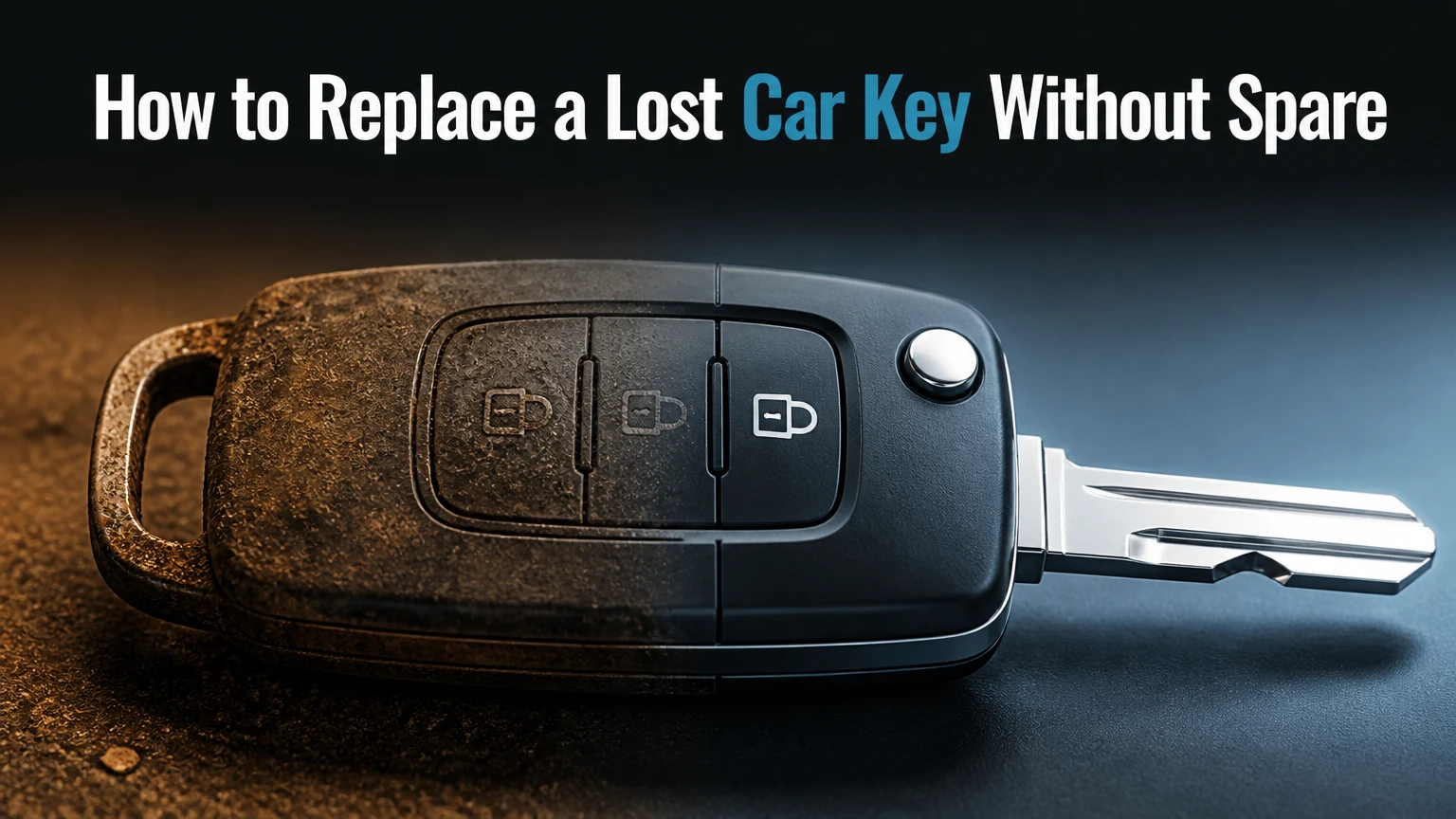
A lost car key can be replaced without a spare by having an automotive locksmith or dealership identify the vehicle, obtain the authorized key information, cut a new blade or supply a compatible fob, and program its immobilizer or proximity system. The VIN helps identify the vehicle, but proof of ownership and successful programming are also required.
Key facts
A mobile automotive locksmith can often replace and program a lost key at the vehicle’s location.
The VIN identifies the vehicle, but the VIN alone does not physically create or authorize every replacement key.
A metal blade may unlock the door while an unprogrammed transponder still prevents the engine from starting.
Typical US replacement costs range from about $80 for a basic mechanical key to more than $600 for some modern luxury smart keys.
A lost electronic key should be deleted from the vehicle’s memory whenever the immobilizer system allows it.
A reputable provider normally verifies your identity, vehicle ownership, key compatibility, and final operation before completing the job.
Can a Car Key Be Made Without a Spare?
Yes, a car key can be made without an original or spare. The provider uses the vehicle identification number, lock or ignition information, manufacturer data, and compatible programming equipment to create a new key rather than duplicate an existing one.
The process has two separate parts. First, a locksmith cuts a mechanical blade or supplies the correct emergency blade. Second, the provider pairs the transponder, remote, or proximity credential with the vehicle’s immobilizer and body-control systems. Some vehicles require a manufacturer security PIN, online authorization, or a dealer-only diagnostic connection.
A VIN is useful, but it is not a universal key generator. A VIN may identify the correct key family and factory cut code through an authorized database, yet the provider still must confirm the lock configuration, model year, region, trim, frequency, and security system. A reputable locksmith will not cut a key solely because someone supplies a VIN online.
What Should You Gather Before Calling?
Gather the VIN, government-issued photo identification, vehicle registration or title, exact parking location, and the vehicle’s make, model, year, and trim. Tell the provider whether the key was lost, stolen, locked inside the vehicle, or damaged, because each situation changes the recommended security work.
The VIN usually appears through the windshield on the driver-side dashboard, on the driver-door jamb label, and on registration or insurance records. Do not publish the full VIN in a public post. Give it directly to a verified locksmith, dealer, insurer, or roadside provider.
Also record whether the car has a turn-key ignition, push-button start, remote buttons, an emergency metal blade, or a keyless-entry keypad. These details help the technician bring the correct blank and programming equipment.
Which Key Type Does the Vehicle Use?
The vehicle’s key type determines whether replacement requires only cutting, cutting plus immobilizer programming, or an electronically authorized proximity credential. The ignition design and dashboard behavior usually identify the category before a technician arrives.
| Key type | Typical vehicle feature | Replacement work | Typical US cost |
|---|---|---|---|
| Mechanical metal key | Older ignition with no security chip | Decode or originate blade cuts | $40-$100 |
| Transponder key | Turn-key ignition with plastic-headed key | Cut blade and program chip | $100-$250 |
| Laser-cut or sidewinder key | High-security groove and often transponder chip | Specialized cutting and immobilizer programming | $150-$350 |
| Remote-head key | Metal blade combined with lock buttons | Cut blade, pair remote, program chip | $130-$300 |
| Smart or proximity fob | Push-button start and proximity antennas | Register fob, emergency blade, and immobilizer credential | $200-$650+ |
Mechanical Keys
A mechanical key uses blade cuts to align pins or wafers in the lock cylinder. Mechanical-only systems generally do not require electronic programming, although some older vehicles have a separate immobilizer system that is easy to overlook.
A locksmith may decode the driver-door lock, decode the ignition cylinder, or retrieve the factory cut code. A key that fits the door but does not turn the ignition can indicate worn locks, a different cylinder, or an incomplete code match.
Transponder and High-Security Keys
A transponder key contains a passive chip that communicates with an immobilizer antenna near the ignition. The engine control unit, immobilizer control unit, or body-control module must recognize the chip before the starter or fuel system is authorized.
Laser-cut, sidewinder, and high-security keys describe the blade profile, not a separate universal electronic standard. The thicker blade and central groove require appropriate milling equipment, but the vehicle may still need a transponder registration step after cutting.
Smart Keys and Proximity Fobs
A smart key allows entry or starting when the credential is within the vehicle’s detection range. The fob may contain lock buttons, a passive transponder, an emergency blade, and a low-frequency proximity circuit, so remote locking and engine authorization can fail independently.
Do not identify a smart key by appearance alone. Two fobs with identical shells can use different radio frequencies, board layouts, encrypted credentials, or regional part numbers. The vehicle’s part number, frequency, FCC or regional approval marking, and programming compatibility matter more than the shell design.
What Is the Correct Replacement Process?
Replacing a lost car key without a spare normally takes six practical steps: verify ownership, identify the key system, obtain a compatible part, cut the blade, program the credential, and test every function. Typical mobile service takes 30-90 minutes when the correct part and security access are available.
Before You Start
| Requirement | Typical amount or range | Why it matters |
|---|---|---|
| Identification | 1 government-issued photo ID | Confirms the customer’s identity |
| Ownership document | 1 registration, title, or lease record | Authorizes key creation |
| Vehicle information | 17-character VIN, make, model, year, trim | Identifies the key system |
| Service time | 30-90 minutes mobile, 1-3 days dealer | Depends on programming and part availability |
| Typical budget | $100-$650+ | Reflects key type, brand, location, and urgency |
| Vehicle access | All doors, ignition, and trunk available if possible | Allows complete testing |
Do not remove interior panels, disassemble the ignition, or buy a blank before confirming compatibility. A damaged connector, active alarm, weak vehicle battery, or locked security gateway can turn a simple key job into a diagnostic appointment.
Step 1: Verify Ownership and Locate the Vehicle
Provide the technician with your identification, ownership document, VIN, and exact vehicle location. A legitimate provider should ask for these details before cutting or programming a key because unauthorized key production creates a direct theft risk.
If the vehicle is leased, rental-owned, financed with restricted documentation, or registered to a business, ask which additional authorization is accepted. Some dealers require the registered owner or a documented agent to be present.
You will know this step worked when: the provider confirms the VIN, ownership documents, vehicle location, and service eligibility before dispatch.
Common mistake: giving only a license plate number and assuming it proves ownership. A plate can identify a vehicle but usually does not satisfy a locksmith’s authorization requirements.
Step 2: Confirm the Key System and Exact Part
Tell the provider whether the vehicle uses a standard key, transponder, remote-head key, or smart fob. The technician should verify the exact part number, blade profile, frequency, and immobilizer generation using the VIN and vehicle data.
For online parts, check whether the fob is new, refurbished, locked to another vehicle, aftermarket, or explicitly compatible with your year and trim. A used fob may be reusable on some vehicles and permanently locked on others.
You will know this step worked when: the replacement part is matched by vehicle data and not merely by its visual shape.
Common mistake: ordering a fob with the wrong frequency. A 315 MHz and 433 MHz fob may look identical but cannot substitute for one another.
Step 3: Obtain the Authorized Key Information
The locksmith or dealership retrieves a factory key code, generates an authorized credential, or uses vehicle-specific programming procedures. The method varies by manufacturer and may involve a restricted database, security PIN, online subscription, or direct module authorization.
A key code normally describes mechanical blade cuts. It does not automatically contain the transponder credential. Modern vehicles can also require a secure gateway login before a diagnostic tool can access the immobilizer system.
You will know this step worked when: the provider confirms both the mechanical code and electronic programming path, if the vehicle requires both.
Common mistake: assuming every VIN lookup provides the complete key solution. Some vehicles require a lock-cylinder decode, dealer authorization, or replacement part ordered by the manufacturer.
Step 4: Cut the Blade or Prepare the Emergency Key
The technician cuts a blank to the retrieved code or decodes an accessible lock. High-security blades require a compatible milling machine, while conventional edge-cut keys may use a standard duplicator or code cutter.
For smart fobs, the emergency blade may be cut separately. That blade can unlock the door but normally cannot start a push-button vehicle by itself.
You will know this step worked when: the blade enters and turns the driver-door lock, trunk lock where applicable, and ignition cylinder without excessive force.
Common mistake: testing only the door. A blade can operate a door lock while failing to rotate the ignition because the cylinders have different wear patterns or the code was incomplete.
Step 5: Program the Transponder, Remote, or Smart Fob
The technician registers the electronic credential through the vehicle’s diagnostic connector, manufacturer software, or an approved wireless procedure. Depending on the vehicle, programming may involve the immobilizer control unit, engine control unit, body-control module, smart-key ECU, or secure gateway.
Vehicle battery voltage matters. A weak battery can interrupt programming, cause a security lockout, or produce misleading communication errors. Professional technicians commonly stabilize the battery before beginning on vehicles with sensitive immobilizer modules.
Some vehicles support onboard self-programming only when an already-authorized key is present. That method does not solve a true all-keys-lost situation. Other vehicles require dealer access or a locksmith tool with current manufacturer credentials.
You will know this step worked when: the security indicator behaves normally, the engine starts, remote buttons operate, and the fob is recognized at the expected range.
Common mistake: treating remote-button pairing as immobilizer programming. Door-lock buttons can work while the transponder remains unauthorized for starting.
Step 6: Test Every Function and Delete Lost Credentials
Test the driver door, passenger doors, trunk, ignition, engine start, remote lock and unlock, panic function, proximity entry, emergency blade, and dashboard security light. Ask the provider whether the lost key or fob can be erased from the vehicle’s authorized-key list.
Deleting a lost electronic key reduces the risk that someone who finds it can unlock or start the vehicle. Erasure procedures differ by brand, and some systems delete all existing credentials before re-registering the keys that remain.
You will know this step worked when: the replacement starts the vehicle repeatedly, every requested button works, and the provider documents the number of active keys.
Common mistake: leaving immediately after the engine starts. A trunk button, passive-entry antenna, or emergency blade may still be defective and harder to address after the technician leaves.
Which Provider Should You Choose?
A mobile automotive locksmith is usually the fastest and least expensive choice for standard vehicles and many mainstream models. A dealership is the safer choice when the vehicle requires proprietary authorization, a replacement module, or a brand-specific part unavailable to independent technicians.
| Provider | Typical total cost | Typical completion time | Best fit | Main limitation |
|---|---|---|---|---|
| Mobile automotive locksmith | $100-$350 | 30-90 minutes | Mainstream cars, vans, and trucks at the vehicle | Brand coverage varies |
| Authorized dealership | $250-$800+ | Same day to 3 business days | New, luxury, encrypted, or dealer-restricted systems | Towing and labor increase cost |
| Online key retailer plus local cutting | $50-$200 part plus labor | 2-7 days | Nonurgent, well-documented key models | Wrong parts may be nonreturnable |
| Roadside assistance provider | $100-$400, policy dependent | 30-120 minutes | Immediate lockout and mobile dispatch | May subcontract key work |
| Insurance or manufacturer assistance | $0 deductible to policy limit | 1-5 days | Covered loss or roadside benefit | Coverage and authorization restrictions |
When Is a Locksmith the Better Choice?
Choose a mobile locksmith when the vehicle is accessible, the make and model are within the technician’s coverage, and you need same-day service without towing. A capable locksmith can often cut and program the key at the parking location, reducing transport costs.
Ask for the total price before dispatch. The quote should identify the key or fob, cutting, programming, travel, emergency-hour surcharge, taxes, and warranty. Confirm that the provider owns equipment for the specific vehicle rather than planning to determine compatibility after arrival.
When Is a Dealership the Better Choice?
Choose an authorized dealer for many late-model luxury vehicles, encrypted secure-gateway systems, unusual immobilizer faults, and cases where the manufacturer requires a preordered key. Dealer service may also be necessary when every credential must be replaced after theft.
Dealership pricing is higher because the bill can include a proprietary key, programming authorization, diagnostic labor, and towing. Call the parts department first and ask whether the key must be ordered against the VIN and whether all registered keys must be present.
How Much Does Replacement Cost?
A typical US replacement costs $80-$150 for a basic mechanical key, $100-$350 for a transponder or remote-head key, and $200-$800 or more for a modern smart fob. Emergency dispatch, towing, luxury brands, multiple keys, and security-module work can raise the final invoice.
| Vehicle situation | Key or fob cost | Labor and programming | Typical total |
|---|---|---|---|
| Older mechanical key | $20-$60 | $20-$90 | $40-$150 |
| Mainstream transponder key | $40-$120 | $60-$180 | $100-$300 |
| High-security remote key | $80-$220 | $80-$180 | $160-$400 |
| Mainstream proximity fob | $100-$300 | $100-$250 | $200-$550 |
| Luxury or recent encrypted fob | $250-$500+ | $200-$400+ | $450-$900+ |
| Lost-key emergency after hours | $40-$150 surcharge | Included in service quote | Add $40-$250 |
These are typical practitioner ranges, not a national price schedule. Vehicle year, city, brand software, part availability, and whether the technician can work at the vehicle cause substantial variation.
Insurance may cover lost keys under comprehensive coverage, roadside assistance, or a dedicated key-replacement benefit. The deductible can make a low-cost replacement uneconomical, so compare the covered amount with the provider’s cash quote before filing a claim.
How Long Will the Process Take?
A mobile locksmith commonly completes a compatible mainstream key in 30-90 minutes, while a dealership may require one to three business days when the key must be ordered. Programming delays, missing documents, inaccessible vehicles, and secure manufacturer authorization can extend either estimate.
| Situation | Typical time | Primary delay |
|---|---|---|
| Mechanical key at an accessible vehicle | 15-30 minutes | Lock access or worn cylinder |
| Mainstream transponder key | 30-60 minutes | Programming and security handshake |
| Smart fob with available part | 45-120 minutes | Fob registration and testing |
| Dealer-ordered luxury key | 1-3 business days | VIN-restricted parts and authorization |
| Vehicle with dead battery or alarm fault | 1-4 hours | Diagnosis before programming |
| Wrong online fob already purchased | 1-7 days | Return, replacement, and second service visit |
The fastest route begins with a complete phone description. Give the provider the VIN, vehicle location, ignition type, ownership documents available, and whether the car is locked, disabled, or suspected stolen.
Is DIY Programming a Practical Option?
DIY programming is practical only for vehicle systems that explicitly support owner programming and usually require at least one working authorized key. A true all-keys-lost situation often requires professional diagnostic equipment, security credentials, or dealer authorization.
Some manufacturers publish owner procedures for pairing remote buttons, but remote pairing is different from immobilizer registration. A low-cost scan tool may read diagnostic codes yet lack the security access needed to add a transponder.
Do not experiment with EEPROM changes, immobilizer bypasses, or undocumented security procedures. Those actions can disable the vehicle, erase existing credentials, violate local law, and create a much larger repair bill. Ordering a compatible part and paying a technician for cutting and programming is safer than trying to force a generic fob into a restricted system.
What Should You Do If the Key Was Stolen?
If the key was stolen, request deletion of the lost credential and consider rekeying or replacing exposed door locks. A replacement key alone may leave the stolen fob authorized, especially when the vehicle uses proximity entry.
Move the vehicle to a secure location if possible. Report the theft to the police when appropriate, notify your insurer, and tell the locksmith that the event is a security incident rather than an ordinary loss. Ask whether the vehicle can retain only the newly issued keys and any keys still in your possession.
A mechanical key creates a different risk from a smart fob. A thief with only a blade may unlock a door but not start the vehicle; a programmed proximity fob can potentially perform both functions. The security response must match the credential that disappeared.
What Is the Fastest Safe Route?
The fastest safe route is to call a verified mobile automotive locksmith with the VIN and ownership documents, then use a dealership if the locksmith confirms that the vehicle requires restricted manufacturer access. Avoid towing first unless the vehicle is inaccessible or the provider cannot program its immobilizer.
Use this decision sequence:
- Check whether roadside assistance, insurance, or the manufacturer covers key service.
- Gather identification, registration or title, VIN, and vehicle location.
- Call two providers and request an itemized total price.
- Confirm the exact key type, part status, programming capability, and warranty.
- Ask whether the old key or fob will be deleted.
- Test every function before paying and obtain the number of active keys in writing.
A 24-hour locksmith is not automatically an automotive specialist. Confirm vehicle-specific capability, physical business details, identification requirements, and the final price before authorizing work.
Common Mistakes and How to Fix Them
Ordering by Appearance Instead of Part Number
Identical-looking fobs can differ in frequency, circuit board, encryption, blade profile, or market region. Verify the part number and vehicle compatibility before purchase. If the part is wrong, do not let a technician force programming attempts that could waste labor or trigger security lockouts.
Assuming the VIN Solves Every Problem
The VIN can identify factory specifications, but it may not reveal a changed ignition, replaced door lock, aftermarket alarm, or previous immobilizer repair. A technician may need to decode the lock or inspect the module when the factory code does not match the vehicle.
Towing Before Checking Mobile Capability
Many standard vehicles do not need a dealership tow. Call a mobile locksmith first, but ask whether secure-gateway access, a replacement module, or dealer-only programming makes towing unavoidable.
Accepting a Low Quote Without Inclusions
A quote for $75 may cover only an aftermarket shell or basic blade. Confirm whether the total includes the transponder, remote board, cutting, programming, travel, emergency fees, taxes, and a working-key guarantee.
Forgetting to Erase the Lost Fob
A newly programmed key does not necessarily deactivate the missing key. Request credential deletion and test that only the keys you possess remain authorized, where the vehicle system supports that function.
Replacing the Fob When the Vehicle Battery Is Dead
A dead vehicle battery can prevent proximity detection and diagnostic communication. Recharge or stabilize the vehicle battery before judging the replacement fob, but do not jump-start an unfamiliar vehicle without following its owner’s manual.
Why Does the New Key Fail to Start the Engine?
A key that turns the ignition but does not start the engine usually has a programming, transponder, immobilizer, or communication fault rather than a cutting fault. The security lamp may flash or remain illuminated, while the blade still operates the lock normally.
Ask the technician to verify:
- The transponder chip matches the vehicle’s immobilizer generation.
- The key was added to the correct immobilizer or body-control module.
- The vehicle battery remained above the required programming voltage.
- The security gateway accepted the diagnostic session.
- The key count and active credential list were saved successfully.
- An aftermarket alarm or remote starter is not blocking authorization.
Do not repeatedly cycle an unrecognized key if the owner’s manual warns against security lockout. The technician may need to complete a timed relearn, obtain a security code, or restore communication with a module.
What If the Smart-Key Buttons Work but Starting Fails?
Working lock buttons do not prove that a smart key can authorize engine starting. The remote transmitter, passive transponder, proximity antenna, and immobilizer credential are separate functions that can fail independently.
First replace the fob battery with the specified type and inspect the battery contacts. Then use the vehicle’s emergency-start procedure, which commonly involves holding the fob against a marked area or directly against the start button while pressing the brake, although the exact location differs by manufacturer.
If emergency starting works, the fob battery, proximity antenna, or wireless detection path needs diagnosis. If emergency starting fails after confirmed programming, the issue may involve the smart-key ECU, brake-pedal input, vehicle battery, or an incorrect fob.
What If the Diagnostic Tool Cannot Connect?
A locksmith cannot program many vehicles when the OBD-II connector lacks power or the secure gateway blocks access. Check the vehicle battery, the diagnostic-port fuse, and aftermarket accessories only with the owner’s manual or a qualified technician.
The diagnostic connector may share a fuse with the cigarette lighter or accessory outlet, but fuse locations vary. A replacement fuse must have the same rating. Never install a higher-rated fuse to keep programming moving, because that can damage wiring or modules.
On newer vehicles, physical OBD-II access may not equal immobilizer access. The technician may need authenticated manufacturer software, an approved security subscription, or a dealer connection.
Can a Key Be Replaced After a Lockout or Dead Battery?
Yes, a key can be replaced after a lockout or dead battery, but the immediate problem may not require replacement. A locked-in key, dead fob battery, or dead vehicle battery can often be resolved without creating a new credential.
A locksmith can unlock the vehicle without damaging the door, retrieve a key, provide a mechanical emergency blade, or replace the fob battery. If every key is genuinely lost, the provider can proceed with all-keys-lost replacement after verifying ownership.
Avoid forcing the door, using improvised wedges, or breaking a window. Modern side airbags, weather seals, wiring harnesses, and frameless glass can turn a short lockout into a costly repair.
The Bottom Line
To replace a lost car key without spare, gather the VIN and ownership documents, identify the key system, compare a mobile automotive locksmith with a dealership, and confirm both cutting and electronic programming before authorizing work. Expect roughly $40-$150 for a mechanical key, $100-$400 for many transponder keys, and $200-$900 or more for smart and luxury systems.
Ask for lost-key deletion when the missing credential could unlock or start the vehicle. Test the blade, ignition, engine, remote buttons, proximity entry, trunk, and emergency-start function before the provider leaves.
Frequently Asked Questions
Can I get a replacement car key with only the VIN?
Usually, no. The VIN helps an authorized locksmith or dealership identify the vehicle and retrieve possible factory key information, but the provider still needs proof of ownership, a compatible blank or fob, cutting equipment, and programming access. Changed locks or aftermarket systems may require additional inspection.
Will a replacement key work immediately after it is cut?
A mechanical-only key may work immediately after accurate cutting. A transponder, remote-head key, or smart fob generally requires programming before the vehicle will authorize starting. Remote lock buttons and immobilizer authorization are separate, so one function can work while another remains unprogrammed.
Is a dealership always required for a lost smart key?
No. A qualified automotive locksmith can program many mainstream smart keys at the vehicle’s location. A dealership becomes more likely when the brand uses encrypted security gateways, dealer-restricted credentials, VIN-ordered parts, unusual module faults, or replacement procedures unavailable to independent technicians.
Can I use a used key fob from the same model?
Sometimes, but compatibility is not guaranteed. Used fobs may be permanently locked to another vehicle, use a different frequency, contain a different board revision, or require special resetting. Confirm the exact part number and reuse policy with the technician before buying a used fob.
Should I replace all the locks after losing one key?
Usually, no. Replacing locks is unnecessary when the missing key is only electronically deleted and the vehicle’s remaining physical security is acceptable. Rekey or replace exposed door, trunk, or ignition cylinders when the key was stolen, the vehicle location was known, or the missing blade could still operate the locks.
Does roadside assistance pay for a new car key?
Roadside assistance often covers lockout entry or towing, but key cutting and programming may have a separate limit or no coverage. Check the policy’s dollar limit, deductible, subcontractor rules, and whether lost-key replacement is included before accepting service.