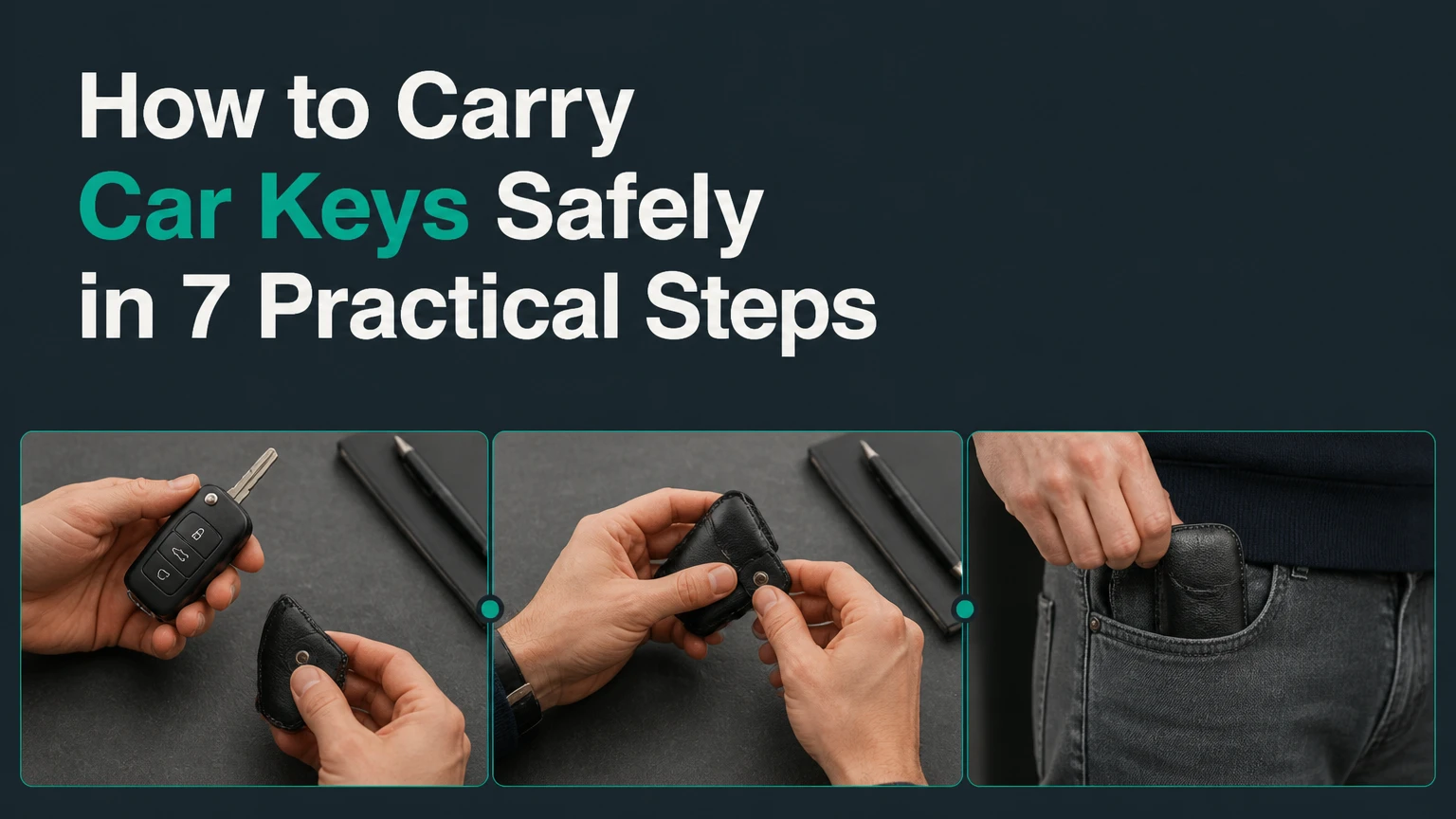
To carry car keys safely, identify the key type, remove unnecessary weight, attach the remaining keys securely, and keep them in a consistent pocket or clipped bag compartment. Smart-key owners should also reduce relay-theft exposure with distance or a tested signal-blocking pouch. The best setup takes about 5-10 minutes and depends mainly on your vehicle and daily activity.
Key Facts
A conventional transponder key usually communicates only when it is close to the vehicle’s ignition or reader.
A proximity key fob may respond to the vehicle only after a request, rather than continuously transmitting at full power.
A Faraday pouch must be fully closed and tested beside the vehicle; a pouch with a gap may provide little protection.
A heavy keychain can place unnecessary leverage on a traditional ignition cylinder.
Exterior magnetic key boxes are poor routine storage because thieves can locate, remove, or damage them.
A consistent carry location reduces lost-key incidents more effectively than adding decorative key accessories.
What should you prepare before carrying car keys?
Prepare the vehicle key, any genuinely necessary access keys, one attachment method, and a dedicated carry location. Most people need no specialized equipment. A smart-key owner may add a Faraday pouch, while someone who runs, cycles, swims, or works outdoors needs protection from sweat, water, impact, or accidental button presses.
Before You Start
| Requirement | Typical value | Why it matters |
|---|---|---|
| Setup time | 5-10 minutes | Allows key sorting, attachment, and signal testing |
| Difficulty | Low | No vehicle disassembly or programming is required |
| Basic cost | $0-$15 | Uses an existing pocket, split ring, or small pouch |
| Organizer cost | $15-$60 | Reduces noise and protects folding or loose keys |
| Signal-blocking pouch | $10-$30 | Adds relay-risk protection when completely closed |
| Tools | 1 split ring or clip, 1 pouch, 1 spare battery | Covers ordinary daily and backup needs |
| Prerequisite | Vehicle manual and spare-key plan | Confirms battery type and emergency-entry procedure |
Do not place a loose fob beside coins, sharp tools, or a phone with an exposed screen. Do not begin by buying a large organizer. First determine whether the vehicle uses a metal blade, a transponder, remote buttons, proximity entry, a digital key, or a combination of these systems.
Step 1: Audit and separate your key loadout
Separate the car key from house keys, workplace keys, access cards, and decorative objects before choosing a carrier. Keep the items required for the current trip together, but avoid attaching every key you own to the vehicle key.
A useful loadout has three groups:
- Daily essentials: vehicle key, house key, and one required access fob.
- Occasional keys: mailbox, storage unit, office cabinet, or bicycle lock keys.
- Decorative or redundant items: oversized tokens, loose charms, and duplicate keys that add bulk.
The distinction matters because a car key is used in places where a full key bundle creates problems. A large bundle can scratch a vehicle, press buttons inside a pocket, catch on a seat belt, or expose your home keys while you are away from home.
You will know the setup is appropriate when: the car key can be removed without dismantling unrelated keys, and the bundle does not create pressure against the fob buttons.
Common mistake: carrying a spare house key with a visible address tag. If the key bundle is lost, the tag can connect vehicle ownership, home access, and location.
Step 2: Identify how your vehicle key operates
Identify the key system from the key itself and the vehicle manual before selecting storage or signal protection. A metal blade, transponder key, remote fob, proximity fob, and digital key have different failure modes and cannot be managed identically.
| Key system | Physical features | Typical operating behavior | Main carrying concern |
|---|---|---|---|
| Metal ignition key | Cut blade, no electronic housing | Mechanical lock operation | Bending, scratching, and ignition wear |
| Transponder key | Blade plus small coded housing | Immobilizer authentication at close range | Water, impact, and lost spare |
| Remote-entry fob | Lock, unlock, panic, or trunk buttons | Battery-powered radio command | Accidental button presses |
| Proximity smart key | Larger fob, emergency blade, passive-entry vehicle | Vehicle and fob exchange short-range signals | Relay theft, battery failure, false unlocks |
| Digital key | Smartphone, smartwatch, or access card | Bluetooth, NFC, or manufacturer application | Battery depletion, app access, device loss |
Older transponder systems generally do not behave like a smart key that unlocks the car while remaining in a pocket. The vehicle usually energizes or interrogates the transponder near the ignition or reader. Proximity systems commonly use low-frequency wake-up signals around the vehicle and higher-frequency radio communication for authentication, but frequency, range, and behavior vary by manufacturer.
A smart key does not necessarily transmit a strong signal continuously. Some systems sleep until they receive a vehicle challenge, while others periodically communicate or remain responsive near the vehicle. The exact behavior belongs to the vehicle manufacturer, not to the generic label “keyless.”
You will know the key type is confirmed when: the manual identifies passive entry, push-button start, an immobilizer transponder, or a digital-key function.
Common mistake: buying a Faraday pouch for a remote-only fob while leaving the vehicle’s spare proximity key exposed near an entry door.
Step 3: Choose a secure attachment without adding harmful weight
Choose a small split ring, quick-release clip, or key organizer according to the key system and your clothing. Use a separate clip for a smart fob if you need the fob quickly, but keep a conventional ignition key’s bundle light and close to the body.
| Carry method | Typical cost | Bulk and noise | Best use | Main limitation |
|---|---|---|---|---|
| Split ring | $1-$5 | 2-5 keys, moderate noise | Simple pocket carry | Slow key removal |
| Belt-loop carabiner | $5-$25 | Visible, louder movement | Workwear and bags | Can snag or advertise keys |
| Compact organizer | $15-$60 | 2-6 flat keys, low noise | Office, commuting, formal clothing | Bulky smart fobs may not fit |
| Zippered pouch | $5-$30 | Quiet, protected | Bags, running, travel | Slower access |
| Quick-release clip | $8-$35 | Low to moderate noise | Separating car and house keys | Clip gate can open if poorly made |
Key organizers work best with flat, traditional keys. Many modern smart fobs are too wide, thick, or irregular for a plate-style organizer. A flexible silicone cover protects the fob from abrasion, but it does not block radio signals and may make buttons easier to press if the cover is loose.
A keychain’s weight is more important with a traditional ignition cylinder than with a push-button vehicle. There is no universal manufacturer limit of 100 grams that applies to every car. A safer practitioner rule is to keep the ignition key bundle as light as possible, avoid long dangling chains, and follow the owner’s manual if it specifies a limit.
You will know the attachment works when: the ring or clip remains closed after repeated pocket removal and the key does not swing far enough to strike the vehicle.
Common mistake: attaching a heavy multitool, flashlight, and several keys directly to an ignition key. Carry those tools separately.
Step 4: Choose a consistent carry location
Choose one dedicated location that protects the key from impact, moisture, and unauthorized access while allowing rapid retrieval. A front trouser pocket works for a small fob, an internal bag clip works for commuting, and a zipped belt or waist pocket works better during exercise.
| Situation | Recommended location | Protection needed | Access check |
|---|---|---|---|
| Daily trousers | Front pocket away from phone | Rigid or silicone fob cover | Buttons must face inward |
| Suit or office clothing | Zipped inner pocket | Slim pouch or organizer | Fob must not fall when seated |
| Backpack or handbag | Internal tether or key leash | Clip plus soft sleeve | Locate it without emptying the bag |
| Running or cycling | Zipped waist belt | Sweat-resistant pouch | Key must not bounce or press buttons |
| Swimming or water work | Waterproof container outside water | IP-rated sealed case | Confirm the vehicle has another entry plan |
| Public transit | Closed inner pocket | Optional Faraday pouch | Avoid displaying the vehicle brand |
Keep smart keys away from exterior doors, windows, and vehicle-adjacent walls when at home. The Metropolitan Police and the Automobile Association have both advised keyless-car owners to store keys away from doors and windows and to consider signal-blocking storage, because relay equipment can extend the apparent distance between a key and vehicle.
A signal-blocking pouch does not protect a key from theft if the pouch itself is stolen. It also does not stop mechanical entry, smashed windows, stolen spare keys, or attacks against the vehicle’s electronic control systems.
You will know the location is effective when: you can identify the key’s location immediately and retrieve it without placing it on a café table, car roof, or bathroom counter.
Common mistake: using a different pocket every day. Inconsistent placement is a leading practical cause of misplaced keys, especially after changing clothes.
Step 5: Add signal protection when the vehicle needs it
Use a Faraday pouch for a proximity smart key when the vehicle is vulnerable to relay attacks and the pouch has passed a real-world test. The pouch must surround the entire fob, close completely, and prevent the vehicle from detecting or responding to the key from outside the pouch.
How do you test a Faraday pouch?
- Stand beside the locked vehicle with the fob outside the pouch.
- Confirm that passive unlocking or push-button starting works normally.
- Put the entire fob inside the pouch and close the flap or zipper.
- Try the vehicle handle and start procedure again.
- Repeat the test at the distance where the key is usually stored at home.
You will know it worked when: passive entry fails and the vehicle cannot start with the fob fully enclosed. Test both sides of a two-layer pouch if the manufacturer provides separate compartments.
A Faraday pouch blocks or attenuates radio communication; it does not “stop car theft entirely.” Performance varies with stitching, seams, closure design, wear, and whether the emergency blade or another electronic key remains outside. Replace or retest the pouch if the lining tears or passive entry begins working through it.
| Security measure | Protects against | Does not protect against | Typical effort |
|---|---|---|---|
| Faraday pouch | Relay extension of fob signals | Physical theft or cloned credentials | 2 seconds per use |
| Key stored away from entry points | Easy signal capture near the vehicle | A stolen key or forced entry | 0 seconds |
| Steering-wheel lock | Vehicle being driven away after entry | Window breakage or key theft | 10-20 seconds |
| Manufacturer software updates | Some known electronic weaknesses | Every attack method | 5-30 minutes |
| Visible spare-key control | Unauthorized use of a spare | Relay attacks against the active fob | 1-5 minutes |
Common mistake: leaving the fob in the pouch but keeping the pouch unzipped for convenience. An open pouch provides no dependable shielding.
Step 6: Protect the key from water, impact, and battery failure
Protect a car key from water and impact, then plan for battery failure before the warning appears. Most fobs use a replaceable coin-cell battery, commonly a CR2032 or CR2025, but the correct type must come from the vehicle manual or the marking inside the fob.
Weak range, delayed button response, a dashboard warning, or repeated “key not detected” messages can indicate a low battery. Those symptoms can also result from interference, a damaged antenna, a failed fob, or a vehicle battery problem, so changing the battery is a first diagnostic step rather than a guaranteed repair.
Store one correctly specified spare battery at home, not loose beside coins. Learn the emergency-blade release and the backup starting position described in the manual. Many vehicles place the fob against a marked area, steering column, center console, or start button when the fob battery is depleted, but the location is model-specific.
You will know the key is protected when: the buttons cannot be pressed accidentally, the housing has no cracks, and you can enter and start the vehicle using the documented backup procedure.
Common mistake: carrying the fob loose in swimwear, a wet work pocket, or a bag containing a leaking bottle. Water damage can cost far more than a replacement battery.
Step 7: Establish a lost-key and spare-key plan
Create a spare-key plan before the primary key disappears. Keep a working spare in a secure home location, record the vehicle identification number separately, and store the manufacturer’s roadside-assistance or locksmith details without photographing sensitive key information publicly.
Do not upload a clear photograph of the key blade cuts to an ordinary cloud album. A blade image can reveal the mechanical code to anyone who gains access to the account. If a locksmith needs key information, provide it through a secured channel and verify ownership.
A dealer or automotive locksmith may need proof of ownership, the VIN, a key code, the existing fob, or specialized programming equipment. Replacement cost varies widely by vehicle and region. Typical figures range from roughly $50-$150 for a simple mechanical duplicate, $100-$300 for many transponder or remote keys, and $200-$600 or more for some proximity fobs after cutting and programming.
You will know the contingency works when: another household member can locate the spare and the vehicle can be recovered without relying on an unsecured key photograph.
Common mistake: storing the spare in a magnetic box underneath the vehicle. Exterior hiding places are discoverable, exposed to road salt and water, and often recommended online without considering the security risk.
Which key-carrying method fits your routine?
The best method depends on whether you prioritize low bulk, rapid access, water protection, or signal isolation. Pocket carry is usually simplest, a clip is practical for workwear, an organizer reduces noise, and a zipped pouch is the safest general choice for active movement.
| User profile | Recommended setup | Typical cost | Why it fits | Avoid when |
|---|---|---|---|---|
| Minimalist commuter | Fob cover plus front pocket | $5-$20 | One compact item, immediate access | The fob has frequent accidental presses |
| Office worker | Organizer for house keys plus separate fob | $20-$60 | Quiet and professional | The smart fob is too thick |
| Outdoor athlete | Zipped waist belt and waterproof sleeve | $10-$40 | Controls bounce, sweat, and loss | Swimming without a sealed container |
| High-risk keyless owner | Tested Faraday pouch plus steering lock | $20-$80 | Addresses relay and physical theft separately | The pouch is not tested or fully closed |
| Large key bundle owner | Quick-release clip with separate rings | $10-$35 | Removes house keys when driving | The clip gate is weak or exposed |
A carabiner is convenient, but it is not automatically more secure than a pocket. An exposed belt-loop clip can be seen, grabbed, or snagged, while a pocket can lose the key if it has no zipper. Select the method based on retention and concealment, not appearance.
An organizer is also not universally better. Thick proximity fobs often fit poorly, and forcing a fob into a rigid case can press buttons or stress the attachment loop. The practical winner for many smart-key owners is a compact sleeve with a separate key ring rather than a plate organizer.
What should you do in special situations?
Use a zipped, water-resistant container for running, cycling, or manual work, and use a properly sealed waterproof case for swimming. Do not tie a powered smart key to a shoelace or expose it to saltwater simply because the vehicle needs to remain accessible.
For a gym visit, keep the key in a closed locker or a zipped belt rather than an open bench pocket. For airline travel, keep the key in your personal item and maintain possession of it; checked baggage increases the chance of loss and makes a dead-battery problem harder to resolve.
Digital keys require a separate plan. Enable the vehicle manufacturer’s backup access method, keep the phone charged, protect the phone with a screen lock, and understand whether the vehicle supports NFC entry when Bluetooth or the phone battery is unavailable. A digital key is not a reason to abandon the physical spare.
Can you carry a car key in the same pocket as a phone?
Yes, ordinary phone proximity does not normally disable a correctly functioning vehicle key. However, a phone case with metal plates, a wallet containing foil or magnets, coins, and dense electronic equipment can reduce range or obstruct button access in some combinations.
Move the fob to a separate pocket if the range changes after adding a magnetic wallet or metal accessory. Do not assume a temporary failure proves theft or permanent fob damage.
Common problems and precise fixes
| Symptom | Likely cause | Immediate fix | Escalate when |
|---|---|---|---|
| Passive entry fails | Low fob battery or weak signal | Replace the specified coin cell and test outside the pouch | A fresh battery fails repeatedly |
| Buttons activate in pocket | Soft cover or crowded pocket | Turn buttons inward or use a rigid cover | Buttons remain stuck |
| Car does not detect fob | Dead fob battery, interference, or vehicle battery | Use the manual’s backup start position | Multiple keys fail |
| Key disappears at home | Inconsistent storage location | Search clothing, bags, counters, and vehicle | No spare is available |
| Pouch does not block signal | Open flap, worn lining, poor construction | Test the pouch and replace it | Vehicle still unlocks while fully enclosed |
| Ignition feels difficult | Worn key, cylinder, or excessive key leverage | Remove weight and try the spare | Resistance remains |
A key fob that fails only inside one bag may be experiencing shielding from metallic lining or nearby electronics. A fob that fails everywhere after a battery change may have a damaged circuit board, broken antenna, or programming problem.
A vehicle that unlocks while the fob is inside a properly closed pouch indicates failed shielding, not proof that the car has been hacked. A vehicle that unlocks without the fob requires prompt inspection because the cause could involve a second key, a door sensor, a software fault, or an attempted relay attack.
FAQ
Is it better to carry car keys in a front or back pocket?
A front pocket is usually better because the key remains easier to monitor and less likely to sit on when you bend or drive. Keep a smart fob away from the outside edge of the pocket and separate it from sharp objects. A zipped back pocket can retain keys, but sitting on a rigid fob can damage its housing.
Should I remove my car key from my house-key bundle?
Remove the car key when the bundle becomes heavy, noisy, difficult to identify, or likely to scratch the vehicle. Separating the fob also lets you leave house keys secured when parking with a valet, lending the car, or using a gym locker. A quick-release clip makes separation practical without carrying two unrelated bundles.
Can a Faraday bag drain a key-fob battery?
A Faraday bag does not normally drain a key-fob battery merely by blocking radio signals. The pouch can reduce unnecessary communication if the fob would otherwise respond near a vehicle, but battery life depends mainly on the fob’s design, wake cycles, temperature, and battery condition. Keep the pouch closed and replace the battery according to symptoms or the manual.
How far away should a smart key be from a car at home?
Keep a smart key several meters away from the vehicle and away from exterior doors and windows when practical. Greater distance reduces the opportunity for relay equipment to bridge the gap, although no universal distance guarantees protection because vehicle systems and attack equipment differ. A tested Faraday pouch adds another control.
Can I leave a spare car key under the vehicle?
Routine storage under a vehicle is not recommended. Magnetic boxes can detach, collect moisture, corrode the key, and provide a predictable hiding place that a thief may search. Keep the spare inside a secure building, or use a professionally managed key safe that does not expose the key to the vehicle exterior.
What is the safest way to carry a digital car key?
Keep the phone or smartwatch locked, charged, and physically secured in a zipped pocket or personal bag. Enable the manufacturer’s backup access method and carry a physical key when a dead phone, damaged device, or app outage could prevent entry. Digital access improves convenience, but it does not eliminate the need for recovery planning.
The Bottom Line
Carry car keys by using the lightest secure attachment, a consistent concealed location, and protection matched to the key system. Separate unnecessary keys, keep conventional ignition bundles light, protect smart fobs from water and accidental button presses, and test a fully closed Faraday pouch if relay theft is a concern. The right setup for how to carry car keys is the one that remains secure during your actual routine, including work, exercise, travel, and a dead-battery emergency.