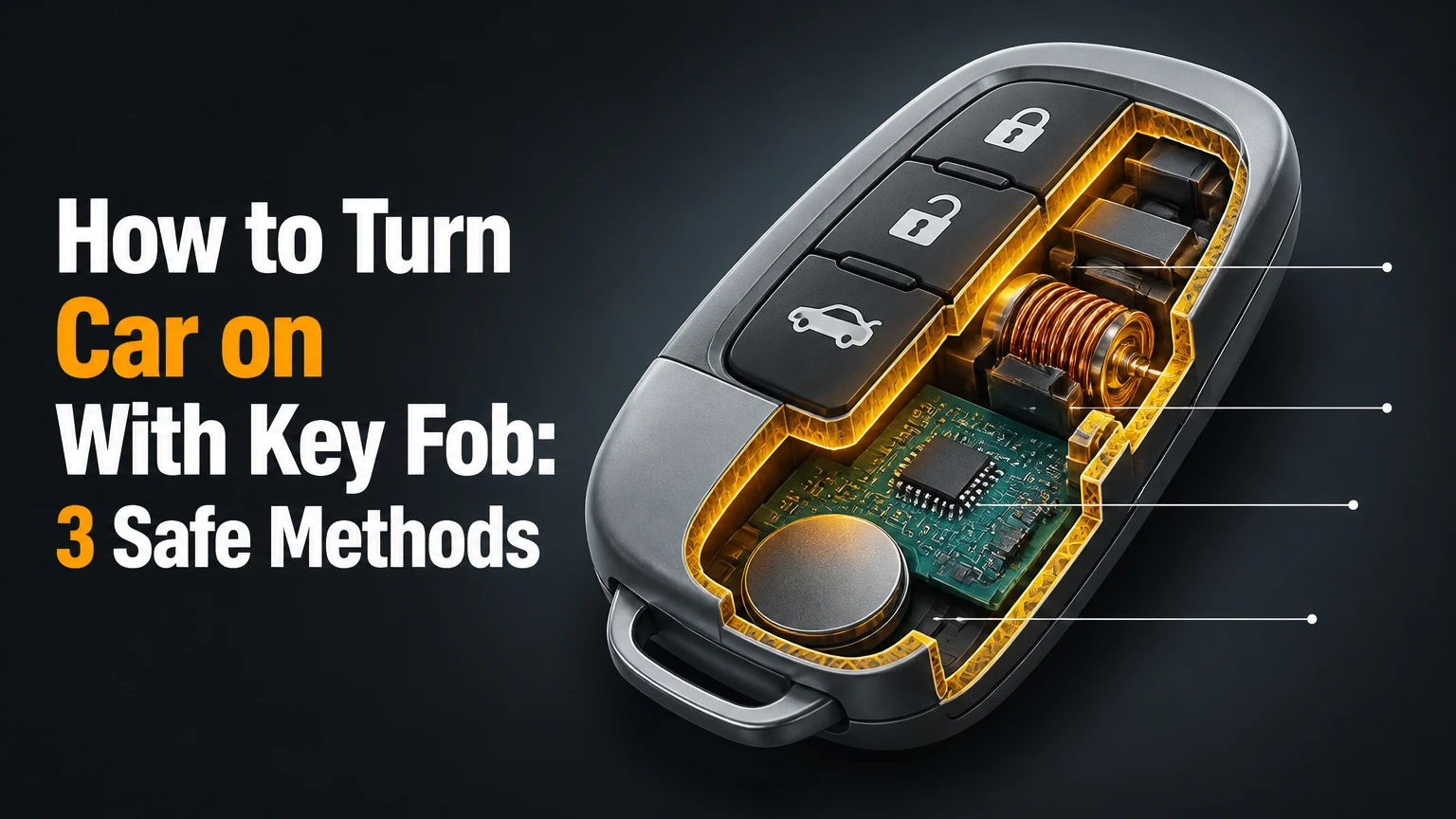
To turn a car on with a key fob, first identify whether the vehicle uses a physical ignition cylinder, push-button start, or a remote-start function. For push-button ignition, place the programmed fob inside the vehicle, select Park, press the brake, and press the Start/Stop button once. A dead fob battery usually requires the vehicle’s backup-reader position.
Key Facts at a Glance
A door-unlock button can work even when the fob cannot authorize engine starting.
A push-button car normally requires the fob inside the cabin, the transmission in Park, and the brake pedal depressed.
A hidden mechanical key usually unlocks the door but does not bypass the electronic immobilizer.
Many vehicles can read a dead fob when the fob touches the Start button or sits in a designated backup pocket.
Remote start and normal ignition are separate functions, and remote-start availability varies by vehicle, fob, subscription, and climate-control system.
A weak vehicle 12-volt battery can imitate a dead key fob and is often the real cause of a no-start condition.
What Kind of Key Fob Does the Car Use?
A car key fob generally belongs to one of four ignition categories: a traditional key with an integrated remote, a switchblade or jackknife key, a proximity fob with push-button start, or a remote-start transmitter. The buttons may look similar, but the starting procedure is different for each category.
| Fob and ignition type | Driver interaction | Engine authorization | Typical backup method |
|---|---|---|---|
| Traditional metal key | Insert and turn key | Transponder plus ignition cylinder | Mechanical key and chip |
| Switchblade or jackknife | Release blade, insert and turn | Transponder plus ignition cylinder | Fold-out blade |
| Proximity smart fob | Press Start/Stop with fob nearby | Interior antenna and immobilizer | Fob against button or backup slot |
| Remote-start fob | Lock, then press circular-arrow button | Remote-start module and immobilizer | Normal in-car start procedure |
A lock, unlock, trunk, or panic button does not prove that the fob can start the vehicle. Remote keyless entry and engine immobilizer authorization are related systems, but they can fail independently.
How Do You Identify the Correct Starting Method?
Look for an ignition cylinder, a Start/Stop button, or a circular-arrow button on the fob. A metal key slot behind a steering-wheel cover indicates a conventional ignition, while a Start/Stop button indicates proximity ignition even if the fob has a hidden blade.
Check the fob for these physical clues:
- A fold-out metal blade indicates a mechanical ignition or emergency door entry.
- A circular arrow, “2X,” or “remote start” label indicates remote starting.
- No visible blade and a Start/Stop button usually indicate a proximity smart key.
- A key-shaped slot in the center console, dashboard, glove box, or steering column may be the backup reader.
The owner’s manual remains the final authority because manufacturers place backup readers in different locations. The procedure for a 2024 Toyota Camry, 2021 Ford F-150, and 2018 Nissan Rogue can differ even when all three use push-button ignition.
How to Turn Car on With Key Fob Using Push-Button Start
To start a push-button vehicle, put the programmed key fob inside the cabin, shift the automatic transmission into Park, press the brake pedal firmly, and press the Start/Stop button once. The instrument cluster should illuminate and the engine should start, or a hybrid vehicle should show a “Ready” indicator instead of engine noise.
Step 1: Bring the Fob Inside the Vehicle
Place the key fob in the passenger compartment, not on the roof, behind the vehicle, or several feet outside the door. Interior antennas must detect the fob before the immobilizer permits normal starting.
Keep the fob away from metal containers, another vehicle key, and devices that can interfere with proximity detection. A phone beside the fob is rarely the sole cause of a no-start, but moving the fob into the open cabin removes a simple variable.
Success checkpoint: The dashboard does not display “Key Not Detected.”
Common mistake: Leaving the fob in a coat pocket outside the vehicle while trying to start it.
Step 2: Select Park and Press the Brake
Place an automatic transmission in Park and press the brake pedal through its normal travel. Many vehicles will not crank unless the brake-light switch reports that the pedal is depressed.
Manual-transmission cars commonly require the clutch pedal to be fully depressed instead. Some vehicles also require the transmission to be in Neutral, the parking brake engaged, or both. Never press the accelerator during a normal start unless the manufacturer specifically directs it for a flooded engine.
Success checkpoint: The dashboard shows the correct gear and the Start button responds.
Common mistake: Pressing the Start button without the brake, which selects accessory or ignition mode rather than starting the engine.
Step 3: Press Start/Stop Once
Press and release the Start/Stop button once while holding the brake. Do not repeatedly tap the button, and do not hold it down unless the owner’s manual specifies a special procedure.
A gasoline or diesel vehicle may crank for several seconds before starting. A hybrid may remain nearly silent, so confirm the “Ready” indicator, tachometer behavior, or vehicle information display before selecting Drive.
Success checkpoint: The engine runs, or the hybrid displays “Ready.”
Common mistake: Assuming a quiet hybrid has not started and pressing the button again, which may switch the vehicle off.
Step 4: Confirm That the Vehicle Is Ready to Move
Keep the brake pressed until the vehicle’s normal drive indication appears. Check warning lights, fuel or charge level, parking-brake status, and the surrounding area before selecting Drive or Reverse.
A remote-started vehicle often requires an additional brake-and-button transition, while a normally started vehicle usually does not. Follow the dashboard message rather than guessing.
How Do You Start a Car With a Physical Key Fob?
To start a car with a physical key fob, release or unfold the metal blade, insert it into the ignition cylinder, turn it to the ignition position, and then turn it to the start position while controlling the brake or clutch as required. The transponder chip must also be recognized by the immobilizer.
- Press the blade-release button and unfold the key.
- Sit in the driver’s seat and confirm Park or Neutral.
- Insert the blade fully into the ignition cylinder.
- Turn the key to the accessory or ignition position.
- Press the brake on an automatic vehicle, or the clutch on a manual vehicle.
- Turn the key briefly to the start position, then release it when the engine runs.
A metal blade can rotate the cylinder without being electronically authorized. If the engine cranks and immediately stops, the immobilizer may not recognize the transponder, the key may be damaged, or the key may not be programmed to the vehicle.
What If the Key Blade Will Not Turn?
Do not force a resistant ignition key. Apply light turning pressure while moving the steering wheel a few centimeters left and right, because a locked steering column can place pressure on the ignition cylinder.
A worn key, damaged cylinder, incorrect key blade, or mechanical steering-lock fault can also prevent rotation. If a spare key works normally, replace or repair the primary key rather than repeatedly forcing it.
How Do You Use the Remote-Start Button?
A typical remote-start sequence is to press Lock, then press and hold the circular-arrow or “2X” button for approximately 2-5 seconds. The vehicle may flash its hazard lights, sound a confirmation, or display a remote-start message, but button order and timing vary by manufacturer.
| Remote-start condition | Typical requirement | Reason for the lockout |
|---|---|---|
| Transmission position | Park | Prevents unintended movement |
| Hood status | Hood fully closed | Protects anyone servicing the engine |
| Key position | No key in ignition cylinder | Prevents conflicting authorization |
| Fuel or battery state | Adequate fuel or charge | Avoids running empty or draining power |
| Doors and tailgate | Closed and secured | Limits unauthorized entry |
| Runtime | Commonly 10-15 minutes | Controls fuel use and unattended operation |
After entering the vehicle, keep the fob inside, press the brake, and follow the dashboard’s takeover procedure. Many systems require pressing the Start/Stop button, while some factory systems only require the brake pedal.
Remote start should never operate in a closed garage or enclosed carport. A running combustion engine can produce carbon monoxide, an odorless gas that can accumulate quickly even when a door is partly open.
Remote start is also unavailable on some vehicles when the hood is open, the check-engine light is active, the fuel level is low, the alarm is triggered, or the vehicle has been left in an unauthorized state. An aftermarket remote starter may have different indicators and runtime settings.
How Do You Start the Car When the Fob Battery Is Dead?
When a key-fob battery is dead, use the hidden mechanical blade to unlock the driver’s door, then hold the fob at the manufacturer-designated backup reader while pressing the brake and Start button. The backup reader may be inside the Start button, center console, cup holder, glove box, or a marked slot.
Emergency Procedure for a Push-Button Vehicle
- Remove the mechanical key. Slide the release latch and pull out the emergency blade.
- Unlock the driver’s door. Insert the blade into the concealed door cylinder, often hidden under a handle cap.
- Enter and place the fob correctly. Try touching the fob to the Start button first. If that fails, use the console or dashboard key slot listed in the manual.
- Select Park. For some models, Neutral is an alternative only during specific fault conditions.
- Press the brake. Depress it firmly and keep it down.
- Press Start with the fob. Use the fob body to push the button if the manual specifies that method.
- Replace the battery. Install the exact battery type and polarity shown inside the fob.
Success checkpoint: The vehicle recognizes the fob and starts without a “No Key Detected” message.
Common mistake: Assuming the hidden metal key itself can start a push-button vehicle. The blade normally unlocks the door; the transponder and immobilizer still control engine authorization.
Some cars use a passive transponder that does not need the coin-cell battery, while others require a particular fob orientation or a functional backup reader. A dead fob battery therefore has no universal workaround.
Why Does the Key Fob Unlock the Car but Not Start It?
A key fob can unlock the doors but fail to start the engine because door access and immobilizer authorization use separate commands, antennas, or security checks. The most common causes are a weak fob battery, a discharged vehicle battery, an unrecognized transponder, incorrect gear position, or a brake or clutch switch fault.
| Symptom | Most likely area | Safe first check | Escalation point |
|---|---|---|---|
| No lights or clicks | Vehicle 12-volt battery | Check headlights and cabin lights | Jump-start test or battery service |
| “Key Not Detected” | Fob battery or reader | Hold fob at backup reader | Replace battery or diagnose antenna |
| Rapid clicking | Low vehicle battery | Try a known-good jump source | Battery and starter testing |
| Engine cranks but does not run | Fuel, ignition, immobilizer | Try spare programmed key | Diagnostic scan |
| Start button changes modes only | Brake or clutch switch | Press pedal fully | Switch and fuse inspection |
| Starts in Neutral only | Park-position circuit | Select Park again | Range sensor diagnosis |
What Should You Check First?
Check the vehicle battery before blaming the key fob. Dim interior lights, weak headlights, a clicking starter, or a blank instrument cluster point toward low 12-volt voltage, particularly after the vehicle has sat unused or experienced cold weather.
Next, try the spare programmed key. If the spare works, the original fob battery, case, transponder, or programming is suspect. If neither key works, the vehicle’s receiver, immobilizer system, brake switch, starter circuit, or battery requires diagnosis.
Move the shifter firmly from Park to Neutral and back to Park once. A misadjusted transmission range sensor can prevent starting, but repeatedly forcing the shifter will not repair the fault.
Do not attempt to bypass the immobilizer by cutting wires or installing an unverified module. That can disable theft protection and damage body-control or engine-control electronics.
What Are the Main Key-Fob System Differences?
Push-button proximity systems provide the fastest everyday starting experience, traditional keys offer the simplest mechanical fallback, and remote-start systems add distance operation rather than replacing normal ignition. Replacement cost, battery dependence, security exposure, and repair complexity differ substantially.
| Decision factor | Traditional key | Proximity smart fob | Remote-start-equipped fob |
|---|---|---|---|
| Normal starting action | Turn key | Press button | Press button inside vehicle |
| Typical replacement hardware | $50-$150 | $150-$400 | $200-$600 |
| Typical programming fee | $50-$100 | $100-$200 | $100-$250 |
| Typical replacement time | 15-30 minutes | 30-60 minutes | 45-90 minutes |
| Common coin-cell life | 2-5 years | 2-3 years | 1-2 years |
| Common battery examples | CR2032, CR2016 | CR2032, CR2450 | CR2032 |
These are typical North American ranges, not fixed prices. Vehicle brand, model year, key availability, immobilizer generation, local labor rates, and whether all keys are lost can change the final bill.
Is a Smart Fob More Secure Than a Traditional Key?
A modern smart fob normally provides stronger electronic authentication than a plain mechanical key, but proximity systems can be exposed to relay attacks when the fob remains near an exterior door. A relay attack extends communication between the vehicle and fob, making the car interpret the signal as nearby.
A Faraday pouch can reduce passive signal leakage when the fob is stored at home, but the pouch must be tested periodically because damaged lining or poor closure can defeat its purpose. Do not store the spare key beside the front door.
Traditional keys avoid proximity relay attacks, yet they remain vulnerable to physical theft, lock picking, key duplication, and transponder cloning. Security depends on the complete system, not the shape of the key.
How Much Does Key-Fob Replacement Cost?
A typical replacement key fob costs $50-$600 for hardware and $50-$250 for programming, with luxury proximity keys and all-keys-lost situations at the high end. Automotive locksmiths often charge less than dealerships, but an aftermarket fob must match the vehicle’s frequency, immobilizer system, buttons, and programming requirements.
| Service situation | Typical hardware cost | Typical labor or programming | Typical total time |
|---|---|---|---|
| Cut traditional transponder key | $40-$120 | $40-$100 | 15-45 minutes |
| Replace standard remote fob | $50-$150 | $50-$120 | 20-60 minutes |
| Replace proximity smart key | $150-$400 | $100-$250 | 30-90 minutes |
| Replace luxury or European smart key | $250-$600 | $150-$350 | 1-3 hours |
| All keys lost, mobile locksmith | $100-$500 | $100-$400 | 1-4 hours |
Call an automotive locksmith before ordering a fob online. Some vehicles accept owner-programmed remotes, while others require security credentials, diagnostic equipment, or an existing working key.
A replacement shell does not necessarily contain a transponder chip. Moving buttons and a circuit board into a new shell can restore appearance, but it will not repair a damaged chip, dead circuit board, or lost programming.
Which Troubleshooting Mistakes Should You Avoid?
The most damaging mistakes are repeatedly pressing Start without checking the battery, forcing a locked key cylinder, leaving a remotely started vehicle in an enclosed space, and buying a visually compatible but electronically incompatible fob.
Use this recovery sequence:
- Confirm the transmission is in Park and the brake or clutch is fully depressed.
- Check interior lights and headlights for signs of a weak 12-volt battery.
- Try the spare key, if available.
- Replace the fob coin cell with the specified type and correct polarity.
- Use the emergency reader location from the owner’s manual.
- Inspect dashboard messages and note whether the engine cranks.
- Arrange an automotive locksmith or repair diagnosis if the fault persists.
A car that does not crank has a different diagnostic path from a car that cranks but will not run. The distinction prevents unnecessary fob replacement.
What Variations Matter for Hybrids, Manuals, and Older Cars?
Hybrid vehicles may start silently, manual-transmission vehicles usually require clutch interlock confirmation, and older cars may use a transponder key even when the fob buttons control only the door locks. The ignition design, not the fob’s appearance, determines the correct procedure.
| Vehicle situation | Starting requirement | Confirmation of success |
|---|---|---|
| Gasoline automatic | Park plus brake | Engine sound and charging indicators |
| Hybrid automatic | Park plus brake | “Ready” message or indicator |
| Manual transmission | Neutral plus clutch | Engine running and clutch interlock satisfied |
| Older transponder key | Insert, turn, and chip recognition | Security lamp turns off |
| Remote-started vehicle | Brake plus takeover command | Drive gear becomes available |
Some older vehicles have a blade that turns the cylinder and a separate transponder capsule molded into the key. A copied metal blade may unlock or rotate the ignition but still fail immobilizer authentication.
For a manual transmission, never remote-start a vehicle unless the system has a verified reservation mode or equivalent manufacturer-approved safeguard. A vehicle left in gear can move unexpectedly.
What Information Does a Technician Need?
A locksmith or service department can diagnose the problem faster with the vehicle identification number, make, model year, key count, dashboard message, and a description of whether the engine cranks. Do not provide a photo of a key showing its complete security code publicly.
Record these details before calling:
- Exact make, model, and model year
- Push-button or physical-cylinder ignition
- Whether the doors lock and unlock
- Whether the dashboard illuminates
- Whether the starter cranks
- Whether a spare key works
- Whether the fob battery was recently replaced
- Whether the vehicle battery was recently discharged
- Whether all keys are missing or one programmed key remains
A dealership may be necessary for security credentials or software-specific programming. A qualified automotive locksmith may offer mobile cutting, key registration, and immobilizer diagnostics at a lower total cost.
Frequently Asked Questions
Can I Start a Car Without the Key Fob?
You generally cannot start a modern immobilizer-equipped car without a programmed key, recognized smart fob, or manufacturer-approved digital-key credential. The hidden blade may unlock the door, but engine control normally requires a transponder or encrypted authorization. Contact the owner, roadside assistance, dealership, or an automotive locksmith rather than bypassing the immobilizer.
How Long Does a Key-Fob Battery Last?
A key-fob coin cell typically lasts two to five years, although frequent button use, passive proximity detection, extreme temperatures, and poor-quality batteries shorten that period. Replace the battery when range decreases or the vehicle displays a low-key warning, and verify the replacement number and polarity against the fob marking.
Can I Drive Away After Remote Start?
A remotely started vehicle usually requires the fob inside the cabin and a brake-pedal takeover before Drive or Reverse becomes available. Some factory systems require a Start/Stop button press, while others authenticate the fob when the brake is pressed. Never operate remote start inside a garage or enclosed structure.
Why Does the Car Say No Key Detected?
“No Key Detected” usually means the vehicle cannot receive the fob’s signal or cannot authenticate its transponder. Move the fob away from metal, replace its coin cell, try the backup-reader position, and test the spare key. If both keys fail, investigate the vehicle battery, antenna, receiver, and immobilizer system.
Does a Phone Interfere With a Key Fob?
A phone beside a key fob can occasionally complicate proximity detection, but ordinary smartphone use is not usually the primary cause of a no-start condition. Move the fob away from phones, laptops, metal wallets, and other keys during testing. A weak vehicle battery or failed receiver is more likely when the problem affects every fob.
Is a Key-Fob Battery the Same as a Car Battery?
The key-fob battery is a small coin cell that powers buttons and radio communication, while the vehicle battery is a larger 12-volt battery that powers the starter, control modules, lights, and backup ignition systems. Replacing the fob battery will not correct dim lights, rapid clicking, or a blank dashboard caused by a discharged vehicle battery.
The Bottom Line
To turn a car on with a key fob, identify the ignition type first. Use the metal blade for a conventional cylinder, place a smart fob inside the cabin for push-button starting, or use the lock-and-circular-arrow sequence for remote start. When the fob battery is dead, unlock the door with the hidden blade and use the vehicle’s specified backup reader. If the car still will not start, test the vehicle battery and spare key before buying replacement hardware. Knowing how to turn car on with key fob depends on the vehicle’s exact make, model, year, and ignition system.