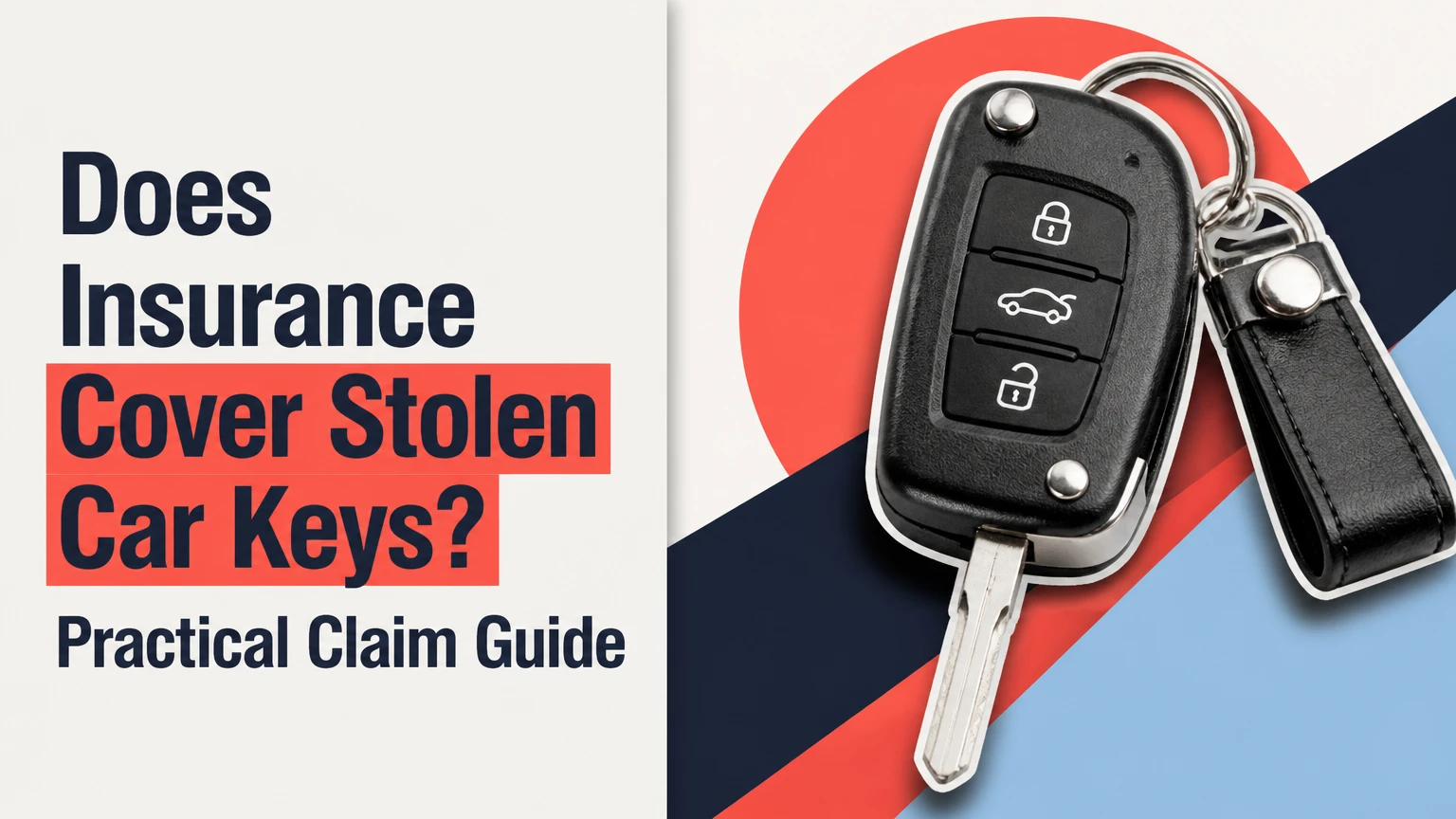
Insurance may cover stolen car keys through comprehensive auto insurance, homeowners or renters insurance, or a specific key-replacement endorsement. Coverage depends on where the theft occurred, whether the policy covers the event, your deductible, and whether the insurer pays programming or locksmith costs. Liability-only auto insurance usually does not cover replacement keys.
Key Facts
Comprehensive auto insurance may cover keys stolen during a covered burglary or vehicle theft, but a deductible usually applies.
A key-replacement endorsement or standalone key-care plan is usually the most direct option for stolen keys.
Homeowners or renters insurance may cover keys as personal property, subject to exclusions, limits, and a separate deductible.
Reprogramming the vehicle to delete the stolen key is a security expense that many basic policies exclude.
A claim generally makes financial sense only when the covered amount exceeds the deductible and any likely premium impact.
A police report, itemized invoice, proof of ownership, and evidence of key deletion can materially improve a theft claim.
Does Insurance Cover Stolen Car Keys?
Stolen car keys are covered only when a specific policy section includes the loss. Comprehensive auto insurance is more likely to respond when the keys were taken during a documented burglary or when the entire vehicle was stolen, while a key endorsement may cover standalone theft with a smaller deductible.
The same incident can produce different results under different contracts. An insurer may classify a key taken from a locked home as personal property under renters insurance, but classify a key taken from an unlocked gym locker as excluded or inadequately documented. A key left inside an unlocked vehicle can also create a negligence dispute.
Policy territory matters. The rules, terminology, claim deadlines, and mandatory benefits differ among US states, Canadian provinces, the United Kingdom, India, Bangladesh, and other markets. The policy schedule and endorsements control the outcome, not a general statement that “comprehensive covers theft.”
What counts as a stolen key?
A stolen key is a vehicle key, remote, transponder, proximity fob, digital-key device, or related credential taken through theft, burglary, robbery, or another insured event. A missing key that cannot be linked to a theft is usually treated as lost, and many standard auto policies exclude loss without associated vehicle damage.
Proof can include a police incident number, burglary report, CCTV footage, witness details, a workplace or gym incident report, and a timeline showing where the key was last secured. Insurers commonly distinguish between “stolen,” “lost,” and “misplaced” because the insured peril changes.
Which Policy Pays for Stolen Keys?
The policy most likely to pay depends on the theft location and the wording attached to the policy. A dedicated key-replacement endorsement generally offers the clearest route, while comprehensive auto insurance and homeowners insurance require closer analysis of the insured event, deductible, and property definition.
| Coverage source | Typical trigger | Common payment issue | Likely best use |
|---|---|---|---|
| Comprehensive auto | Burglary, vandalism, vehicle theft | $250-$1,500 deductible; standalone key loss may be excluded | Keys taken during vehicle or property damage |
| Homeowners insurance | Theft of personal property from a covered location | $500-$2,500 deductible; vehicle-related limits may apply | Keys stolen from a home or covered premises |
| Renters insurance | Theft of the renter’s personal property | Personal-property limit and deductible apply | Apartment, locker, or covered off-site theft |
| Key endorsement | Lost, stolen, damaged, or broken key listed in endorsement | $0-$100 deductible; annual or per-claim cap | Standalone key replacement and programming |
| Roadside membership | Lockout, towing, or locksmith dispatch | Service cap, visit limit, or mileage limit | Emergency access, not usually ownership of a new fob |
| Liability-only auto | Damage or injury caused to others | No first-party key benefit | Usually does not pay replacement keys |
Does comprehensive insurance cover a stolen key?
Comprehensive insurance may cover a stolen key when the key theft is part of a covered burglary, vandalism event, or vehicle theft. Comprehensive coverage does not automatically mean every lost or stolen key is covered, and the deductible can exceed the replacement cost.
For example, a thief breaks a car window, steals the key from the center console, and damages the ignition area. The insurer may evaluate the glass, interior damage, lock repairs, and key replacement under the same comprehensive claim, subject to policy terms. A key taken from a kitchen table without vehicle damage is less likely to fall under auto comprehensive coverage.
The Insurance Information Institute describes comprehensive coverage as protection for non-collision events such as theft, vandalism, fire, and weather damage. That description identifies the covered peril, but it does not guarantee payment for every item associated with the vehicle.
Does homeowners insurance cover car keys?
Homeowners or renters insurance may cover a stolen car key as personal property when theft occurred from a covered location. The policy may still exclude vehicle parts, limit property kept in a vehicle, or apply a deductible that makes a small key claim uneconomic.
A key stolen from a locked residence is a stronger property-insurance scenario than a key taken from an unattended, unlocked car. Off-premises theft may have a lower sublimit, and some policies treat automotive equipment differently from ordinary personal belongings. The declarations page, personal-property section, exclusions, and endorsements need review together.
Do not assume two policies will pay the same bill. An auto insurer and a homeowners insurer may each argue that the other policy is primary, or one may exclude the same cost. Ask both insurers for a written coverage position before authorizing expensive work when safety allows.
What does a key-replacement endorsement cover?
A key-replacement endorsement is an optional policy addition that can cover replacement, cutting, coding, programming, locksmith labor, towing, and sometimes lock replacement. The exact benefit may have a per-claim limit, annual limit, approved-provider rule, or requirement to use an original-equipment part.
Some products cover lost and stolen keys; others cover only accidental damage or provide roadside dispatch. A dealership protection plan may also be limited to the original vehicle owner, first ownership period, or a specified number of claims. Read the schedule rather than relying on the product name.
How Much Does a Replacement Car Key Cost?
Typical US replacement costs range from $20-$80 for a basic metal key to $250-$1,000 or more for a smart key, proximity fob, or luxury vehicle system. Programming, emergency labor, towing, lock changes, and a backordered OEM part can add substantially to the invoice.
| Key system | Typical part cost | Programming or labor | Typical total time |
|---|---|---|---|
| Metal mechanical key | $20-$80 | $0-$100 | 20-60 minutes |
| Transponder key | $50-$180 | $50-$150 | 1-3 hours |
| Remote key fob | $100-$350 | $75-$200 | 1-4 hours |
| Proximity smart key | $200-$600 | $100-$300 | 2 hours-2 days |
| Luxury or EV fob | $300-$1,000+ | $100-$400 | 1-7 days |
These are typical practitioner ranges, not guaranteed market prices. Chase’s consumer guidance notes that vehicle make, model, year, key technology, and programming requirements drive replacement cost. A 2010 compact car and a current Mercedes-Benz or Tesla can require very different equipment and authorization.
A dealer quote may include an OEM key, security registration, labor, taxes, and a vehicle inspection. An automotive locksmith may offer a lower price, but the locksmith must support the vehicle’s immobilizer, proximity system, or manufacturer-specific enrollment process.
Does insurance pay programming and lock replacement?
Insurance pays programming or lock replacement only when the applicable policy includes those costs and the insurer accepts them as necessary. A key endorsement often lists programming and labor explicitly, while comprehensive or property coverage may pay only for the damaged or stolen property.
Ask the insurer whether the benefit covers:
- Key cutting or replacement of the physical blade
- Transponder or immobilizer programming
- Remote and proximity-fob enrollment
- Deletion of the stolen key from vehicle memory
- Door, trunk, ignition, or steering-lock replacement
- Towing to an approved dealer
- Emergency locksmith labor
- Digital-key reset or mobile-app credential removal
The distinction matters because deleting an old key can be more important than cutting a new one. A replacement fob does not necessarily disable the stolen credential.
Should You File an Insurance Claim?
File a key claim when the expected covered reimbursement materially exceeds the deductible and the policy does not impose a meaningful claim-history disadvantage. Paying directly is often more rational for a $100-$300 key under a $1,000 comprehensive deductible, while a $700 smart-key system may justify a low-deductible endorsement claim.
Use this break-even calculation:
Expected insurance payment = approved replacement cost minus deductible, subject to policy limits.
Example: a $620 replacement and programming invoice with a $500 deductible produces a theoretical $120 payment before exclusions, taxes, or claim limits. A $620 invoice under a $1,000 deductible produces no payment. A $75 endorsement claim with a $0 deductible may be worthwhile if the endorsement does not impose a restrictive annual limit.
Premium consequences are not universal. Some insurers surcharge comprehensive claims, some treat theft claims differently from at-fault collisions, and some jurisdictions restrict how insurers may use claim history. Ask the carrier how the claim will be coded before withdrawing or proceeding.
| Scenario | Invoice | Deductible | Theoretical payment | Practical decision |
|---|---|---|---|---|
| Basic transponder key | $180 | $500 | $0 | Usually pay directly |
| Proximity fob | $650 | $500 | $150 | Compare claim record and coverage |
| Two smart keys after burglary | $1,100 | $250 | $850 | Claim often merits review |
| Key endorsement claim | $650 | $0 | Up to policy limit | Usually use endorsement |
| Key plus broken window | $900 total | $500 | $400 before exclusions | Review combined damage |
A practitioner rule of thumb is to request a written estimate before filing a low-value claim. The estimate reveals whether programming, towing, or security work changes the calculation.
What Should You Do Immediately After Key Theft?
Secure the vehicle, report the theft, and delete the stolen credential before treating the incident as an ordinary replacement. The safest sequence is police documentation, insurer notification, an authorized locksmith or dealer, and verification that the stolen key no longer starts or unlocks the vehicle.
Step 1: Report the theft
File a police report promptly and describe the key type, vehicle identification number, location, time window, and any stolen registration or address documents. Request the report or incident number, because an insurance call log may not establish that the event was theft.
A report does not guarantee coverage. It establishes the event and creates evidence that supports the claim.
Step 2: Move or immobilize the vehicle
Move the vehicle to a locked garage or monitored location if the car remains drivable and doing so is safe. If the key was stolen with registration, a home address, garage remote, or house key, treat the incident as a possible access threat rather than a simple lost-property event.
Use the manufacturer’s connected-car app to disable remote access where available. Do not rely on an app command as a substitute for physical key deletion.
Step 3: Notify the insurer before expensive work
Give the insurer the police number, theft location, vehicle identification number, key description, and proposed repair provider. Ask for a claim number and written instructions about preapproval, documentation, and approved vendors.
Emergency security work may be reasonable before an adjuster responds, but photograph the vehicle, save damaged parts, and obtain authorization when possible. Policy conditions may require prompt notice or inspection.
Step 4: Delete the stolen key
Ask a dealer or qualified automotive locksmith to erase the stolen transponder, remote, and proximity credential from the vehicle’s memory. Request an invoice or diagnostic record stating how many keys remain authorized after the procedure.
Some vehicles cannot delete a single credential without re-enrolling every remaining key. Bring every key still in your possession so the technician can confirm the final key count.
Step 5: Replace the credential
Obtain at least two itemized quotes when the policy allows consumer choice. Confirm whether each quote includes the physical key, battery, cutting, immobilizer programming, remote enrollment, labor, tax, towing, and any required security code.
An ALOA-affiliated locksmith may have suitable training, but affiliation alone does not prove compatibility with every vehicle. Verify the provider’s ability to program the exact make, model, year, and system.
Step 6: Preserve claim evidence
Keep the police report, photos, receipts, written estimates, payment records, damaged lock parts, locksmith credentials, and insurer correspondence. Record the date and name of every person who gives approval or coverage instructions.
A verbal assurance that “keys are covered” is incomplete. The claim may still be limited by deductible, annual maximum, approved-part rules, or a property exclusion.
Step 7: Test every function
Before closing the claim, test ignition authorization, remote lock and unlock, trunk release, proximity entry, panic alarm, mechanical blade operation, and any digital key. You know the security work succeeded when the stolen credential no longer unlocks or starts the vehicle.
What Can Prevent an Insurance Payout?
Common denial causes include policy exclusions, insufficient theft evidence, failure to report promptly, unauthorized repairs, a deductible above the loss, and a claim for a lost key under coverage that applies only to theft. Insurers may also dispute costs that exceed a policy limit or were incurred without required approval.
| Denial or reduction reason | Why the insurer raises it | Evidence or response |
|---|---|---|
| “Lost,” not stolen | No identifiable insured theft event | Police report, witness, CCTV, timeline |
| Deductible exceeds invoice | Covered loss falls below retention | Compare endorsement or property policy |
| Unlocked vehicle | Negligence or policy condition issue | Explain circumstances and document forced entry |
| No prior authorization | Contract requires approved provider | Ask for emergency-work exception |
| Excessive dealer invoice | Limit or reasonable-cost clause | Obtain comparable qualified quotes |
| Old key still active | Replacement was incomplete | Request security-memory report |
| Policy bought after theft | No coverage for known loss | Provide purchase and incident timestamps |
The “keys left in the car” issue often concerns the later theft of the vehicle, not merely replacement of the keys. Progressive and other auto insurers explain that leaving keys in an unattended vehicle can affect a stolen-car claim because the conduct may be treated as an increased risk or policy violation. The exact result depends on the contract and local law.
How do you appeal a denied key claim?
Request the denial in writing, identify the exact exclusion or limit, and submit the police report, policy endorsement, itemized invoices, and evidence of necessary programming. If the insurer maintains the denial, ask for an internal review and contact the state insurance department or equivalent regulator.
An appeal should answer the insurer’s stated reason rather than repeat the original request. For example, if the insurer says the key was lost, provide evidence tying the key to a documented burglary. If the insurer disputes programming, point to the endorsement language or obtain a technician statement explaining why the vehicle remained vulnerable without it.
Can Someone Steal the Car With the Key?
A stolen mechanical key may open a door but cannot start many modern vehicles without a matching transponder. A stolen proximity fob or enrolled digital credential can create a greater risk because it may permit passive entry and ignition until the vehicle system removes that credential.
| Credential type | Typical vehicle access | Main security action |
|---|---|---|
| Metal blade | Door or trunk lock | Replace blade or lock cylinder |
| Transponder chip | Engine start authorization | Erase chip and enroll new key |
| Remote fob | Lock, unlock, alarm, trunk | Delete remote ID and replace fob |
| Proximity fob | Passive entry and push-button start | Revoke credential and re-enroll keys |
| Mobile digital key | App-based entry and start | Revoke account access and reset sharing |
Modern immobilizers reduce casual hot-wiring, but they do not remove the risk from an authorized credential. A thief who has the key and a document showing the home address may also target the residence, garage, or second vehicle.
If the stolen key was connected to a house key, garage remote, registration, or insurance card, change relevant locks or access codes. Remove the vehicle from the address when practical until the credential is deleted.
Which Coverage Option Is Best?
A key endorsement is usually the best financial fit for people seeking standalone key protection, while comprehensive insurance is more suitable for a broader burglary or vehicle-theft event. Homeowners insurance may help when the key was stolen from the residence, and roadside assistance is mainly a service alternative rather than insurance.
| Option | Deductible or cap | What it commonly includes | Main limitation |
|---|---|---|---|
| Comprehensive auto | $250-$1,500 deductible | Theft-related vehicle damage and some associated losses | Standalone key loss may be excluded |
| Key endorsement | $0-$100; $500-$2,000 cap | Key, coding, labor, towing, sometimes locks | Must exist before the incident |
| Homeowners or renters | $500-$2,500 deductible; property sublimits | Stolen personal property | Automotive exclusions and off-premises limits |
| Roadside membership | $50-$150 service allowance | Locksmith dispatch, towing, lockout service | Often does not pay for the fob itself |
| Self-pay | No deductible or claim record | Any provider and repair method | Entire cost is immediate |
Roadside assistance from an auto club may arrange a locksmith or reimburse a capped service amount. It often covers unlocking a vehicle, towing to a dealer, or emergency labor, but replacement hardware and programming may remain your responsibility.
A manufacturer warranty rarely covers theft or loss because those events are not manufacturing defects. A dealer protection plan, lease contract, credit-card benefit, or vehicle-service contract may provide separate assistance, but eligibility and exclusions must be verified before relying on it.
What varies by vehicle?
Vehicle age, immobilizer design, key availability, regional parts supply, and manufacturer programming rules determine both cost and repair time. Electric vehicles may use proximity fobs, phone credentials, backup cards, or account-based access, so a physical replacement alone may leave a digital credential active.
Luxury brands frequently require dealer software or security credentials. Some independent locksmiths can program them; others cannot. A quote that appears cheaper may exclude the required security gateway access, towing, or a second key needed for enrollment.
How Can You Reduce the Cost?
Compare an authorized automotive locksmith with the dealer, but compare identical deliverables rather than headline prices. The cheapest quote is inadequate if it supplies an aftermarket fob that the vehicle rejects, omits key deletion, or provides no programming record.
Use these cost-control measures:
- Ask the insurer whether preapproval is required.
- Obtain the exact part number and key frequency where applicable.
- Confirm whether an aftermarket or refurbished fob is permitted.
- Ask for a price that includes cutting, programming, labor, tax, and travel.
- Bring all remaining keys to avoid repeat enrollment charges.
- Check manufacturer roadside benefits, lease protection, and vehicle-club coverage.
- Avoid buying a replacement online until compatibility and return rules are confirmed.
An automotive locksmith can be cheaper than a dealership for common transponder systems, but dealer service may be the only practical option for a new or restricted security platform. Never sacrifice credential deletion to save a programming fee.
What Policy Details Should You Check?
Check the declarations page, comprehensive limit, deductible, key-loss endorsement, personal-property limit, theft exclusions, locksmith rules, claim deadline, and requirement for prior authorization. These details determine whether a policy pays a replacement key, a security reset, damaged vehicle components, or none of those costs.
Search the policy for terms such as “keys,” “key fob,” “remote,” “transponder,” “personal property,” “vehicle equipment,” “theft,” “burglary,” “locksmith,” “programming,” “reasonable cost,” and “loss prevention.” The absence of a search result does not settle coverage because exclusions may use different wording.
The National Association of Insurance Commissioners advises consumers to review policy documents and contact the insurer or agent about coverage questions. Ask for a coverage answer that identifies the applicable insuring agreement, exclusion, deductible, and limit.
What is this coverage not good for?
Standard comprehensive insurance is not a reliable low-cost warranty for every missing key. It may be poor value for a routine lost-key event, a claim below the deductible, or a vehicle with an inexpensive mechanical key.
A key endorsement is also not universal theft protection. It may exclude digital credentials, lock replacement, commercial vehicles, rental cars, intentional damage, or claims made after the policy limit is exhausted. A roadside membership is not a substitute for immobilizer reprogramming.
FAQ
Does insurance cover lost car keys as well as stolen keys?
Many standard auto policies cover neither standalone lost nor misplaced keys, although a key-replacement endorsement may cover both. Comprehensive coverage is more likely to respond when the key loss accompanies a covered burglary, vandalism, or vehicle theft. The policy must specifically include the relevant event or benefit.
Will replacing a stolen key lower my insurance premium?
Replacing a stolen key does not normally lower an insurance premium. A claim could affect future pricing, but the effect varies by insurer, claim type, jurisdiction, prior history, and fault rules. Ask whether the insurer treats a key claim as a comprehensive claim and whether withdrawing it changes the claim record.
Can I claim a stolen key without a police report?
You may be able to notify an insurer without a police report, but many theft claims require formal evidence before payment. A police report is especially important when no vehicle damage exists. If local police will not take a report, obtain an incident number or written alternative and ask the insurer what evidence it accepts.
Does car insurance cover keys stolen from a hotel or gym?
Coverage depends on the policy and location. Homeowners or renters insurance may cover personal property stolen away from home, often with a separate limit, while auto comprehensive may exclude a key taken without vehicle damage. Obtain the venue’s incident report and check off-premises and vehicle-property exclusions.
Does a stolen spare key require changing the locks?
A stolen spare key may require lock-cylinder replacement when the physical blade can still open the vehicle or when the thief knows the vehicle’s location. For electronic keys, deleting the credential may be enough for engine-start protection, but confirm whether it also disables remote and passive-entry functions.
Does a lease or financed car change the claim?
A lease or finance agreement does not automatically change insurance coverage, but the vehicle owner or leasing company may require approved parts, security procedures, or notification. Follow the contract, insurer instructions, and manufacturer requirements. Keep the programming record because missing keys can create charges at lease return.
The Bottom Line
Does insurance cover stolen car keys? Sometimes. Comprehensive auto insurance may respond to keys stolen during a covered burglary or vehicle theft, homeowners or renters insurance may cover them as personal property, and a key-replacement endorsement usually provides the clearest standalone benefit.
Compare the replacement estimate with the deductible before filing. Report the theft, secure the vehicle, preserve evidence, and have every stolen credential deleted from the vehicle system. The policy wording, theft circumstances, location, vehicle technology, and jurisdiction determine the final payment.