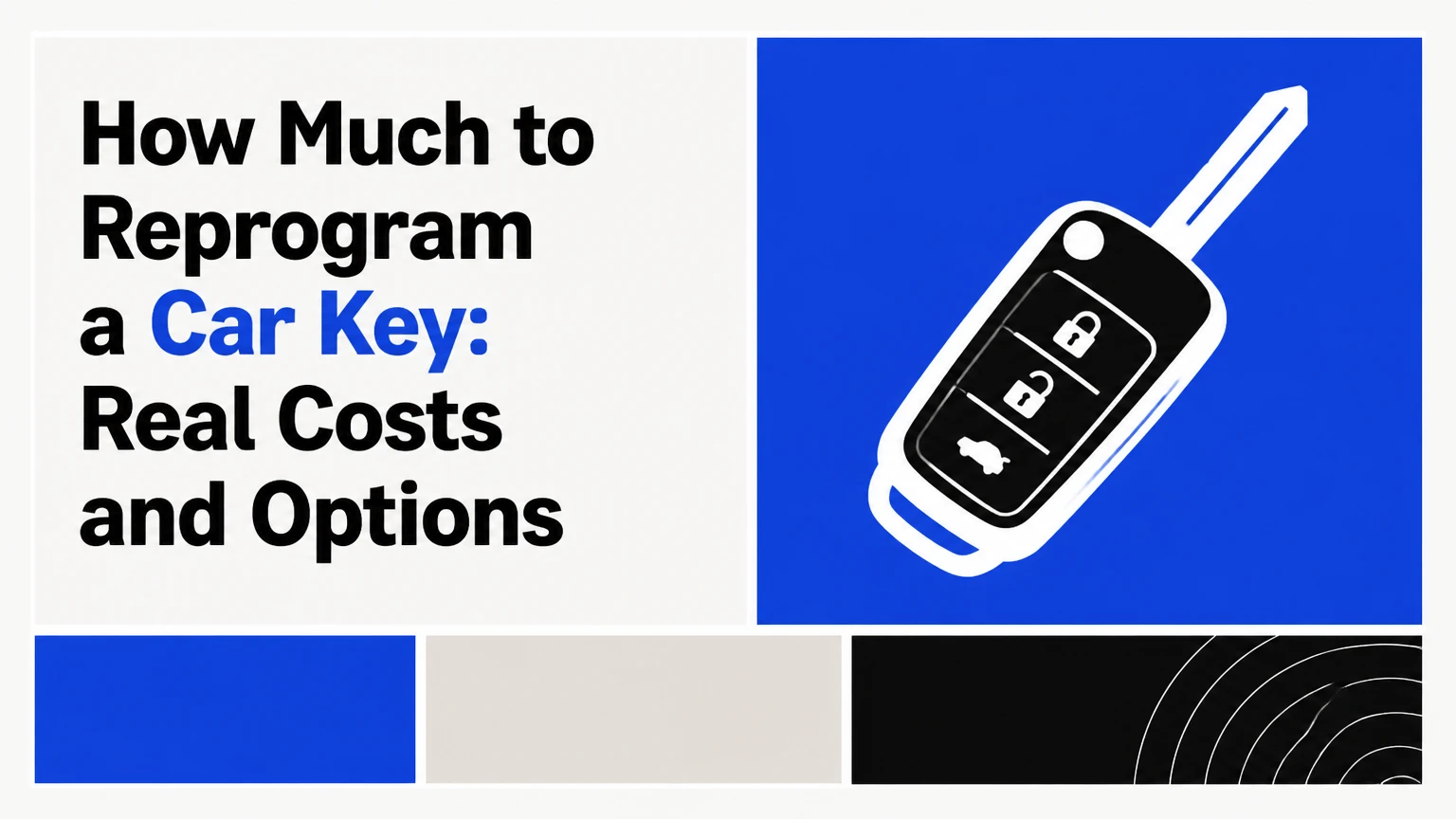
Reprogramming a car key typically costs $50-$250 for programming alone and $70-$500 or more when the replacement key or fob is included. Basic transponder keys are usually least expensive, while push-button-start proximity keys, lost-all-key situations, luxury vehicles, emergency callouts, and dealership security access create the highest bills.
Key Facts at a Glance
- A basic transponder-key programming appointment commonly takes 15-30 minutes and costs $50-$100.
- A remote key-fob replacement and programming commonly totals $120-$300, including the fob.
- A smart proximity key commonly costs $200-$500 or more, including the device and programming.
- Programming a remote lock button is different from programming the immobilizer chip that permits engine starting.
- A working original key can reduce the job’s price, but many vehicles still require diagnostic equipment.
- A used fob may be reusable on some vehicles and permanently locked on others, so compatibility must be checked by part number, FCC ID, and vehicle application.
How Much Does It Cost to Reprogram a Car Key?
Car key reprogramming alone generally costs $50-$250, but a complete replacement usually costs more because the invoice can include the key, cutting, programming, mobile travel, emergency labor, and security-code access. Typical US consumer pricing is shown below; metropolitan rates and luxury-brand pricing can exceed these ranges.
| Key or service type | Programming-only price | Typical total with replacement key | Typical appointment time |
|---|---|---|---|
| Metal key with no chip | $0-$30 | $20-$80 | 10-20 minutes |
| Transponder ignition key | $50-$100 | $70-$150 | 15-30 minutes |
| Remote-head key | $60-$140 | $100-$250 | 20-40 minutes |
| Separate remote fob | $50-$120 | $90-$220 | 15-35 minutes |
| Push-button proximity fob | $100-$250 | $200-$500+ | 30-60 minutes |
| All keys lost, standard vehicle | $100-$250 | $180-$450 | 45-120 minutes |
| Luxury or restricted-security vehicle | $150-$400 | $400-$800+ | 60-180 minutes |
The most important pricing distinction is programming versus replacement. If a vehicle owner already has a compatible, cut key or blank fob, the technician may charge only for synchronization. If the key is missing, the bill also covers the replacement device and, for an all-keys-lost job, additional vehicle-security work.
After-hours appointments can add $50-$150, while a mobile locksmith may add a travel or service-call charge of $20-$100. Dealers often bundle diagnosis, OEM parts, and programming into one labor line, making their quote harder to compare directly with a locksmith’s programming-only price.
What Does a Car Key Need to Be Programmed?
A car key needs a compatible transponder or electronic fob, a vehicle immobilizer system, and a programming method authorized for that make, model, year, and market. A cut metal blade alone does not require electronic programming, but a chip key or proximity fob does if it must start the vehicle.
A modern automotive key may contain several separate functions:
- Mechanical blade: Opens the door or turns an ignition cylinder.
- Transponder chip: Communicates with the immobilizer for engine authorization.
- Remote transmitter: Operates lock, unlock, trunk, or panic buttons.
- Proximity system: Lets the vehicle detect a fob inside or near the cabin.
- Emergency blade: Provides physical entry when the fob battery is dead.
These functions do not always use the same programming procedure. A remote may lock and unlock the doors while its immobilizer function remains unregistered. Conversely, a transponder may start the engine while the remote buttons remain inactive.
The vehicle’s immobilizer control module, body control module, instrument cluster, or engine-control system stores authorized identifiers. The exact architecture varies by manufacturer. Some cars use a separate immobilizer module, while others integrate authorization into a body or gateway module.
How Does Car Key Programming Work?
Car key programming creates an authorized relationship between the vehicle’s security module and the key’s electronic identifier. During programming, a diagnostic tool or approved vehicle procedure places the car into a learn mode, authenticates access, and stores the new key data.
A simplified sequence is:
- The technician identifies the vehicle and compatible key.
- The vehicle enters a security-authorized learning mode.
- The key and vehicle exchange encrypted or coded information.
- The immobilizer stores the key identifier.
- The technician tests starting, locking, proximity detection, and emergency functions.
The common description of an ECU sending a pulse and the key returning a code is directionally useful, but it is not a complete description of every vehicle. Some systems use low-frequency wake-up antennas, radio-frequency responses, rolling codes, cryptographic authentication, challenge-response exchanges, or security gateways between the diagnostic port and immobilizer module.
A key-fob battery usually powers the buttons and proximity transmitter. The passive transponder used for starting may operate through the vehicle’s inductive field on some designs, meaning a weak fob battery can disable remote entry without preventing an emergency start. The owner’s manual determines the correct backup-start position.
Which Car Key Type Costs the Least?
A traditional transponder key costs the least among electronically coded keys because it normally contains a small chip and a mechanical blade rather than a proximity module, multiple antennas, or a complex remote circuit board. A simple replacement commonly totals $70-$150 when a compatible blank is available.
| Key type | Main vehicle function | Common failure symptom | Typical replacement total |
|---|---|---|---|
| Metal key | Physical entry or ignition rotation | Key turns lock but has no electronic function | $20-$80 |
| Transponder key | Engine-start authorization | Engine cranks or turns over but will not run | $70-$150 |
| Remote-head key | Starting plus remote buttons | Start works, buttons fail, or both functions fail | $100-$250 |
| Smart proximity fob | Keyless entry and push-button start | “No key detected” or intermittent entry | $200-$500+ |
| Integrated digital key | Phone or card-based authorization | App, phone, or vehicle pairing failure | $0-$300, vehicle dependent |
Older vehicles sometimes support owner programming when two already-authorized keys are available. That capability is manufacturer-specific and cannot be inferred from the key’s appearance. The vehicle owner’s manual is more reliable than a generic online sequence.
Is Programming a Remote Fob the Same as Programming a Transponder?
Programming a remote fob is not necessarily the same as programming a transponder key. Remote programming controls wireless convenience features such as door locks, whereas transponder programming authorizes the vehicle’s immobilizer to permit engine operation.
This distinction explains many confusing outcomes:
- The remote buttons work, but the engine will not start.
- The engine starts, but the door-lock buttons do nothing.
- A replacement shell fits the blade but contains an incompatible chip.
- A fob battery replacement restores buttons but does not repair lost immobilizer authorization.
- A vehicle accepts a remote through a manual sequence but requires a scan tool for the immobilizer.
Some vehicles combine these procedures into one diagnostic session. Others separate them completely. A quote should state whether it includes remote synchronization, immobilizer registration, key cutting, or all three.
Can You Program a Car Key Yourself?
You can program some car keys yourself, but only when the vehicle manufacturer provides an owner procedure and the required prerequisites are present. The most common prerequisite is two already-working keys, although some models permit a single-key procedure or remote-only programming.
A generic two-key sequence may resemble this pattern:
- Insert an authorized key and switch the ignition to the specified position.
- Turn it off within the manufacturer’s time limit.
- Insert the second authorized key and repeat the sequence.
- Insert the new key and place the ignition in the required position.
- Wait for the security indicator or confirmation message.
- Test engine starting and remote functions.
That sequence is not universal. Timing, ignition position, door state, key order, and the number of keys required vary by make and model. Applying the wrong sequence normally fails, but repeated incorrect attempts can trigger a security lockout or consume a limited learning cycle.
DIY programming is most reasonable when the owner has a verified blank, two working keys, a stable vehicle battery, and an exact factory procedure. It is a poor choice when all keys are lost, the vehicle has a security gateway, the replacement fob is used, or the vehicle is needed immediately.
What Happens During Professional OBD-II Programming?
Professional OBD-II programming connects a compatible diagnostic tool to the vehicle’s data network and uses authorized software to add, delete, or synchronize keys. The technician first verifies ownership and vehicle identity, then performs a security procedure specific to the manufacturer.
A legitimate professional process generally includes:
- Confirming the VIN, model year, key type, and replacement part.
- Checking vehicle and key-fob battery voltage.
- Connecting an automotive diagnostic programmer to the data port.
- Obtaining security access through a PIN, online account, token, or timed procedure.
- Adding the new key and confirming whether existing keys remain enrolled.
- Testing immobilizer authorization, remote operation, proximity detection, and emergency functions.
The phrase “OBD programming” does not describe one universal tool or one universal level of access. Some vehicles allow local key addition, while others require manufacturer-server authentication, a subscription, a security gateway unlock, or an approved OEM platform.
A technician may erase missing keys from memory during an all-keys-lost job, but key deletion is not automatic on every vehicle. Ask directly: Will my existing keys still work after this procedure? Bring every working key to the appointment because some systems require all keys to be present during relearning.
Which Service Is Cheaper, a Locksmith or a Dealership?
An automotive locksmith is usually cheaper for compatible transponder and proximity-key work, often charging 30%-50% less than a dealer, while a dealership is more likely to handle restricted security systems and OEM-only parts. The better option depends on the vehicle, location, key availability, and whether all keys are missing.
| Decision factor | Mobile automotive locksmith | Dealership service department | DIY kit or online purchase |
|---|---|---|---|
| Typical total, standard transponder | $70-$180 | $150-$350 | $30-$120 |
| Typical total, proximity fob | $200-$500 | $350-$800+ | $100-$350 |
| Vehicle access | Mobile, often 20-60 minutes away | Usually requires appointment or towing | Owner must access vehicle |
| Key source | OEM or aftermarket, application dependent | Usually OEM | Aftermarket or online seller |
| All-keys-lost capability | Common on supported models | Common, model dependent | Limited and risky |
| Security access | Multi-brand tools and credentials | Factory systems and databases | Model-specific, often restricted |
| Best fit | Standard vehicles and roadside situations | Restricted, newer, or warranty work | Supported older vehicles with two keys |
A locksmith may not be the right choice for every car. Some newer European vehicles require online credentials, a security gateway procedure, or a manufacturer-only key authorization process. A dealer may also be preferable when the vehicle remains under a key-system warranty or when an OEM replacement is required for an insurance claim.
Dealership towing is not inevitable. Some dealers offer mobile or roadside programming, and some locksmiths cannot program a vehicle without bringing it to a shop. Confirm the access requirement before accepting the quote.
Why Does an All-Keys-Lost Job Cost More?
An all-keys-lost job costs more because the technician must create a new authorized key without relying on an existing key’s authorization, and may need to secure the vehicle against the missing key. The typical total is $180-$450 for standard vehicles and $400-$800 or more for restricted luxury models.
The additional work may include:
- Traveling to a locked or stranded vehicle.
- Identifying the VIN when no key is available.
- Producing or cutting a mechanical blade.
- Extracting security data or completing an online authorization.
- Adding the new key to the immobilizer.
- Deleting missing keys where the vehicle supports that function.
- Testing whether the new key starts and operates the vehicle.
Deleting a lost key from memory does not recover the physical key or guarantee that every control module has removed it. Ask the technician whether the lost identifier is being removed from the immobilizer, remote system, passive-entry system, or all relevant modules.
Vehicle ownership verification is normal. A locksmith or dealer may request government identification, registration, title, insurance documents, or a lease agreement. This protects against unauthorized key creation.
Are Used Car Key Fobs Programmable?
Used car key fobs are programmable on some vehicles but permanently locked or economically impractical on others. Compatibility depends on the exact part number, FCC ID, frequency, transponder type, immobilizer generation, and whether the fob has already been paired to another vehicle.
| Compatibility check | Example information | Why it matters |
|---|---|---|
| Vehicle identity | 2020 Toyota RAV4 XLE | Trim and year can change key application |
| Part number | 89904-0R180 | Identifies the intended electronic assembly |
| FCC ID | HYQ14FBA | Confirms transmitter certification and application |
| Frequency | 315 MHz or 433 MHz | Region and model determine radio operation |
| Key condition | New, refurbished, previously paired | Some modules cannot be reset economically |
| Blade format | Emergency blade profile | Determines physical entry compatibility |
An online listing that says “fits Toyota” or “fits Ford” is insufficient. The replacement must match the vehicle’s application, and a visually identical shell can contain the wrong circuit board or frequency.
The blanket claim that every used proximity fob is unusable is inaccurate. Some brands and generations permit reset or reuse with specialized equipment; others retain vehicle-specific data or require a new OEM unit. A locksmith can often determine reusability before attempting programming.
What Mistakes Make Programming Fail?
The most common programming failures involve an incompatible key, low voltage, incomplete key enrollment, incorrect security access, or a damaged vehicle antenna. The programming fee may still apply because the technician has spent time diagnosing a compatibility or vehicle fault rather than simply adding a key.
Avoid these mistakes:
- Matching appearance instead of identifiers. Verify part number, FCC ID, frequency, chip type, and VIN application.
- Ignoring vehicle-battery voltage. A weak battery can interrupt a security procedure; stabilize voltage before programming.
- Bringing only one working key. Some vehicles erase or require re-enrollment of all keys during the session.
- Confusing a dead fob battery with lost programming. Replace the correct coin cell before ordering a new fob.
- Using an uncut emergency blade. Electronic registration does not make a blade mechanically fit the locks.
- Starting with a cheap universal tool. Unsupported security functions can leave the vehicle unable to accept additional keys.
A practitioner rule of thumb is to verify the replacement part before paying for programming. A technician can often reject the wrong fob in minutes, while an attempted session may create additional diagnostic work or a temporary security lockout.
What Should You Check When a Programmed Key Does Not Work?
When a programmed key does not work, check the fob battery, vehicle battery, key compatibility, security indicator, and emergency-start procedure before assuming the programming failed. Remote buttons, passive entry, and engine authorization should be tested separately because each can fail independently.
Use this diagnostic order:
- Install the specified CR2032, CR2025, or other correct battery with the polarity facing the marked direction.
- Test the vehicle battery, especially if interior lights are dim or the starter operates slowly.
- Try the emergency key blade for physical entry.
- Hold the fob in the manufacturer-specified backup-start position.
- Observe the immobilizer or padlock indicator.
- Test the original key, if available, to separate a vehicle fault from a replacement-key fault.
- Confirm that the key’s FCC ID, frequency, and part number match the vehicle.
A rapidly flashing security light may indicate an unrecognized or unauthorized key, but dashboard symbols vary by manufacturer. A failed antenna, damaged ignition reader, blown fuse, or body-control-module fault can mimic a programming problem.
A nonworking remote does not necessarily mean the immobilizer key is bad. If the engine starts normally but the buttons fail, diagnose the remote circuit and battery first.
How Can You Reduce the Programming Price?
You can reduce the programming price by obtaining a precise compatible key, using a mobile locksmith during normal hours, bringing every working key, and comparing a written locksmith quote with the dealer’s complete price. The cheapest online fob is not the cheapest solution if it cannot be reset or programmed.
Before requesting a quote, record:
- Vehicle make, model, year, and trim.
- VIN, if the provider requests it securely.
- Turn-key ignition or push-button start.
- Number of working keys.
- Whether the key starts the engine.
- Whether remote buttons or proximity entry work.
- Whether a blade must be cut.
- Your location and whether the vehicle is accessible.
Ask for these invoice details:
- Replacement key or fob price.
- Cutting price.
- Immobilizer programming fee.
- Remote synchronization fee.
- Mobile callout or after-hours charge.
- Security-code or online-access charge.
- Warranty period.
- Whether existing keys remain active.
Insurance, roadside-assistance memberships, vehicle warranties, fleet programs, and some lease agreements may reimburse key replacement. Coverage commonly depends on proof of ownership, an itemized invoice, and whether the loss resulted from theft, accidental damage, or simple misplacement.
How Long Does Car Key Programming Take?
Car key programming usually takes 15-60 minutes when the correct key and a working vehicle are available. All-keys-lost jobs, security-gateway vehicles, damaged locks, online authorization, or luxury European systems can take 45-180 minutes.
| Situation | Typical programming time | Main delay |
|---|---|---|
| Remote-only synchronization | 10-30 minutes | Vehicle-specific entry sequence |
| Spare transponder key | 15-30 minutes | Security access or cutting |
| New proximity fob | 30-60 minutes | Authentication and multi-system testing |
| All keys lost, standard model | 45-120 minutes | Key creation and deletion procedure |
| Newer European vehicle | 60-180 minutes | Online credentials or gateway access |
| Damaged ignition or antenna | 1-4 hours | Diagnosis and component repair |
Programming time is separate from travel time and waiting for a replacement part. A dealer may quote a short labor time but require an appointment several days later, while a mobile locksmith may arrive quickly but need to source an uncommon OEM fob.
Which Option Fits Your Situation?
The best option depends on the vehicle’s security level and the number of working keys, not simply on the lowest advertised programming fee.
You Have Two Working Keys
Use the manufacturer’s owner procedure if the manual confirms self-programming and the new key is verified compatible. Expected cost can be $20-$100 for a blank or fob, although some vehicles still require a professional scan tool.
You Have One Working Key
A locksmith is usually the practical choice. The appointment commonly costs $70-$250, and bringing the existing key helps the technician confirm the vehicle’s system before adding another.
You Have No Working Keys
Request an all-keys-lost quote from a locksmith experienced with the exact vehicle. Expect $180-$450 for many standard vehicles, with higher prices for restricted models, towing, emergency service, or key deletion.
You Drive a New European Luxury Vehicle
Call a dealer or a locksmith that explicitly lists the exact model and security generation. Confirm online authorization, OEM-key availability, security-gateway access, and whether the provider can complete the job without towing.
You Only Need a Replacement Fob Battery
Do not pay for immobilizer programming before installing the correct battery and testing the backup-start procedure. A battery replacement commonly costs $5-$20 for the cell, or approximately $20-$60 when a shop supplies and installs it.
What Information Produces an Accurate Quote?
An accurate car-key quote requires the vehicle’s make, model, year, trim, ignition type, working-key count, and exact symptom. “I need a key for a 2018 Ford” is not enough because different trims and markets can use different key systems.
A provider should be able to explain whether the quoted price covers a blank key, OEM or aftermarket hardware, blade cutting, immobilizer registration, remote programming, mobile labor, taxes, and a workmanship warranty. A quote that lists only “programming” may exclude the most expensive component, the replacement fob.
The strongest expert practice is to request two prices: programming an owner-supplied verified key and supplying and programming the complete replacement. The difference reveals whether online purchasing actually saves money.
Frequently Asked Questions
Can AutoZone or another parts store program my car key?
Some parts stores can cut metal keys, replace fob batteries, or program selected remote transmitters, but coverage varies by vehicle and store equipment. Many immobilizer transponder and proximity-key systems require a locksmith or dealer with dedicated diagnostic access. Call the specific location with the VIN application and key part number before purchasing a blank.
Does a new car key have to be cut before programming?
A mechanical blade should be cut before the complete key is tested, but electronic programming and blade cutting are separate operations. A correctly programmed transponder can authorize engine starting even if its emergency blade is uncut, while an uncut blade cannot reliably open the door or operate a mechanical ignition cylinder.
Can a dead key-fob battery prevent the car from starting?
A dead fob battery can prevent remote locking and passive-entry detection, but many vehicles still permit emergency starting through a designated backup position. The exact position may be a steering-column slot, center-console pocket, cupholder, or start-button contact point. The owner’s manual identifies the correct location.
Will programming a new key erase my old key?
Programming a new key does not always erase an old key, but some vehicle procedures erase the key list and require every desired key to be present. Ask the technician whether the job is an add-key procedure or an all-keys-relearn procedure, then bring every working key to avoid an unexpected inactive spare.
Is a dealership always safer than a locksmith?
A dealership is not always the only safe option, and a qualified automotive locksmith can program many standard vehicles with appropriate equipment and ownership verification. Dealerships are usually stronger for restricted OEM systems, current European security platforms, and warranty documentation. Confirm exact model capability rather than choosing solely by business type.
Does roadside assistance pay for car-key programming?
Roadside assistance may cover lockout entry or towing but often excludes the replacement key and electronic programming. Policy terms differ by insurer and membership plan. Before authorizing work, ask whether the benefit covers mobile locksmith labor, the key itself, after-hours charges, and a maximum reimbursement amount.
The Bottom Line
The answer to how much to reprogram a car key is usually $50-$250 for programming alone and $70-$500 or more for a complete replacement. A basic transponder key is the least expensive, while a proximity fob, all-keys-lost situation, after-hours callout, or restricted luxury vehicle raises the price. Verify the part number, ask whether all existing keys must be present, and compare a complete mobile-locksmith quote with the dealership’s itemized price.