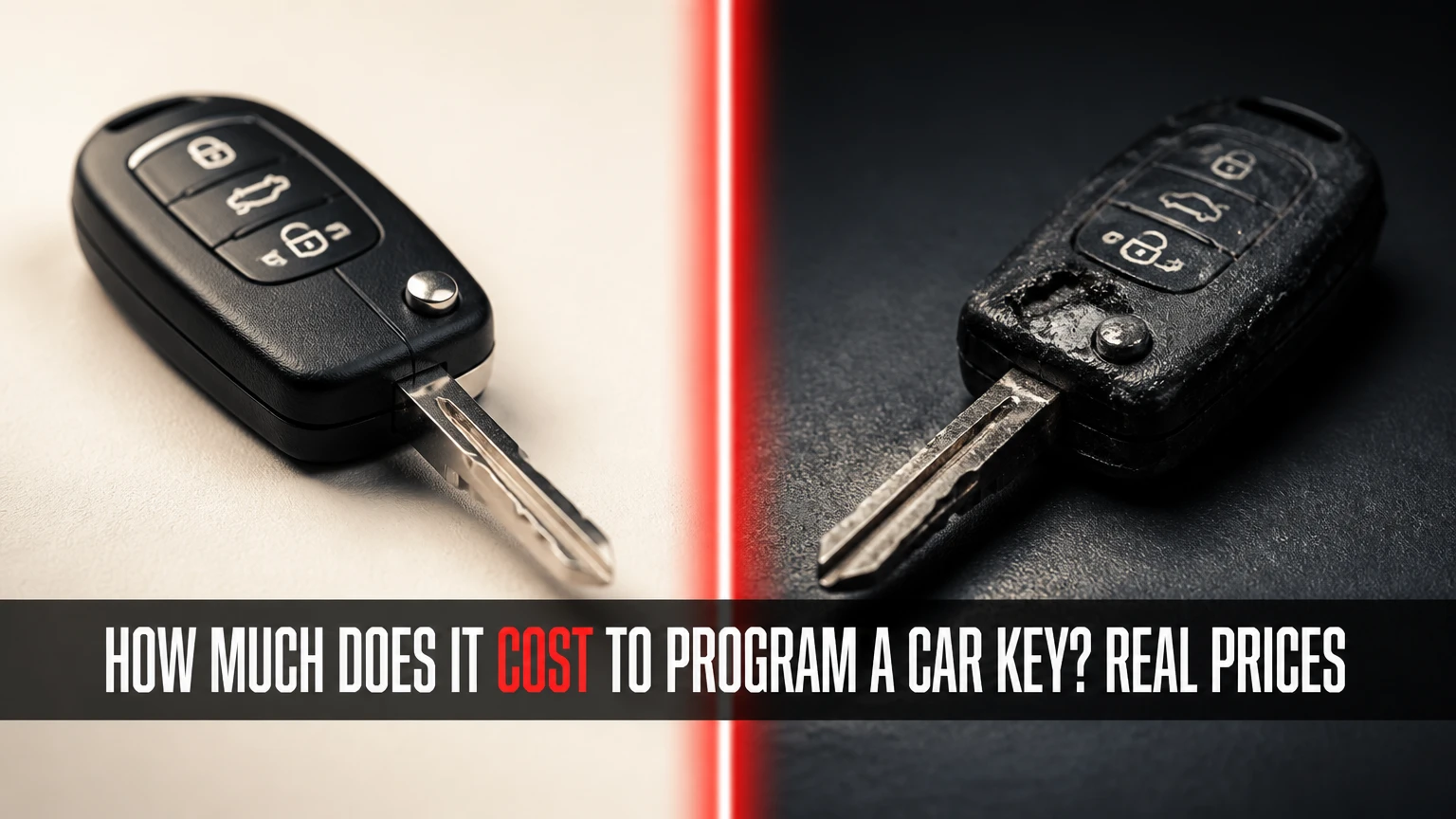
Programming a car key typically costs $50-$250 for labor when you already have a compatible key, while a replacement key, cutting, and programming usually total $120-$600. Luxury vehicles, current-year models, lost-all-key situations, and dealer-only security systems can raise the final bill to $800-$1,200 or more.
Key Facts at a Glance
- A basic transponder key usually costs $50-$100 to program and $120-$250 with the key and cutting.
- A smart key or proximity fob commonly costs $100-$250 for programming and $250-$600 or more as a complete replacement.
- A mobile automotive locksmith often charges $80-$250, while a dealership commonly charges $150-$500 or more.
- Having one working key can reduce the price because the technician may use an add-key procedure instead of an all-keys-lost procedure.
- Remote-button pairing and engine immobilizer programming are separate functions on many vehicles.
- A compatible aftermarket key can lower hardware cost, but incorrect part numbers, protocols, or locked used fobs can eliminate the saving.
How Much Does It Cost to Program a Car Key?
The programming labor alone is usually $50-$100 for a basic transponder, $75-$150 for a remote-head key, and $100-$250 for a smart key. The complete price includes more than software access: the technician may need to supply a key, cut an emergency blade, retrieve a security code, travel to the vehicle, and erase missing keys from the immobilizer memory.
A low online advertisement may show only the programming line item. A customer who needs a complete replacement can also pay for the key shell, transponder or circuit board, mechanical cutting, shipping, diagnostic access, mobile dispatch, sales tax, and an after-hours surcharge. Ask for an itemized, out-the-door quote.
The vehicle’s make, model, year, trim, region, and key status determine the range. A 2008 Ford with one working transponder key is a different job from a 2024 Mercedes-Benz with no remaining keys.
Typical Cost by Service Situation
| Service situation | Programming labor | Other common charges | Typical total |
|---|---|---|---|
| Compatible key already owned | $50-$150 | Diagnostic or visit fee: $0-$100 | $50-$250 |
| New basic transponder key | $50-$100 | Key and cutting: $70-$150 | $120-$250 |
| New remote-head key | $75-$150 | Key and cutting: $75-$200 | $150-$350 |
| New proximity smart key | $100-$250 | Fob and emergency blade: $150-$400 | $250-$650 |
| All keys lost, standard vehicle | $100-$250 | Mobile service, cutting, security access: $50-$200 | $200-$500 |
| Luxury or dealer-only system | $200-$500 | OEM key, coding, towing: $300-$800 | $500-$1,200+ |
These are typical United States consumer ranges, not fixed tariffs. A rural mobile call can cost more because of travel distance, while a scheduled shop appointment may remove the dispatch fee. Overnight, weekend, and roadside calls often add $50-$150.
What Exactly Does Car Key Programming Do?
Car key programming authorizes a transponder or smart key to communicate with the vehicle’s immobilizer system. The physical blade can match the ignition cylinder and the remote can lock the doors, yet the engine may still refuse to start until the immobilizer recognizes the key’s electronic identity.
A transponder is usually a passive chip inside a conventional key. A smart key contains a powered circuit board, buttons, antennas, and often a backup transponder function. When the vehicle detects the key, the immobilizer control module checks its cryptographic response against an authorized credential. A successful match permits systems such as the engine control module, starter authorization, or fuel delivery to operate.
The common “frequency” explanation is incomplete. Radio frequency matters for remote communication, but compatibility also depends on the vehicle’s part number, market, encryption protocol, immobilizer generation, and whether the fob is new, reusable, cloned, or locked to another vehicle.
Remote Pairing Versus Immobilizer Programming
Remote pairing teaches the car to respond to lock, unlock, panic, trunk, or liftgate buttons. Immobilizer programming authorizes the key to start the engine. Some older vehicles combine these functions in one onboard procedure, but many modern vehicles require separate steps or a diagnostic scan tool.
That distinction explains a common failure: a replacement fob locks the doors but produces a no-start condition. The remote transmitter paired successfully, while the immobilizer transponder did not receive authorization.
Which Key Types Cost the Most?
Smart proximity keys cost the most among common consumer key types because the fob contains more electronics and the vehicle uses a stronger security procedure. Luxury European systems can exceed $1,000 total when an OEM key, factory coding, programming labor, and towing are required.
| Key type | Program labor | Complete replacement | Typical time | Main feature |
|---|---|---|---|---|
| Basic transponder key | $50-$100 | $120-$250 | 15-20 minutes | Metal blade and hidden immobilizer chip |
| Remote-head key | $75-$120 | $150-$350 | 20-30 minutes | Blade and lock buttons in one housing |
| Switchblade key | $90-$150 | $200-$350 | 25-40 minutes | Folding spring-loaded blade |
| Smart proximity fob | $100-$250 | $250-$650 | 30-60 minutes | Push-button start and hands-free access |
| Luxury European smart key | $200-$500 | $500-$1,200+ | 45-120 minutes | OEM security and rolling-code systems |
A replacement shell is not equivalent to a complete key. A shell may contain no transponder, circuit board, or battery contact, so moving the original electronics into it only repairs physical damage. It does not create an additional authorized key.
Why Are OEM Keys More Expensive?
OEM keys cost more because they carry vehicle-specific electronics, manufacturer supply-chain costs, and, in some cases, VIN-linked ordering or factory security procedures. An aftermarket fob may cost $30-$150, while an OEM smart key can cost $150-$500 before programming.
Aftermarket does not automatically mean unreliable. A reputable supplier that verifies the exact FCC ID, part number, frequency, blade profile, and compatibility can provide a practical alternative for many older vehicles. The risk increases when a listing says “fits hundreds of models” without identifying the immobilizer system.
Is a Locksmith Cheaper Than a Dealership?
An automotive locksmith usually costs less than a dealership for standard vehicles and mobile service, especially when the vehicle is stranded. A dealership becomes more attractive when the vehicle is new, luxury-branded, under a key warranty, or dependent on proprietary factory software.
| Provider | Typical service total | Access and equipment | Best use case | Main limitation |
|---|---|---|---|---|
| Mobile automotive locksmith | $80-$250 labor or service | Professional key cutter and diagnostic programmer | Stranded vehicle or standard replacement | May lack current proprietary software |
| Locksmith shop | $70-$220 labor or service | Shop cutter and immobilizer tools | Scheduled replacement with vehicle access | Vehicle may need to be brought in |
| Dealership | $150-$500+ labor | Factory diagnostic software and OEM inventory | New, luxury, or dealer-restricted vehicle | Towing and appointment delays |
| DIY onboard programming | $0-$50 after key purchase | Existing vehicle procedure | Eligible older vehicles with working key | Limited makes, models, and key counts |
| DIY scan-tool programming | $20-$150 tool rental or purchase | Compatible OBD programmer | Supported vehicles and experienced owners | Security access and bricking risk |
A locksmith is not automatically qualified for every vehicle. Before booking, ask whether the technician can program the exact year, trim, and immobilizer system, whether the quoted price includes cutting, and whether the company handles all-keys-lost jobs.
A dealership is not automatically required for every smart key. Independent specialists may have legitimate professional tools and security credentials, but a dealer may be the only practical choice for a current model with restricted key enrollment.
What Happens During Professional Programming?
Professional key programming usually takes 15-60 minutes, although all-keys-lost work, security-code retrieval, and difficult access can extend the appointment to two hours. The technician connects a compatible diagnostic tool, authenticates access, enrolls the key, and tests both starting and remote functions.
The Standard Programming Sequence
- Verify ownership and vehicle identity. The technician checks the vehicle identification number, registration, title, driver’s license, or other local proof-of-ownership requirements.
- Inspect the key and vehicle. The technician confirms the part number, blade, transponder type, battery condition, vehicle battery voltage, and existing fault codes.
- Connect to the diagnostic port. A programmer connects through the OBD-II port, normally beneath the dashboard near the driver’s knees.
- Authenticate with the immobilizer. Depending on the brand, the tool uses a security PIN, online authorization, challenge-response process, or factory-backed account.
- Choose add-key or all-keys-lost mode. Add-key mode preserves existing credentials; erase-and-relearn mode removes missing keys and enrolls the keys present.
- Cut and test the mechanical blade. The blade must turn the ignition or operate the emergency lock without binding.
- Enroll the electronic key. The programmer writes the credential to the immobilizer, body control module, or related security module.
- Validate every function. The technician checks engine starting, lock buttons, proximity detection, trunk release, emergency start position, and warning lights.
A stable vehicle battery matters during the write process. A weak coin-cell battery can prevent remote functions from working, but it usually does not erase a properly programmed passive transponder. The more serious risk is interrupted diagnostic communication or low vehicle voltage during security-module writing.
Can You Program a Car Key Yourself?
You can program some car keys yourself, but only when the vehicle supports onboard programming or the replacement procedure explicitly permits owner enrollment. Older Ford, General Motors, Chrysler, Toyota, and other models may allow an existing-key sequence, while many newer vehicles require a scan tool and authenticated security access.
DIY is most suitable when you have at least one working key, the owner’s manual confirms the procedure, and the replacement key has verified compatibility. A key that starts the vehicle may be required before the car will permit an additional key to be enrolled.
Do not rely on a generic “turn the ignition five times” procedure. The sequence varies by manufacturer and may be disabled on the exact trim or model year. A failed attempt usually does not permanently destroy the vehicle, but repeated incorrect procedures can create a lockout, leave the car with no recognized key, or require a paid diagnostic reset.
DIY Cost and Eligibility
| DIY method | Key or tool cost | Typical time | Suitable vehicle condition | Main risk |
|---|---|---|---|---|
| Remote-button pairing | $20-$80 | 5-15 minutes | Remote-only issue on supported models | Immobilizer remains unprogrammed |
| Manual onboard enrollment | $30-$150 | 10-30 minutes | Manual explicitly permits owner programming | Requires an existing working key |
| Rental scan tool | $50-$150 | 30-90 minutes | Tool lists exact vehicle security system | Unsupported software or failed access |
| Professional mobile service | $80-$500 | 15-90 minutes | Most standard and stranded situations | Higher cost than a confirmed DIY procedure |
Auto parts stores may sell batteries, shells, and some keys, but retail key cutting or remote testing is not the same as immobilizer programming. Confirm the exact service before assuming a store can authorize engine starting.
What Changes the Price Most?
The largest price difference comes from whether one working key remains. Adding a key is often faster and less expensive than generating keys when none are recognized, because the technician can access the vehicle’s security system through an existing authorized credential.
The vehicle’s age also matters. Older vehicles may use a replaceable transponder and simple key cut, while newer vehicles may combine proximity antennas, encrypted communication, a body control module, and a factory authorization system. Luxury brands add OEM inventory and security-module complexity.
Cost Factors to Check Before Booking
- One working key or none: all-keys-lost service can add $50-$200.
- Key ownership: customer-supplied keys reduce hardware cost but increase compatibility risk.
- Vehicle location: mobile travel commonly adds $0-$100.
- Time of service: emergency or after-hours calls often add $50-$150.
- Vehicle condition: a dead battery, damaged ignition, or locked steering column may require separate repair.
- Key source: OEM smart keys commonly cost $150-$500; aftermarket units can cost $30-$150.
- Programming access: factory-restricted systems may require dealer software or an authorized independent specialist.
- Cutting requirement: laser or side-milled blades can cost more than standard edge-cut blades.
- Number of keys: some vehicles erase all previously stored keys during enrollment, so every desired key must be present.
A quote that excludes the key itself is not comparable with a quote that includes an OEM fob and cutting. Ask, “What is my final price including the key, cutting, programming, tax, mobile travel, and testing?”
What Does an All-Keys-Lost Job Cost?
An all-keys-lost job commonly costs $200-$500 for a mainstream vehicle and $500-$1,200 or more for a luxury or current-year vehicle. The technician must obtain vehicle access, create a mechanical key, authenticate the immobilizer, erase missing credentials when supported, and enroll new keys.
Towing is not always necessary when a mobile locksmith has the correct equipment. A dealer may require the vehicle at its service department, adding a tow that commonly costs $75-$200. Some brands also require a wait for an ordered key, while a locksmith may cut a key by code if the vehicle and local rules permit it.
Lost keys should be removed from the vehicle’s memory when possible. Deleting them prevents a found key from starting the car, although it does not necessarily prevent that key from mechanically opening a door.
How Do You Buy the Correct Replacement Key?
Buy by exact vehicle compatibility, not by appearance. Confirm the year, model, trim, FCC ID, part number, blade type, frequency, button layout, and immobilizer technology before ordering.
Use the vehicle owner’s manual, the original key markings, a dealer parts department, or a qualified locksmith to validate the part. A key designed for the same model name can still fail because the market, production date, body control module, or push-start system differs.
Compatibility Checklist
- Record the VIN and complete model year.
- Photograph the original key and its part-number markings.
- Match the FCC ID and transmitter frequency where applicable.
- Confirm whether the vehicle uses a transponder, remote-head key, or proximity fob.
- Ask whether the replacement is new, refurbished, cloned, or previously locked.
- Check the seller’s return policy before cutting the blade.
- Confirm who will program the key after purchase.
A cut key cannot usually be returned. Have the locksmith verify the electronic part before cutting it.
Why Does a Programmed Key Unlock Doors but Not Start the Car?
A key that unlocks the doors but will not start the engine usually has remote pairing without successful immobilizer enrollment. The remote transmitter and the engine-start transponder can use separate circuits, procedures, and security checks.
First, test the vehicle battery and the fob battery, then try the manufacturer’s emergency-start position, such as holding the fob against a designated backup antenna. If the key still fails, the technician should check immobilizer fault codes, key recognition status, transponder compatibility, and whether the vehicle reached its maximum stored-key count.
Do not assume a new battery will solve a no-start condition. A coin cell powers button transmission, while many passive transponders receive energy from the vehicle’s antenna and do not depend on that coin cell.
Common Programming Problems and Fixes
| Symptom | Likely cause | Practical fix | Typical added cost |
|---|---|---|---|
| Buttons do nothing | Dead coin cell or wrong remote frequency | Install correct battery and verify FCC ID | $5-$40 |
| Doors work, engine will not start | Immobilizer not enrolled | Run diagnostic key registration | $75-$250 |
| Key will not turn lock | Incorrect blade profile or cut | Decode and recut the blade | $20-$100 |
| Tool cannot access security module | Unsupported programmer or low voltage | Use compatible factory-level equipment | $100-$400 |
| Used fob rejected | Fob locked to another vehicle | Replace with new or resettable unit | $50-$500 |
| All keys stopped working | Vehicle battery failure or security fault | Test voltage and scan immobilizer system | $80-$300 |
Wrong frequency is only one possible mismatch. A 315 MHz remote and a 433 MHz remote are not interchangeable in many markets, but two keys using the same frequency can still be incompatible because their encryption, FCC ID, or immobilizer protocol differs.
A battery failure during programming does not normally corrupt a transponder permanently. The technician should stabilize vehicle voltage, restart the enrollment procedure, and inspect module communication before replacing the key.
Which Option Should You Choose?
Choose a mobile automotive locksmith for most standard vehicles when you need a replacement quickly, especially if the vehicle is stranded or one working key remains. Choose a dealership for a new luxury vehicle, a dealer-restricted system, a warranty-covered key, or a situation where the locksmith cannot verify software compatibility.
Older Vehicle With One Working Key
Check the owner’s manual for onboard programming first. A verified aftermarket key and manual enrollment can cost $30-$150, but professional cutting and testing remain worthwhile because an incorrectly cut blade cannot be repaired through software.
Everyday Vehicle With a Dead or Missing Fob
Use a qualified mobile locksmith and request a complete quote. A typical smart-key replacement costs $250-$650, including hardware, cutting of the emergency blade, programming, and testing.
Luxury or Current-Year Vehicle
Call the dealer and at least one specialist with documented experience on the exact model. Compare the complete total, because a lower independent quote is not useful if the technician must later send the vehicle to a dealer after an unsuccessful security-module procedure.
All Keys Lost at Home or on the Road
Ask whether the provider supports all-keys-lost programming before authorizing dispatch. Confirm ownership documents, vehicle access requirements, whether towing is included, and whether missing keys will be erased from memory.
How Can You Avoid Paying Twice?
Get the vehicle identification number and key status ready before calling. A reputable provider can often give a narrower estimate when you provide the model year, trim, push-button or keyed ignition, location, and whether a working key starts the engine.
Ask these five questions:
- Is the quote for programming labor only or the complete replacement?
- Does the price include the key, cutting, tax, mobile travel, and emergency fees?
- Is the proposed key OEM, aftermarket, refurbished, cloned, or used?
- Can the technician program this exact year, trim, and immobilizer system?
- Will the technician test starting, remote buttons, proximity detection, and the emergency blade?
Avoid providers that quote an unusually low programming fee but will not state the key price or final total. The cheapest advertised line item can become the most expensive appointment when compatibility is discovered after dispatch.
FAQ
Can a dealership program a key I bought online?
A dealership may program a customer-supplied key, but policies vary by brand and service department. Some dealers require an OEM key purchased through their parts department, while others will attempt programming only after inspecting the part. Ask before ordering, because a rejected or cut aftermarket key may not be refundable.
Can a locksmith program a key without the original?
Many automotive locksmiths can create and program a key without the original, but the procedure costs more than adding a key with one working credential. The locksmith needs vehicle access, ownership verification, a compatible blank or fob, and equipment that supports the vehicle’s all-keys-lost security mode.
Can a dead car battery erase the key programming?
A dead vehicle battery normally does not erase stored key authorization. It can prevent the car from detecting the fob or interrupt a programming attempt if voltage falls too low. Recharge or replace the vehicle battery, test the fob battery, and scan for immobilizer faults before buying another key.
Are used car key fobs reusable?
Some used fobs can be reset, cloned, or reprogrammed, while others remain locked to the first vehicle. Compatibility depends on the manufacturer, fob generation, security protocol, and tool used. A used fob that matches the case and frequency can still be unusable, so verify reset capability before purchase.
How many keys should I program at once?
Program every key you want to keep active during the same enrollment session when the vehicle uses an erase-and-relearn procedure. Some systems delete previously stored keys when new credentials are written. Keeping two working keys also reduces future costs because the next replacement may qualify as a simpler add-key job.
The Bottom Line
The answer to how much does it cost to program a car key is usually $50-$250 for programming alone and $120-$650 for a complete standard replacement. All-keys-lost service, luxury vehicles, OEM smart fobs, dealer-only security, towing, and after-hours travel can push the bill above $800.
The most economical safe choice is usually a qualified mobile automotive locksmith for a mainstream vehicle with a verified compatible key. Use a dealership when factory access is required, and attempt DIY programming only when the owner’s manual confirms that the exact vehicle supports it. Always compare an itemized final price, not a programming-only advertisement.