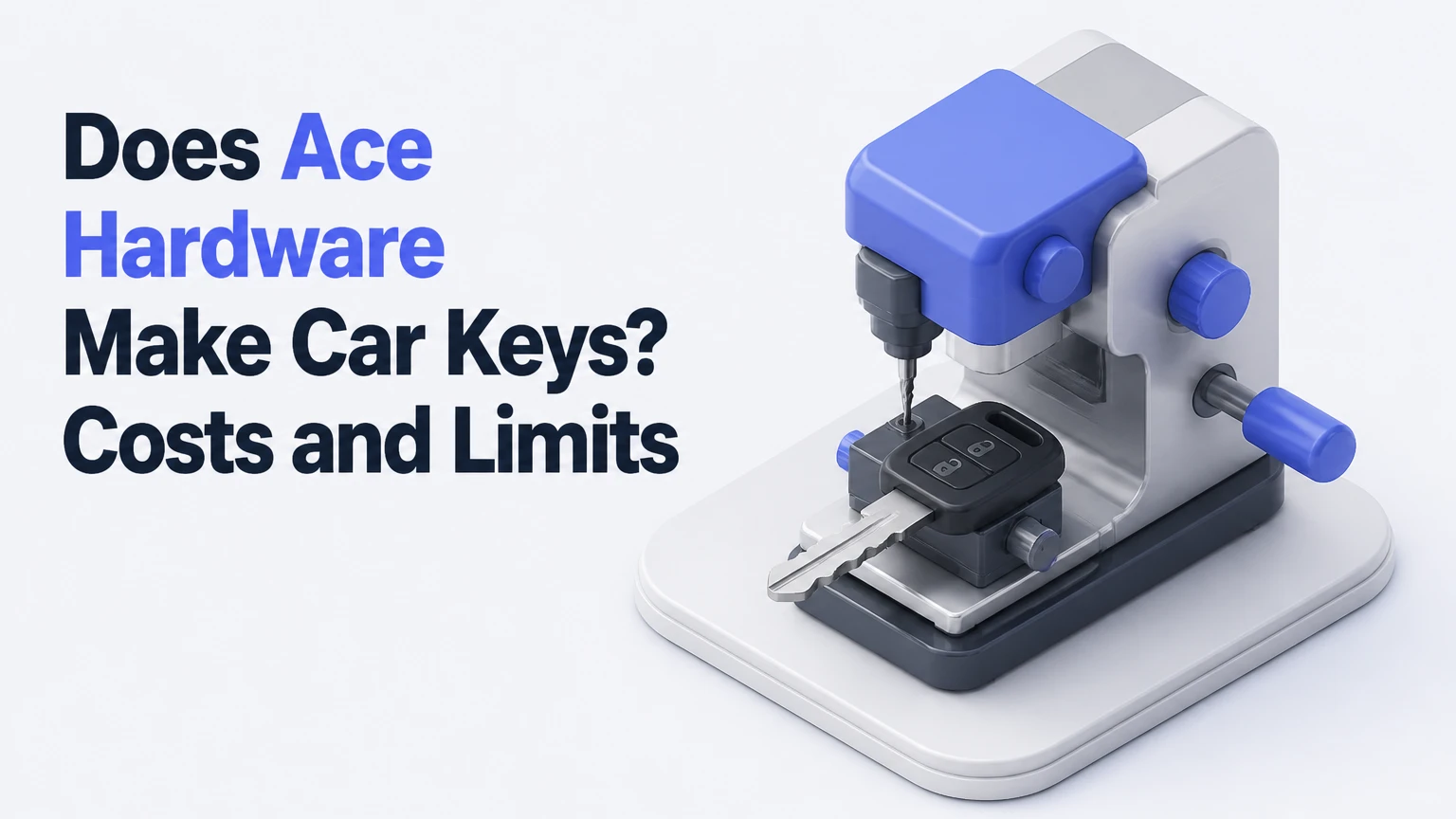
Yes, Ace Hardware can make many car keys, including mechanical keys, transponder keys, remote-head keys, and some key fobs. Availability depends on the individual Ace location, vehicle year and model, key type, and programming equipment. Confirm compatibility with Ace’s automotive key finder and call the store before bringing the vehicle.
Key Facts
Ace Hardware locations commonly duplicate mechanical car keys and offer selected automotive transponder and remote keys.
Key programming is vehicle-specific, so a key that fits the ignition may still fail to start the engine.
Typical prices range from $3-$10 for a basic metal key and $50-$250 for many chipped keys, remotes, and fobs.
Most programmable keys require the vehicle and at least one working key at the store.
Ace Hardware does not provide identical automotive services at every location because many stores are independently operated.
A locksmith or dealership is usually the better option when every key is lost or the vehicle has advanced security.
Does Ace Hardware Make Car Keys?
Ace Hardware makes replacement car keys at participating stores, but “Ace Hardware” does not represent one identical automotive-key service nationwide. Some locations sell and cut only metal blanks, while others also offer transponder programming, remote-head keys, and selected proximity fobs through services such as KeyStart or compatible aftermarket systems.
The practical answer is conditional: Ace is a good first call for a spare key when the vehicle has a supported key type and one working key remains. Ace is a poor assumption for an all-keys-lost emergency, an unusual luxury vehicle, or a late-model smart key that requires specialized authorization.
Ace’s automotive key finder is useful for an initial compatibility check, but the local store remains the final authority. Inventory, equipment, staffing, and franchise policy can change by location. A listing for a compatible blank does not prove that a specific store can cut and program it.
Why does Ace availability vary by store?
Ace stores are commonly independently owned and operated, so automotive services differ by location. One store may have a key-cutting machine and a programming tablet, while another may stock automotive blanks but refer programming to a locksmith.
Call before driving over and provide the exact vehicle year, make, model, trim, and key description. State whether the car uses a metal key, a plastic transponder key, buttons on the key head, or push-button start. Ask whether the vehicle must be present and whether the store sells and programs that specific key.
What types of car keys can Ace Hardware make?
Ace Hardware may make four broad categories of automotive keys: mechanical keys, transponder keys, remote-head keys, and smart or proximity keys. The category determines whether cutting alone is enough or whether the car’s immobilizer and remote systems also need programming.
| Key type | Physical features | Vehicle function | Typical Ace outcome |
|---|---|---|---|
| Mechanical key | Metal blade, no electronic chip | Opens doors and starts older vehicles | Usually cut at the counter |
| Transponder key | Blade plus concealed immobilizer chip | Unlocks and authorizes engine starting | Cut and programmed when supported |
| Remote-head key | Blade with lock, unlock, or panic buttons | Starts vehicle and controls locks | Cut, immobilizer-programmed, and remote-paired |
| Smart or proximity fob | Push-to-start remote, often with emergency blade | Authorizes proximity starting and entry | Available only for selected vehicles and stores |
Mechanical car keys
A mechanical key contains no electronic identity. The machine duplicates the blade’s grooves from an existing key or matches a blank to the vehicle’s key profile. Older vehicles may use this arrangement, although a metal key can also be a door-only spare for a newer vehicle.
A copied blade must turn the lock smoothly and operate the ignition without binding. Cutting a door key does not guarantee that the key can start the engine, because many vehicles use a separate transponder chip even when the key looks ordinary.
Transponder keys
A transponder key contains a small electronic chip that communicates with the vehicle’s immobilizer. The blade may be cut correctly while the engine remains disabled because the chip has not been enrolled or cloned correctly.
Many late-1990s and newer vehicles use immobilizer technology, but the exact introduction date varies by manufacturer and model. Do not identify a transponder key by appearance alone. Check the owner’s manual, vehicle documentation, key code, or compatibility lookup.
Remote-head keys
A remote-head key combines the ignition blade and buttons in one plastic housing. The immobilizer function and the lock-button function may require separate procedures, which explains why a new key can start the car while its remote buttons remain inactive.
After programming, test engine start, lock, unlock, trunk release, panic operation, and physical door unlocking. Button labels and procedures vary across Ford, General Motors, Toyota, Honda, Nissan, Chrysler, Dodge, Jeep, and other brands.
Smart and proximity fobs
A smart key or proximity fob authorizes starting when the fob is inside the vehicle or near an approved detection zone. Many contain an emergency blade for manual entry, but that blade does not replace the electronic programming required for push-button ignition.
Ace may support selected proximity keys, but coverage is less predictable than for ordinary metal and transponder keys. Luxury brands and newer vehicles can require security credentials, online authorization, manufacturer software, or a specialist automotive locksmith.
How does Ace Hardware cut and program a car key?
Ace Hardware first cuts the physical blade, then programs the electronic functions when the store and vehicle support the key. The car’s immobilizer recognizes an authorized transponder identity, while the remote system separately recognizes button commands.
The exact procedure differs by vehicle. Some clonable transponder keys can copy data from an existing key, while other systems require a diagnostic tool connected to the vehicle’s OBD-II port. Remote pairing can use an onboard sequence, a dedicated programmer, or manufacturer-specific software.
What should you bring to Ace Hardware?
Bring the vehicle, every working key, the key or fob you want duplicated, and proof of ownership if the store requests it. The working key identifies the blade and may provide the electronic data needed for duplication.
Before visiting, gather:
- Vehicle year, make, model, and trim
- Existing key, remote, or fob
- Vehicle itself, parked near the store
- Owner’s manual if available
- Registration or other ownership documentation
- Key code or FCC ID when printed on the fob
Do not rely on a product photograph alone. Two keys for the same model year can differ by trim, immobilizer system, frequency, blade profile, or FCC ID.
What is the usual process?
- Check compatibility. Use Ace’s automotive key finder, then call the specific location with the full vehicle details.
- Bring the vehicle and working key. Many programming jobs cannot be completed at a counter without the car.
- Choose the replacement format. Compare a basic transponder key, remote-head key, replacement fob, or shell.
- Cut the blade. The associate duplicates the key profile and removes excess material.
- Program the immobilizer. The store pairs or clones the chip when its equipment supports the vehicle.
- Pair the remote. Lock and unlock buttons may need a separate programming sequence.
- Test every function. Start the engine, operate the locks, test the trunk and panic button, and check manual entry before leaving.
A straightforward duplicate often takes 10-30 minutes, although 30-60 minutes is more realistic when programming equipment, multiple keys, or a difficult key profile is involved. A failed programming attempt can require a locksmith or dealer rather than repeated cutting.
How much does an Ace car key cost?
A typical Ace car key costs $3-$10 for a basic metal duplicate, $50-$90 for many transponder keys, and $100-$250 for many remote-head keys or fobs. Smart keys, premium vehicles, unusual blanks, and local labor policies can exceed those ranges.
These are practical retail ranges, not a nationwide Ace price list. The final price depends on the key blank, electronics, vehicle coverage, programming labor, local market, and whether the replacement is an aftermarket or original-equipment part.
| Replacement type | Typical price range | Typical time | Main cost driver |
|---|---|---|---|
| Basic metal key | $3-$10 | 2-10 minutes | Blade blank and cutting |
| Transponder key | $50-$90 | 10-30 minutes | Chip and programming |
| Remote-head key | $80-$180 | 20-45 minutes | Buttons, chip, and pairing |
| Standard replacement fob | $100-$250 | 20-60 minutes | Electronics and vehicle procedure |
| Smart proximity key | $150-$400+ | 30-90 minutes | Security access and fob technology |
A dealer often costs more because the replacement may use an OEM key, VIN-based ordering, proprietary software, and dealer labor. A locksmith can be cheaper or more expensive than Ace depending on travel, urgency, vehicle security, and whether the locksmith provides an aftermarket or OEM component.
Why does the same key cost different amounts?
A key price reflects more than the metal blade. A transponder chip adds immobilizer electronics, a remote adds a radio transmitter and buttons, and a proximity fob adds encrypted communication and vehicle-specific security procedures.
Ask for an itemized quote covering the key, cutting, programming, taxes, and any diagnostic or service charge. Ask whether the quote includes a second key, because some vehicles require a specific number of keys in the programming procedure.
How does Ace compare with a dealership or locksmith?
Ace Hardware is usually the most convenient low-cost option for a supported duplicate when one working key remains. A dealership is the most predictable source for OEM keys and manufacturer-specific programming, while an automotive locksmith is usually the strongest option for mobile service, damaged ignitions, or all-keys-lost situations.
| Decision factor | Ace Hardware | Dealership | Automotive locksmith |
|---|---|---|---|
| Basic duplicate | $3-$10 typical | $20-$60 typical | $60-$150 typical |
| Chipped duplicate | $50-$90 typical | $150-$400 typical | $80-$250 typical |
| Smart-fob replacement | $150-$400+ typical | $250-$600+ typical | $150-$450 typical |
| Vehicle location | Customer usually drives in | Customer usually drives in | Mobile service often available |
| Working key required | Usually for easy duplication | Not always | Not always |
| All keys lost | Often unavailable | Usually available with VIN and security proof | Often available with ownership proof |
| Key source | Aftermarket commonly | OEM commonly | OEM or aftermarket |
| Brand coverage | Selected vehicles | Strongest for its own brand | Broad, equipment-dependent |
The table uses typical market ranges rather than guaranteed prices. A luxury vehicle, encrypted smart key, emergency callout, or after-hours visit can change the comparison substantially.
When is Ace the best choice?
Choose Ace when you need a spare, the vehicle is supported, a working key is available, and the key format is ordinary enough for the store’s equipment. Ace is particularly sensible for an older mechanical key or a common transponder key when cost matters more than an OEM logo.
Ace is not automatically the best choice for a remote that has stopped working. A replacement battery or shell may solve the problem at a fraction of the price.
When should you choose a locksmith?
Choose an automotive locksmith when every key is lost, the vehicle cannot be driven, the ignition is damaged, or the car uses a security system that the local Ace cannot support. A mobile locksmith can cut and program the key at the vehicle, often avoiding towing.
Ask the locksmith whether the quoted service includes key generation, immobilizer programming, remote pairing, and deletion of lost keys from the vehicle’s memory. Those are separate capabilities on some models.
When is the dealership worth the extra cost?
Use the dealership when the manufacturer requires OEM hardware, online authorization, a secure gateway procedure, or a factory diagnostic system. A dealer is also the safer route when the vehicle is under warranty or has a complicated smart-key system.
The trade-off is price and scheduling. Dealers may need to order the key using the VIN, verify ownership, and require an appointment or a tow.
What can Ace Hardware not do?
Ace Hardware cannot guarantee every automotive key service because store equipment, inventory, and programming permissions vary. Common limitations include all-keys-lost jobs, unsupported smart keys, restricted luxury-vehicle systems, customer-supplied blanks, and keys that require manufacturer authorization.
Will Ace cut or program a customer-supplied key?
Many Ace locations refuse customer-supplied automotive keys or fobs, although local policy differs. The store cannot verify the blank’s material, electronic compatibility, security code, or manufacturing quality, and an incorrect blank may fail in the cutting machine.
A cheap online key may have the right appearance but the wrong transponder, frequency, FCC ID, blade profile, or circuit board. Ask the store before buying an outside key. If the store agrees to cut it, confirm whether programming is included and whether the work carries any guarantee.
Can Ace make a key if every key is lost?
Usually, Ace is not the first choice when every car key is missing. Duplication services are designed around an existing key, while an all-keys-lost job may require a key generated from the vehicle, an immobilizer reset, security-code access, or deletion of missing keys.
An automotive locksmith can often create and program a key at the vehicle after verifying ownership. The dealership can usually order and program a key using the VIN, but towing, waiting time, and dealer labor may increase the total cost.
Can Ace make laser-cut or sidewinder keys?
Some Ace stores can cut high-security or laser-style automotive keys, but the phrase “laser-cut” describes the blade profile, not guaranteed programming capability. A sidewinder blade can still contain a transponder or belong to a remote-head key.
Confirm both capabilities separately: ask whether the store can cut the exact blade profile and whether it can program the electronic system. A correctly cut high-security blade may open the door yet fail to start the vehicle.
Can Ace help with a damaged key shell?
Yes, a replacement shell can solve a cracked housing, worn buttons, or broken key ring when the original circuit board and transponder remain functional. The internal electronics are transferred into the new case, so no new immobilizer programming is normally needed.
A shell does not repair a failed circuit board, dead transponder, damaged buttons, or water damage. Test the original key before transferring its components, and keep the old shell until every function works.
Why does a newly made car key fail?
A new car key usually fails because the blade profile, transponder programming, remote pairing, battery, or vehicle compatibility is wrong. Engine starting and remote-button operation are separate tests, so one function can work while another fails.
| Symptom | Likely cause | First check | Correct next step |
|---|---|---|---|
| Key will not enter or turn | Wrong blade profile or poor cut | Compare with working key | Stop forcing it; request recut |
| Key turns but engine will not start | Unprogrammed or wrong transponder | Try original key | Return for programming diagnosis |
| Engine starts but buttons fail | Remote not paired or dead battery | Replace battery, often CR2032 | Pair remote separately |
| Buttons work but engine will not start | Immobilizer chip issue | Test spare key | Reprogram or replace transponder |
| Fob works intermittently | Weak battery or damaged contacts | Measure or replace battery | Inspect board and case |
| Key works at door but not ignition | Door-only blank or incorrect cut | Compare blade shoulders and tip | Obtain the correct ignition key |
A CR2032 battery is common, but the correct battery number depends on the fob. Replacing a battery cannot program a new immobilizer chip, and programming cannot fix a physically damaged button or circuit board.
If the new key fails, do not keep forcing it into the ignition. Confirm that the original key still works, return to the store promptly, and request a test of the blade, chip, remote, and vehicle procedure separately.
What should you check before paying?
Check the key before leaving the Ace parking lot because cut automotive keys are often difficult to return or resell. Verify that the blade turns the driver’s door and ignition, the engine starts, and every remote button performs its intended function.
Use this departure checklist:
- Start the vehicle twice with the replacement key.
- Lock and unlock the doors from the remote.
- Test the trunk, hatch, panic button, and sliding doors if fitted.
- Unlock the door manually with the metal blade.
- Confirm that the key does not bind or require unusual force.
- Ask for the receipt, programming result, and warranty terms.
Do not assume a successful engine start proves complete success. A remote-head key can pass immobilizer authorization while still lacking remote pairing.
Which option fits your situation?
| Situation | Best first option | Typical cost | Reason |
|---|---|---|---|
| Older car with metal key | Ace Hardware | $3-$10 | Fast blade duplication |
| One working chipped key | Ace or locksmith | $50-$150 | Affordable programmed spare |
| Broken fob housing | Replacement shell | $15-$40 | Reuses working electronics |
| Dead remote battery | Battery replacement | $3-$10 | Avoids unnecessary key purchase |
| Every key lost | Automotive locksmith | $100-$450 | Can generate a key at the car |
| New luxury smart key | Dealer or specialist locksmith | $250-$600+ | Security and OEM equipment |
| Non-running vehicle | Mobile locksmith | $100-$450 | No tow required |
| Online key already purchased | Confirm store policy first | Varies | Compatibility and liability concerns |
For a “just in case” spare, a basic transponder key can be more practical than another expensive remote. It may start the car and provide emergency entry, but it will not necessarily provide remote locking or trunk controls.
For a vehicle with push-button start, confirm the emergency-start procedure before choosing a backup. Some manufacturers require holding the fob against a designated spot, while others use a hidden mechanical blade only for door access.
FAQ
Does Ace Hardware make car keys for all vehicle brands?
No. Ace Hardware supports many common makes and models, but coverage varies by store and key type. A store may handle a Honda transponder key but lack the equipment for a particular Mercedes smart key. Confirm the exact year, model, trim, and FCC ID before visiting.
Can Ace make a spare car key without the car?
Sometimes, but only for certain simple duplicates or clonable transponder keys. Remote-head keys, proximity fobs, and many diagnostic-programmed keys require the vehicle to be present. Bring the car whenever programming is involved, even if a working key is available.
Is Ace Hardware cheaper than a car dealership?
Ace Hardware is often cheaper for common aftermarket duplicates, especially mechanical and standard transponder keys. A dealership may be preferable for OEM smart keys or manufacturer-authorized programming. Compare the complete price, including cutting, programming, taxes, towing, and travel fees.
Does Ace Hardware program key fobs?
Participating Ace locations program selected remote-head keys and fobs, but programming is not universal. A fob can have compatible buttons and still use the wrong radio frequency or security system. Ask the store to verify the exact part number or FCC ID.
What is the cheapest way to replace a car key?
The cheapest option is usually a $3-$10 mechanical duplicate when the vehicle does not require a chip. For a chipped vehicle, a supported aftermarket transponder key is commonly less expensive than a remote fob or dealership replacement. Do not buy the cheapest online key until compatibility is confirmed.
Should I go to Ace or a locksmith for a lost car key?
Choose Ace for a supported spare when one working key remains and the vehicle can be driven to the store. Choose a locksmith when every key is lost, the car is immobilized, the ignition is damaged, or the vehicle needs mobile service. A dealership remains a strong option for proprietary smart-key systems.
The Bottom Line
Ace Hardware does make many car keys, but the service is location-specific rather than guaranteed for every vehicle. Expect about $3-$10 for a metal key, $50-$90 for many transponder keys, and $100-$250 for many remote or fob replacements, with smart keys and luxury vehicles often costing more.
Check Ace’s automotive key finder, call the local store, bring the vehicle and a working key, and test every function before leaving. For all-keys-lost situations, advanced smart keys, or unsupported vehicles, an automotive locksmith or dealership is usually the more reliable solution.