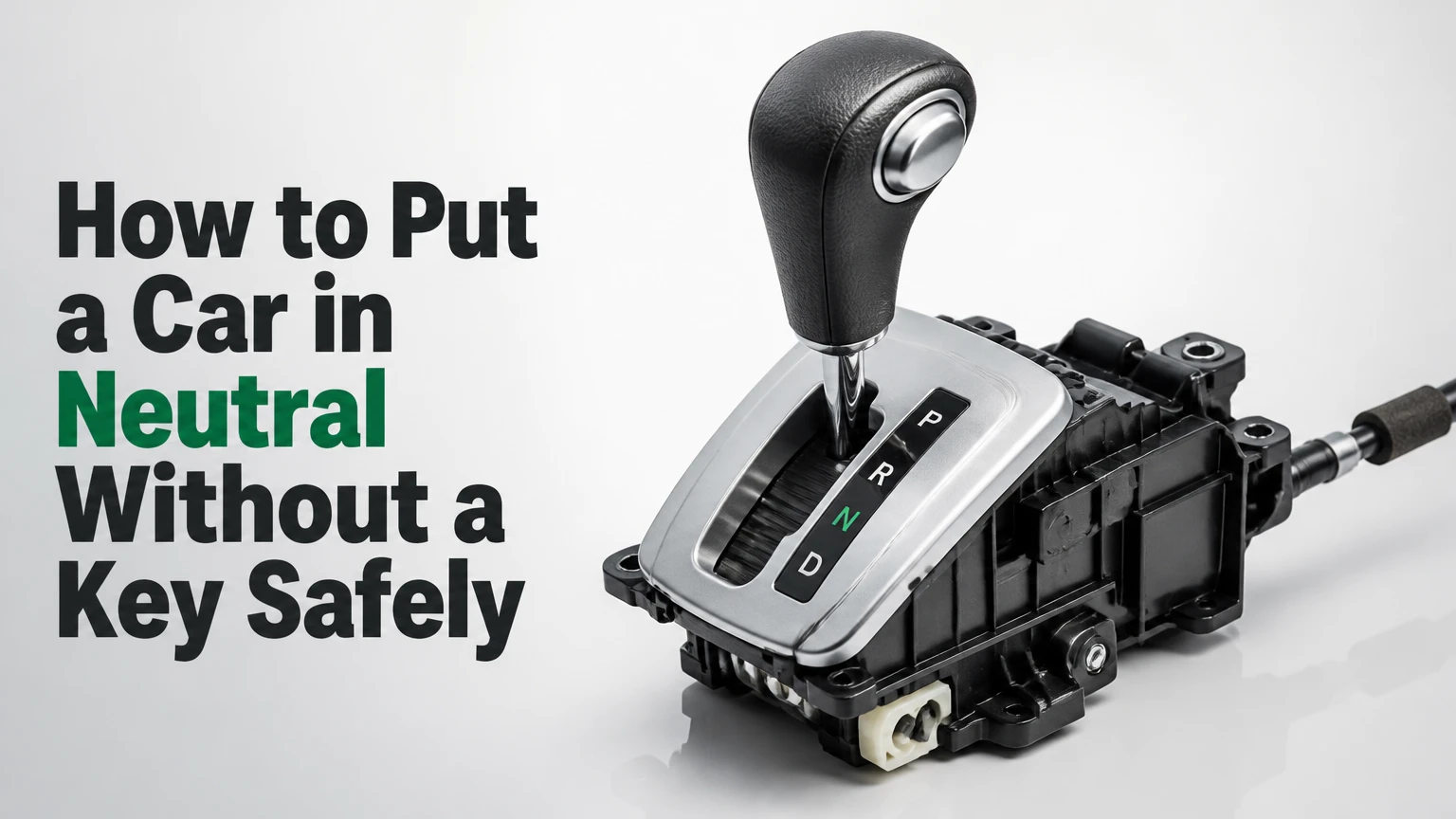
To put a car in neutral without a key, use the vehicle’s shift-lock override, usually located beside the automatic gear selector, then move the shifter from Park to Neutral while the car is secured. The exact release location varies by make, model, and year. If the override is absent, damaged, or ineffective, use a flatbed tow truck or wheel dollies rather than forcing the transmission linkage.
Key Facts at a Glance
A missing key and a dead battery are different problems, but either can prevent a normal automatic transmission shift.
Most automatic cars have a mechanical shift-lock release near the shifter, although some electronic selectors require a model-specific procedure.
Chock the wheels before releasing Park, and never rely on a parking brake alone while the vehicle is being repositioned.
Neutral does not necessarily release an electronic parking brake, seized brakes, a locked transfer case, or driveline damage.
Never crawl beneath a vehicle supported only by a jack; use a professional tow operator or rated support stands.
The owner’s manual is the authoritative source for the override location and permitted towing distance.
What Prevents the Car From Shifting Without a Key?
An automatic vehicle’s brake-shift interlock prevents the selector from leaving Park unless the control system detects the required conditions. In a conventional design, the ignition switch supplies electrical power, the brake-light switch confirms pedal application, and a shift-lock solenoid releases the selector.
A lost key may leave the steering lock and ignition switched off, while a dead battery may prevent the solenoid from moving. Neither condition necessarily means the transmission itself is damaged. The transmission can remain mechanically capable of selecting Neutral even when the cabin selector is locked.
The shift-lock override bypasses the electrical release for the selector. It does not start the engine, disable the immobilizer, unlock the steering wheel, release the parking brake, or repair a broken shift cable. That distinction matters during towing because a car can display Neutral yet remain unable to roll.
A keyless-start vehicle may have no traditional ignition cylinder, but its shift interlock still depends on power and brake-switch input. A missing key fob can therefore create the same practical problem as a conventional lost key.
Before You Start: Safety, Tools, and Conditions
Prepare the vehicle before touching the shift-lock release. The typical cabin procedure takes 2-5 minutes and needs a small flat-head screwdriver, flashlight, wheel chocks, and the owner’s manual; no special transmission tool is normally required.
Place the vehicle on the flattest available surface. Keep people clear of the front and rear, turn the wheels away from nearby traffic when appropriate, and ask another adult to sit in the driver’s seat if the vehicle may move.
Use the parking brake while the vehicle is being secured. After Neutral is selected, release the parking brake only when the tow operator or spotter is ready for controlled movement. Leaving the brake engaged defeats the purpose of shifting to Neutral and can drag or damage the rear brakes.
| Item or condition | Typical requirement | Why it matters |
|---|---|---|
| Wheel chocks | 2-4 rated chocks | Prevents unexpected rolling before and during selector movement |
| Flat-head screwdriver | 1 small, 3-5 mm tip | Opens many override covers without damaging trim |
| Flashlight | 1 LED light | Reveals the slot and confirms selector position |
| Owner’s manual | Vehicle-specific | Identifies the release and towing limitations |
| Helper or spotter | 1 adult | Watches wheel movement and controls the parking brake |
| Safe working time | 5-10 minutes | Allows setup, release, and a controlled roll test |
Do not attempt the procedure on a steep slope, beside moving traffic, or where a released vehicle could enter a roadway. Call roadside assistance if the wheels cannot be secured.
How to Put an Automatic Car in Neutral Without a Key
The cabin shift-lock override is the preferred method for most conventional automatic vehicles because it avoids opening the engine bay and does not require working beneath the chassis. The release is commonly hidden under a small removable cap beside the shifter, but some vehicles place it inside a storage pocket, beneath a trim panel, or near the steering column.
Step 1: Secure the Vehicle
Apply the parking brake and place wheel chocks tightly against the tires before opening the override cover. If the vehicle is on an incline, add chocks on both sides of the downhill tires and keep the selector in Park until the person controlling the vehicle is ready.
You will know the vehicle is prepared when the wheels cannot rotate by hand and nobody is standing in its likely path. The common mistake is releasing Park before placing the chocks, which allows the car to roll while the operator is still inside the console area.
Step 2: Locate the Shift-Lock Release
Search the trim immediately around the automatic selector for a rectangular or round cover labeled “Shift Lock,” “Lock Release,” or an equivalent symbol. Consult the owner’s manual if the cover is not visible, because trim layouts differ substantially between floor shifters, column shifters, rotary dials, and push-button systems.
Do not confuse a USB cover, trim fastener, cup-holder insert, or transmission-mode button with the override. The common mistake is prying an unrelated trim panel and breaking retaining clips.
Step 3: Remove the Cover Carefully
Use a plastic trim tool when available. If using a screwdriver, wrap its tip with tape and lift only the removable cap, applying light pressure around the cap’s edge rather than levering against the surrounding console.
Stop if the cover does not move with modest hand pressure. A sealed panel may require a specific removal sequence described in the manual, and force can damage the selector bezel, wiring, or leather and plastic trim.
Step 4: Press the Mechanical Release
Insert the screwdriver or approved release tool vertically into the opening and press the internal button or lever. Some designs require the brake pedal to be pressed even during the manual override, while others do not, so follow the vehicle’s instructions.
The release should move a short distance with firm but controlled pressure. If the tool bottoms out immediately, illuminates no clear mechanical response, or requires excessive force, stop rather than enlarging the hole or using a longer object.
Step 5: Move the Selector to Neutral
Keep the release depressed while moving the selector from Park through Reverse to Neutral, or according to the selector’s labeled sequence. Move slowly and watch the instrument display if power is available, because the number of detents is not universal.
Neutral is confirmed when the selector indicator shows “N” or the manual identifies the current detent as Neutral. The vehicle should still remain stationary until the parking brake is intentionally released.
Step 6: Test and Prepare for Movement
Keep the wheel chocks in place while checking the selector position. When a tow operator is ready, release the parking brake and remove the chocks only under direct supervision, then verify that the vehicle rolls freely for a very short distance.
You will know the procedure worked when the car rolls without engine power and without tire drag. A car that remains fixed may have an engaged electronic parking brake, seized brake pads, a locked transfer case, a damaged axle, or a selector that never reached Neutral.
What Changes With a Dead Battery?
A dead battery can prevent the shift-lock solenoid and electronic parking brake from operating, so jump-starting the vehicle is often safer than bypassing every system. Supply power with a correctly rated booster or another vehicle, then follow the normal brake-pedal and selector procedure if the vehicle manufacturer permits it.
A jump-start does not repair a failed battery, corroded terminal, blown fuse, or defective brake-light switch. It only provides temporary electrical power. If the instrument cluster remains dark, do not assume the transmission is in Neutral because the selector moved.
| Battery and control state | Likely result | Appropriate next action |
|---|---|---|
| Battery charged, key missing | Shift lock may remain active | Use the manual override or call roadside assistance |
| Battery fully discharged | Solenoid and EPB may not operate | Jump-start if safe, then use the normal procedure |
| Battery connected but cluster dark | Power, fuse, or terminal fault possible | Request electrical and towing assistance |
| EPB applied with no battery power | Wheels may remain locked | Restore power or use wheel dollies |
| Hybrid or EV disabled | High-voltage and 12-volt systems differ | Follow the manufacturer’s recovery procedure |
Never connect booster cables to a hybrid or electric vehicle’s high-voltage components. Use only the designated 12-volt terminals identified by the manufacturer.
Can a Manual-Transmission Car Go Into Neutral Without a Key?
A manual-transmission car can usually be placed in Neutral without a key by pressing the clutch pedal and moving the gear lever to the center Neutral position. The engine does not need to run, but a locked steering wheel, engaged parking brake, or seized clutch and brakes can still prevent safe movement.
On many manual cars, the clutch pedal is not necessary to move the lever into Neutral when the transmission is stationary, although pressing it reduces resistance and prevents accidental engagement. Do not force a lever that feels jammed; linkage damage or drivetrain load may be holding the gears.
Place the lever in the Neutral gate, release the clutch if the vehicle is not moving, and keep the parking brake applied until a controlled roll is ready. A manual car in Neutral can roll immediately on even a slight incline.
Older vehicles may use a mechanical floor or column linkage with no shift-lock override. The absence of a key therefore does not normally prevent Neutral selection, but it also does not unlock the steering column or operate electrically released brakes.
How Do Push-Button, Rotary, and Electronic Selectors Differ?
Push-button, rotary, and joystick selectors often control an electronic transmission range module rather than a direct mechanical cable. These vehicles may have a hidden “N” procedure, a dedicated tow mode, a 12-volt reset requirement, or an emergency release located away from the selector.
Read the exact owner’s manual before removing trim. A rotary dial that returns to Park when power is lost cannot be treated like a conventional lever, and a button marked “N” may not remain selected after the control module shuts down.
| Selector design | Typical Neutral method | Main limitation |
|---|---|---|
| Floor lever | Shift-lock cap beside the lever | Release location varies by console |
| Column lever | Manual release near column or lower dash | Access may require trim removal |
| Rotary dial | Vehicle-specific emergency procedure | Dial may return to Park without power |
| Push buttons | Manufacturer-specific tow or Neutral mode | Electronic module may need 12-volt power |
| Monostable joystick | Dedicated override or service procedure | Display and transmission state may differ |
A tow operator should use manufacturer instructions for BMW, Mercedes-Benz, Tesla, Ford, Hyundai, Kia, Toyota, and other brands because emergency procedures are not interchangeable. A generic screwdriver method is not a universal solution.
Which Method Is Safest for Towing?
The safest choice is the cabin shift-lock override when the vehicle manufacturer provides one and the car can be moved on a level, controlled surface. A flatbed truck with wheel dollies is safer when the override is inaccessible, the wheels are locked, the vehicle has all-wheel drive, or the transmission state cannot be verified.
| Method | Typical time | Best use | Main risk or restriction |
|---|---|---|---|
| Cabin shift-lock override | 2-5 minutes | Conventional automatic in Park | Does not release EPB or seized brakes |
| Jump-start then normal shift | 5-15 minutes | Dead 12-volt battery | Incorrect connections can damage electronics |
| Flatbed tow truck | 15-45 minutes onsite | AWD, EV, locked wheels, unknown faults | Requires suitable access and loading space |
| Wheel dollies or Go-Jaks | 5-20 minutes | Locked or inaccessible drive wheels | Equipment must match vehicle weight |
| Under-hood linkage access | 10-30 minutes | Qualified technician with clear access | Hot components and incorrect detent selection |
| Under-vehicle linkage access | 15-45 minutes | Older mechanical vehicles by professionals | Crush and roll hazards beneath the car |
A temporary Neutral position is not permission for long-distance towing. Automatic transmissions, AWD systems, transfer cases, hybrids, and EVs may require driven wheels lifted or a flatbed regardless of the selector position.
Is Under-Hood Linkage Movement Appropriate?
Under-hood transmission-lever movement is appropriate only for a person who can positively identify the transmission selector arm and work around hot, moving, or electrically energized components. The arm is commonly connected to a cable from the firewall, but its location may be beneath the battery tray, air box, or other components.
Do not pull the cable housing, disconnect electrical connectors, or guess at the lever direction. The detent order may be P-R-N-D, P-R-N-D-S, or another arrangement, and the Neutral position cannot be reliably inferred as “two clicks” on every vehicle.
A qualified technician should secure the vehicle, identify the manual lever from service information, select the Neutral detent, and verify wheel rotation before loading. If the cable eyelet is detached, the selector may move while the cabin indicator remains misleading.
Is Crawling Under the Vehicle Safe?
Crawling under a vehicle to move the transmission linkage is not safe when the vehicle rests only on a factory jack or an improvised support. A vehicle can roll in the time required to move one detent, causing fatal crushing injuries even if the engine is off.
Use a professional tow operator for under-vehicle access. If a trained technician must work beneath the vehicle, the vehicle needs level ground, properly rated jack stands at manufacturer-approved points, wheel chocks, a stable transmission state, and no person in the vehicle’s travel path.
The safer alternative is to lift or dolly the driven wheels without shifting the transmission. This approach avoids guessing at the linkage and protects against an unintended roll.
Why Will the Car Not Roll in Neutral?
A car that will not roll in Neutral usually has another restraint beyond the transmission selector. The most common causes are an engaged electronic parking brake, seized brake components, incorrect selector position, a locked transfer case, tire obstruction, or axle and driveline damage.
Check the following in order:
- Confirm that the dashboard or selector display shows Neutral.
- Confirm that the parking brake indicator is off.
- Check whether the rear brake cables or electronic actuators remain applied.
- Look for wheel chocks, curb contact, low tires, or physical obstructions.
- Stop if a tire drags, the vehicle jumps, or one axle remains locked.
- Request a wheel-dolly or flatbed solution instead of adding force.
Rust can bond brake pads or shoes to rotors and drums after rain or extended storage. Pulling harder with another vehicle can damage the tire, hub, driveshaft, differential, or transmission.
What Should You Avoid?
Avoid forcing the shift lever, selecting Neutral on a slope without a spotter, and disconnecting linkage components without service information. These actions can convert a simple towing problem into damaged trim, a bent selector cable, an unintended roll, or an unsafe transmission state.
Common mistakes and corrections include:
- Removing the wrong console cover: Stop prying when the panel is not labeled or documented; use the owner’s manual.
- Skipping wheel chocks: Re-secure the vehicle before pressing the release; the parking brake is not a substitute for chocks.
- Assuming two detents means Neutral: Read the indicator or service procedure; selector layouts differ.
- Ignoring the electronic parking brake: Restore 12-volt power or use wheel dollies when the EPB cannot release.
- Working under a jack-supported vehicle: Exit the danger zone and call a tow operator with proper lifting equipment.
- Towing an AWD or EV with wheels down: Confirm the manufacturer’s towing method; use a flatbed when required.
A particularly important practitioner rule is to separate “selector in Neutral” from “vehicle ready to tow.” The first describes transmission range. The second also requires released brakes, suitable steering control, correct axle support, and compliance with the vehicle’s towing limits.
How Much Time and Money Should You Expect?
A cabin shift-lock release typically takes 2-5 minutes and costs nothing if the correct tool is available. A roadside technician or tow operator commonly charges a service or dispatch fee of about $50-$150 in the United States, with location, time, membership coverage, and vehicle type changing the final amount.
Typical total costs vary as follows:
| Service or outcome | Typical time | Typical U.S. cost | Cost drivers |
|---|---|---|---|
| DIY cabin override | 2-5 minutes | $0-$15 | Screwdriver or trim tool |
| Battery jump-start | 5-15 minutes | $0-$100 | Battery access and roadside plan |
| Shift-lock roadside assistance | 15-45 minutes | $50-$150 | Dispatch, distance, nighttime call |
| Flatbed tow | 30-90 minutes | $100-$300 | Mileage, loading difficulty, local rates |
| Diagnostic inspection | 30-90 minutes | $80-$180 | Shop labor rate and fault complexity |
| Brake or EPB repair | 1-4 hours | $150-$1,000+ | Caliper, actuator, cable, or rotor damage |
These are typical planning ranges, not guaranteed prices. A locked vehicle blocking traffic, an underground garage, a damaged axle, or a long-distance tow can exceed them.
What If the Key Is Lost Rather Than the Battery Dead?
A lost key does not usually prevent a mechanical shift-lock override from placing an automatic transmission in Neutral, but the key may still be necessary to unlock the steering wheel, disable an alarm, start the engine, or release an electronic parking brake. Towing personnel should know which functions remain unavailable.
Do not attempt to defeat the vehicle’s immobilizer or steering lock. Provide proof of ownership and contact the manufacturer, an automotive locksmith, or roadside assistance for a replacement key or controlled recovery.
If the vehicle has a smart key, keep the key fob away from the car while it is being loaded unless the manufacturer’s procedure requires a recognized fob. Some vehicles repeatedly reapply Park or engage the parking brake when the control module detects shutdown.
Which Towing Option Should You Choose?
Choose the cabin override for a conventional automatic car on level ground when the wheels, steering, and brakes function normally. Choose a jump-start first when the only symptom is a dead 12-volt battery and the manufacturer provides accessible battery terminals.
Choose a flatbed or wheel-dolly service when the vehicle is AWD, electric, hybrid, immobilized by an EPB, blocked by seized brakes, parked on a slope, or missing a confirmed Neutral indication. Choose professional mechanical assistance when the shift cable, selector, or transmission linkage appears broken.
The cabin override is fast but limited. The flatbed is slower and costs more, yet it avoids many drivetrain and personal-injury risks.
FAQ
Can I Push an Automatic Car in Neutral Without Starting It?
Yes, an automatic car can usually be pushed with the engine off after the selector is placed in Neutral and the parking brake is released. Keep the distance short and the speed walking pace unless the manufacturer specifies a towing procedure, because lubrication and AWD restrictions may make extended movement unsafe.
Can I Put a Car in Neutral With a Dead Key Fob?
Usually, yes, if the vehicle has a documented shift-lock override or receives temporary 12-volt power. A dead key fob may also prevent ignition authorization, steering release, or electronic parking-brake operation, so Neutral selection alone may not make the car ready for towing.
Where Is the Shift-Lock Release on My Car?
The release is commonly beside the automatic shifter under a small removable cap, but some vehicles place it near the column, beneath a trim panel, or in a dedicated emergency-access location. Search the owner’s manual using “shift lock release,” “manual Park release,” or “tow mode.”
Can I Tow a Car in Neutral With the Drive Wheels on the Ground?
Only when the manufacturer permits that exact arrangement and distance. Many AWD vehicles, automatic transmissions, hybrids, and EVs require a flatbed or lifted drive wheels, because rotating components can turn without adequate lubrication or can energize drivetrain systems.
What Happens if the Shifter Cable Is Broken?
A broken shift cable can leave the cabin lever disconnected from the transmission’s manual selector. The cabin override will not repair that fault. A technician must identify the transmission lever and select Neutral safely, or the tow operator must use dollies or a flatbed.
Should I Disconnect the Battery Before Moving the Car?
No. Disconnecting the battery can disable the electronic parking brake, steering controls, alarm, and transmission controls. Keep the battery connected unless a manufacturer procedure or qualified technician specifically requires disconnection, and use a flatbed when the vehicle’s electronic state is uncertain.
The Bottom Line
To put a car in neutral without a key, secure the vehicle with wheel chocks, locate the manufacturer-provided shift-lock override, press the mechanical release, and move the selector to Neutral under controlled supervision. A dead battery, electronic parking brake, AWD system, seized brake, broken linkage, or locked steering column can make that procedure insufficient. When the vehicle cannot be positively verified as safe to roll, use a flatbed or wheel-dolly tow rather than working beneath it or forcing the transmission.