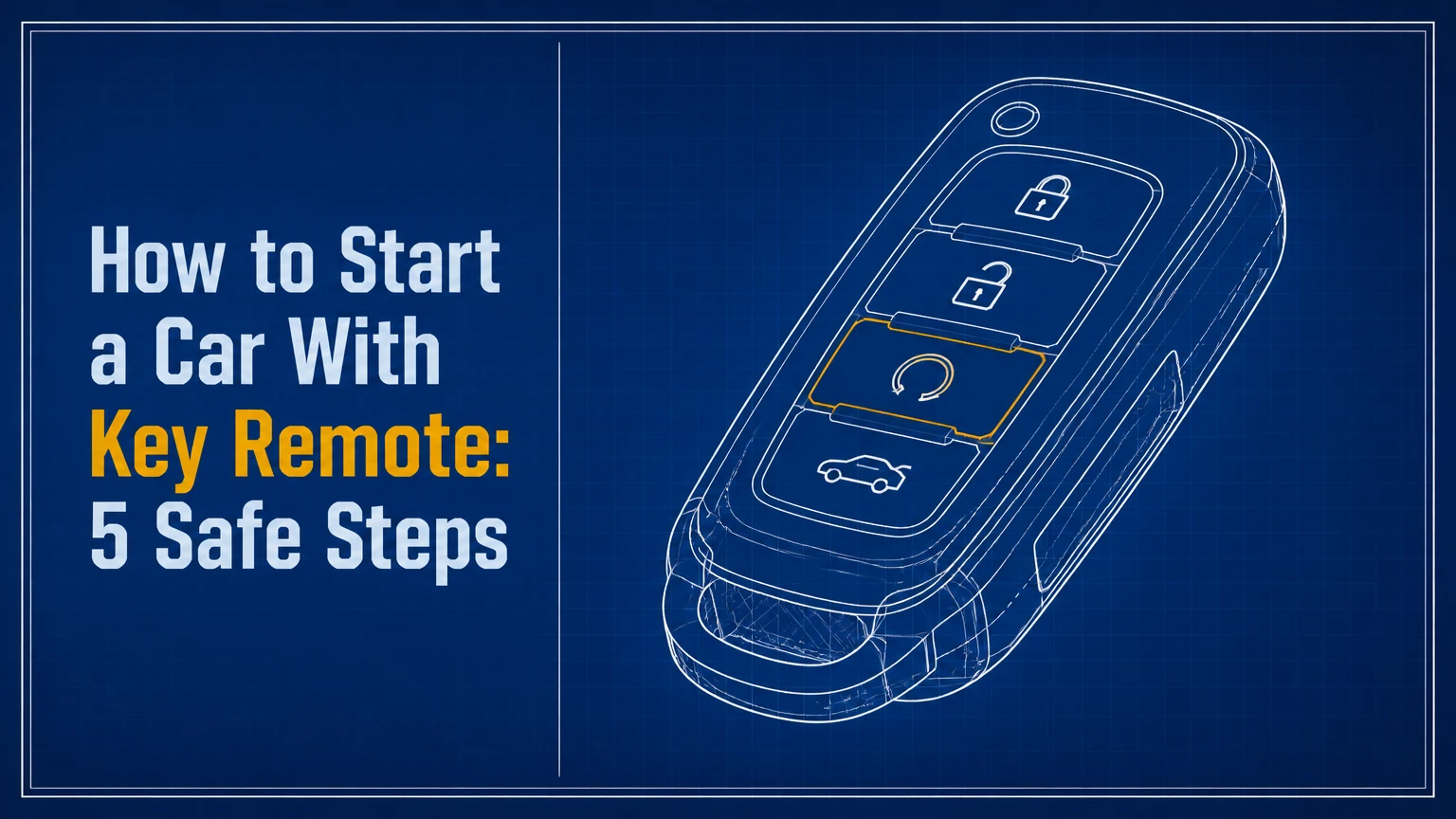
A remote car starter starts a vehicle from outside using a programmed key-fob command, usually by pressing Lock and then holding a circular-arrow or 2X button for 2-5 seconds. The car must meet safety conditions, and you must complete the manufacturer’s takeover procedure before shifting into gear.
Key Facts at a Glance
Most remote starters require the vehicle to be locked before the start command.
A typical remote-start cycle runs for 10-15 minutes before automatic shutdown.
A push-button car usually requires the key fob inside the cabin before you press the brake.
A turn-key car usually requires inserting the key and switching to the On position before braking.
Remote start cannot normally bypass the factory immobilizer for driving without the authorized key.
Never use remote start in a closed garage because engine exhaust can create fatal carbon monoxide levels.
What You Need Before Starting the Car Remotely
A working remote-start system, a charged vehicle battery, a compatible key fob, and a safe outdoor location are the basic requirements. The vehicle normally must be in Park, the hood and doors must be closed, and the parking brake must be set when the system supports remote operation.
Remote start may be factory-installed, added by a dealer, or installed as an aftermarket module. The key fob must have a dedicated remote-start command, commonly shown as a circular arrow, a star icon, or “2X.” Lock and unlock buttons alone do not prove that the vehicle has remote engine start.
Check the owner’s manual before trying an unfamiliar sequence. Some Ford, Toyota, Hyundai, Kia, Subaru, Chevrolet, Nissan, and Honda systems use different button timing, while aftermarket brands such as Compustar, Viper, Directed, and Autostart may use separate remotes.
Before-you-start checklist
| Requirement | Typical value or condition | Why it matters |
|---|---|---|
| Remote distance | 100-3,000 feet for RF fobs | Walls, metal structures, and interference reduce range |
| Engine runtime | 10-15 minutes per cycle | Prevents extended unattended idling |
| Transmission position | Park, automatic transmission | Prevents movement during an unattended start |
| Hood status | Fully closed | Hood pin prevents service-area engine starts |
| Vehicle battery | Approximately 12.4-12.7 volts at rest | Low voltage can cancel or interrupt starting |
| Location | Open outdoor area | Prevents carbon monoxide accumulation |
How Does a Remote Car Starter Work?
A remote car starter receives an authenticated wireless command and activates the vehicle’s starter, ignition, and accessory circuits without allowing normal driving until the authorized key is present. The remote transmits a coded signal to a receiver or control module, which checks safety inputs before requesting engine operation.
The system is not the same as hot-wiring. Modern vehicles use an immobilizer, body-control module, engine-control module, and coded transponder or smart key. A properly installed starter coordinates with those systems through a vehicle-specific interface or bypass module.
A typical sequence is:
- The key fob sends a radio-frequency command.
- The vehicle module verifies the fob’s rolling or encrypted code.
- Safety inputs confirm Park, closed doors, closed hood, and acceptable alarm status.
- The module activates ignition and starter circuits.
- The engine-control system confirms that the engine has started.
- Climate-control and accessory circuits operate according to the vehicle’s settings.
The exact radio frequency is system-dependent. Many remote keyless systems operate in regional bands such as 315 MHz, 433.92 MHz, or 868 MHz, while some aftermarket products use 900 MHz-class two-way communication. Frequency alone does not determine range or security.
Remote unlocking is not remote starting
A key fob that unlocks the doors may not start the engine. Remote start requires a dedicated button, a programmed control module, and vehicle compatibility. Some OEM systems hide the start command in a sequence, such as pressing Lock three times, while aftermarket remotes may require holding a dedicated button.
How to Start a Car With Key Remote
The common sequence is Lock, then press and hold the remote-start button for 2-5 seconds, but the owner’s manual controls when that sequence is valid. Follow the five steps below, then verify the engine and complete the takeover procedure before driving.
Step 1: Put the vehicle in a safe starting condition
Park the car on a stable surface, select Park, apply the parking brake, close the hood, and close every door, liftgate, and trunk. Remove people, pets, and loose objects from unsafe areas around the vehicle.
Do not remote-start a vehicle inside a garage, carport with restricted airflow, enclosed loading bay, or building entrance. Carbon monoxide has no reliable odor warning, and an open garage door does not guarantee safe ventilation.
You’ll know it worked when: the vehicle is locked, stationary, and outside in an open area.
Common mistake: leaving the hood slightly open after maintenance. The hood switch commonly blocks remote start even when the hood appears closed.
Step 2: Press the Lock button
Stand within the effective range of the key fob and press Lock once. Some factory systems require two or three Lock presses, while many aftermarket systems use one Lock press followed by a start command.
Locking first confirms that the vehicle is secured and gives the control module a defined starting state. If the horn sounds or the hazard lamps flash, wait for the lock confirmation before continuing.
You’ll know it worked when: the doors lock and the remote displays or signals a locked status.
Common mistake: pressing the start button immediately after unlocking. Some systems reject a start request when the vehicle is unlocked.
Step 3: Press and hold the start command
Press and hold the button marked with a circular arrow, “2X,” or a manufacturer-specific remote-start symbol for approximately 2-5 seconds. Do not press the brake pedal, open a door, or press the accelerator during the starting sequence.
Some OEM key fobs use a short Lock, Lock, Lock sequence instead of a separate start button. Other systems require pressing a function button first, then pressing Start. A smartphone app may require selecting the vehicle and confirming the command.
You’ll know it worked when: the parking lights flash, the horn chirps, the fob vibrates, or a two-way display shows an engine-running symbol.
Common mistake: holding the wrong button. Trunk-release or panic commands can trigger an alarm or open a compartment rather than start the engine.
Step 4: Confirm the engine is running
Check for the vehicle’s confirmation signal before walking away. A one-way remote may show only parking-light flashes, while a two-way remote can report engine status, cabin temperature, battery voltage, or a failed-start code.
A typical remote-start runtime is 10-15 minutes, although many systems allow a configurable 5-30-minute period. The vehicle usually shuts down automatically when the timer ends, when a safety input changes, or when the system detects an abnormal starting condition.
Remote start does not repair a weak battery, poor fuel quality, failed glow plugs, or an engine fault. An engine that cranks without starting can still leave the battery depleted after repeated attempts.
You’ll know it worked when: the engine remains running for several seconds and the confirmation signal indicates a successful start.
Common mistake: assuming flashing lights always mean the engine started. On some one-way systems, the lights confirm receipt of the command rather than successful combustion.
Step 5: Complete the takeover before driving
The takeover method depends on the ignition design and remote-start module. For a turn-key vehicle, insert the authorized key and turn it to On without cranking again, then press the brake and shift into gear. For a push-button vehicle, carry the authorized key fob inside, press the brake, and press the Start button if the manual requires it.
Do not press the brake before the takeover sequence is ready. Many systems shut the engine off immediately when the brake input occurs without an authenticated key or completed handoff.
| Vehicle and system | Typical takeover action | Result if done incorrectly |
|---|---|---|
| Turn-key OEM system | Insert key, turn to On, press brake | Engine may shut off or starter may not accept handoff |
| Turn-key aftermarket system | Insert key, turn to On, press brake within 30 seconds | Remote-start cycle ends |
| Push-button OEM system | Enter with key fob, press brake, select gear | Vehicle remains in Park until key authentication |
| Push-button aftermarket system | Enter with key fob, press brake, press Start if required | Engine can stop if takeover timing fails |
| Manual-transmission system | Follow reservation-mode procedure exactly | System may refuse remote start |
You’ll know it worked when: the engine remains running after braking and the vehicle shifts normally into gear.
Common mistake: treating remote start as a key replacement. Remote starting warms or cools the cabin, but the authorized key still controls immobilizer authentication and driving permission.
Which Remote-Start System Fits Your Vehicle?
Factory remote start integrates with the vehicle’s original electronics, while aftermarket systems usually offer longer range and more settings. A smartphone-controlled system adds cellular access but depends on an active service plan and cellular coverage for both the phone and vehicle.
| System type | Typical range | Confirmation | Recurring cost | Best fit |
|---|---|---|---|---|
| OEM key fob | 50-200 feet | Lights, horn, dashboard status | $0-$15 per month | Owners needing simple factory integration |
| 1-way aftermarket | 500-1,500 feet | Vehicle lights or horn | $0 | Drivers who can see the vehicle |
| 2-way aftermarket | 1,500-3,000 feet | Fob tone, vibration, or screen | $0-$10 per month | Apartment or office parking |
| Smartphone telematics | Cellular coverage range | App status and notifications | $5-$20 per month | Users starting vehicles from distant locations |
Range figures are typical rather than guaranteed. Concrete walls, underground parking, radio interference, vehicle antenna placement, and local transmission rules can reduce usable distance substantially.
OEM remote start versus aftermarket installation
OEM remote start normally preserves the original key, alarm logic, and vehicle interface. Its limitations include short range, model-year restrictions, and subscription requirements for some connected services.
Aftermarket remote start can add longer range, temperature sensing, heated-seat control, turbo timers, alarm sensors, and phone access. Installation quality matters more than brand alone because the system may interface with CAN-bus data, ignition circuits, brake inputs, door triggers, and immobilizer hardware.
A manufacturer warranty is not automatically void merely because an aftermarket accessory exists. However, an installer-caused wiring or module failure can create a warranty dispute, so retain the installation invoice and use a vehicle-specific harness where available.
How Much Does Remote-Start Installation Cost?
Typical installed pricing ranges from $150-$400 for a basic aftermarket system and $300-$800 or more for a smartphone system or complex vehicle. Luxury vehicles, diesel engines, manual transmissions, and advanced immobilizers can require additional bypass hardware and programming.
| Installation scenario | Hardware range | Labor range | Typical time | Added complication |
|---|---|---|---|---|
| Basic 1-way aftermarket | $60-$180 | $90-$220 | 2-4 hours | Vehicle-specific wiring |
| 2-way aftermarket | $150-$350 | $120-$280 | 3-5 hours | Antenna and confirmation module |
| Smartphone telematics | $200-$450 | $150-$350 | 3-5 hours | Cellular module and subscription |
| Luxury European vehicle | $250-$600 | $200-$500 | 4-8 hours | Immobilizer and CAN-bus integration |
| Manual-transmission vehicle | $150-$400 | $150-$350 | 3-6 hours | Reservation-mode safety logic |
Prices vary by country, vehicle year, installer, and module availability. The figures above are typical planning ranges, not a quote. Ask whether programming, bypass modules, extra remotes, taxes, and the first year of cellular service are included.
Professional installation is preferable on vehicles with push-button ignition, proximity keys, factory alarms, remote immobilizers, or multiple CAN-bus networks. A wiring mistake can disable body electronics or create intermittent no-start problems that are harder to diagnose than a completely failed system.
What Should You Leave Set for Heating or Cooling?
Set the climate controls before leaving the vehicle because remote start usually preserves the last temperature, fan, and seat-heater settings. Remote start does not create heat instantly, and cabin temperature depends on ambient temperature, engine coolant, electrical load, and the vehicle’s climate-control strategy.
For cold weather, set the heater to a moderate temperature, direct airflow toward the windshield if defrosting is needed, and leave the fan at a practical speed. Do not rely on remote start alone to remove thick ice. Use a scraper and confirm clear windows before moving.
For hot weather, set the air conditioner before switching off the vehicle if the model retains those settings. An idling engine can cool the cabin, but solar heat through glass may require several minutes before the interior becomes comfortable.
Remote start is not a substitute for a mechanical inspection. If the defroster does not clear the windshield, the coolant level is low, or the blower fails, do not drive until visibility is restored.
Why Is the Remote Starter Not Working?
A failed remote start most often results from an unclosed hood or door, a weak key-fob battery, low vehicle voltage, an active valet mode, an incorrect button sequence, or a safety fault. Diagnose external conditions first, then check the remote, then consult the system’s flash code or installer.
| Symptom | Likely cause | First check | Safe next action |
|---|---|---|---|
| No response from fob | Dead CR2032 or CR2016 cell | Replace coin-cell battery | Retry within normal range |
| Doors lock but engine does not start | Hood, door, brake, or Park input | Close panels and verify Park | Check dashboard warning messages |
| Lights flash three times | Safety input or open hood | Inspect hood and doors | Read the system manual’s flash chart |
| Engine cranks and stops | Immobilizer bypass or fuel fault | Try the normal key | Contact installer if key works |
| System starts then shuts down | Brake input, low voltage, alarm trigger | Release brake and check battery | Stop repeated attempts |
| Remote works nearby only | Weak fob battery or antenna issue | Replace battery | Inspect antenna installation |
| Completely inactive | Valet mode, blown fuse, disconnected module | Check valet indicator and vehicle fuses | Use installer-specific reset procedure |
Flash codes are not universal. Three flashes may indicate an open hood on one module and a different safety fault on another, so never apply a generic code chart without identifying the brand and model.
How do you exit valet mode?
Valet-mode procedures vary by manufacturer and installation. Common methods involve switching the ignition to On and pressing a control-center button, remote button combination, or valet switch, but the exact sequence must come from the owner’s manual or installer.
Do not randomly press Lock, trunk, and alarm buttons while the vehicle is unattended. That can trigger the alarm, change programming, or activate another feature. If the system entered valet mode after service, ask the installer for the module’s exact exit procedure.
Can Every Vehicle Use Remote Start?
Most modern automatic-transmission vehicles can support remote start when a compatible factory or aftermarket system exists, but manual-transmission, diesel, hybrid, electric, and older vehicles have different conditions. Vehicle compatibility depends on model year, immobilizer design, transmission logic, and available control modules.
Manual-transmission cars
Manual cars require a reservation or ready mode that verifies neutral, parking brake engagement, door status, and a safe exit sequence. Opening a door or releasing the parking brake after setup may cancel the reservation.
Never install or use a remote starter on a manual car without a system designed for manual transmissions. A poorly configured system can start a car left in gear.
Diesel vehicles
Diesel engines may require a glow-plug wait period before cranking, especially below freezing. A diesel-compatible remote starter must monitor the glow-plug or wait-to-start signal rather than using a gasoline-engine timing assumption.
Hybrids and electric vehicles
Hybrid and electric vehicles may not produce an obvious engine sound during a remote climate cycle. A hybrid can condition the cabin while the gasoline engine remains off, and an EV generally uses its high-voltage battery and electric HVAC system rather than starting an engine.
Use the manufacturer’s app or factory procedure when available. An aftermarket gasoline remote-start module may be unsuitable for a high-voltage vehicle.
Older cars with separate keys
Older vehicles may lack an electronic immobilizer, but they still need compatible ignition wiring, door and hood inputs, and a safe starter module. A qualified installer should identify the ignition architecture before recommending a product.
Common Mistakes That Damage Convenience or Safety
Remote-start problems often come from incorrect assumptions rather than defective hardware. The following practitioner rules prevent most repeat failures.
- Do not repeat failed starts indefinitely. Two or three unsuccessful attempts can drain a marginal battery and make the original fault harder to identify.
- Do not warm a vehicle by idling in an enclosed space. Move the vehicle outdoors before using remote start, even if the garage door is open.
- Do not leave the climate controls at maximum every day. Maximum fan and heated accessories increase electrical demand during cold starts.
- Do not ignore a hood-pin fault after bodywork. A bent hood switch, damaged pin, or disconnected connector commonly causes a sudden no-start condition.
- Do not assume a longer range means better security. Two-way confirmation improves feedback, but immobilizer authentication and professional installation determine theft resistance.
- Do not use remote start to conceal an engine fault. Misfires, warning lights, abnormal smoke, and low oil pressure require diagnosis rather than longer idle periods.
A remote starter is useful for cabin conditioning and convenience. It is not appropriate for unattended idling near children, pets, pedestrians, or enclosed structures.
Which Remote-Start Method Should You Choose?
Choose the factory key fob for simple operation and original-equipment integration, a 2-way aftermarket system for reliable confirmation across a parking lot, and smartphone telematics for distant control where cellular coverage and subscriptions are acceptable.
| User situation | Recommended system | Reason | Main limitation |
|---|---|---|---|
| Home driveway within sight | OEM key fob | Lowest complexity and no extra remote | 50-200-foot typical range |
| Apartment parking lot | 2-way aftermarket | Confirms engine status remotely | Higher installation cost |
| Office several floors away | 2-way or telematics | Concrete structures weaken one-way signals | RF range may still vary |
| Airport or distant parking | Smartphone telematics | Cellular control exceeds fob range | Requires service coverage |
| Older vehicle with complex wiring | Professional aftermarket installation | Adds compatibility assessment | Installation may exceed $400 |
| Manual-transmission vehicle | Manual-rated remote starter | Includes reservation-mode controls | More restrictive operating procedure |
A smartphone system is not automatically the best choice. It may fail in underground parking where cellular service is absent, while a two-way RF remote can work reliably through some structures. Match the control method to where the vehicle is parked, not to the feature list alone.
Frequently Asked Questions
Does remote start drain the car battery?
Remote start uses fuel and electrical power, but a healthy charging system usually replaces the starting energy during normal driving. Repeated short remote cycles, cold temperatures, an aging battery, or a vehicle parked for long periods can leave the battery undercharged. A battery test is appropriate when remote starts repeatedly fail.
Can I drive the car after remote starting without the key?
Most vehicles cannot be driven without the authorized key or smart fob. Remote start activates the engine, but the immobilizer normally prevents gear selection or engine continuation unless the key is authenticated during takeover. Do not treat a running remote-start vehicle as unlocked driving access.
How far away can a key-fob remote starter work?
A factory key fob commonly works from 50-200 feet, a one-way aftermarket remote from 500-1,500 feet, and a two-way system from 1,500-3,000 feet in favorable conditions. Concrete, metal, underground parking, antenna placement, and radio interference can reduce every range substantially.
Does remote start work in very cold weather?
Remote start can operate in cold weather if the battery, starter, fuel system, and engine oil are suitable for the temperature. Cold reduces battery output and increases cranking resistance, so a weak battery may fail even when the remote command is accepted. Diesel vehicles also need proper glow-plug timing.
Why does the engine stop when I press the brake?
The engine stops because the remote-start module has detected a brake input before a valid takeover. That safety behavior prevents a person from driving a remotely started vehicle without the authorized key. Enter with the key, follow the correct ignition or push-button handoff, and then press the brake.
Can I install a remote starter myself?
DIY installation is reasonable only for a genuinely compatible plug-in system and a person who understands vehicle electronics. Hardwired systems can interact with immobilizers, CAN-bus networks, airbags, alarms, and brake circuits. Use a qualified installer when the vehicle has proximity keys, push-button ignition, a manual gearbox, or complex factory security.
The Bottom Line
To start a car with key remote, lock the vehicle, press and hold the dedicated remote-start command for 2-5 seconds, verify the confirmation signal, and complete the authorized-key takeover before shifting into gear. If the car does not start, check the fob battery, hood and door status, Park position, vehicle battery, brake input, and valet mode in that order.