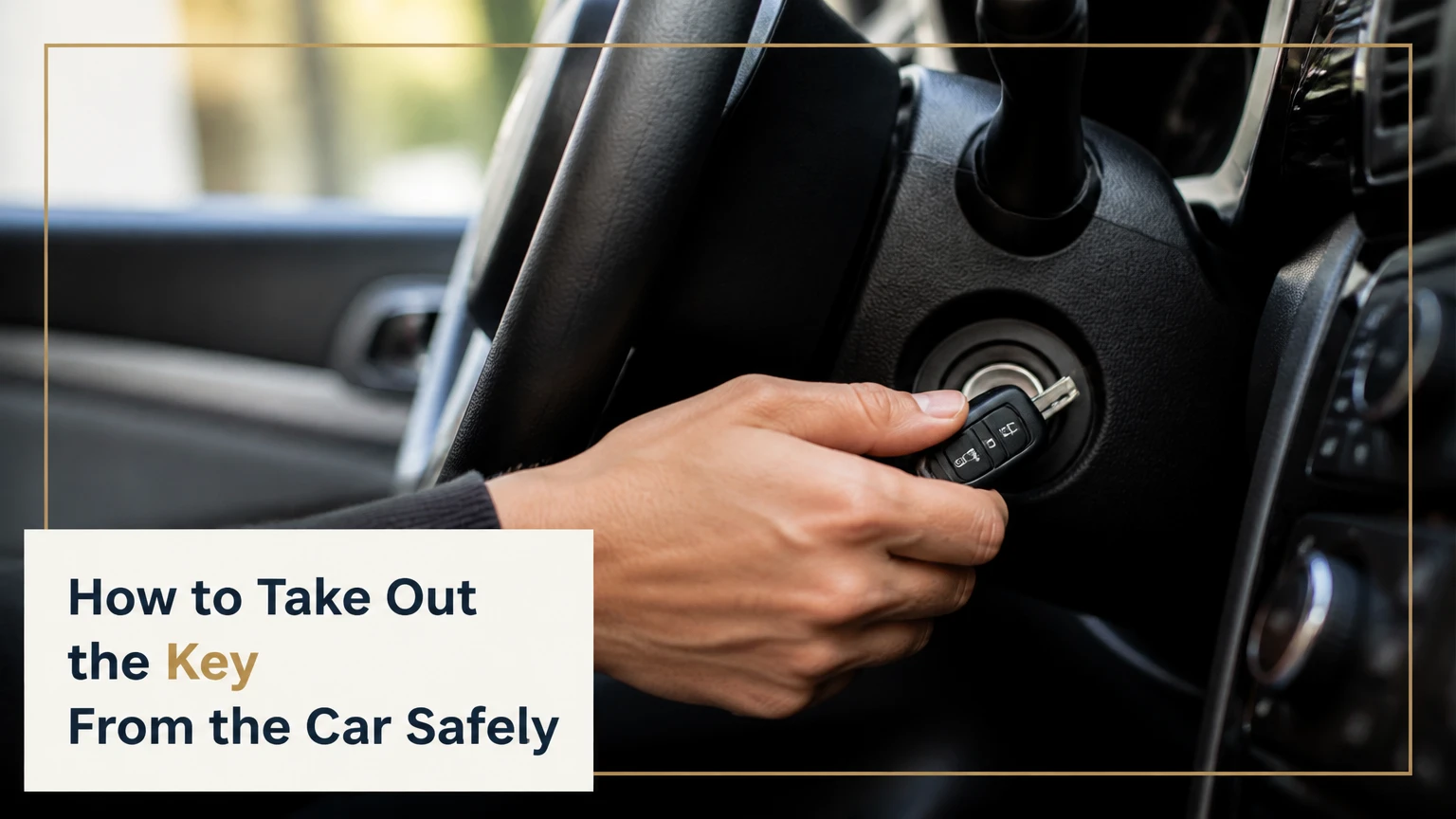
To take out the key from the car, stop completely, apply the parking brake, select Park if the vehicle has an automatic transmission, and switch the ignition to Lock or Off. Push the key inward while turning it gently counterclockwise, then pull it straight out. Never force a key that resists.
Key Facts
A conventional ignition key normally releases only in the Lock or Off position.
Automatic vehicles commonly require the shifter to register fully in Park.
A locked steering wheel can prevent the ignition cylinder from reaching the release position.
A dead battery can affect electronic key-release systems, but it cannot explain every stuck key.
Graphite or a manufacturer-approved dry PTFE lubricant is safer for many cylinders than oil.
A bent, cracked, or heavily worn key should be replaced before it damages the ignition cylinder.
Before You Remove the Car Key
The removal process usually takes less than 30 seconds and requires no tools, but the vehicle must be stationary and secured first. The most important condition is that the ignition reaches the manufacturer’s Lock or Off detent while the transmission and steering interlocks are satisfied.
| Item | Typical requirement | Why it matters |
|---|---|---|
| Vehicle position | Complete stop | Prevents accidental movement |
| Parking brake | Fully engaged | Adds a second holding system |
| Automatic shifter | P, fully seated | Releases the Park interlock |
| Manual shifter | Neutral preferred | Prevents an unexpected launch |
| Ignition position | Lock or Off | Aligns the key-release mechanism |
| Removal force | Gentle, straight pull | Reduces blade and cylinder damage |
Before touching the key, keep your foot on the brake, confirm the instrument cluster is off, and check that no accessory remains powered. A vehicle parked on a slope may place extra load on the transmission parking pawl, which can make the shifter or ignition feel unusually tight.
What do you need?
You need the vehicle key, the parking brake, and a clear view of the shifter and ignition. A flashlight helps when the key slot is dark. Do not begin with pliers, a screwdriver, penetrating oil, or a large amount of spray lubricant because those items can turn a simple interlock problem into a broken-cylinder repair.
How to Take Out the Key From the Car
Follow these five steps for a standard metal key in a dashboard or steering-column ignition. The method works for many automatic vehicles, although the exact release position may be labeled Lock, 0, Off, or a padlock symbol.
Step 1: Stop and secure the vehicle
Bring the car to a complete stop, keep the brake pedal depressed, and engage the mechanical or electronic parking brake. If the vehicle is on a hill, straighten the wheels where practical and keep the brake applied throughout the procedure.
Success checkpoint: The car does not roll when your foot briefly changes position.
Common mistake: Relying on the transmission’s Park position without applying the parking brake. Parking-brake use reduces load on the parking pawl and can make later shifter movement easier.
Step 2: Select the correct transmission position
Move an automatic transmission firmly into P, then gently pull or push the selector to confirm that it is fully seated. Some vehicles release the ignition only when a position sensor or microswitch reports Park, not merely when the lever appears close to P.
For a manual transmission, select neutral and apply the parking brake. Manual vehicles generally do not use the same Park interlock, but some models still use an ignition lock, clutch switch, or steering-column mechanism.
Success checkpoint: The dashboard or shifter indicator displays P without flickering or showing an adjacent position.
Common mistake: Holding the shifter between positions or pressing the release button while the lever is not fully in Park.
Step 3: Turn the ignition to Lock or Off
Turn the key gently counterclockwise through Start, Run, and Accessory until it reaches Lock or Off. Do not pull while the key remains in the Run or Accessory position because many cylinders mechanically retain the key there.
Use the lowest force that moves the key. A typical key blade turns only a small arc between Accessory and Lock, so excessive torque can bend the blade or damage the wafers inside the cylinder.
Success checkpoint: The key stops at a distinct final position, the engine and accessories shut down, and the steering lock may engage.
Common mistake: Stopping at Accessory because the labels are difficult to see. Accessory is not the release position on most conventional ignition systems.
Step 4: Push the key inward and release steering tension
Press the key straight toward the ignition cylinder with light finger pressure while turning it the final few degrees toward Lock. If the steering wheel is locked, move the wheel a few centimeters left and right while maintaining gentle key pressure.
The wheel may bind against the steering-lock pin when the front tires rest against a curb or when the driver turns the wheel after switching off the engine. Alternate pressure on the steering wheel rather than wrenching the key.
Success checkpoint: The key reaches Lock and rotates without sudden resistance.
Common mistake: Pulling outward while turning. Many ignition cylinders require inward pressure to align the release detent.
Step 5: Pull the key straight out
Once the cylinder reaches Lock or Off, pull the key directly along the axis of the keyhole. Keep the blade level, and avoid twisting it during removal.
Success checkpoint: The key exits smoothly, the key warning chime stops if fitted, and the instrument panel remains off.
Common mistake: Rocking the key from side to side. Side loading can enlarge the cylinder opening, wear the key blade, or break a weakened key.
Why Does an Ignition Key Get Stuck?
A stuck car key usually results from one of four conditions: the ignition is not fully in Lock, the automatic shifter has not registered Park, steering-lock pressure is binding the cylinder, or the key or cylinder is worn. Electronic faults and low voltage account for some modern cases, especially with slot-mounted fobs.
A conventional ignition cylinder contains wafers or tumblers that must align before the inner plug can rotate. The transmission interlock adds a separate condition, using a cable, microswitch, or electronic actuator to prevent key removal unless the vehicle is secured.
| Symptom | Most likely area | First safe action | Stop-DIY indicator |
|---|---|---|---|
| Key turns but will not exit | Lock detent or worn key | Push inward and return to Lock | Key blade bends |
| Key will not turn at all | Steering lock or damaged cylinder | Move wheel gently left and right | No movement after two attempts |
| Key stops at Accessory | Park signal or ignition switch | Reseat shifter in P | Shifter indicator disagrees |
| Key releases after battery jump | Electronic interlock | Test battery and charging system | Battery warning or repeated failure |
| Key blade is cracked | Key damage | Use a spare key | Crack widens or blade flexes |
| Fob remains in slot | Slot latch or low voltage | Follow owner’s manual release method | Manual release requires trim removal |
A manufacturer owner’s manual takes priority over generic instructions. For example, General Motors manuals commonly state, “The ignition key can only be removed when the transmission is in P (Park),” but some vehicles use different wording or a separate manual-release procedure.
What Should You Do If the Key Will Not Turn?
If the key will not turn, stop applying force and first relieve steering-wheel pressure. Hold the steering wheel near the nine-o’clock and three-o’clock positions, move it gently in both directions, and turn the key with light pressure toward Lock or Run.
Do not spin the wheel violently. The objective is to unload the steering-lock pin, not to overcome it with torque. A curb, a sloped parking space, or a wheel that was turned after shutdown can create enough pressure to prevent cylinder movement.
Try the following sequence:
- Keep the brake pedal depressed.
- Confirm the shifter is fully in Park.
- Move the steering wheel left and right by a small amount.
- Turn the key gently while pushing it inward.
- Stop if the blade flexes, cracks, or begins to twist.
A second key is a useful diagnostic tool. If the spare works immediately, the original key is probably worn or bent. If both keys fail in the same way, the ignition cylinder, interlock, steering lock, or electrical system deserves inspection.
What If the Key Is Stuck in Accessory?
A key stuck in Accessory usually means the cylinder has not reached Lock or the vehicle has not confirmed the required transmission position. Press the brake, move the selector firmly into Park, and try turning the key counterclockwise while pushing it inward.
Some vehicles require the shifter to be moved out of Park and returned to Park. Perform that test only while the brake is applied and the parking brake is engaged. A flashing gear indicator, a shifter that feels loose, or a vehicle that starts in a position other than Park indicates a possible range-sensor or interlock fault.
| Accessory-position clue | Likely cause | Appropriate response |
|---|---|---|
| Radio remains powered | Key is still in ACC | Rotate farther toward Lock |
| Shifter indicator is blank | Range sensor issue | Do not force the ignition |
| Key releases after reseating P | Park microswitch or cable | Arrange an inspection |
| Key remains after battery recharge | Mechanical cylinder fault | Contact a locksmith or shop |
| Key turns only with shifter movement | Interlock alignment | Avoid repeated cycling |
A key that remains trapped after the engine is off can drain the battery because accessory circuits may stay active. Remove the key promptly if possible, then address the underlying fault rather than leaving the vehicle unattended overnight.
Can a Dead Battery Prevent Key Removal?
A dead battery can prevent key removal on vehicles that use an electronic shift-lock or electrically controlled ignition release, but battery failure is not a universal explanation. A purely mechanical ignition cylinder can usually release its key without battery power if the key reaches Lock and the shifter interlock is mechanically satisfied.
Modern vehicles may use a solenoid that retracts a locking pin when the body control module sees Park, brake, ignition, and voltage signals. Low voltage can therefore produce a key-retention symptom even when the metal blade and cylinder are healthy.
Check for these signs:
- Interior lights are dim or absent.
- The instrument cluster does not illuminate.
- The vehicle produces rapid clicks or no starter response.
- The shifter cannot move normally.
- The key slot or release button does not respond.
Use the owner’s manual for the approved jump-start points and emergency key-release location. Do not insert metal tools into a smart-key slot or apply external voltage to an unknown terminal.
How Do Smart Fobs and Push-Button Cars Differ?
A push-button vehicle usually does not require removing a metal key from an ignition cylinder. The driver switches the vehicle to Park, presses the stop button, and confirms that the dashboard shows Off; the smart fob then remains in the driver’s possession rather than inside the car.
Some vehicles have a backup fob slot or a recessed emergency reader. The slot can retain a fob because of a mechanical latch, a dead fob battery, contamination, or a fault in the reader. A removable emergency blade may also be stored inside the fob housing.
| Key system | Normal removal action | Typical battery | Typical replacement cost |
|---|---|---|---|
| Mechanical key | Turn to Lock and pull | None | $10-$50 |
| Transponder key | Turn to Lock and pull | Often none in blade | $50-$250 |
| Slot-mounted smart fob | Press stop, then remove fob | CR2032 or CR2025 | $100-$400 |
| Proximity smart fob | Switch to Off and carry fob away | CR2032 or CR2025 | $150-$600 |
| Emergency metal blade | Press release tab and slide blade out | None | $10-$80 |
Replacement figures are typical North American consumer prices, not fixed rates. Dealer programming, vehicle security systems, regional labor rates, and whether all keys are lost can change the final invoice substantially.
Do not assume a smart fob’s dead battery means the vehicle is mechanically locked. Many manufacturers provide a designated backup location, but the location differs by model and should be confirmed in the owner’s manual.
Should You Use Lubricant in the Ignition?
Use lubricant only when the key inserts and rotates with gritty or intermittent mechanical resistance, and choose a small amount of dry graphite or manufacturer-approved dry PTFE. Lubricant will not repair a failed Park sensor, a broken ignition switch, a bent key, or an electronic solenoid.
For a conventional cylinder, one short application of dry powder or a brief dry-lubricant spray is usually sufficient. Insert and remove the key several times, then wipe the blade clean before trying again. Excess material can migrate into electrical contacts or attract debris.
Avoid these common products:
- Motor oil, because it collects dust and can thicken inside the cylinder.
- Grease, because it can obstruct small wafer movements.
- Water-displacing sprays used as a permanent lubricant, because residue may collect dirt.
- Household adhesives or cleaning chemicals, because they can damage plastic and seals.
Lubricant is a limited intervention, not a substitute for diagnosis. If resistance appeared suddenly, the key is visibly worn, or the cylinder produces grinding sounds, repeated lubrication can conceal a developing failure.
Which Car Key System Is Easiest to Remove?
A traditional mechanical key is the easiest system to remove because the release depends mainly on the key position, cylinder alignment, and any transmission interlock. A smart fob avoids a physical ignition cylinder but adds battery, proximity, slot, and software dependencies.
| System | Mechanical wear | Electronic dependency | Typical service time | Main failure risk |
|---|---|---|---|---|
| Mechanical key | High after 10+ years | Low | 5-30 minutes | Worn wafers or blade |
| Transponder key | Medium | Medium | 15-60 minutes | Programming or antenna fault |
| Slot smart fob | Medium | High | 15-90 minutes | Reader latch or low voltage |
| Push-button fob | Low physical cylinder wear | High | 10-60 minutes | Fob battery or proximity fault |
Mechanical keys are generally cheaper to duplicate, while transponder and smart keys require programming equipment or a compatible diagnostic process. A vehicle with a physical key can still have immobilizer electronics, so successful removal does not prove that the key will start the engine.
How Much Does a Stuck-Key Repair Cost?
A replacement metal key typically costs $10-$50, while an automotive locksmith visit for diagnosis or extraction commonly falls around $75-$250 during normal hours. Ignition-cylinder replacement often costs $200-$600, and dealer smart-key replacement can reach $150-$600 or more.
| Repair or service | Typical price | Typical time | Price drivers |
|---|---|---|---|
| Duplicate metal key | $10-$50 | 5-20 minutes | Blank type and cutting |
| Transponder key | $50-$250 | 20-60 minutes | Programming and vehicle security |
| Fob battery | $5-$20 | 2-10 minutes | Battery size and housing |
| Locksmith extraction visit | $75-$250 | 30-90 minutes | Travel, time, and damage |
| Ignition-cylinder repair | $150-$400 | 1-3 hours | Vehicle access and parts |
| Ignition-cylinder replacement | $200-$600 | 1-4 hours | Part, coding, and labor |
| Dealer smart-key replacement | $150-$600+ | 30-120 minutes | Programming and all-keys-lost status |
These are typical ranges rather than published universal prices. Request an itemized quote that separates travel, extraction, key cutting, programming, and cylinder replacement.
A locksmith is often cheaper than a dealer for a damaged key or cylinder, while a dealer may be necessary for certain immobilizer programming tasks. Verify ownership before service because legitimate automotive professionals require proof of authorization.
What Are the Most Common Removal Mistakes?
The most expensive mistake is forcing a key that has not reached its release position. Ignition cylinders contain small precision parts, and excessive twisting can snap the blade inside the cylinder or damage the steering-column housing.
Avoid these failure patterns:
- Using pliers for extra torque: Pliers can crush or twist the blade. Use a spare key or professional extraction instead.
- Ignoring the shifter indicator: A lever in P may not mean the Park switch has registered P.
- Pulling at an angle: Angled force increases wear on the cylinder mouth.
- Spraying oily lubricant: Residue can trap grit and worsen wafer movement.
- Disconnecting the battery first: Power removal may prevent an electronic release from operating.
- Removing trim to reach a manual release: Airbag and steering-column components can create injury and electrical risks.
An experienced technician tests the simplest explanation first: key position, Park status, steering tension, key condition, and voltage. That order avoids replacing an ignition cylinder when the actual fault is a $10 key or a misadjusted shifter cable.
When Should You Stop and Call for Help?
Stop DIY attempts when the key bends, cracks, breaks, refuses to rotate after two gentle steering and Park checks, or remains trapped after an approved battery test. Professional help is also appropriate when the cylinder is loose in the column, the key turns without engaging the engine, or the vehicle has an alarm or immobilizer fault.
Arrange a locksmith, repair shop, or roadside service when:
- Part of the blade is inside the ignition.
- The ignition housing rotates with the key.
- The shifter display contradicts the lever position.
- The vehicle is parked in traffic or on a steep slope.
- A smart-fob slot requires trim removal.
- The key cannot be removed without noticeable force.
Do not drive with a cracked key, even if the engine starts. Vibration can break the remaining blade in the cylinder, turning a convenient repair into an extraction and replacement job.
How Does a Manual Transmission Change the Procedure?
A manual-transmission car normally has no Park position, so place the gearbox in neutral, apply the parking brake, and turn the ignition to Lock or Off. Some manual models still use an electronic clutch or ignition interlock, but the automatic-transmission Park check does not apply.
Keep the clutch pedal depressed if the owner’s manual requires it for starting or electrical release. Confirm that the car cannot roll before removing the key, especially on an incline.
Manual vehicles can still suffer from steering-lock pressure, worn keys, damaged wafers, and a faulty ignition switch. The absence of a Park interlock narrows the diagnosis, but it does not make force safe.
How Can You Prevent a Key From Sticking Again?
Replace a worn key before its cuts become rounded, keep the key ring light, and use the parking brake before selecting Park on slopes. A spare key stored securely at home provides a practical backup, but hiding a key inside or under the vehicle creates a theft risk.
Preventive practices include:
- Keep heavy work keys and tools off the ignition ring.
- Clean visible dirt from the blade before insertion.
- Use only approved dry lubricant when the cylinder becomes gritty.
- Replace a fob battery when range decreases or the vehicle displays a low-battery warning.
- Have a locksmith cut a duplicate from the original code when possible.
- Ask a technician to inspect a cylinder that needs repeated jiggling.
A duplicated key cut from a badly worn copy may reproduce the same inaccuracies. The original factory key, key code, or a properly decoded unworn key produces a better replacement.
FAQ
Can I remove the key while the engine is running?
Usually no, because conventional ignition cylinders retain the key in Run or Accessory and release it only at Lock. Do not attempt to defeat that interlock while the vehicle is moving or idling unattended. If the key appears removable in an unusual position, consult the owner’s manual before testing the mechanism.
Why does my key come out only when I jiggle the shifter?
The shifter movement may be temporarily aligning a worn Park switch, cable, or interlock actuator. Treat that behavior as a fault rather than a normal technique. A technician should inspect the range sensor or cable adjustment before the vehicle fails to recognize Park completely.
Can I use WD-40 to free an ignition key?
Avoid using WD-40 or oily household products as a lasting ignition lubricant because residue can collect dust inside the cylinder. A small amount of dry graphite or dry PTFE made for locks is more appropriate when the problem is gritty mechanical movement rather than an electrical or shifter fault.
What should I do if the key breaks inside the ignition?
Stop turning the cylinder and do not push the broken piece deeper. If enough metal remains exposed, a trained automotive locksmith may extract it with specialized tools; if the fragment is recessed, the cylinder may require disassembly or replacement. Keep the vehicle secured until the immobilizer and spare-key situation are confirmed.
Why is my key stuck after a jump-start?
A jump-start may restore voltage to an electronic shift-lock or ignition-release solenoid, but it does not repair a worn cylinder or misadjusted Park sensor. Check the battery terminals, charging system, and shifter-status display after the key is removed. Repeated low-voltage symptoms require electrical diagnosis.
Is a key stuck in the ignition covered by roadside assistance?
Coverage varies by policy and provider. Roadside plans commonly cover lockout service or locksmith dispatch, while cylinder replacement, key programming, and parts may cost extra. Ask whether the policy covers extraction, after-hours labor, travel distance, and a replacement key before authorizing work.
The Bottom Line
To take out the key from the car, apply the parking brake, select Park or neutral as appropriate, turn the ignition fully to Lock or Off, relieve steering-wheel pressure, push the key inward, and pull it straight out. If gentle checks fail, stop before the blade or ignition cylinder breaks. A locksmith can usually distinguish a worn key, Park interlock fault, low-voltage issue, and damaged cylinder without unnecessary parts replacement.