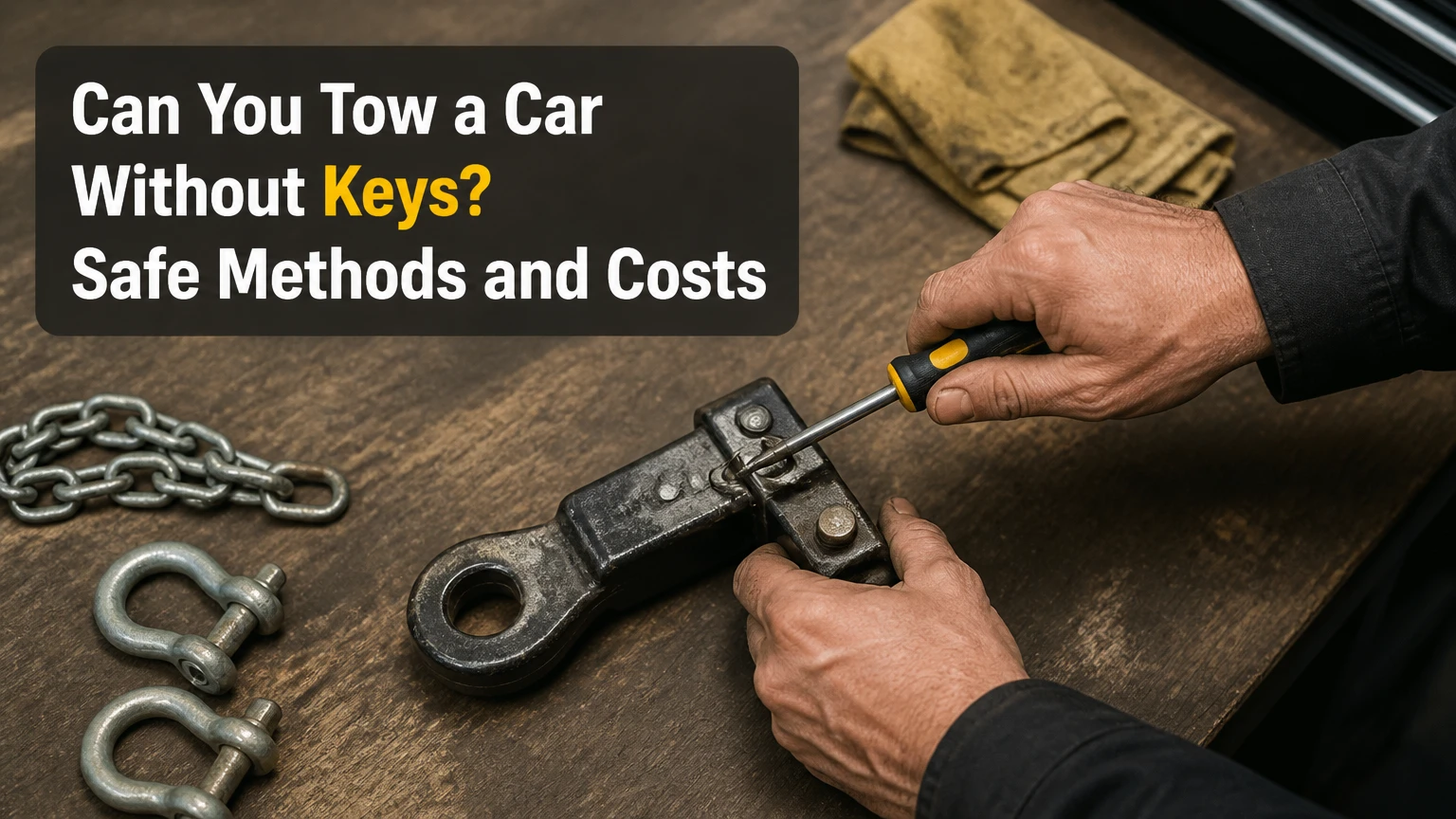
Yes, you can tow a car without keys, but a professional must account for the locked steering, transmission, parking brake, and drivetrain. A flatbed with wheel skates is usually the safest option for a locked vehicle, while wheel lifts require correct drive-wheel positioning and extra dollies for AWD, 4WD, many hybrids, and most EVs.
Key Facts at a Glance
A missing key does not prevent professional vehicle recovery when ownership or authorization is verified.
A flatbed is the default low-risk method for locked, AWD, 4WD, hybrid, and electric vehicles.
Typical local keyless towing costs range from $125-$350 for approximately 10 miles.
An electronic parking brake may require a powered release, wheel dollies, or skates.
Tow operators should attach equipment to factory tow points or approved structural locations, never steering or suspension components.
A locked vehicle should not be dragged with drive wheels rotating unless the manufacturer permits that method.
Can You Tow a Car Without Keys?
A tow company can move a car without keys if the vehicle owner, lawful custodian, property manager, police agency, lender, or other authorized party requests the service. The missing key affects steering, gear selection, and brake release, but professional recovery equipment can load the vehicle without starting the engine.
Keyless towing is different from bypassing a vehicle’s security system. A reputable operator does not need to start the engine, defeat the immobilizer, or make a replacement key merely to transport the car. The operator verifies the vehicle identification number, location, condition, drivetrain, and destination before choosing equipment.
Private-property and impound rules vary by state, province, city, and site owner. A tow company may require a driver’s license, registration, title, insurance record, police authorization, or written property-owner authorization. If the car is leased, financed, abandoned, or involved in a collision, additional release documents may apply.
What Does “Without Keys” Include?
Keyless towing includes a missing metal key, dead key fob, locked-in smart key, broken ignition key, disabled remote, or vehicle whose owner cannot access the cabin. A dead key-fob battery is usually a lockout problem, while a missing programmed key becomes a transport and replacement-key problem.
The distinction affects the cheapest solution. If the car is otherwise operational and the key is locked inside, an automotive locksmith may open it without towing. If the car has a seized wheel, engaged electronic parking brake, flat tire, collision damage, or blocked access, a tow operator needs recovery equipment even after entry.
Why Is a Keyless Car Difficult to Move?
A keyless car is difficult to move because the transmission may be locked in Park, the steering column may be immobilized, and the parking brake may remain applied. Manual-transmission cars can also resist movement when left in gear, although the exact behavior varies by model.
An automatic transmission uses a parking pawl to hold the drivetrain when the selector is in Park. The steering lock keeps the front wheels from freely following a tow truck’s direction. Modern electronic parking brakes add a further obstacle because their actuators may need battery power and vehicle controls to release.
A professional evaluates these barriers instead of pulling harder. Excessive winch force can damage a bumper, tie rod, half-shaft, wheel bearing, tire, or body panel when the car cannot roll.
Which Vehicle Details Matter First?
The most important details are drivetrain, transmission, parking-brake type, vehicle weight, ground clearance, wheel condition, and access space. The VIN or exact model and model year can matter because towing instructions differ between trims that appear mechanically similar.
| Vehicle condition | Main obstruction | Equipment usually considered | Primary risk |
|---|---|---|---|
| FWD automatic in Park | Locked front drive wheels | Flatbed, front wheel lift, or dollies | Front drivetrain rotation |
| RWD automatic in Park | Locked rear drive wheels | Flatbed, rear wheel lift, or dollies | Rear differential rotation |
| AWD or 4WD | Multiple connected axles | Full flatbed or four-wheel dollies | Transfer-case or differential damage |
| Manual transmission in gear | Engine compression and locked drive wheels | Flatbed with skates or dollies | Clutch, tire, and driveline strain |
| EV or hybrid | Motor, reduction gear, and electronic brake | Manufacturer-approved flatbed method | Motor or high-voltage system damage |
Which Towing Method Is Safest?
A full flatbed is generally the safest method for a locked car because all four tires travel on the truck bed and the vehicle’s drive wheels do not rotate on the road. A wheel lift can work for a conventional FWD or RWD car when the lifted axle and manufacturer instructions match, but AWD, 4WD, EV, and many hybrid vehicles usually warrant a flatbed.
| Method | Typical setup time | Best application | Main limitation |
|---|---|---|---|
| Full flatbed | 15-30 minutes | AWD, EV, collision, long distance | Requires loading clearance and truck access |
| Wheel lift alone | 5-15 minutes | Short FWD or RWD move | Wrong axle placement can damage drivetrain |
| Wheel lift with dollies | 15-30 minutes | Tight access or AWD extraction | More equipment and securing points |
| Skates with winch | 15-35 minutes | Locked or seized wheels | Requires careful tire and frame support |
| Hook and chain | Variable, often 20+ minutes | Heavy recovery or wrecked equipment | High risk of body and suspension damage |
A hook-and-chain setup is not the normal choice for an intact passenger vehicle. Modern recovery operators generally use wheel lifts, straps, dollies, skates, and flatbeds because chains around axles or bumpers can bend components and tear trim.
How Does a Flatbed Load a Locked Car?
A flatbed loads a locked car by placing skates or dollies under wheels that cannot roll, attaching the winch to an approved tow eye or structural point, and pulling the vehicle slowly onto the bed. The operator then secures each wheel with over-the-tire straps before transport.
The process commonly follows these steps:
- Confirm authorization and vehicle details. The operator records the VIN, location, damage, drivetrain, destination, and visible condition.
- Assess access and hazards. The operator checks slope, clearance, traffic, loose gravel, water, collision damage, and nearby vehicles.
- Release movable restraints where permitted. A trained operator may use the vehicle’s documented shift-lock procedure or a professional lockout method.
- Place skates or dollies under locked wheels. This reduces tire scrub and prevents a seized wheel from resisting the winch.
- Attach the winch correctly. The connection goes to a factory tow eye, recovery hook, or approved frame location.
- Winch at a controlled angle. The operator uses low, steady tension and watches for bumper, rocker-panel, and underbody contact.
- Secure the vehicle for transit. Heavy-duty straps hold the tires, and loose doors, hoods, accessories, and damaged panels receive separate protection.
You will know loading is correct when the tires are centered on the bed, the straps restrain the wheels rather than fragile suspension parts, and no component carries unintended side-load pressure. A common mistake is hooking a tie rod or control arm because it is easy to reach.
Can AWD, 4WD, Hybrid, and EVs Be Towed?
AWD, 4WD, hybrid, and EV vehicles should generally be transported on a full flatbed unless the manufacturer specifically approves another method. Rotating only one axle can move power through a transfer case, center differential, electric motor, or reduction gear that is not lubricated or controlled for road-speed towing.
The broad safety rule is simple: keep all drive wheels off the pavement. Some vehicles permit limited wheel-lift towing with a specific axle raised, transmission setting, speed limit, or distance limit, but those instructions are model-specific rather than universal.
Tesla, Ford, Toyota, Hyundai, and other manufacturers publish towing and roadside procedures in owner manuals. Manufacturer guidance takes priority over general tow-truck practice, particularly for EVs and hybrids with high-voltage propulsion systems. A tow operator should know the exact model before dispatch.
| Vehicle type | Preferred transport | Why it matters | Ask the operator |
|---|---|---|---|
| Permanent AWD SUV | Full flatbed | Front and rear axles remain coupled | “Do you have a flatbed?” |
| Part-time 4WD truck | Flatbed or approved dollies | Transfer-case position varies | “What does the owner manual require?” |
| Battery EV | Full flatbed in most cases | Drive motors can rotate with wheels | “Can you load an EV without wheel spin?” |
| Hybrid crossover | Flatbed is the conservative choice | Electric and mechanical drivetrains interact | “Do you have the hybrid procedure?” |
| Conventional FWD sedan | Front lift or flatbed | Rear wheels can often roll when free | “Which axle will remain on the road?” |
EV owners should also mention the state of charge, disabled 12-volt battery, charging location, and whether the car is in a parking structure. A powered winch or external battery may be needed even when the traction battery is charged.
How Much Does Keyless Towing Cost?
A typical 10-mile local keyless tow costs about $125-$350, including a $50-$125 hookup charge, $3-$7 per mile, and a possible $50-$150 charge for lockout work, skates, dollies, difficult access, or an electronic parking-brake issue. Prices vary sharply by region, vehicle size, time, and recovery complexity.
A basic wheel-lift tow of an accessible FWD sedan can fall near the lower end. A flatbed extraction from an underground garage, a locked wheel, an AWD SUV, or an EV can exceed the typical range because the operator may need more labor and specialized equipment.
| Cost component | Typical range | What changes the price |
|---|---|---|
| Base hookup | $50-$125 | Region, truck class, service hour |
| Mileage | $3-$7 per mile | Loaded distance, minimum mileage |
| Keyless or lockout work | $50-$150 | Cabin access, shift override, tools |
| Dollies or skates | $25-$100 | Number required, seized wheels |
| Local 10-mile total | $125-$350 | Vehicle, access, timing, equipment |
Roadside assistance from an auto insurer, vehicle manufacturer, credit card, fleet plan, or membership organization may cover the base service but exclude mileage, private-property recovery, storage, special equipment, or key replacement. Ask for the customer portion before dispatch.
How Long Does the Service Take?
A normal accessible tow often arrives in 30-60 minutes and loads in 5-15 minutes. A locked vehicle with skates, dollies, a dead battery, collision damage, or a garage extraction commonly takes 15-35 minutes to load after the truck arrives.
Weather and location can dominate the schedule. A steep icy driveway, a narrow parallel space, or a low-ceiling garage can require a second truck or a transfer from a low-profile wheel lift to a flatbed.
Can a Car Leave a Tight Garage Without Keys?
A car can leave a tight garage without keys, but the garage’s ceiling height, ramp angle, lane width, and turning radius determine which truck can reach it. A standard flatbed may not fit underground, so a low-profile wheel lift with dollies may first extract the vehicle to street level.
Before booking, provide the garage entrance height and width, the vehicle’s height and length, the parking level, and whether the car faces uphill or downhill. Send photos of the space, ramp, wheels, and surrounding clearance when the dispatch service allows them.
The safest sequence is often extraction inside the structure, transfer outside, and flatbed transport to the final destination. A long flatbed forced into a low garage can strike sprinklers, beams, columns, or the vehicle’s roof.
What If the Wheels Are Seized or the Parking Brake Is On?
A seized wheel or engaged parking brake requires skates, dollies, or a method approved for the vehicle. Pulling a locked tire directly across pavement can damage the tread, wheel, brake components, and loading surface.
Electronic parking brakes are especially variable. Some release with a charged 12-volt battery and the correct control sequence; others require a diagnostic procedure or mechanical service position. Operators should not probe brake wiring or apply power directly to an actuator without the manufacturer’s procedure.
What Should You Tell the Tow Company?
Tell the tow company that the vehicle is locked, the keys are missing or inaccessible, and the vehicle cannot be placed in Neutral. Also provide the make, model, year, drivetrain, transmission, parking-brake type if known, exact location, destination, and whether the car is an EV or hybrid.
Use this booking checklist:
- Vehicle make, model, year, and license plate
- FWD, RWD, AWD, or 4WD status
- EV, hybrid, conventional gasoline, or diesel powertrain
- Locked steering, engaged parking brake, or seized wheel
- Garage height, ramp width, slope, and parking position
- Collision damage, flat tires, missing wheels, or body damage
- Proof of ownership or written authorization
- Destination address and requested transport distance
- Insurance, roadside-assistance, or membership details
The phrase “locked and unable to roll” is more useful than simply saying “I lost my keys.” Dispatch can then assign skates, dollies, a flatbed, or a low-clearance truck instead of sending equipment designed only for a rolling vehicle.
Can You Tow the Car Yourself?
Most owners should not tow a locked passenger car with a rope, chain, rented dolly, or improvised winch. A do-it-yourself attempt combines unknown drivetrain requirements with high tension, limited steering control, parking-brake resistance, and potential legal restrictions on public-road towing.
A rental tow dolly is not automatically safe for AWD, 4WD, EV, or hybrid vehicles. It may also be unsuitable when the steering column is locked or when the lifted wheels cannot be secured exactly as the rental company specifies. A trailer or flatbed rental is safer only when the owner can load and secure the vehicle correctly.
A licensed tow operator is particularly important after a collision, on a public road, on a steep slope, in a confined garage, or when the vehicle has damaged suspension. The lower service price of an improvised tow can become a large repair bill.
What Problems Occur During Keyless Towing?
The most common keyless-towing failures are incorrect axle selection, dragging locked tires, attaching to weak components, overlooking an electronic parking brake, and using a truck that cannot access the site. Each problem can cause mechanical damage before the vehicle reaches the destination.
AWD Drivetrain Damage
Towing an AWD or 4WD vehicle with only two wheels on the pavement can rotate internal drivetrain components at different speeds. The result may include transfer-case, center-differential, propeller-shaft, or tire damage. The vehicle manual may permit a limited exception, but the operator must verify it.
Tire Flat Spots and Sidewall Damage
A locked tire dragged onto a bed can develop tread abrasion or a flat spot. Skates distribute movement and reduce friction, but they do not correct a damaged tire or a wheel with a bent rim.
Wrong Attachment Point
Tow hooks should connect to factory recovery eyes or approved frame locations. Tie rods, sway bars, control arms, axles, exhaust parts, bumpers, and plastic undertrays are not general-purpose winch anchors.
Missing Authorization
A company may refuse a request when the caller cannot establish authority. That rule protects owners and reduces the risk of an unauthorized vehicle removal, especially from apartment lots, dealerships, workplaces, and private garages.
Battery and Electronic Access Failure
A dead 12-volt battery can prevent an electronic shift lock or parking brake from responding. The correct solution may involve a jump pack, a manufacturer-approved mechanical release, skates, or a flatbed, not repeated attempts to operate the shifter.
Is a Locksmith Better Than a Tow Truck?
An automotive locksmith is usually the better first call when the vehicle is undamaged, safely parked, and the only problem is a locked-in or missing key. A tow truck is the better choice when the car cannot roll, has a seized wheel, needs workshop transport, or sits in a dangerous or inaccessible location.
| Situation | Best first service | Typical objective | Likely extra issue |
|---|---|---|---|
| Keys locked inside | Automotive locksmith | Open cabin without damage | Alarm or dead fob battery |
| Lost programmed smart key | Locksmith or dealer | Cut and program replacement | VIN and ownership verification |
| Car in Park with no key | Tow operator | Load without starting engine | Skates or shift procedure |
| Flat tire and missing key | Tow operator | Move vehicle safely | Wheel lock key may be needed |
| Collision with locked steering | Recovery tow operator | Stabilize and transport | Suspension or body damage |
A locksmith may still be unable to program a key immediately for some newer systems, aftermarket alarms, or vehicles requiring dealer-level credentials. The owner can request both services, but the tow provider should know whether a locksmith is already scheduled.
What Is the Safest Booking Decision?
Choose a flatbed when the vehicle is AWD, 4WD, hybrid, electric, collision-damaged, locked in Park, fitted with an electronic parking brake, or being moved farther than a short local distance. Choose a wheel lift only when the vehicle’s drivetrain and manufacturer instructions allow the selected axle to remain on the ground.
Use this decision sequence:
- Can the car roll and steer? If no, request skates, dollies, or a flatbed.
- Are all drive wheels isolated from road rotation? If no, choose a flatbed or approved four-wheel dolly setup.
- Can the truck enter the location? If no, request a low-profile extraction truck.
- Is the vehicle an EV or hybrid? If yes, disclose it before dispatch.
- Can you prove authorization? If no, resolve documents before the truck arrives.
- Is the problem only access to the key? If yes, compare locksmith pricing before ordering transport.
The safest option is not always the least expensive option. A $75 equipment surcharge can be cheaper than repairing a differential, electric drive unit, brake caliper, bent suspension arm, or damaged rocker panel.
FAQ
Can a manual-transmission car be towed without keys?
Yes, a manual car can be transported without keys, but the transmission may be left in gear and the steering may be locked. A flatbed with skates or dollies avoids forcing the driven wheels to roll. An operator should not assume the clutch will make a locked vehicle easy to move.
Will car insurance pay for a keyless tow?
Insurance may cover towing after a covered collision, while roadside assistance may cover a defined number of miles or service calls. Key replacement, private-property removal, storage, mileage beyond the allowance, and special equipment may be excluded. Confirm the policy’s towing limit and dispatch rules before authorizing extra work.
Can a tow company move a car with the key locked inside?
Yes. A tow company can load the vehicle without opening the cabin by using a flatbed, wheel skates, or dollies. If the operator needs access to Neutral or the parking-brake controls, the company may use a professional lockout procedure or recommend an automotive locksmith.
Can a car be towed from private property without the owner present?
A company may tow a vehicle from private property without the owner present when an authorized property owner, manager, lender, police agency, or legally designated custodian orders the removal. Requirements vary by jurisdiction, and an unauthorized individual cannot lawfully order removal merely because the vehicle is inconveniently parked.
Can a dead battery prevent keyless towing?
A dead 12-volt battery can prevent an electronic parking brake, shift lock, powered steering system, or liftgate from operating. The vehicle can still often be transported, but the operator may need a jump pack, skates, dollies, or a full flatbed. An EV’s traction-battery charge does not necessarily power its 12-volt systems.
How do I prevent damage after the tow?
Photograph all four sides, wheels, dashboard warnings, and existing damage before loading. Record the vehicle’s mileage, remove loose personal items, confirm the destination, and inspect straps and body panels when unloading. Report new damage promptly with photographs and the tow company’s invoice.
The Bottom Line
You can tow a car without keys, but the correct equipment depends on whether the vehicle can roll, steer, and keep its drive wheels from rotating. For a locked, disabled, AWD, 4WD, hybrid, or electric vehicle, request a flatbed and disclose every access problem before dispatch. Verify authorization, expect approximately $125-$350 for a typical 10-mile local service, and never let an improvised tow drag locked or connected drive wheels.