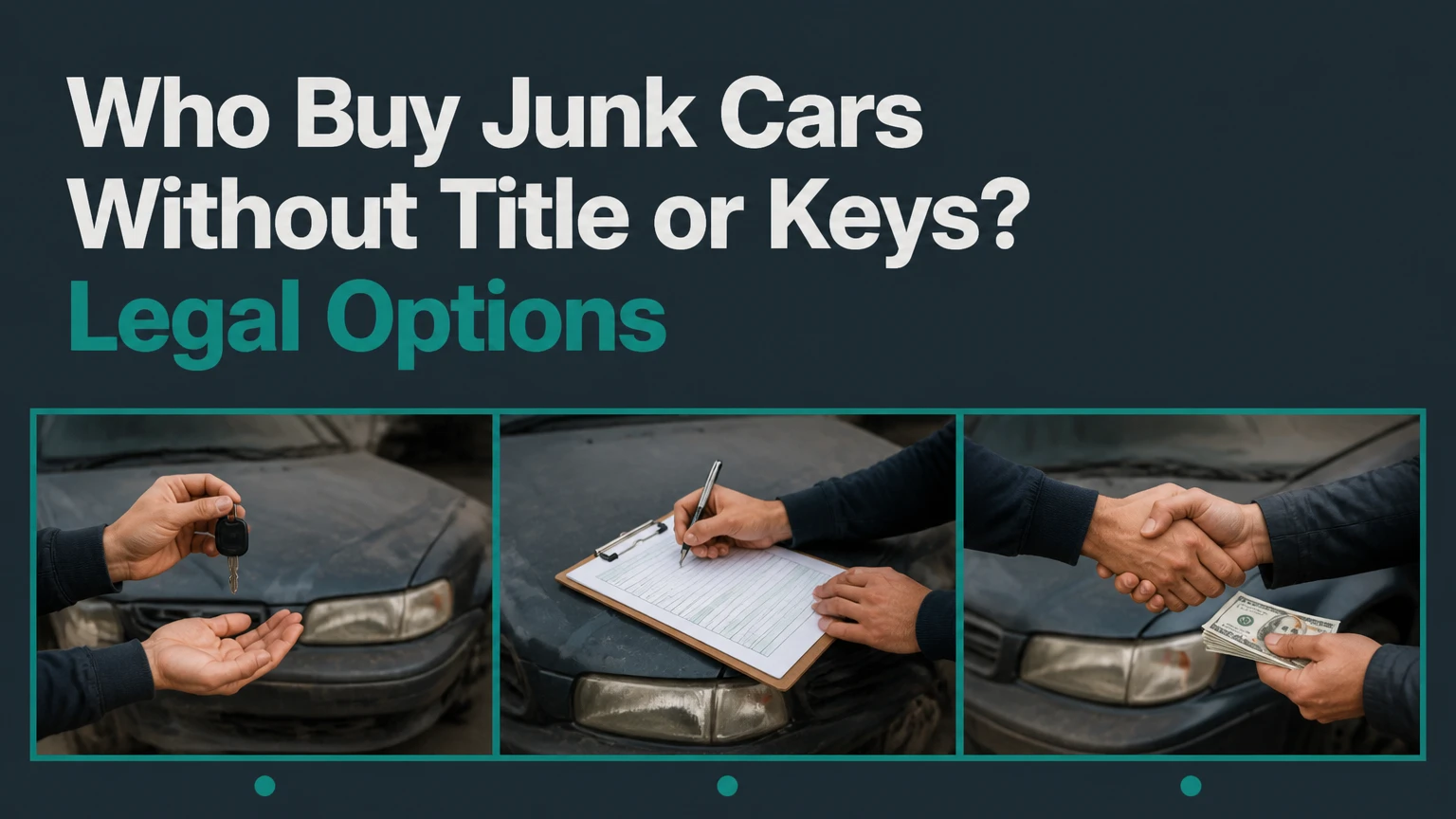
Licensed salvage yards, auto recyclers, dismantlers, junk-car brokers, and some towing companies buy junk cars without title or keys, but acceptance depends on state law and proof of ownership. A missing key usually affects loading rather than eligibility; a missing title creates the larger problem because the buyer must verify that the vehicle is not stolen or subject to a lien.
Key Facts at a Glance
- A junk-car buyer may accept registration, a bill of sale, or other ownership evidence when local law permits title-free purchases.
- A vehicle without keys can usually be removed with a flatbed, wheel dollies, a winch, or a lockout tool.
- A missing title can reduce the offer by a typical $50-$200, or prevent the transaction entirely, depending on the state.
- The registered owner should disclose the missing title and keys before accepting a quote.
- License plates, personal property, lien information, and DMV release-of-liability rules require separate attention.
- An abandoned vehicle cannot normally be sold as personal property merely because it sits on private land.
Who Buy Junk Cars Without Title or Keys?
Junk-car recyclers, salvage yards, dismantlers, vehicle-removal companies, and online buying networks are the main businesses that purchase cars without keys or, in some cases, without a paper title. These businesses recover steel, aluminum, catalytic-converter metals, engines, transmissions, body panels, and reusable components rather than relying only on road-ready resale.
The most suitable buyer depends on three facts: whether the seller is the legal owner, what documents exist, and where the vehicle is located. A national buying platform may route the car to a local licensed recycler, while a neighborhood salvage yard may require the original title before accepting it.
A buyer that advertises “no title needed” still may require a government-issued ID, current registration, a signed affidavit, a VIN inspection, or a state-specific junking form. Advertising language is not a substitute for the law.
Main Buyer Types
| Buyer type | Typical paperwork demand | Typical pickup method | Typical payment timing |
|---|---|---|---|
| Local salvage yard | Title or state-approved ownership evidence | Flatbed or wrecker | At pickup or yard intake |
| Auto recycler | VIN, ID, registration, title substitute | Flatbed, winch, wheel dollies | At vehicle release |
| Online buying network | ID plus registration or title workflow | Local contracted carrier | Usually at pickup |
| Independent tow-buyer | ID, VIN, signed sale documents | Wrecker or flatbed | Check or electronic payment |
| Parts dismantler | Title, bill of sale, or dismantling certificate | Flatbed or rollback truck | On acceptance |
Can a Buyer Take a Car Without Keys?
A licensed buyer can usually remove a keyless junk car if the vehicle is accessible and the seller discloses the condition in advance. Missing keys prevent normal starting, steering, and transmission release, so the carrier may send a flatbed, wheel skates, a winch, or a truck with a lockout kit instead of a conventional wheel-lift tow truck.
A locked steering wheel can make a short-distance tow unsafe. If the transmission is stuck in park, the carrier may need wheel dollies or skates under the drive wheels. A vehicle buried in mud, parked behind another car, or blocked by a narrow gate requires additional recovery equipment.
The missing key normally has a smaller financial effect than the missing title. A recycler can dismantle a vehicle without testing its engine, but the carrier still incurs extra loading time and equipment costs.
Tell the Buyer These Details
Provide the buyer with the VIN, exact address, vehicle condition, wheel status, access width, terrain, and key status. State whether the car rolls, steers, has inflated tires, and can be reached by a rollback truck.
Do not leave a key hidden on the property unless the buyer specifically requests it. A hidden key creates security and liability problems if another person finds it.
What Documents Can Replace a Title?
Registration, a government-issued ID, a bill of sale, an insurance card, a lien release, or a state ownership affidavit may support a no-title transaction, but no single substitute works nationwide. The controlling rules come from the state motor-vehicle agency and sometimes from the county or municipal recycling authority.
The strongest combination is current registration in the seller’s name, matching photo identification, a VIN that matches the vehicle, and evidence that no lien remains. An insurance card can support identity and vehicle history, but many yards will not treat it as proof of ownership by itself.
The National Motor Vehicle Title Information System, administered by the U.S. Department of Justice, helps participating states, insurers, junk yards, and other authorized entities check title and brand information. A database check does not automatically authorize a sale without the documents required by the state where the vehicle is located.
Paperwork by Situation
| Seller situation | Documents to gather | Likely next action |
|---|---|---|
| Registered owner, title lost | Photo ID, registration, VIN | Request duplicate title or ask a compliant buyer |
| Registration and title names differ | ID, bill of sale, transfer records | Resolve transfer before pickup |
| Paid-off vehicle with lien record | Lien release, registration, ID | Obtain corrected title or state clearance |
| Inherited vehicle | Death certificate, probate or executor documents | Follow estate transfer procedure |
| Dealer or business-owned vehicle | Business ID, authorized signer proof | Use company sale documents |
| Vehicle found on private property | Police, tow, or abandoned-vehicle records | Obtain legal disposition authority |
A title replacement is often the cleanest solution. State fees and processing times vary; a duplicate title may cost roughly $10-$50 and arrive in several days or several weeks, while expedited service may be available in some jurisdictions.
How Do You Sell a Junk Car Without Title or Keys?
Selling the vehicle requires confirming legal ownership, collecting alternative documents, obtaining several quotes, arranging suitable towing, completing the transfer paperwork, and reporting the sale to the motor-vehicle agency. The process commonly takes one day when the buyer accepts the documents, but a duplicate title or estate transfer can extend it substantially.
Step 1: Confirm Ownership and Check for a Lien
Locate the VIN on the dashboard, driver-side door label, registration, insurance record, or prior repair paperwork. Compare every VIN character because one incorrect digit can cause a buyer’s verification system to reject the vehicle.
Check whether a lender, finance company, or credit union still appears on the record. A paid loan does not always mean the lien has been removed from the title record. Ask the lender for a written lien release before requesting pickup.
Step 2: Gather Identification and Vehicle Records
Prepare a valid photo ID, registration, bill of sale, insurance record, lien release, and any state affidavit that applies. Photograph the VIN and vehicle condition before the carrier arrives.
Remove license plates if state rules require the owner to surrender or retain them. Do not assume the buyer will handle plates, registration cancellation, or release-of-liability reporting.
Step 3: Contact Three to Five Buyers
Ask each buyer whether the company accepts a vehicle without a title in your state and whether the offer assumes that the keys are missing. Provide the year, make, model, trim, mileage if known, condition, location, and accessibility.
Request the following in writing:
- Gross purchase price
- Towing charge, if any
- Documents required at pickup
- Payment method
- Quote expiration period
- Conditions that allow a price change
A phone quote is conditional if the buyer has not verified the VIN, ownership documents, and vehicle condition.
Step 4: Verify the Buyer and Carrier
Check the company’s physical address, business registration, online complaint history, and towing license where applicable. Confirm the carrier’s name, truck type, appointment window, and payment process.
A legitimate transaction should not require you to pay an upfront “processing,” “release,” or “towing deposit” before the vehicle is collected. Verify the company independently rather than using only a phone number sent by text.
Step 5: Prepare the Vehicle for Removal
Remove personal property, toll transponders, garage-door remotes, fuel cards, documents, and spare keys. Unlock gates, clear the driveway, and tell the dispatcher if the vehicle is immobile, flat-tired, locked, or partly dismantled.
The carrier needs enough room to align a rollback truck. A typical flatbed requires a clear approach wider than a passenger car, but the dispatcher should evaluate the actual site.
Step 6: Complete the Sale and Obtain a Receipt
Read the bill of sale, odometer statement, junking certificate, or ownership affidavit before signing. Confirm that the VIN, buyer’s legal name, price, date, and vehicle description are correct.
Receive payment before the vehicle leaves unless the contract clearly states another arrangement. Keep photographs, signed documents, the receipt, and the carrier’s information for the period required by your state.
How Much Is a Junk Car Without Title or Keys Worth?
A typical complete junk car without title or keys may bring about $150-$800, but the range is not a guaranteed market price. Scrap weight, catalytic-converter value, vehicle completeness, local steel rates, transport distance, demand for parts, and documentation risk determine the actual offer.
The AI Overview’s $150-$500 range is reasonable for many older, ordinary vehicles, while a heavier SUV, truck, or complete late-model vehicle can exceed that range when usable components have value. A stripped shell, missing catalytic converter, or difficult recovery location can reduce the payment below typical estimates.
Scenario-Based Price Ranges
| Vehicle condition | Typical gross offer | Main value driver | Common reduction |
|---|---|---|---|
| Complete compact car, accessible | $200-$500 | Steel and catalytic converter | Missing title, $50-$200 |
| Complete midsize SUV | $350-$800 | Weight and reusable parts | Long-distance pickup, $50-$250 |
| Running but unwanted older car | $500-$1,500 | Resale or parts value | Mechanical uncertainty |
| Missing converter or major parts | $100-$350 | Remaining ferrous metal | Component removal |
| Burned, flooded, or stripped shell | $75-$300 | Scrap weight only | Contamination or loading |
| Hard-to-recover vehicle | $100-$600 | Vehicle value minus recovery cost | Winch or special equipment |
These are typical practitioner ranges, not published price guarantees. Scrap prices change by region and date, and online buyers may offer a bundled price that includes transport rather than showing a separate towing deduction.
Why Do Offers Differ?
A salvage yard may value the car by scale weight, while a broker estimates local resale and parts demand. A private tow-buyer may offer less because the buyer must transport the vehicle, process paperwork, and resell it to a recycler.
Compare net proceeds rather than the headline offer. A $500 offer with a $150 towing deduction is worse than a $425 offer with free removal and payment at pickup.
Which Buyer Type Usually Pays More?
A direct sale to a licensed recycler or dismantler can produce the strongest net price when the seller has acceptable documents and can arrange convenient access. An online broker may be faster and simpler, while an independent tow-buyer may accept unusual conditions but compensate for added risk with a lower offer.
Buyer Comparison
| Decision factor | Online network | Local salvage yard | Independent tow-buyer | Direct dismantler |
|---|---|---|---|---|
| No-title flexibility | Medium, state-dependent | Low to medium | Medium to high | Low to medium |
| Typical quote time | 5-15 minutes | 15-30 minutes | 10-30 minutes | 20-45 minutes |
| Pickup window | 24-72 hours | Same day to 48 hours | Same day to 72 hours | 24-72 hours |
| Offer structure | Bundled price | Scrap or vehicle price | Negotiated price | Parts and scrap valuation |
| Documentation control | Centralized workflow | Yard-specific rules | Variable | Formal intake process |
| Scam exposure | Lower if established | Moderate | Higher if unlicensed | Lower if licensed |
| Best fit | Registered owner | Accessible complete car | Difficult recovery | Valuable parts vehicle |
No buyer category wins every case. The highest offer is useful only if the buyer can legally take the vehicle and provides the promised payment.
How Do You Screen a Junk-Car Buyer?
Screen a junk-car buyer by confirming licensing, the legal business name, the total price, towing terms, paperwork, payment method, and the policy for arrival-time changes. A buyer who refuses to identify the purchasing entity or demands money before pickup should be treated as high risk.
Ask for a written quote that identifies the vehicle by VIN or at least by year, make, and model. Ask whether the quote is reduced for missing keys, title substitutes, flat tires, dismantling, or an inaccessible location.
Red Flags and Safer Responses
| Warning sign | Risk | Safer response |
|---|---|---|
| Upfront towing deposit | Payment fraud | Use a buyer offering no-cost pickup |
| No legal business name | Weak accountability | Request registration and address |
| Price changes at arrival | Bait-and-switch | Require written change terms |
| Request for blank title | Ownership fraud | Complete every field yourself |
| Cash pressure without receipt | Poor evidence trail | Require a signed receipt |
| VIN mismatch on paperwork | Transfer error or fraud | Stop and correct documents |
| Buyer asks for personal banking login | Identity theft | Use a standard payment method |
An established recycler will understand VIN verification, title branding, salvage certificates, and state reporting requirements. The buyer should explain the process without asking the seller to falsify a document.
What If the Car Belonged to Someone Else?
A seller cannot lawfully dispose of another person’s vehicle merely because the vehicle is parked on the seller’s property. Inherited vehicles, cars left by former tenants, repossession situations, divorce property, and vehicles owned by a dissolved business each require a documented transfer route.
For an estate, the executor or administrator may need a death certificate, letters of authority, probate paperwork, and a state transfer form. A surviving spouse may have a simplified procedure in some states, but that rule is jurisdiction-specific.
For a vehicle left behind by a tenant or repair customer, contact local law enforcement, the DMV, or a licensed towing authority before calling a junk buyer. An abandoned-vehicle process may require notices, waiting periods, photographs, a police report, and a disposal authorization.
Ownership Problems That Commonly Stop Pickup
- Registration belongs to a former owner.
- A lender remains on the title record.
- The seller has only an unsigned bill of sale.
- The vehicle is leased rather than owned.
- The VIN is unreadable or does not match the paperwork.
- The seller is not the executor of an estate.
- The vehicle is subject to a court order or police hold.
A buyer that ignores these problems may be exposing both parties to stolen-property, title-fraud, or civil-liability allegations. Flexible paperwork is lawful only when the state provides a valid exception.
Why Is an Abandoned Car Different?
An abandoned car is different because possession does not establish ownership. A property owner, landlord, mechanic, or tenant generally cannot sell an abandoned vehicle as scrap without following the applicable notice and disposal procedure.
The correct first contact is usually the local police non-emergency line, DMV, municipal code office, or a licensed towing authority. The authority will identify the process, which may vary according to whether the car is on private property, public property, a repair facility, or an impound lot.
Do not remove the VIN, crush the vehicle, sell parts, or transfer it to a recycler before receiving written authorization. A salvage yard cannot cure an unlawful chain of ownership after accepting the vehicle.
How Is a Keyless Car Loaded?
A keyless car is loaded with a rollback flatbed, winch, wheel dollies, or skates selected according to whether the wheels steer and roll. The buyer needs advance notice because a standard wheel-lift truck may not safely move a locked, immobile, or transmission-disabled vehicle.
Equipment by Vehicle Condition
| Vehicle condition | Suitable equipment | Site requirement | Likely loading issue |
|---|---|---|---|
| Rolls and steers | Wheel-lift or flatbed | Clear driveway | Steering lock |
| Rolls but does not steer | Flatbed and winch | Straight approach | Front-wheel alignment |
| Locked in park | Wheel dollies or skates | Firm pavement | Drive-wheel movement |
| Flat tires | Flatbed, skates, or tire equipment | Extra clearance | Rim damage |
| Mud-embedded | Winch-equipped wrecker | Recovery anchor or access | Ground suction |
| Behind another vehicle | Flatbed or recovery truck | Obstacle removal | Insufficient approach |
The seller should not attempt to break the steering lock, bypass the ignition, or drag the car with improvised equipment. Those actions can damage property, create injury hazards, and complicate the buyer’s insurance claim.
What Should You Do After the Sale?
After pickup, keep the receipt, remove or surrender plates as required, cancel or update insurance, and file the state’s notice of sale or release of liability. The exact deadline and form vary, but prompt reporting reduces exposure to future parking tickets, tolls, registration fees, and misuse of the vehicle.
The buyer’s receipt should identify the purchasing company, vehicle identification number, date, amount paid, and transfer description. Save photographs showing the vehicle’s condition and the truck removing it.
Contact the DMV if the vehicle was junked, totaled, dismantled, or transferred without a title. Some states issue a junking certificate or require a salvage disposition report, and those records may differ from an ordinary private-party sale.
Final-Sale Checklist
- Remove personal belongings and documents.
- Photograph the VIN and vehicle before removal.
- Record the buyer’s legal name and carrier details.
- Complete every required field on the sale document.
- Receive payment and a signed receipt.
- Remove or surrender plates according to state rules.
- Cancel insurance after possession transfers.
- File notice of sale or release of liability.
- Keep documents and photos in a secure file.
- Confirm that any lien release was delivered.
What Problems Can Stop the Sale?
The most common failure points are an unresolved lien, a VIN mismatch, an ownership-name discrepancy, an abandoned-vehicle claim, an inaccessible location, and a buyer that does not operate under the required license. Fixing the paperwork before dispatch is faster than discovering the problem beside the tow truck.
Troubleshooting Table
| Problem | Why it happens | Practical fix | Expected delay |
|---|---|---|---|
| Title is lost | Misplaced ownership document | Order duplicate title | 3 days to 6 weeks |
| Name differs | Marriage, divorce, or prior owner | Provide legal name-change or transfer records | 1-4 weeks |
| Lien remains | Loan payoff not recorded | Obtain lender release | 3-14 days |
| VIN is unreadable | Corrosion or collision damage | Request law-enforcement or DMV inspection | 1-8 weeks |
| Vehicle is inaccessible | Mud, narrow gate, blocked driveway | Book winch or rollback equipment | 1-3 days |
| Buyer rejects no-title sale | State or yard policy | Replace title or contact another compliant buyer | 3 days to 6 weeks |
| Estate ownership unclear | Probate incomplete | Obtain executor authority | Several weeks or longer |
Do not solve a rejected title transaction by signing someone else’s name, altering a registration, or creating a backdated bill of sale. A delayed lawful sale is safer than a fast transaction that creates criminal or civil exposure.
Is Replacing the Title Better Than Selling Without One?
Replacing the title is usually better when the vehicle has meaningful resale or parts value, when several buyers reject registration-only paperwork, or when the owner wants a clean record. Selling without a title may be reasonable for a low-value, severely damaged vehicle when the state permits the buyer’s documentation process.
A duplicate title usually expands the buyer pool and reduces verification risk. It may also improve the offer because the buyer does not need to estimate the cost of handling missing ownership paperwork.
A no-title sale is not a universal shortcut. The seller should compare the title-replacement fee and waiting time with the likely offer increase, then choose the lawful route.
Frequently Asked Questions
Can I junk a car with registration but no title?
You may be able to junk a car with registration but no title if the registration is current, matches your identification, and state law allows a title exception. Some buyers require a signed affidavit or duplicate-title application. Ask the DMV and buyer before scheduling pickup because registration alone does not prove the same rights in every jurisdiction.
Do junk-car buyers pay cash for cars without keys?
Some junk-car buyers pay cash, while others use a check, electronic transfer, or company payment card. Payment form is separate from eligibility. Confirm the amount, payment method, and timing in writing, and do not accept a lower curbside amount unless the vehicle or documents materially differ from the quoted information.
Can I sell a car with no title if the owner is deceased?
An inherited car may be sold after the estate or state transfer process establishes the seller’s authority. The required documents can include a death certificate, executor appointment, probate order, surviving-spouse form, title, and lien release. A salvage yard should not accept the vehicle solely because the seller is a family member.
Will a junkyard accept a car with no license plates?
A junkyard may accept a car without license plates because plates are normally separate from the vehicle’s ownership record. The seller must still complete the required transfer and plate steps for the state. Remove or surrender plates only according to DMV instructions, since rules differ for ordinary sales, scrapped vehicles, and vehicles sold out of state.
Can I get a junk-car quote without the VIN?
You can receive a preliminary estimate without the VIN, but a firm offer usually requires VIN confirmation or a detailed vehicle description. The VIN identifies the model, title brand, theft record, and sometimes parts value. Give the buyer the VIN before pickup so a verification problem does not cancel the appointment.
What happens if the junk-car buyer does not take the vehicle?
If a buyer refuses pickup, document the reason and review the quote terms before choosing another company. Do not pay an unexpected fee merely because the buyer dispatched an unsuitable truck. Correct the title, access, VIN, or condition issue, then obtain a new written offer from a licensed recycler or salvage yard.
The Bottom Line
The businesses that buy junk cars without title or keys are licensed salvage yards, auto recyclers, dismantlers, online buying networks, and some towing companies. Missing keys are usually a towing problem; missing ownership documents are the legal problem. Confirm ownership, disclose every condition, compare net offers, use proper transfer paperwork, and report the sale to the DMV. Following those steps makes a no-title, no-key sale lawful where local rules permit it.