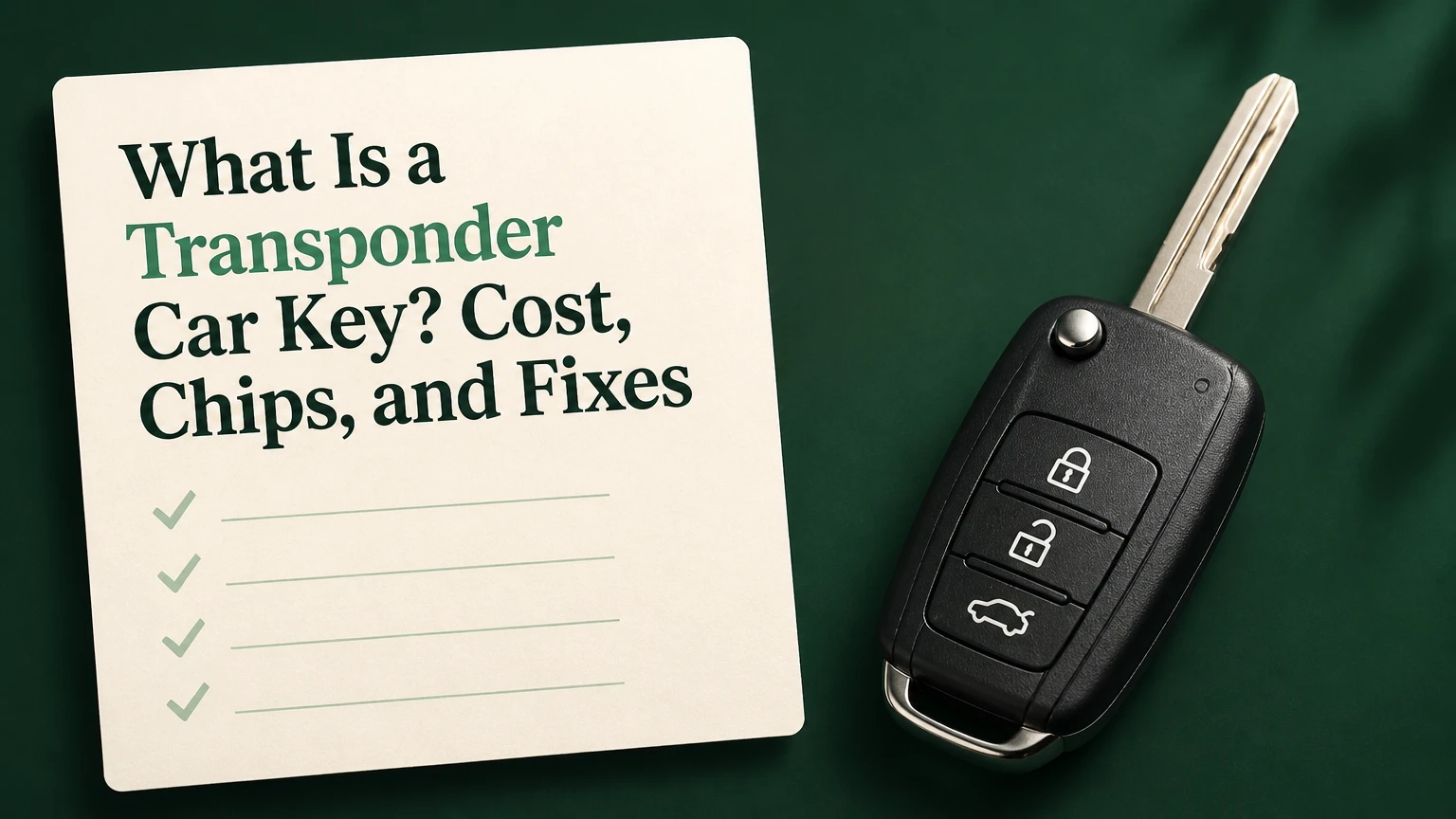
A transponder car key is a vehicle key containing a coded electronic chip that communicates with the car’s immobilizer system before the engine can run. The metal blade operates the lock and ignition cylinder, while the transponder authenticates the key electronically. A correct blade without a recognized chip may turn the ignition but still fail to start the engine.
Key Facts at a Glance
- A transponder chip is usually powered wirelessly by an antenna around the ignition cylinder.
- The chip normally does not need the coin-cell battery used by remote-locking buttons.
- Key cutting creates the correct physical blade shape; programming authorizes the chip to the vehicle.
- A flashing key, padlock, or security light can indicate an immobilizer authentication problem.
- Transponder keys became common in passenger vehicles during the 1990s and early 2000s.
- Typical United States replacement pricing is about $90-$500, depending on the vehicle and key design.
What Is a Transponder Car Key?
A transponder car key is an anti-theft ignition key with a miniature radio-frequency identification chip embedded in its plastic head, metal housing, or a separate glass capsule. When the key is inserted or brought near the start system, the vehicle reads the chip’s identifier and permits engine operation only after successful authentication.
“Transponder” combines transmitter and responder, although the automotive component is more accurately described as a passive RFID transponder. The chip does not generally send a useful signal across a parking lot. It responds at close range to an electromagnetic field generated by the vehicle.
A traditional mechanical key only needs matching cuts. A transponder key needs two matches: the blade must fit the lock cylinder, and the electronic identifier must be accepted by the immobilizer. That distinction explains why a hardware store can sometimes cut a key that unlocks a door but cannot make the vehicle start.
The immobilizer does not make a vehicle impossible to steal. It mainly blocks unauthorized engine starting through methods such as a copied mechanical key or a bypassed ignition cylinder. The protection does not automatically stop towing, theft of a valid key, relay attacks against some passive-entry systems, or attacks against poorly secured electronic modules.
How Does a Transponder Car Key Work?
A transponder car key works through a short-range electronic exchange between the key chip, an antenna coil, and the vehicle’s immobilizer controller. The vehicle energizes the passive chip, receives its response, verifies the key against stored security data, and then authorizes or blocks engine operation.
The exact architecture varies by manufacturer. Some vehicles route immobilizer data through a dedicated security module, while others integrate related functions with the body control module or engine control unit. The engine computer may receive a valid-start message rather than directly reading the key.
The Authentication Sequence
- The driver turns or activates the key. A conventional system detects the ignition switch moving to the run or start position. A push-button system detects a nearby smart key through separate antennas.
- The vehicle creates a magnetic field. An antenna coil near the ignition lock commonly operates around 125 kHz or 134 kHz, although frequency and protocol depend on the manufacturer.
- The chip receives power. A coil inside the key harvests energy through induction, allowing the transponder to respond without its own replaceable battery.
- The chip sends identification data. Older chips may return a fixed identifier. Newer systems can use encrypted challenge-response authentication.
- The immobilizer checks the response. The vehicle compares the response with keys learned during the programming process.
- The vehicle authorizes starting. If authentication succeeds, the control system permits the required fuel, spark, injection, or starter functions. If it fails, the engine may crank without starting or start briefly and stop.
The 125 kHz and 134 kHz figures describe common low-frequency automotive transponder systems, not a specification shared by every car. Key frequency, chip family, encryption, antenna design, and programming procedure must match the vehicle.
| Component | Physical location | Primary function | Battery requirement |
|---|---|---|---|
| Metal key blade | Key front or folding housing | Turns locks and ignition cylinder | None |
| Transponder chip | Plastic head or glass capsule | Authenticates the key to the immobilizer | Usually passive |
| Antenna coil | Around ignition cylinder or inside start system | Energizes and reads the chip | Vehicle-powered |
| Remote transmitter | Key head or fob circuit board | Locks doors and releases trunk | Usually coin cell |
| Immobilizer module | Vehicle security electronics | Validates key response | Vehicle battery |
Does a Transponder Key Need a Battery?
The immobilizer transponder usually does not need a battery, but the key’s remote-entry functions usually do. A dead CR2032 or similar coin cell can stop lock, unlock, panic, or trunk buttons while leaving the passive ignition chip operational.
A remote-head key contains two related systems. The passive transponder handles engine authorization through the vehicle’s antenna field. The remote-control circuit sends a separate radio signal and relies on a coin-cell battery.
This separation creates a useful diagnostic clue: if the buttons stop working but the engine still starts, replace the remote battery rather than the transponder. If the buttons work but the security indicator prevents starting, the problem may involve chip programming, antenna communication, vehicle voltage, or the immobilizer module.
Push-button vehicles require more care. A smart key often contains a passive backup transponder or emergency detection method, but the backup location differs by model. The owner’s manual may specify a marked pocket, steering-column area, center-console slot, or precise button-contact position.
What Types of Transponder Keys Exist?
The main transponder-key categories are fixed-code keys, encrypted keys, remote-head keys, flip keys, and proximity smart keys. These categories overlap because a single key can use an immobilizer chip, remote buttons, and a folding blade in the same housing.
| Key type | Engine authentication | Door-control method | Typical battery role |
|---|---|---|---|
| Fixed-code chip key | Repeated identifier | Metal blade or separate remote | No chip battery |
| Encrypted chip key | Challenge-response exchange | Blade or remote buttons | No chip battery |
| Remote-head key | Passive chip plus remote | Integrated buttons | Coin cell powers buttons |
| Flip key | Passive chip plus remote | Folding blade and buttons | Coin cell powers buttons |
| Proximity smart key | Low-frequency and higher-frequency communication | Passive entry and push button | Battery normally required for proximity functions |
Fixed-Code Transponders
A fixed-code transponder returns the same programmed identifier each time the vehicle reads it. Many early systems used this simpler architecture, which provided more security than a plain mechanical key but less protection than later cryptographic systems.
A fixed code is not necessarily easy for an untrained person to copy because programming still requires compatible equipment and vehicle access. However, fixed identifiers generally provide less resistance to interception and cloning than modern challenge-response designs.
Encrypted and Rolling-Code Systems
Encrypted systems use a secret algorithm or key relationship so the vehicle can validate more than a plainly repeated number. Some systems change values during authentication, but “rolling code” is not a universal description for every modern immobilizer.
Remote door-locking systems also use rolling codes, and their rolling-code behavior should not be confused with the immobilizer chip’s authentication method. The lock buttons can use one protocol while engine authorization uses another.
Remote-Head and Flip Keys
A remote-head key places the transponder and remote circuit in one plastic housing. A flip key adds a spring-loaded folding blade, reducing pocket length but increasing housing and hinge complexity.
A broken shell can hide the chip. The chip may be a small black module or glass capsule that is separate from the circuit board. Discarding the housing before identifying and transferring that component can turn an inexpensive shell repair into a complete key replacement.
How Can You Identify a Transponder Key?
You can identify a transponder key through the vehicle’s model-year documentation, a locksmith’s chip tester, or a compatible parts catalog, because appearance alone does not reliably reveal whether a key contains an immobilizer chip. A plastic head suggests electronic content, but it does not prove the chip type or programming status.
Useful identification methods include:
- Check the owner’s manual for terms such as immobilizer, PATS, PASS-Key, SecuriLock, transponder, smart key, or engine immobilization.
- Look for a security indicator shaped like a key, car, or padlock on the instrument panel.
- Compare the original key with the manufacturer’s replacement-key diagram.
- Give a locksmith the vehicle identification number, make, model, year, engine, and market.
- Have the key tested with a transponder detector before cutting or opening its shell.
- Record FCC and part numbers from the remote housing, but do not treat those numbers as proof of chip compatibility.
Some older General Motors VATS and PASS-Key systems complicate identification. VATS uses a visible resistor pellet in the key blade rather than a wireless RFID transponder. A resistor key can look electronic because it is part of an anti-theft system, but its operating principle differs from a passive chip key.
| Security technology | Common era or example | Recognition method | Is it an RFID transponder? |
|---|---|---|---|
| Plain mechanical key | Older vehicles and equipment | Blade cuts only | No |
| GM VATS | Many 1980s-1990s GM vehicles | Measured resistor value | No |
| GM PASS-Key III | Late 1990s-2000s GM vehicles | Embedded transponder | Yes |
| Ford SecuriLock PATS | Many 1996 and newer Ford vehicles | Coded transponder | Yes |
| Modern smart key | Current push-button vehicles | Proximity authentication | Usually includes electronic immobilizer functions |
How Much Does a Transponder Car Key Cost?
A typical United States transponder car key costs $90-$500 to replace, with an independent automotive locksmith commonly charging less than a dealership for ordinary vehicles. The final price depends on whether the key is basic, remote-equipped, proximity-enabled, dealer-restricted, cut by code, and programmed with all keys lost.
| Replacement situation | Typical locksmith price | Typical dealership price | Typical completion time |
|---|---|---|---|
| Basic chip key, one blade | $90-$160 | $150-$250 | 20-45 minutes |
| Remote-head key | $150-$275 | $250-$500 | 30-90 minutes |
| Flip key | $175-$325 | $300-$550 | 30-90 minutes |
| Proximity smart key | $200-$450 | $300-$800 or more | 45 minutes-3 hours |
| All keys lost, mobile service | $180-$500 | $300-$1,000 plus towing | 45 minutes-3 hours |
These are typical practitioner ranges, not a guaranteed quote. European vehicles, newer encrypted systems, restricted key orders, immobilizer module replacement, emergency travel, and required server authorization can raise the cost.
A duplicate usually costs less than an all-keys-lost job because a working key may allow faster programming or owner-authorized onboard learning. Some vehicles require two already-programmed keys before owner programming is available. Others require diagnostic equipment for every additional key.
What Is the Difference Between Cutting and Programming?
Key cutting reproduces the mechanical blade pattern; transponder programming teaches the vehicle to accept the electronic chip. Both operations may be necessary, but neither operation substitutes for the other.
A locksmith can cut a blade from an existing key, a key code, or decoded lock information. Programming requires a compatible diagnostic tool, security credentials, a valid chip, and a vehicle-specific procedure. The technician may add a key, erase lost keys, synchronize a remote, or perform an immobilizer relearn.
A key can therefore fail in several combinations:
| Blade condition | Chip condition | Likely result |
|---|---|---|
| Correct cut | Correctly programmed | Doors and engine operate normally |
| Correct cut | Unprogrammed | Blade may turn, engine does not start |
| Incorrect cut | Correctly programmed | Chip authenticates, but lock or ignition operation fails |
| Incorrect cut | Unprogrammed | Neither mechanical nor electronic functions work |
| Worn or damaged cut | Correctly programmed | Key may stick, fail to turn, or damage the cylinder |
Can You Program a Transponder Key Yourself?
You can program some transponder keys yourself, but only when the vehicle supports an owner procedure and the required number of working keys is available. Many vehicles require a scan tool, security PIN, online authorization, or dealer-level process, so buying a blank key does not guarantee a successful DIY result.
Common DIY requirements include:
- A compatible, unused or properly reset key blank.
- The correct blade profile and transponder protocol.
- One or two working keys, depending on the vehicle.
- A fully charged vehicle battery.
- The exact procedure in the owner’s manual.
- Proof that the replacement remote frequency matches the vehicle.
Some Ford, General Motors, and Chrysler vehicles from particular years support onboard additional-key programming. The procedure is not transferable across brands or even across trim levels. A used key may also remain locked to another vehicle, and a remote that matches the frequency may still contain an incompatible immobilizer chip.
A locksmith is usually the safer choice when every key is lost, the vehicle uses a restricted European system, the security light remains active, or the replacement key came from an uncertain source.
How Does It Compare With Other Car Keys?
A transponder key offers stronger engine-start security than a mechanical key, while a smart key adds convenience and additional communication hardware. A remote fob may lock doors without containing the chip needed to authorize ignition, so the names are not interchangeable.
| Key option | Starts engine electronically | Remote buttons | Passive entry | Typical replacement cost |
|---|---|---|---|---|
| Mechanical key | No | No | No | $5-$25 |
| Separate remote plus chip key | Yes | Sometimes separate | No | $100-$250 |
| Remote-head transponder key | Yes | Yes | No | $150-$325 |
| Proximity smart key | Yes | Yes | Yes | $200-$800 |
| VATS resistor key | Uses resistance | Usually no | No | $40-$150 |
A transponder key is a poor choice for a vehicle owner seeking the cheapest possible duplicate, because chip compatibility and programming add cost. It is a practical choice when retaining the factory immobilizer matters more than obtaining a five-dollar mechanical copy.
What Problems Do Transponder Keys Develop?
Transponder-key failures usually involve physical damage, lost programming, antenna communication, low vehicle voltage, or a fault in the immobilizer system. The chip itself has no routine battery to recharge, so replacing a remote coin cell will not repair every no-start condition.
Check these symptoms systematically:
- Try the spare key. If the spare starts the vehicle, the original key, shell, blade, or programming is the likely fault.
- Inspect the shell. Confirm that the transponder capsule did not fall out during a shell replacement.
- Replace the remote battery only when remote buttons fail. Battery polarity and contact pressure matter.
- Remove other electronic keys from the key ring. Some manufacturers warn that nearby transponder devices can interfere with key recognition.
- Check vehicle voltage. A weak battery can create communication faults during authorization.
- Observe the security lamp. A flashing or rapidly blinking indicator supports an immobilizer-related diagnosis, but the owner’s manual determines the exact meaning.
- Use model-specific service information. A ten-minute relearn procedure exists on some vehicles, but applying it universally can waste time or create additional lockout conditions.
A car that cranks but will not start can also have a fuel, ignition, crankshaft-sensor, or engine-computer problem. The security light narrows the possibilities; it does not prove that the key chip failed.
Expert Insight: Do Not Diagnose by the Remote Battery
The most common incorrect diagnosis is replacing a key fob battery when the immobilizer chip or antenna circuit is the actual problem. The reverse mistake also occurs: owners pay for chip programming when only a corroded coin-cell contact prevents remote locking.
Expert Insight: A Shell Replacement Can Create a No-Start
A replacement shell may contain the correct buttons and circuit board but omit the separate transponder capsule. Before discarding an old housing, photograph its interior and identify every loose component. A locksmith can often transfer the chip and board into a compatible shell.
Expert Insight: Two Working Keys Change the Economics
A vehicle with two recognized keys may support an inexpensive additional-key procedure, while the same vehicle with zero recognized keys may require immobilizer access and mobile diagnostic service. Creating a spare before the last key fails is often the largest available cost reduction.
What Should You Do After Losing Every Key?
After losing every key, contact an automotive locksmith or dealership with the vehicle present, proof of ownership, registration, and government identification. A locksmith may cut and program a replacement at the vehicle’s location, while a dealership may need a tow and a factory-restricted key order.
Ask for an itemized quote covering:
- Emergency travel or towing.
- Mechanical cutting by code or decoding.
- Transponder or smart-key hardware.
- Programming and immobilizer access.
- Remote-button synchronization.
- Deletion of missing keys from the vehicle memory.
- Warranty for the supplied key.
Deleting lost keys matters because a found key may otherwise remain authorized. The exact erase-and-add procedure varies by manufacturer, and some systems require every desired key to be present during the same session.
How Do You Buy a Replacement Safely?
Buy a replacement by matching the vehicle’s complete application, not by matching the key’s shape alone. Confirm the year, market, body style, frequency, blade profile, chip family, button layout, and whether the part is new, refurbished, or previously paired.
Avoid unverified listings that promise universal compatibility. A remote can have the correct button arrangement but a different frequency, immobilizer protocol, or encrypted pairing method. Some locksmiths will not guarantee programming for customer-supplied keys because counterfeit chips, locked used keys, and poor circuit boards create avoidable failures.
For a broken housing, shell replacement is appropriate when the circuit board and transponder still work. For a water-damaged, cracked, or intermittently recognized key, testing the electronics before ordering a shell prevents paying twice.
Frequently Asked Questions
Will a transponder key start a car with a dead fob battery?
Usually, yes, if the passive transponder and vehicle immobilizer are working. The coin cell powers remote-entry buttons, not normally the ignition chip. A push-button vehicle may require placing the dead smart key in its manufacturer-specified backup location before pressing the start button.
Can a locksmith make a transponder car key?
Yes, many automotive locksmiths can cut and program transponder keys, including mobile service for some vehicles. Capability varies by make, model, year, encryption system, and required security authorization. Ask whether the quote includes the blade, chip, remote synchronization, programming, and deletion of lost keys.
Can a copied metal key start a car?
A copied metal key can start the engine only when the vehicle has no electronic immobilizer or when the copied key also contains a correctly programmed transponder. Matching the blade cuts alone does not reproduce the electronic authorization stored in the original key.
Does a transponder chip wear out?
A transponder chip has no scheduled replacement interval and often lasts for the vehicle’s service life, but impact, water intrusion, damaged solder joints, or housing failure can make a key unreliable. Intermittent starting with one key but not another points toward the key or its chip.
Are transponder keys theft-proof?
No. A transponder key makes unauthorized engine starting harder than hotwiring or using a plain mechanical duplicate, but it does not prevent every theft method. Owners should still secure the vehicle, protect keys from unauthorized access, and follow manufacturer guidance for passive-entry systems.
Is a smart key the same as a transponder key?
No. A smart key usually includes an electronic immobilizer function, but it also supports proximity detection, passive entry, and push-button starting. A basic transponder key may have only a metal blade and passive chip, or it may combine the chip with remote-locking buttons.
The Bottom Line
A transponder car key combines a mechanical blade with a coded electronic immobilizer chip. The vehicle must recognize both elements before normal starting can occur, and the chip usually operates without the remote fob’s coin-cell battery. Replacement commonly costs $90-$500, depending on the vehicle and key type.
When identifying a what is a transponder car key problem, separate the symptoms: remote buttons indicate the fob battery and transmitter, while engine authorization involves the chip, antenna, immobilizer module, and programming. Keep at least one tested spare, verify compatibility before buying online, and use model-specific instructions or a qualified automotive locksmith for programming.