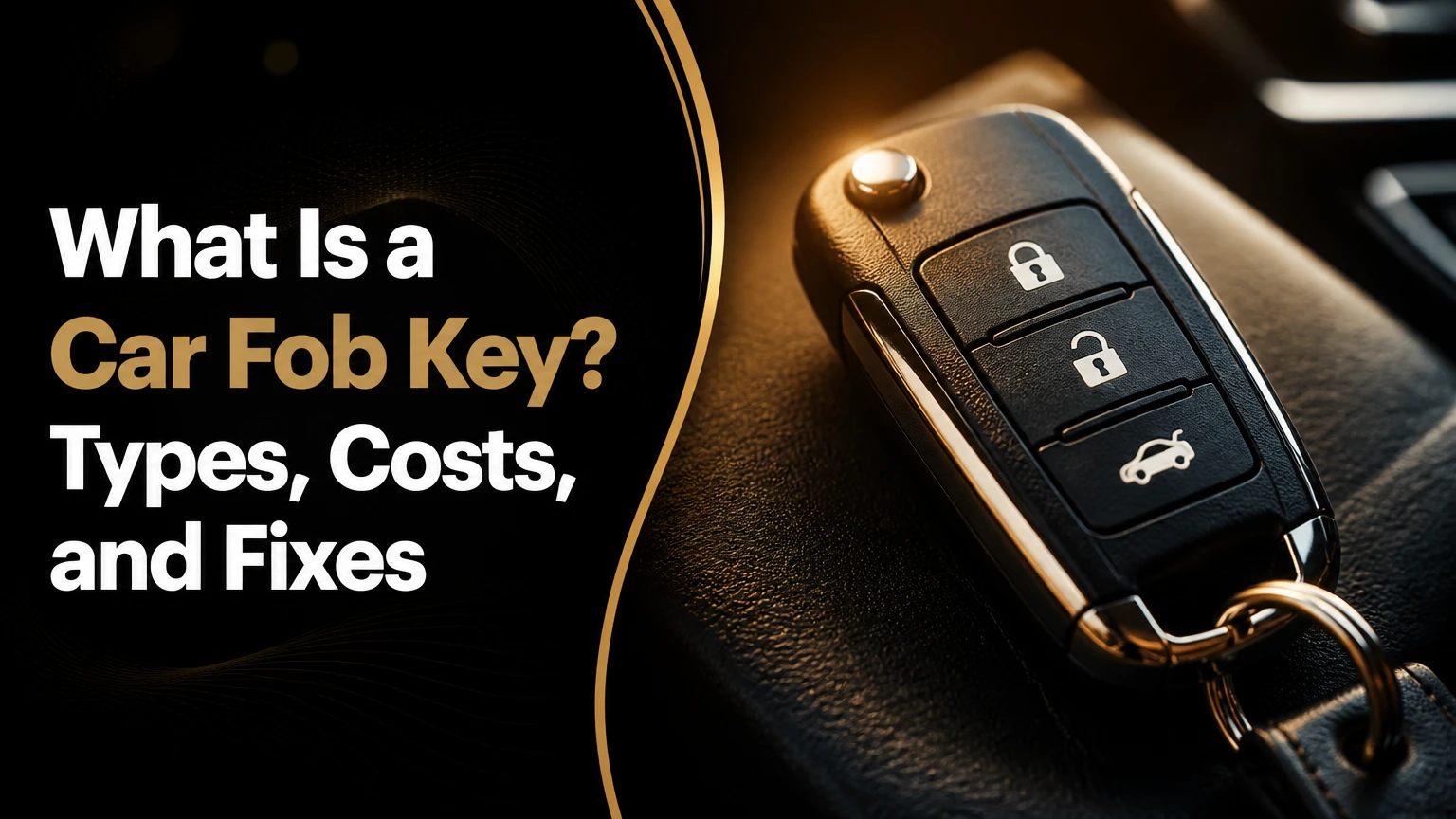
A car fob key is a handheld electronic credential that communicates wirelessly with a vehicle to lock, unlock, open, or sometimes start it. A fob may contain remote-control buttons, an immobilizer transponder, a concealed mechanical key, or passive-entry electronics, so “key fob” and “smart key” are related but not always interchangeable terms.
Key Facts at a Glance
- A key fob sends an encrypted or coded radio command to a vehicle receiver.
- A remote fob can unlock doors without containing the authorization needed to start the engine.
- A smart key uses proximity detection for passive entry and push-button starting.
- Most replaceable fob batteries are CR2032 or CR2450 lithium coin cells.
- A concealed mechanical blade can unlock the door when the fob battery or vehicle battery is dead.
- Replacement cost typically ranges from $45 for an older remote to more than $1,000 for some luxury smart keys.
What Does a Car Fob Key Do?
A car fob key controls vehicle access and, depending on its design, participates in engine immobilizer authorization. Pressing a button usually sends a lock, unlock, trunk, panic, or remote-start command; passive systems exchange signals automatically when the fob is near the vehicle.
The term covers several generations of equipment. An older remote may be a plastic transmitter attached to a separate metal key, while a newer proximity fob can authenticate the driver without leaving a pocket. Some fobs include remote-start controls, programmable window opening, seat-memory selection, lighting controls, or a trunk-release button.
A fob is therefore not always the same thing as the entire car key. The remote portion operates convenience features, the transponder portion helps satisfy the immobilizer, and the blade provides mechanical entry. A vehicle can have all three functions in one housing or distribute them across separate pieces.
Key Fob, Remote, Transponder, and Smart Key
A key fob is the broadest everyday term, while a remote keyless-entry transmitter is primarily an access-control device. A transponder key contains a coded chip read by the immobilizer, and a smart key or proximity key communicates automatically for hands-free entry and starting.
| Term | Main function | Typical user action | Can it start the vehicle? |
|---|---|---|---|
| Remote fob | Lock and unlock doors | Press a button | Sometimes, if a transponder is included |
| Transponder key | Immobilizer authorization | Insert or present the key | Yes, when correctly programmed |
| Remote-head key | Mechanical entry plus remote control | Insert blade, press buttons | Usually, with a transponder chip |
| Smart key | Passive entry and push-button start | Carry near or inside vehicle | Yes, when authenticated |
| Digital car key | Phone or wearable-based access | Use an approved device or app | Model-dependent |
The vehicle manual determines the exact meaning of each system. A replacement shell that fits the original blade can still fail if it lacks the correct transmitter or transponder.
How Does a Car Fob Key Work?
A car fob key works through short-range radio communication, identification, and vehicle-side authorization. A button-operated fob transmits after the driver presses a control, while a passive-entry system usually uses low-frequency vehicle signals to wake the fob before receiving a higher-frequency response.
The communication path contains several stages:
- The fob detects a button press or a proximity challenge.
- Its control chip creates a command containing an identifier and security data.
- A radio transmitter sends the signal through the fob antenna.
- The vehicle receiver checks frequency, format, timing, and authorization.
- The body control module performs the requested action.
- A separate immobilizer check may authorize engine operation.
Many modern systems use rolling codes or challenge-response cryptography. Rolling-code systems advance a synchronized counter so a previously captured unlock transmission cannot simply be replayed. More sophisticated systems use vehicle-generated challenges and cryptographic responses rather than relying on one permanent code.
The exact algorithm, bit length, frequency, and synchronization window vary by manufacturer and model year. A generic statement that every fob uses a 40-bit or 64-bit code is inaccurate because automotive security systems use multiple proprietary designs.
What Components Are Inside a Fob?
The main internal parts are a circuit board, control microcontroller, radio antenna and transmitter, battery, buttons, and sometimes a separate immobilizer transponder. Passive-entry models commonly add a low-frequency antenna, while many fobs retain a mechanical backup blade.
| Component | Function | Failure symptom | Typical detail |
|---|---|---|---|
| Microcontroller | Runs commands and security logic | No response or lost synchronization | Vehicle-specific programmed data |
| RF transmitter | Sends button or proximity responses | Short range or no remote action | Common bands include 315 MHz and 433/434 MHz |
| LF antenna | Receives proximity or emergency-field signals | Passive entry or backup start fails | Often near 125 kHz |
| Transponder chip | Supports immobilizer authorization | Engine cranks poorly or will not start | May work without the coin-cell battery |
| Coin-cell battery | Powers active electronics | Dim indicator, reduced range, dead buttons | CR2032 and CR2450 are common |
| Mechanical blade | Unlocks the door manually | No electronic access | Cut to the vehicle lock cylinder |
The transponder and coin-cell battery are not always electrically dependent. On many vehicles, the immobilizer chip can be read inductively or through a designated backup antenna even when the fob battery is flat. That behavior is model-specific, not a universal property of every key.
What Types of Car Fobs Are Available?
Car fob types range from a separate remote and metal key to advanced proximity devices with display screens or phone integration. The correct category depends on the vehicle’s model year, ignition system, security architecture, and installed options rather than on the fob’s exterior shape alone.
| Fob type | Entry method | Starting method | Typical battery life | Replacement complexity |
|---|---|---|---|---|
| Separate remote and key | Button plus metal lock | Insert transponder key | 2-4 years | Low |
| Remote-head key | Button and attached blade | Insert blade | 2-3 years | Low to moderate |
| Flip or switchblade key | Folding blade and buttons | Insert blade | 2-3 years | Moderate |
| Proximity smart key | Touch handle or automatic unlock | Push button with fob inside | 1-2 years | Moderate to high |
| Display or advanced smart key | Touchscreen or buttons | Push button or remote feature | Rechargeable or 1-2 years | High |
Separate Remote and Mechanical Key
This arrangement was common on older vehicles and remains practical because the inexpensive remote handles convenience functions while the metal key handles physical entry and ignition. A replacement remote may cost $15-$40, but the vehicle may still require separate cutting and transponder programming.
Remote-Head and Flip Keys
A remote-head key combines the blade and transmitter in one housing. A flip key stores the blade inside a spring-loaded body, reducing exposed metal in a pocket but adding a hinge, spring, and release button that can wear or break.
Smart or Proximity Keys
A proximity fob allows passive keyless entry and push-button starting. Exterior antennas detect the fob near a door, while interior antennas verify that the authorized device is inside the cabin before enabling ignition.
Hands-free convenience has a trade-off. The fob must periodically respond to vehicle queries, which can reduce battery life compared with a remote that remains asleep until a button is pressed.
Display Fobs and Digital Keys
Some luxury vehicles add screens, remote-parking controls, climate commands, or rechargeable batteries. Digital keys use technologies such as Bluetooth Low Energy, NFC, or Ultra-Wideband, but a phone-based key is an alternative credential, not automatically a replacement for every physical fob function.
How Is a Fob Different From a Traditional Car Key?
A traditional car key primarily uses a cut blade, while a fob adds wireless access and electronic authorization. A conventional key is simpler and often cheaper to duplicate, but a modern fob can provide passive entry, remote start, theft-resistant immobilizer functions, and programmable convenience controls.
| Feature | Traditional metal key | Remote-head key | Smart key |
|---|---|---|---|
| Physical blade | Required | Attached | Hidden backup only |
| Button battery | None | Usually CR2032 | Usually CR2032 or CR2450 |
| Passive entry | No | No | Usually available |
| Push-button start | No | Rare | Usually available |
| Remote start | No | Model-dependent | Model-dependent |
| Typical duplicate cost | $5-$40 | $75-$250 | $200-$450 |
| Relay-attack exposure | None | Low | Higher if passive entry is active |
A smart key does not make traditional theft methods impossible. The immobilizer can block unauthorized starting, but relay attacks, stolen legitimate keys, damaged security modules, and poorly protected diagnostic access remain separate risks.
How Much Does a Replacement Fob Cost?
A replacement car fob typically costs $45-$100 for an older separate remote, $100-$250 for a remote-head or flip key, and $200-$450 for a standard smart key. Luxury display fobs can exceed $1,000 after the part, cutting, programming, shipping, and emergency service are included.
| Replacement situation | Part cost | Programming or cutting | Typical total | Typical time |
|---|---|---|---|---|
| Older remote fob | $15-$40 | $30-$60 | $45-$100 | 15-30 minutes |
| Remote-head key | $40-$90 | $60-$100 | $100-$250 | 30-45 minutes |
| Standard proximity fob | $90-$250 | $100-$200 | $200-$450 | 45-90 minutes |
| Luxury display fob | $400-$700 | $150-$300 | $550-$1,000+ | 1-3 hours |
| All keys lost | Vehicle-specific | Additional security work | $250-$1,500+ | 1-4 hours |
These are typical U.S. service ranges, not fixed prices. A dealer may charge more for a genuine factory part and database-backed programming, while an automotive locksmith may reduce labor cost by using mobile diagnostic equipment. European-market vehicles, encrypted gateway modules, and vehicles requiring online authorization can raise both price and appointment time.
Dealer, Locksmith, or Online Seller?
A dealer is the safest choice when the vehicle requires manufacturer-server authorization, when all keys are lost, or when a warranty record and factory part matter. An automotive locksmith is often faster and less expensive for common vehicles, provided the locksmith has the correct programming equipment and can verify ownership.
An online blank is economical only when the part number, frequency, button layout, transponder type, and vehicle compatibility all match. “Looks identical” is not enough. Some vehicles reject used fobs, some require the original fob to remain present during programming, and some aftermarket units have incompatible firmware.
Before ordering, record the vehicle identification number, year, make, model, trim, FCC identifier or regional equivalent, button count, blade style, frequency where specified, and whether the vehicle uses passive entry. Keep the seller’s programming and return policy.
Can You Program a Car Fob Yourself?
You can program some older remotes yourself, but most modern smart keys require vehicle-specific diagnostic procedures or professional equipment. The deciding factors are the vehicle model, the programming method, the number of working keys, and whether the replacement fob is new, used, or aftermarket.
A basic remote may use a sequence involving the ignition switch, door lock, or button presses. That procedure often programs door-lock commands only. It may not add the immobilizer transponder needed to start the engine.
Professional programming commonly involves:
- Confirming the fob’s part number and compatibility.
- Connecting an approved scan tool to the OBD-II diagnostic port.
- Entering a security PIN or obtaining online authorization.
- Erasing or retaining existing key credentials according to the procedure.
- Registering the new fob and testing every function.
An important practitioner rule is to program a spare while one working key remains available. All-keys-lost service can require security-code retrieval, immobilizer resets, or module replacement, turning a routine duplicate into an expensive recovery job.
What Should You Do When a Fob Stops Working?
When a car fob stops working, test the battery, range, buttons, spare fob, physical blade, and emergency-start procedure in that order. This sequence distinguishes a low-cost power problem from a damaged transmitter, vehicle receiver fault, or immobilizer problem.
Replace the Coin-Cell Battery
Check the vehicle manual or the marking inside the fob before purchasing a battery. CR2032 and CR2450 cells have different thicknesses, so a cell that fits loosely or forces the cover closed can create intermittent contact.
Use the mechanical blade or a plastic pry tool to open the housing. Keep the circuit board dry, install the battery with the correct polarity, and inspect the metal contacts for flattening or corrosion. Avoid bending contacts aggressively because a detached contact can require board repair.
A fresh battery does not repair water-damaged electronics, broken solder joints, worn tactile switches, or a deprogrammed fob. It only restores the electrical supply.
Use the Emergency Entry and Start Method
Remove the hidden blade and unlock the driver door manually if the remote does not respond. The alarm may sound when the door opens, but inserting the recognized fob into the backup location or holding it against the designated start-button area often lets the immobilizer read the transponder.
Backup locations vary. Common examples include the steering-column shroud, center console, cupholder, glove box, or a slot beneath the dashboard. The owner’s manual is authoritative because pressing the fob against the start button is not the correct procedure for every vehicle.
Test the Spare and Look for Vehicle Faults
If the spare works, the original fob is the likely problem. If both fobs fail simultaneously, inspect the vehicle battery, relevant fuse, receiver area, and 12-volt voltage before buying two replacements.
A weak vehicle battery can create symptoms that resemble fob failure, including failed passive entry, dashboard warnings, and no response from the start button. A locksmith or technician can test radio output and scan body-control and immobilizer modules.
What Security Risks Affect Smart Fobs?
Smart fobs face relay attacks because passive-entry systems may respond to an amplified signal even when the key is inside a home. A Faraday pouch or metal-lined container can reduce this risk, but the container must be tested because seams, gaps, and worn conductive fabric can leak radio signals.
The best practical precautions are:
- Store passive-entry fobs away from exterior doors and windows.
- Use a properly functioning Faraday pouch or box at home.
- Disable passive entry through the vehicle settings when available.
- Keep the mechanical blade separate during outdoor activities.
- Protect the fob from water, salt, heat, crushing, and loose keys.
- Use a steering-wheel lock or approved secondary deterrent for high-risk vehicles.
Relay protection does not solve every theft method. It does not prevent theft with a legitimately stolen key, a compromised vehicle module, or an attack unrelated to passive radio communication.
The fob’s security also depends on key deletion after loss. Ask a dealer or qualified locksmith to remove the missing credential from the vehicle’s authorized-key list where the vehicle supports that procedure. Physical door locks and mechanical blades may require separate rekeying.
What Hidden Features and Edge Cases Matter?
Many fobs support functions that drivers never use, including long-press window opening, remote-start timers, panic alarms, trunk release, approach lighting, and selective unlocking. These features differ by manufacturer and region, so a button combination from one model must not be assumed to work on another.
A long press on an unlock button can open windows or a sunroof on some vehicles. The feature is convenient for ventilation but can expose the cabin to rain if the fob is pressed inside a pocket or bag.
Water resistance also varies. Light rain may cause no problem, but immersion, salt water, and repeated condensation can corrode circuit traces and switches. Do not dry a wet fob with high heat; remove the battery if possible, let the housing dry, and seek repair before powering contaminated electronics.
A fob with a working red indicator light can still fail to operate the car. The light may prove only that the button circuit has power, not that the transmitter frequency, security data, antenna, or programming remains functional.
Which Car Fob Replacement Option Should You Choose?
Choose a dealer for proprietary or luxury systems, an automotive locksmith for most standard replacements, and DIY programming only when the owner’s manual confirms the procedure. The most economical decision changes with the vehicle’s age, the number of working keys, and whether the missing credential must be deleted.
| Driver situation | Best first option | Why | Avoid when |
|---|---|---|---|
| One working key, older vehicle | Locksmith or compatible blank | Lowest duplicate cost | Part number is uncertain |
| All keys lost | Dealer or equipped locksmith | Security recovery is required | Seller offers unverified programming |
| Luxury proximity vehicle | Dealer or specialist locksmith | Online authorization may be needed | Generic aftermarket fob is advertised |
| Remote-only failure | Battery or switch repair | Immobilizer may still work | Housing has severe corrosion |
| Lost smart fob | Program replacement and delete old key | Reduces unauthorized use | Only a shell is replaced |
The lowest purchase price is not the lowest completed cost. An incompatible $30 online fob becomes expensive after shipping, failed programming, locksmith diagnosis, and a nonrefundable return.
Frequently Asked Questions
Is a car fob the same as a key?
A car fob is not always the same as a complete car key. A fob may only operate remote locks, while a complete key system also includes a cut blade and immobilizer transponder. Smart keys combine those electronic functions in one proximity device, but the concealed blade still provides mechanical backup entry.
Can a car fob work without a battery?
A car fob can sometimes start the vehicle without its coin-cell battery because the immobilizer transponder may receive power from an inductive antenna. Remote locking and passive-entry functions usually stop working, however. The exact backup location and procedure depend on the vehicle manufacturer and model year.
How long should a car fob battery last?
A car fob battery commonly lasts 1-4 years. Passive smart keys often use more power than button-operated remotes, especially when stored close to the vehicle or exposed to repeated proximity checks. Heat, accidental button presses, poor-quality cells, and battery contacts can shorten that period.
Can a locksmith make a replacement car fob?
An automotive locksmith can make and program many replacement car fobs, including remote-head keys and common proximity keys. The locksmith needs proof of ownership, vehicle identification, compatible hardware, and suitable programming equipment. Some newer vehicles still require dealer access or manufacturer-server authorization.
What happens if I lose my only smart key?
If you lose your only smart key, contact a dealer or qualified automotive locksmith before ordering a random replacement online. The provider may need to cut a mechanical blade, obtain security authorization, program a new credential, and delete the missing key from the vehicle’s memory.
The Bottom Line
A car fob key is an electronic vehicle credential that may lock doors, start the engine, enable passive entry, and provide a mechanical backup blade. The term includes several designs, so diagnosis and replacement depend on the vehicle’s exact security system rather than the fob’s appearance.
Maintain two programmed keys, replace weak batteries before they fail, store passive-entry devices in a tested Faraday container, and retain the vehicle manual’s emergency-start instructions. Understanding what a car fob key actually contains prevents a cheap battery problem from becoming an unnecessary replacement purchase.